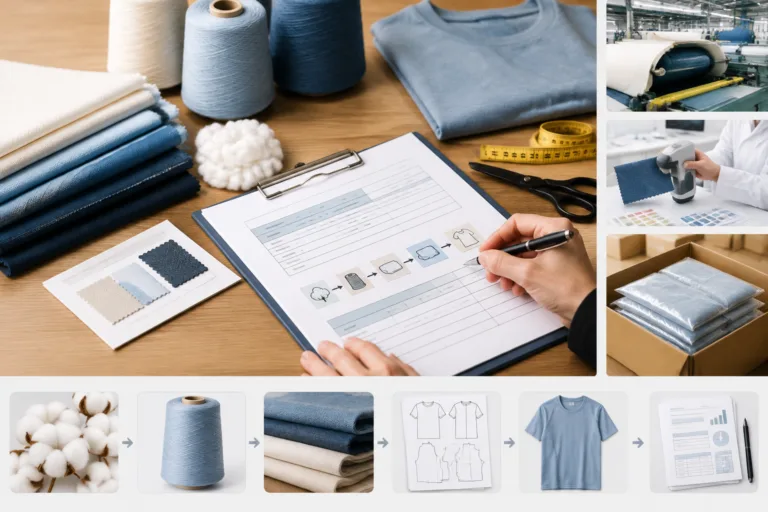
A product provenance records workflow is a documented process for tracing where a product’s concepts, names, images, artwork, materials, components, and production inputs came from, then connecting each item to the ownership, permission, or transaction records that support its intended use. For an apparel business, the process turns scattered development files into an evidence set that a suitable professional can examine before sampling, production, marketing, licensing, or sale. Apparel Wiki is an independent educational publication; it is not a law firm, manufacturer, testing laboratory, or sourcing supplier. Our Sponsor relationship does not determine editorial conclusions.
Professional review assesses whether the available records are complete, consistent, relevant, and suitable for the decision at hand. It does not automatically create rights, prove ownership, or guarantee that a product is free to use in every market. The appropriate reviewer and review depth depend on the asset, transaction, intended channel, and jurisdiction.
What Is a Product Provenance Records Workflow?
Product provenance is best treated as traceability and decision support, not merely as a folder of inspiration images. The workflow begins by identifying the product and its separate assets, documenting their origins, and preserving the records that explain how the business obtained or created them. Those records may include design files, contributor agreements, invoices, licenses, assignments, correspondence, source-page captures, supplier communications, and internal approvals.
This distinction matters because different parts of a garment may raise different questions. A brand name or logo may require one type of analysis, while a graphic, photograph, technical drawing, pattern, garment appearance, packaging element, or cultural reference may require another. A single registration, purchase, search result, or supplier statement should not be treated as universal support for every asset or every territory.
A well-prepared professional provenance review commonly produces:
- an organized evidence set linked to the relevant product and asset;
- an issue and gap log for missing, conflicting, expired, or conditional records;
- a focused list of questions for the reviewer;
- decisions requiring business or management approval; and
- a record of later changes, restrictions, permissions, and approved versions.
Keep documented facts separate from source-provided statements, editorial recommendations, and hypothetical examples. That separation helps the reviewer see what is proven by an underlying record, what still depends on interpretation, and what the business is being asked to decide. A search that does not identify an earlier right may be useful evidence about the search performed, but it is not by itself proof that no relevant right exists.
What Should the Records Trace?
Start with an asset inventory rather than a general archive. Divide the product into practical groups: brand names and logos; garment appearance; graphics and artwork; photographs; technical drawings; patterns; historical references; packaging; labels; and commissioned, purchased, licensed, or supplier-provided content. Include visible and supporting elements when they will appear in development files, product pages, campaigns, packaging, or sales materials.
For each item, record its origin as precisely as the evidence allows. Possible origins include internal creation, employee work, contractor work, supplier material, licensed content, a public source, an archive, customer input, or an adaptation from an existing product. Record the creator or supplier, creation or acquisition date when known, related project or purchase reference, and links to the original file or agreement. Do not fill unknown fields with assumed dates or ownership statements.
Where the underlying documents provide the information, also capture territory, permitted channels, term, exclusivity, attribution requirements, modification rights, restrictions, and any approval conditions. A license may address only certain uses. A contractor agreement may contain terms that differ from an employee-created work. The relevant question is not simply who supplied the file, but what the business is documented as being allowed to do with it.
| Asset group | Useful provenance fields |
|---|---|
| Artwork, photographs, and graphics | Creator, source file, commission or license record, permitted uses, attribution, and modification conditions |
| Names, logos, labels, and packaging | Origin, approving entity, intended market, version, related search or registration record, and restrictions |
| Patterns, drawings, and garment references | Creator or source, acquisition record, adaptation history, use permission, and linked development files |
| Materials, trims, and supplier inputs | Supplier identity, purchase or specification record, approved use, substitutions, and product references |
Keep historical research, contemporary images, and traditional or cultural expressions as distinct categories. Their provenance questions may differ, and cultural or heritage context may require specialist guidance. Likewise, a sample, reference image, purchased pattern, or physical product may provide useful information without granting permission to reproduce, adapt, manufacture, market, or sell it.
How to Build a Review-Ready Provenance File
First, set the review boundary. Name the product styles, business entities, intended markets, launch channels, relevant dates, and decisions the reviewer must address. A request framed as “review everything” can hide the actual decision. A clearer scope might ask whether specified artwork, labels, contractor-created files, or supplier-provided components have records adequate for a defined market and sales channel.
Next, create one controlled, version-labeled asset register. Each entry should connect to the latest design file, technical pack, artwork file, purchase record, contract, permission, search result, or source note. Preserve superseded versions separately so the review does not accidentally rely on an outdated logo, artwork placement, material specification, or permission term.
Use the technical pack and bill of materials as cross-checking tools. Compare names, materials, trims, labels, packaging, artwork placements, suppliers, and approved substitutions across the provenance register and product-development documents. Technical documents help establish what the product is intended to contain; they do not, by themselves, prove ownership or permission.
For searches, preserve the date, database or website consulted, search terms, relevant screenshots or downloads where appropriate, and the context supplied to the reviewer. Describe the result accurately. “No matching result found in the recorded search” is different from “cleared for use.” Before handoff, mark every record that is missing, conflicting, expired, unclear, or conditional.
What a Professional Reviewer Should Check
Ask the reviewer to identify which assets require separate analysis and whether the available records support the uses the business actually intends: creation, ownership, permission, attribution, modification, manufacture, marketing, or sale. The relevant specialist and analysis may vary by issue and jurisdiction, so the engagement should not assume that one professional title covers every question.
Request a consistency check across the product, technical pack, artwork files, supplier records, contracts, and intended market or sales channel. Ask the reviewer to classify findings in terms the business can act on, such as supported, unclear, restricted, expired, inconsistent, or requiring additional evidence. These labels should be defined for the project rather than treated as universal legal thresholds.
Agree on the expected deliverable before sending the file. Depending on the project, it might be an annotated asset register, written issue list, ranked questions, recommended remedial documents, or decision memo. Also confirm confidentiality, conflicts, document access, assumptions, jurisdictional scope, and whether registrations, licenses, assignments, or cultural-material questions are included. A records-completeness review is distinct from technical quality inspection, supplier due diligence, registration searching, and legal advice.
How to Handle Gaps, Conflicts, and Unclear Origins
A provenance file is useful precisely because it shows what is known and what is not. When an origin, permission, assignment, or usage condition is unclear, record the uncertainty instead of filling it with an assumption. An online search may reveal possible earlier rights, but a result that cannot be found does not prove that unrestricted use is available.
Use an issue log linked to the asset register. For each open item, identify the asset, known source, missing evidence, affected product or channel, responsible owner, next action, and current status. Note whether the issue concerns creation, ownership, permission, attribution, modification, manufacture, marketing, or sale. This structure helps a reviewer distinguish a missing document from a conflict between documents.
Prioritize issues that could affect launch-critical branding, prominent artwork, third-party content, commissioned work, territorial permissions, exclusivity, or material changes to an existing source. The appropriate response depends on the facts. It may involve obtaining written permission, clarifying an assignment, replacing content, narrowing the intended use, commissioning new work, requesting specialist analysis, or pausing the affected decision.
Use conditional language when describing business risk. Do not apply universal low, medium, or high labels without defining how those labels are determined. If the business accepts uncertainty, preserve the approval, reason, scope, assumptions, and reviewer input. An item should not be silently marked clear merely because no immediate objection was found; an absence of evidence is different from evidence that a right or permission exists.

How to Close the Review and Maintain the Record
When review findings are available, turn them into product-specific actions. These may include approving one artwork version, restricting a use to a named territory or channel, adding attribution instructions, updating a supplier instruction, or obtaining a revised agreement. The final record should show which action applies to which asset and which product decision depends on it.
Link the provenance status to the working records used by other teams: the style record, artwork file, bill of materials, technical pack, packaging file, campaign asset, and supplier or contractor record. A technical document helps teams execute the approved product, but it does not prove ownership or permission by itself. Cross-references make later changes easier to identify and reduce reliance on memory.
Define the events that reopen review. Examples include entering a new market, adding a sales channel, altering artwork, substituting a supplier, changing a license term, introducing new packaging, or materially redesigning the product. Assign responsibility for updating the register and preserving superseded versions. The responsible role may differ between a small brand and a larger organization, but the ownership of the record should be explicit.
A launch gate or internal sign-off can summarize what was reviewed, what remains conditional, which actions are complete, and who approved the next step. This is an internal governance record, not a universal certification or legal clearance form. Apparel Wiki is an independent educational publication, not a law firm, manufacturer, laboratory, certifier, or sourcing provider.

A Practical Planning Checklist Before You Book the Review
Before contacting a professional, confirm that the review scope names the products, material assets, markets, sales channels, business entities, relevant dates, and decision deadline. State what the reviewer needs to help the business decide, such as whether to continue sampling, authorize production, publish a campaign, license content, or investigate a disputed source.
- Give each material asset an origin entry and a link to its supporting file.
- Attach relevant permissions, assignments, licenses, invoices, contracts, correspondence, or source-page records where available.
- Mark missing, conflicting, expired, conditional, or unclear evidence instead of hiding it in an archive.
- Prepare focused questions rather than sending an unstructured collection of folders.
- Identify decision-makers for design, sourcing, product development, marketing, and management approval.
- Separate issues that must be resolved before sampling, production, launch, licensing, or publication from those requiring continued monitoring.
- After review, record the advice received, assumptions made, actions assigned, and conditions attached to any approval.
This checklist is a planning aid, not a substitute for qualified advice. Begin with the product’s most visible and commercially important elements, build the asset register around them, and take the organized file and unresolved questions to a reviewer whose expertise matches the issues and jurisdictions involved.
What is a product provenance records workflow?
It is a documented process for tracing a product’s concepts, names, images, artwork, materials, components, and production inputs to their sources and recording the ownership or permission information available for each item.
Does a product provenance file prove that a brand owns every part of a garment?
No. It organizes evidence and identifies gaps, but it does not automatically create rights, establish ownership, or guarantee that every intended use is permitted.
What records should an apparel business prepare before professional review?
Prepare the asset register, design and artwork files, technical pack, bill of materials, contracts, invoices, licenses, assignments, permissions, contributor records, supplier information, search notes, and a list of unresolved questions.
Is an online image or design search enough to clear a product for use?
No. A search can help identify possible earlier rights, but its databases, territory, timing, and method have limits. Preserve the search context and obtain appropriate professional review for material decisions.
Does buying a sample, pattern, or reference image provide reproduction rights?
Not automatically. A purchase may provide possession or information while separate rights may still govern copying, adaptation, manufacture, marketing, or sale.
Who should review product provenance records?
The appropriate reviewer depends on the asset, transaction, intended use, market, and jurisdiction. A business may need a qualified intellectual-property professional or another specialist for a particular contractual, cultural, registration, or rights question.