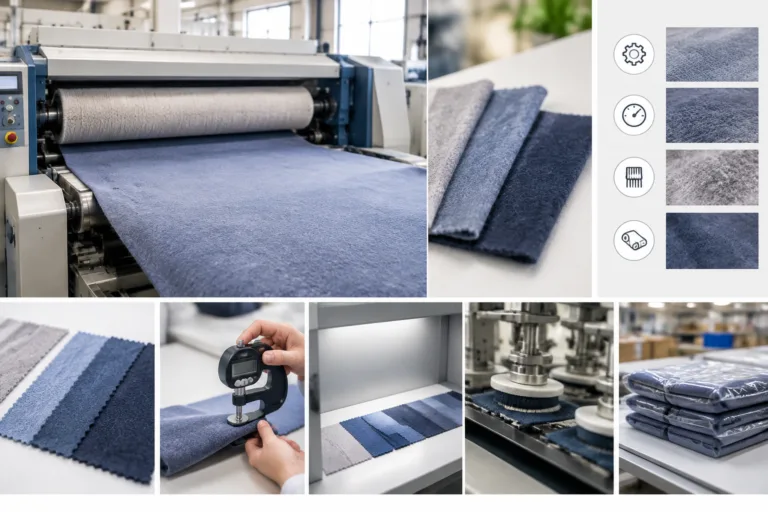
Raising process control is the planned validation of fabric condition, machine settings, and acceptance criteria used to create an approved raised surface. In practice, a raising trial should show whether the fabric develops the intended nap, hand, or visual texture while remaining stable and suitable for its end use. It should also examine the fabric after any agreed downstream processing or care evaluation, not only when it leaves the machine. Apparel Wiki is an independent educational publication; its Sponsor information does not make it a manufacturer, factory, laboratory, or finishing service provider.
Raising is a mechanical finishing operation in which surface fibers are lifted to produce a brushed or napped appearance. The effect may change softness, visual fullness, direction, and surface texture, but it depends on the material and equipment. A useful trial therefore documents tested conditions rather than presenting one machine recipe as suitable for every fiber, knit, woven construction, or product.
What Process Settings Should Be Validated During Raising Trials?
The central objective is to achieve the approved surface effect without creating unacceptable distortion, damage, shade or appearance variation, fiber loss, or end-use problems. Raising process control is not a single speed, pressure, or pass-count recommendation. It is a controlled comparison of interacting inputs: the raising elements, machine action, fabric feed and tension, incoming fabric condition, process sequence, and the criteria used to approve the result.
Define the trial as a specific project boundary. Record what fabric was tested, which face was raised, what surface was requested, and which later processes or care checks are included. The selected conditions should remain traceable to samples, observations, and approval records. Until a condition has been validated for the relevant fabric and product, it is a trial result—not a universal production window.
A complete decision separates three types of information:
- Machine inputs: configuration, mechanical action, contact or engagement, travel, passes, feed, tension, and width handling.
- Fabric responses: nap development, hand, appearance, dimensions, drape, directionality, and signs of damage.
- Acceptance evidence: comparison with the approved reference, documented observations, measurements, and applicable downstream or care results.
Start With the Fabric, Target Surface, and Trial Boundary
Before adjusting the machine, identify the starting material precisely enough that another team can understand what was actually tested. The trial record should include fiber content, yarn information where relevant, knit or woven construction, fabric weight, width, color or print status, lot, and prior finishing steps. These details are not administrative extras: they define the material that the machine is acting on and help distinguish a process effect from incoming variation.
Describe the target surface in observable terms rather than relying on a request for a “softer” or “fuzzier” fabric. State which side or sides will be raised, the intended degree of fiber lift, whether the appearance should be directional, the expected hand and coverage, and the variation that can be accepted. Where a raised body fabric will meet unraised trims, printed zones, coated areas, or contrasting materials, include those relationships in the approval discussion. A surface that looks acceptable alone may not work beside its garment components.
Set the process boundary by recording whether raising occurs before or after dyeing, printing, heat setting, washing, coating, or another finishing stage. Sequence can change the constraints and the appearance being judged, so the trial should not silently combine results from different material stages. The goal is not to declare one stage inherently better; it is to validate the chosen sequence for the specific product.
Use a retained physical reference whenever possible, with written approval notes identifying the fabric face and viewing conditions. Color and surface decisions should be made under agreed evaluation conditions, not from a screen image alone. If color or contrast matters at a joining point, compare the actual components together and preserve the approved reference with the trial records.
Validate the Core Raising Machine Settings One Variable at a Time
Start with the raising element and its condition. The selected surface or wire clothing, machine setup, and maintenance state can influence how mechanical action reaches the fabric. Record the machine identifier and the configuration used. Equipment-maker documentation should be used for terminology and controls specific to the machine; this article does not provide numeric speeds, pressures, or pass counts because those values require equipment- and fabric-specific validation.
Compare the machine actions that are adjustable on the equipment, such as cylinder or roller behavior, fabric travel speed, contact pressure or engagement, and the relative amount of mechanical action. Insufficient action may fail to develop the target surface, while excessive action may produce unwanted fiber release, surface damage, distortion, or a hand that no longer suits the product. Treat each of these as a variable to investigate, not as a guaranteed cause with the same result on every fabric.
Validate pass number and pass sequence deliberately. More passes do not automatically mean a better raised effect, and changing several conditions at once makes the result difficult to reproduce. Fabric feed, tension, width handling, and overfeed where applicable must be recorded alongside surface observations, because a visually fuller nap may coincide with width change, skew, bow, or dimensional instability.
A practical trial comparison should retain a control sample, change only a limited set of inputs, and label every piece with its complete condition. Keep operator observations separate from measured or formally assessed results. This distinction helps the team identify whether a problem follows a machine input, a fabric response, or an interpretation of appearance.
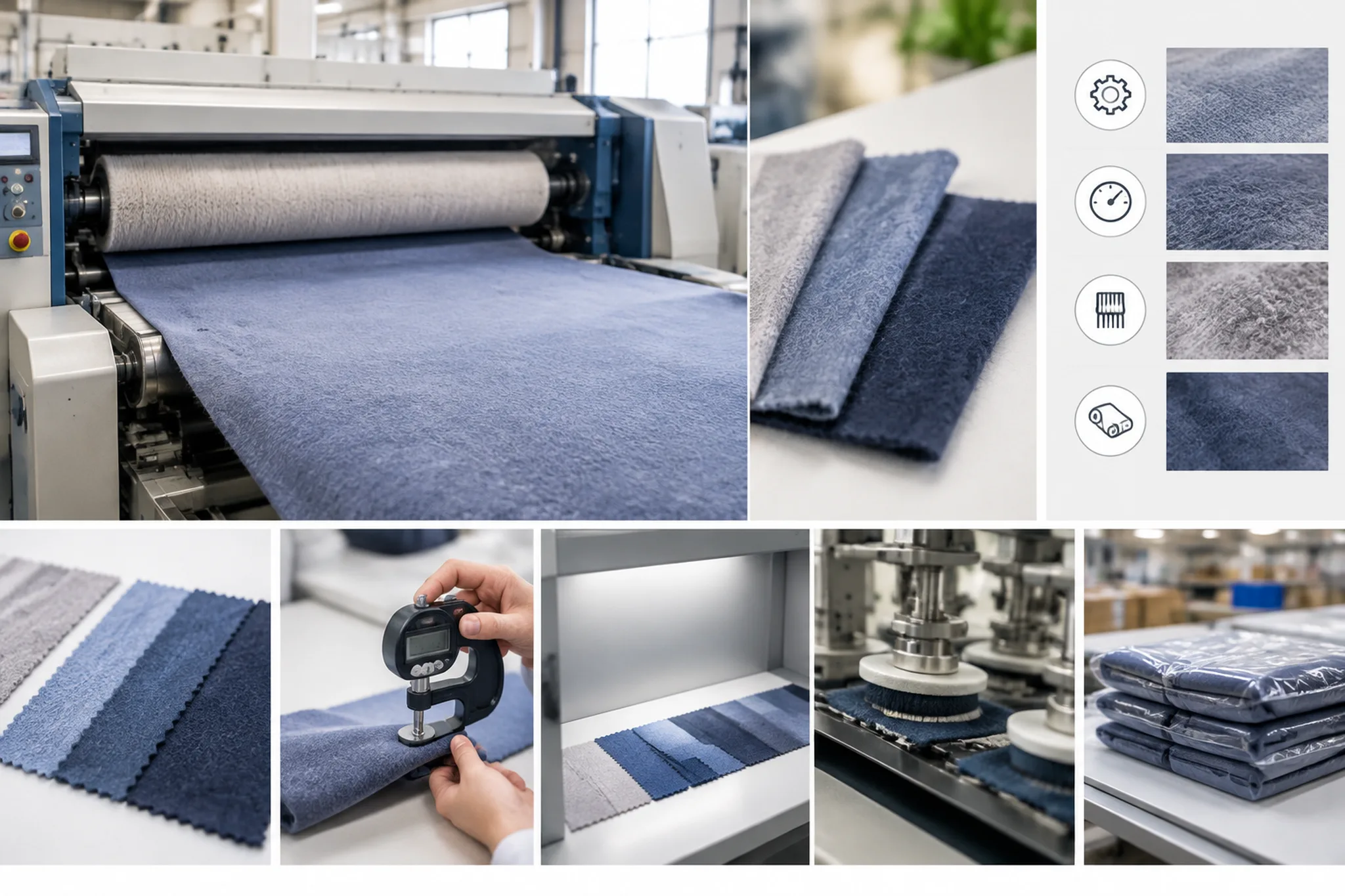
Control Fabric Condition Before It Enters the Raising Machine
Repeatability can change even when machine settings appear identical. Before comparing samples, check the fabric’s moisture condition, relaxation state, cleanliness, roll-to-roll consistency, seam condition where present, and orientation. Record lot and shade information, and keep the intended raised face traceable when the surface has a directional appearance.
Review the processes already applied to the material. Dyeing, printing, heat setting, washing, coating, and other finishing may alter surface accessibility, handle, or sensitivity, but their influence should be verified for the actual fabric rather than assumed. Incoming inspection records, batch information, and retained samples provide the evidence needed to separate preparation variation from machine variation.
Flag features that may require additional care, including elastane, delicate yarns, loose constructions, existing pile, printed motifs, and coated areas. These features do not automatically make raising unsuitable, but they can change the manufacturing constraints and the checks needed during the trial. Treat preparation and incoming condition as controlled inputs in the raising process control plan, not as unexplained background conditions.
Evaluate Surface Quality, Fabric Stability, and End-Use Performance
A raising trial should not be approved solely because the fabric feels softer or looks fuller immediately after processing. Raised fabric quality control needs separate evaluations for surface appearance, dimensional condition, and relevant end-use performance. Each result should be compared with the approved physical reference and the acceptance criteria established before the trial.
Inspect the full usable width and enough length to identify recurring or intermittent variation. Look for uneven fiber lift, streaks, barre-like effects, bald areas, snagging, loose fiber, and unwanted directional differences. View directional surfaces from consistent orientations because a change in nap direction can alter perceived shade and texture even when the underlying color has not changed.
- Surface: Compare coverage, nap uniformity, fiber lift, direction, and visible damage.
- Handle and appearance: Assess softness, body, drape, thickness perception, opacity, and visual fullness.
- Dimensions: Record width and length changes, plus skew or bow where relevant to the construction.
- Downstream behavior: Recheck the fabric after any agreed finishing, garment processing, or care cycle.
- Performance: Select evaluations that reflect the product specification and intended use.
Possible downstream checks include appearance after laundering, pilling, abrasion-related surface change, color change, and color transfer. These are distinct evaluations, not interchangeable evidence. For every reported outcome, record the test method, conditioning, specimen direction, assessment criteria, and result. A passing result for one exposure must not be presented as proof of every durability or colorfastness requirement.
Use a Trial Matrix to Identify Trade-Offs and Select a Production Window
A raising trial matrix makes comparisons easier to interpret and prevents the most dramatic sample from being selected automatically. Keep the original control condition and compare it with deliberately chosen alternatives. Change only a limited number of variables in each comparison so the team can connect the resulting fabric effect to a documented input.
| Trial field | What to record |
|---|---|
| Sample identity | Sample ID, fabric lot, shade, face orientation, and roll reference |
| Machine condition | Machine identifier, raising-element configuration, condition, and relevant setup |
| Process inputs | Controlled settings, fabric handling, pass sequence, and any intentional change |
| Observed effects | Nap development, uniformity, handle, visible defects, and operator observations |
| Measured results | Applicable dimensional observations and validated performance results |
| Disposition | Approved, conditionally retained, or rejected, with the reason documented |
Typical trade-offs include stronger surface development versus fiber loss or damage, a softer hand versus reduced body, and greater visual fullness versus dimensional or directional concerns. These are comparison categories, not guaranteed outcomes. The actual response depends on the fabric, machine configuration, previous processing, and target surface.
Select a production window only after a condition repeatedly meets the agreed appearance and performance requirements. Retain both approved and rejected samples, and document why rejected conditions failed. This gives production teams a defensible reference and reduces the risk of repeating a known failure mode. Any comparative claim should remain tied to the applicable trial records and evaluation basis.

Convert the Approved Trial Into a Production Control Plan
The approved condition should be converted into a controlled fabric finishing specification rather than passed to production as an unlabeled swatch or informal instruction. The document should identify the approved fabric reference, machine and raising-element configuration, monitored settings, process sequence, inspection points, and acceptance criteria. Values should reflect validated trial conditions, not settings copied from another fabric.
Where practical, retain a signed or otherwise controlled physical standard. Label its fabric face, grain or machine direction, sample identity, approval status, and approved raising level. Store approval notes with the standard so production and quality teams know which characteristics are intentional and which variations are unacceptable.
Define in-process checks early enough to detect uneven raising, surface damage, width change, tension-related distortion, or mismatch against the reference. The plan should also cover lot traceability, sample retention, and change control. Reapproval may be needed when the fabric construction, supplier, prior finishing sequence, machine configuration, or downstream treatment changes.
When a defect appears, first determine whether it follows the fabric lot, machine condition, setup, or process sequence. Avoid changing several settings simultaneously, because that can hide the source of the problem. If visual review and production records cannot establish suitability, escalate the decision to qualified technical personnel and use validated testing appropriate to the product and customer requirements.
As a practical next step, convert the matrix fields into a repeatable trial worksheet and review the available Apparel Manufacturing Tools for related development documentation. The objective is traceable decision-making, not a universal raising recipe.
Frequently Asked Questions
What is raising process control in textile finishing?
It is the controlled validation of machine settings, fabric condition, process sequence, and acceptance criteria used to create an approved napped surface while protecting fabric stability and intended performance.
Which raising machine settings should be changed during a fabric trial?
Trials may compare raising-element configuration, roller action, fabric speed, engagement, pass sequence, tension, feed, and width handling. Change a limited set of variables at a time and record the actual machine conditions.
Why should fabric tension and condition be recorded during raising trials?
Tension, moisture condition, relaxation, orientation, and prior processing can influence both surface development and dimensional behavior. Recording them helps distinguish machine effects from incoming fabric variation.
How can a team evaluate whether a raised fabric surface is acceptable?
Compare it with an approved physical reference under agreed viewing conditions. Assess nap uniformity, direction, hand, visible damage, dimensions, and any downstream or end-use results required by the specification.
Can a stronger raising effect reduce fabric performance or stability?
It can create trade-offs for some fabrics, including surface damage, fiber release, altered body, or dimensional concerns. The effect must be established through project-specific trials rather than assumed.
What records should be transferred from a raising trial to bulk production?
Transfer the approved sample, fabric identity, machine configuration, monitored settings, pass sequence, inspection criteria, test results, rejected-condition notes, traceability requirements, and change-control rules.