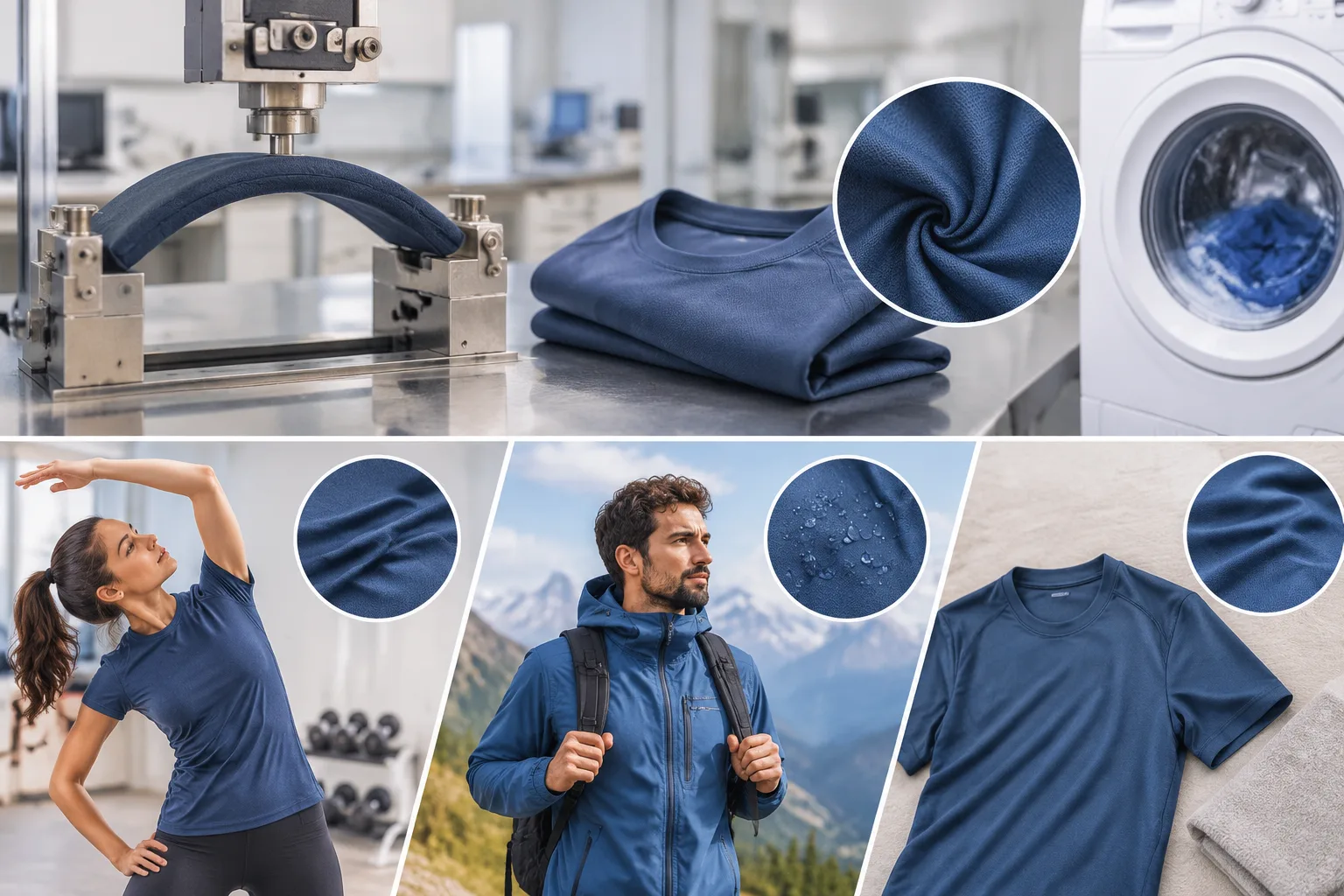
Shape memory textiles durability testing compares shape retention and recovery before and after controlled bending, wear, and laundering. Record the material, garment construction, exposure conditions, recovery conditions, and observation timing, then assess damage and function separately. Apparel Wiki provides independent educational guidance; its Sponsor page explains that sponsorship does not confer editorial control.
Start by defining the intended shape and the change that would matter in use. Establish a baseline, examine each exposure separately, and document combined exposures in a stated order. The result describes behavior under those conditions; a brief test alone cannot establish long-term garment reliability.
What Durability Means for Shape-Memory Textiles
For this evaluation, a shape-memory textile is a textile intended to recover toward a programmed or intended shape under specified recovery conditions. Treat that recovery as something to evaluate. A commercial description alone does not establish how completely, consistently, or quickly a sample will recover.
Define the initial state, intended shape, applied deformation, recovery condition, and observation point before exposure begins. Describe whether the specimen starts flat, curved, folded, supported, or otherwise constrained. State what permits recovery and when the result will be recorded.
Shape retention concerns maintaining a defined shape during a stated interval or exposure. Shape recovery concerns returning toward the intended shape after deformation. Recovery consistency describes whether comparable cycles produce similar outcomes. These are separate questions: retaining a shape does not demonstrate recovery after deformation.
Appearance and garment function add further outcomes. A specimen could approach its intended outline while showing surface damage, distorted seams, or impaired movement. Record each result separately rather than combining them into a single “durable” label.
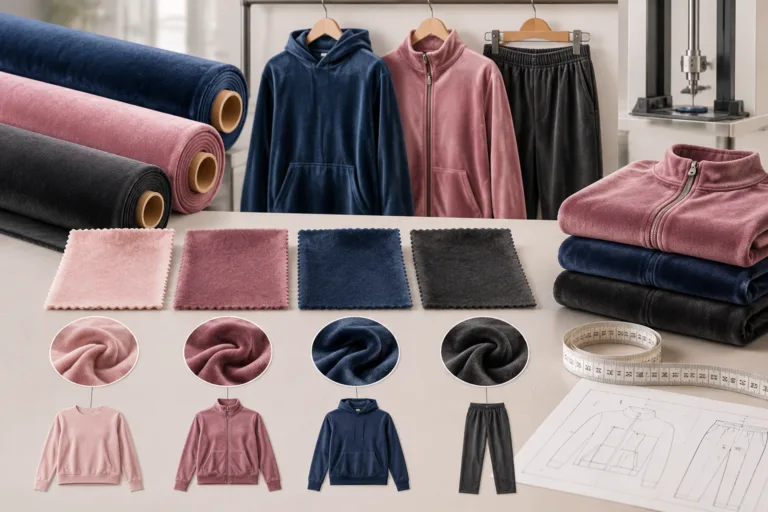
Describe material identity through fiber composition, yarn, fabric structure, and finish. Then document pattern shape, seams, lining, and attachments as construction variables. These layers provide different places to investigate an observed change; a fabric trade name cannot replace their description.
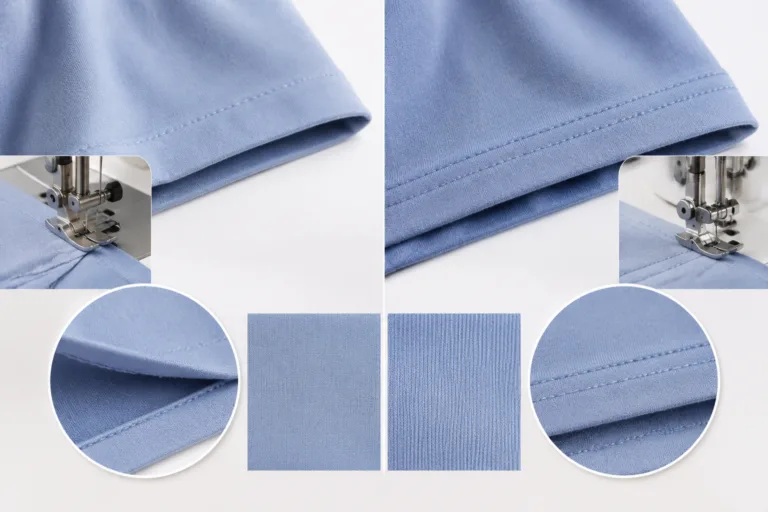
Consider a shaped panel in a lightweight garment. Evaluate its free-standing behavior separately from its behavior when sewn into a seam or held by a lining. Those arrangements introduce different restraints, so they address different questions about the same textile.
If control, power, connections, or data contribute to the intended function, define their roles alongside the textile. A connection failure and a loss of shape recovery require separate records. Shape-memory textile durability therefore means a set of observed outcomes under specified conditions, with no automatic prediction of service life.
Build a Test Plan Around Bending, Wear, and Laundering
Begin with an intended-use brief: where does the textile bend, what rubs against it, how is it handled, and how will it be washed? Identify whether it is free or constrained and which change would affect appearance, fit, movement, or another intended function.
Before exposure, record fiber, yarn, structure, finish, specimen orientation, construction, initial dimensions or shape description, and recovery conditions. Identify seams, trims, linings, and attached components. Specify whether each specimen is a swatch, sewn assembly, or garment section so comparisons retain their construction context.
| Observable input | Exposure implication | Initial test emphasis | Variables that could change the choice |
|---|---|---|---|
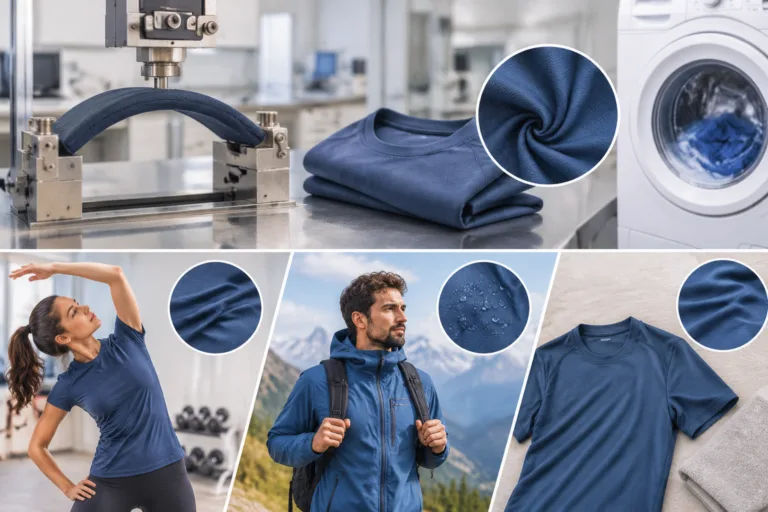
| Repeated fold zones during dressing | Localized bending and release | Shape recovery at the fold and nearby seams | Panel orientation, seam placement, restraint, recovery posture |
| Surface contact during handling or wear | Rubbing alongside garment movement | Surface condition and recovery recorded separately | Contact material, garment construction, moisture, contact location |
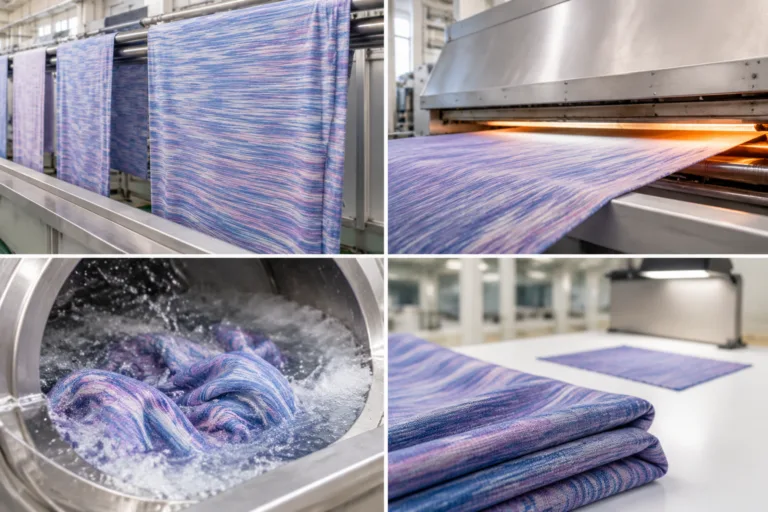
| Planned machine laundering | Washing and drying within a care sequence | Shape, dimensions, attachments, and recovery after care | Care route, temperature, detergent, drying, component removal, cycle sequence |
Identify bending, rubbing, and laundering as separate exposures before combining them. Separate records help associate a change with a particular condition. If exposures are combined, document their order and inspect between stages; an end-only observation leaves the timing of damage unresolved.
Use matched comparison specimens where possible, including an unexposed control kept under documented conditions. Match material and construction details relevant to the question. Reserve separate specimens when one exposure would alter the starting condition for another comparison.
For laundering, document the wash and dry route, component configuration, and recovery setting. Record moisture or sweat exposure separately if included. For every stage, link the input conditions to the resulting observations.
Sample count, conditioning, exposure severity, observation timing, and acceptance criteria need an applicable validated method or a documented project rationale. This planning framework supplies no universal apparatus settings or pass thresholds.
Measure Recovery, Damage, and Functional Change
Choose observations that answer the intended-use question. For shape recovery testing, describe the intended outline, curvature, fold, or other relevant feature before exposure. Afterward, record its position relative to the same reference. Keep overall dimensional change separate from a local change in shape.
Organize the record into distinct categories: shape response; dimensions; surface damage; seam, trim, and attachment condition; hand or drape; and connected-component function. Describe observable features such as residual folds, puckering, loose attachments, or surface fuzzing. Avoid treating every visible change as evidence of reduced recovery.
Record when each observation occurs and the conditions during recovery. An immediate reading answers a different question from one taken after rest, drying, or conditioning. State the sample’s moisture condition, support, orientation, and any applied recovery input. Use comparable observation conditions when comparing specimens.
Before-and-after photographs, written shape descriptions, and traceable specimen labels provide useful documentation. Keep the viewing direction, sample orientation, and reference features consistent. Label images with the exposure stage and observation time. Photographs support comparison, but alone they do not establish a validated performance result.
For a connected textile, define each relevant component and its input or output before interpreting functional change. Record textile behavior, attachment condition, connection status, power state, and data output separately. If the cause remains uncertain, preserve that uncertainty rather than assigning the change to the textile. A changed signal does not establish a health or diagnostic conclusion.
A panel might recover its intended outline after bending while its sewn edge remains puckered. Record the outline recovery and seam distortion as separate findings. If that distortion interferes with garment movement or appearance, document the usability concern alongside the shape result.
Any assessment of changed stiffness, flexibility, hand, or drape should identify the assessment approach. Keep descriptive observations distinct from method-defined measurements. Neither visual recovery nor a short laboratory signal establishes reliable long-term wear performance.
Match Exposure Conditions to the Intended Garment Use
Exposure conditions should reflect how the garment will be handled, worn, cleaned, and stored. A fabric-only observation can be useful, but it may not explain what happens after the material is shaped by seams, linings, trims, or connected components. For shape-memory fabric washing durability, document the care route and the garment arrangement before interpreting any change.
Consider a lightweight knit or woven panel that folds repeatedly during dressing. The relevant bending exposure includes the fold location, seam placement, recovery posture, and restraint from adjacent pieces. A free panel may move toward its intended shape while the same panel sewn into a curved seam remains distorted. Knit or woven construction provides useful context, but it does not independently determine stretch, recovery, breathability, or durability. Fiber, yarn, structure, finish, and construction should remain separate parts of the description.
Handling and rubbing require another distinction. Visible abrasion, fuzzing, or pilling describes a surface change. It does not, by itself, establish loss of shape recovery. Conversely, a panel can retain its appearance while recovering less consistently. The important outcome depends on the use claim: appearance, outline, dimensional stability, movement, or another defined garment function.
For a washable garment, record whether power sources, connectors, or other attached parts are removable before exposure. Note how the textile is separated, protected, or kept attached, then inspect the textile and each relevant connection afterward. Moisture, detergent, temperature, drying, recovery time, and the sequence of exposures may all affect interpretation. Without a validated method or project specification, describe these as variables to control or investigate rather than assigning a universal direction or magnitude.
Use fabric swatches when the question concerns material behavior. Use sewn assemblies when seam restraint, edge finishing, or attachment is part of the intended use. Use a complete garment section when shaping, lining, placement, or handling changes the exposure. Testing these levels separately can show whether a change begins in the textile, construction, or connected system before the effects are combined in a garment-level durability evaluation.
Interpret Results and Report Their Limits
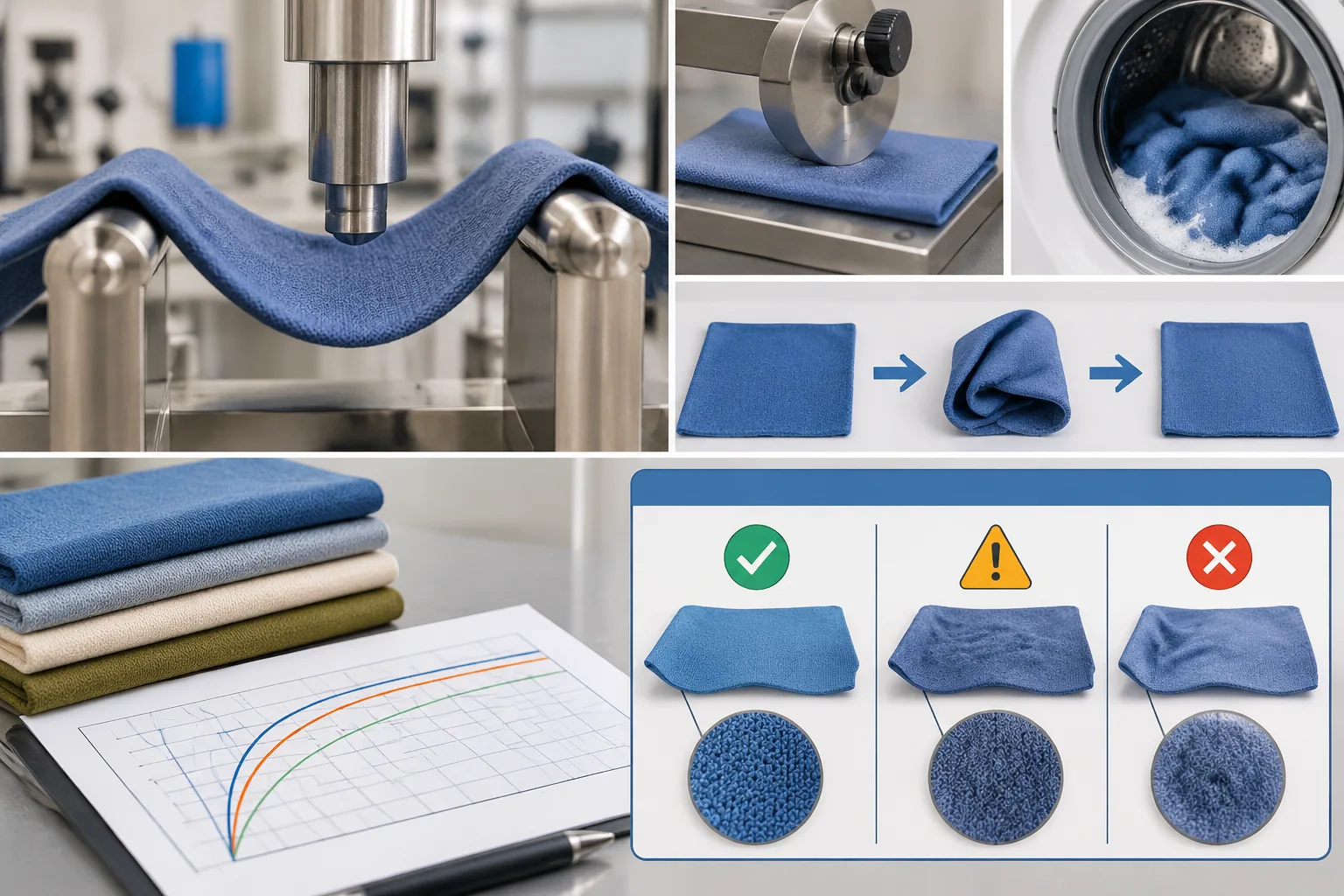
Interpret each exposed specimen against its own baseline and, where practical, a matched comparison. Report the exposure condition, sequence, recovery setting, observation time, and measured or described change together. A result without those qualifiers is difficult to compare because an immediate response may differ from the response after rest, moisture, laundering, or another recovery condition.
Keep the outcome categories separate. Shape recovery describes movement toward the intended shape. Dimensional change describes a change in size or proportion. Surface damage concerns visible material changes. Seam restraint, attachment failure, connection looseness, power interruption, and data interruption belong to other evaluation layers. One visible garment change can have several contributors, so avoid assigning the cause to the textile when the evidence does not isolate it.
A practical durability test report can use the following structure:
- Specimen identity: Record fiber, yarn, structure, finish, construction, orientation, and any attached component.
- Intended use: Describe the garment location, expected bending or rubbing, care route, and outcome that matters to the user.
- Exposure and recovery: State what the specimen experienced, the sequence, the recovery condition, and the observation time.
- Findings: Separate shape, dimensions, surface condition, seam or trim condition, hand or drape, and connected-system observations.
- Evidence record: Add photographs, written descriptions, labels, deviations, comparison references, and unresolved questions.
Before-and-after photographs help show visible differences when orientation, viewing direction, and reference features remain consistent. They do not replace a defined measurement or establish a validated performance result by themselves. Similarly, a short laboratory signal or a single visual recovery observation does not establish reliable long-term wear performance.
Comparable outcomes across comparable specimens are more informative than one striking result, but this article does not assign universal sample counts, repeatability requirements, or acceptance thresholds. Those decisions require an applicable test method or a project-specific rationale. When results disagree, preserve the disagreement and investigate likely failure locations instead of averaging away the uncertainty.
End the interpretation with a practical decision: compare another construction, examine a seam or connection, verify a named method, collect evidence for a specific claim, or repeat an exposure under better-controlled conditions. Do not label a product approved or universally durable from a limited evaluation. Direct observations, method-defined results, project decisions, and editorial recommendations are different evidence categories.
Use the Results to Plan the Next Evaluation
Turn the findings into a comparison brief that lists the textile identity, garment construction, intended use, exposure sequence, recovery condition, observations, limitations, and evidence still needed. Compare specifications and test records side by side, with each result tied to its condition rather than summarized as one durability rating. Before making a product, care, or connected-system claim, check the applicable authoritative method, project requirement, regulation, or technical source.
Frequently Asked Questions
What should be measured when testing shape-memory textiles after bending?
Record the starting shape, deformation, recovery condition, observation time, and resulting shape. Also document dimensional change, surface damage, seam distortion, and any attached-component issue separately. The useful measurement depends on whether the intended outcome concerns appearance, shape, fit, movement, or another defined garment function.
Can a laundering test alone show that a shape-memory textile will remain durable in a garment?
No. Laundering can examine one exposure, but garment durability may also involve bending, rubbing, restraint, drying, handling, and connected components. A laundering result describes behavior under its recorded conditions. It does not by itself establish long-term wear life or explain how the material will perform in every garment construction.
Should shape-memory textile samples be tested as fabric, sewn assemblies, or complete garments?
Use the level that matches the question, and separate levels when construction may affect the result. Fabric swatches help isolate material behavior. Sewn assemblies reveal seam and edge effects. Complete garment sections show the influence of shaping, lining, placement, and handling. These forms may not produce the same recovery behavior.
How can a tester distinguish fabric recovery loss from seam, trim, connection, or power failure?
Define each component and record its input or output separately. Compare the textile shape with seam and attachment condition, then record connection status, power state, and data output independently. If the cause remains uncertain, report that uncertainty instead of treating a garment-level change or signal change as proof of textile failure.
What information should a shape-memory textile durability test report include?
Include specimen identity, fiber, yarn, structure, finish, construction, intended use, exposure conditions, sequence, recovery condition, observation time, measurements, photographs, deviations, and unresolved questions. State whether each finding is a direct observation, a method-defined result, or a project decision, and identify evidence still required for any broader claim.