Before approving a garment moisture-protection claim, verify more than a product name, finish description, or isolated test result. Apparel Wiki’s Sponsor page is separate from this independent educational guidance: the review should connect the stated protection claim with the intended exposure, exact garment configuration, care conditions, traceable materials, and supporting evaluation record. In practical terms, garment moisture protection documentation should let a reviewer answer two questions: what protection is being claimed, and does the evidence apply to the garment version being approved?
Start by recording the claim and its limits. Then compare the expected use with the garment’s materials, seams, openings, closures, and layering. Finally, check whether the evaluation record identifies the relevant specimen, method, conditions, and limitations. Apparel Wiki explains this review process as an independent knowledge publication, not as a manufacturer, laboratory, certifier, or approval authority.
What Garment Moisture Protection Documentation Should Show
Garment moisture protection documentation is the connected record used to understand what moisture-related performance is claimed, for which garment version, under which conditions, and with what supporting evidence. It should connect the claim to the product rather than present a finish name or supplier description in isolation.
A statement that a fabric or garment resists water is a claim about intended performance. It is not automatically proof that the finished garment will provide that protection during every possible exposure. Terms such as water-repellent, water-resistant, and waterproof may be used differently across products, markets, and evaluation methods. Treat the wording as a claim that needs a defined scope, not as a universal technical conclusion.
Before approval, locate the following information:
- the garment style, model, and revision under review;
- the fabric, trim, closure, and other component identities;
- construction details that may affect exposure, including seams, panels, pockets, openings, and interfaces;
- the intended use, exposure pattern, care conditions, and stated exclusions;
- the evaluation or test record, including its scope and reported result;
- the sample, material version, lot, or production stage represented by the record; and
- known limitations, maintenance conditions, and unresolved changes.
This is a review structure, not a claim that every item is legally required in every market. Where a record is missing, mark the gap for follow-up instead of silently treating the claim as complete. A useful approval record makes the relationship between claim, use, garment configuration, evidence, care instructions, traceability, and limitations easy to follow.
The central approval question is therefore conditional: does the documented claim match the actual use and garment configuration, and can the supporting evidence be traced to the version being considered? A material description may support a narrower material-level statement while leaving a whole-garment claim unresolved. Likewise, a result from an earlier sample may be informative without proving that a revised garment has the same documented scope.
Define the Protection Claim and Intended Exposure
“Moisture protection” is too broad to review without further description. First identify the exposure the garment is expected to face. Light contact, persistent wet weather, splash, pressure, localized leakage, and moisture entering through an opening create different questions for the documentation. The record should describe the relevant use conditions in plain language rather than rely on a broad label.
Ask whether the claim applies to the complete garment or only to a fabric, finish, panel, seam, or component. A treated outer material can describe a material feature, but it does not by itself establish the protection of an assembled garment. The review must connect that feature with the garment’s construction and the scope of any evaluation.
Document the intended activity and exposure pattern, including where moisture is expected to contact the garment, whether the wearer moves during use, and whether layering or adjacent equipment changes the conditions. Duration, pressure, movement, and care context are variables to identify and verify through the applicable project requirements or technical method. Avoid turning them into universal exposure limits when no validated threshold is available.
Garment zones also matter to the review. Seams, pockets, openings, closures, and transitions between materials should be identified because they may create different questions from those raised by a flat fabric panel. This does not mean that any one feature automatically causes failure. It means the documentation should make clear whether the evaluation covered the complete assembly or only a selected material or component.
Use the claim wording to define what remains outside scope. For example, a record may describe surface repellency of an outer material while saying nothing about leakage through a closure or seam. That information can still be useful, but it should not be broadened during approval. A narrow, traceable statement is more reviewable than a general claim that hides the exposure and evaluation boundaries.
Record unresolved variables as approval conditions. These may include a revised component, changed seam treatment, altered closure, different layering arrangement, or updated care instruction. The condition should identify what must be confirmed and which claim it affects. This keeps uncertainty visible instead of allowing general wording to imply that all garment versions and uses are covered.
For a water-resistant garment claim review, compare four elements in the same record: the type of exposure, the garment area and configuration, the intended use, and the evidence scope. If one element is absent, the issue is not necessarily proof of poor performance; it is a documentation gap that limits what can be approved confidently.
Build a Traceable Garment and Materials Record
The product record should identify the exact garment connected to the moisture claim. Begin with the style or model, revision, relevant color or material version, component list, and the sample, lot, or production stage represented by the evidence. This identity block prevents a report for an earlier development sample from being mistaken for evidence about the final approval target.
Match each fabric and trim reference to its available composition, construction description, finish or coating description, and supplier or internal material reference. Do not assume that a finish remains unchanged after cutting, sewing, pressing, laundering, repair, or other processing. Those changes are variables to confirm against the applicable material or product documentation.
Record construction features that form part of the moisture-protection review. Include seam treatment, panels, pockets, openings, closures, and interfaces between different materials where they are relevant to the claim. These are review inputs, not automatic proof of success or failure. The purpose is to show whether the evidence describes the same assembled configuration as the garment under approval.
Care, repair, storage, and user instructions belong in the same record. Check whether they qualify the claim or introduce conditions that the approval wording must preserve. If protection depends on maintenance, component replacement, or a specified care approach, document that limitation rather than presenting the claim as unrestricted.
A practical document-control check should flag mismatched revisions, unlabeled samples, missing component changes, and evidence that covers only a fabric rather than the assembled garment. Traceability is a practical control for comparing evidence with the approved product; unless a specific rule applies, do not describe a particular retention or lot-record practice as universally mandatory.
The result should be a garment specification record that allows a reviewer to move from the claim to the material, from the material to the construction, and from the construction to the evidence. If that chain breaks, state exactly where it breaks and narrow or pause the claim until the relevant information is confirmed.
Review Evaluation Evidence Without Overreading the Result
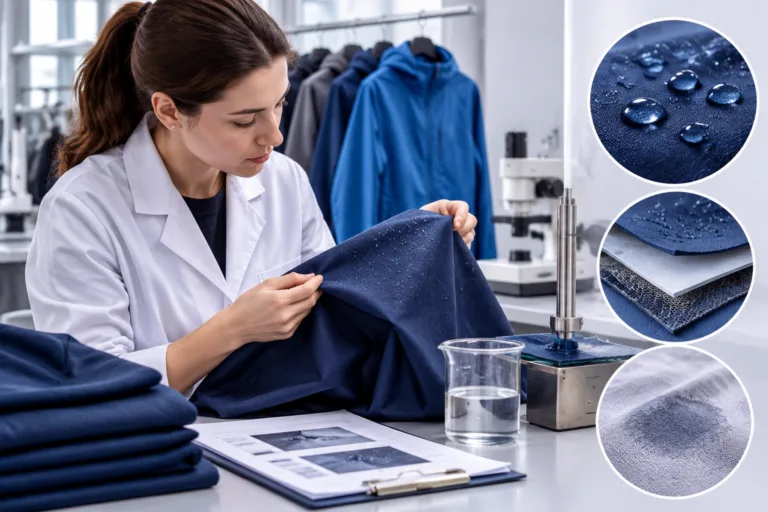
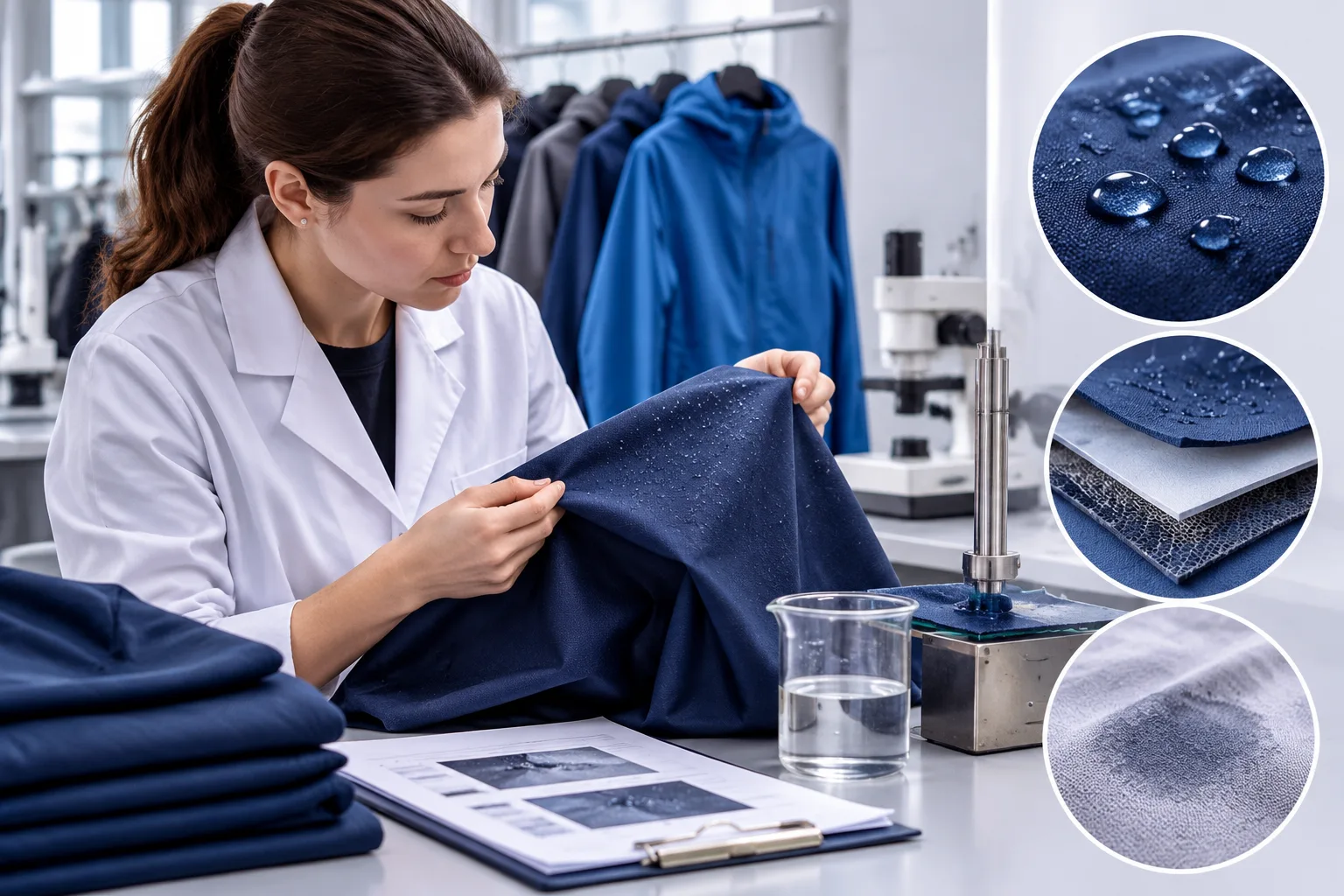
A moisture protection evaluation report is useful only when its method, scope, and specimen can be connected to the garment under approval. Start by recording the evaluation method, relevant version or date, issuing laboratory or evaluator, sample description, result, and report date. A number without this context is not self-explanatory.
Compare the evaluated item with the approval target. The evidence may describe a fabric swatch, seam, panel, closure, or other component rather than the complete garment. It may also describe a development sample while the approval target has a different revision, material version, component, or production stage. These differences do not automatically invalidate the record, but they prevent an unqualified conclusion about the final garment.
Review the conditions under which the evaluation was performed. Note preparation and conditioning, exposure setup, number of specimens, deviations from the stated method, and whether the result is an individual observation or part of a broader product claim. The report should also make clear which units and observations belong to which specimen. Preserve those conditions when summarizing the result so the summary does not imply wider coverage than the record supports.
Keep three statements separate: what the evaluation measured, what a supplier claims, and what an editor infers from the information. A reported method result is not automatically a regulatory requirement, certification status, or guarantee of field performance. Likewise, a supplier statement may help identify the intended claim, but it does not replace evidence whose scope can be checked.
When a report cannot be authenticated or matched to the final garment, do not assign a performance conclusion. Record the precise gap, such as “sample version cannot be confirmed” or “evaluation scope cannot be confirmed.” That wording preserves the distinction between missing evidence and a failed result. It also gives the reviewer a clear basis for narrowing, pausing, or clarifying the claim.
Make the Approval Decision and Record the Gaps
Use the documentation to decide what claim, if any, is supportable for the stated scope. This is an editorial review framework, not a universal pass/fail system. The applicable project specification or other authoritative requirement may impose additional conditions. A narrow, traceable claim can be documentable even when a broader whole-garment claim remains unsupported.
| Observable input | What it supports or leaves uncertain | Initial review action | What could change the decision |
|---|---|---|---|
| Claim, use conditions, and garment version are clearly identified | Supports review of a defined scope; does not cover unlisted uses | Approve the documentation for that stated scope, subject to project requirements | A changed use, revision, material, or limitation |
| Evaluation covers the matching assembled garment | Provides more direct evidence for the documented configuration | Compare method conditions and result with the project requirement | Unrecorded deviations, changed components, or a different lot |
| Evidence covers material only | Supports a material-level statement; assembled-garment performance remains uncertain | Hold or narrow the whole-garment claim | Traceable assembly evidence or an appropriately scoped evaluation |
| Report identifies a different revision or an unlabeled sample | Connection to the approval target cannot be confirmed | Hold for clarification | Verified sample identity and documented component comparison |
| Method, conditions, or result context is missing | Reported information cannot be interpreted reliably | Hold the affected claim; record the missing fields | Complete report details or a validated replacement record |
| Care instructions conflict with the stated protection claim | Claim may be limited by maintenance or user handling | Clarify the limitation and align the approval wording | Corrected care information or documented protection scope |
| Only an unverified supplier statement is available | Shows an asserted claim, not traceable supporting evidence | Do not treat the claim as approved evidence | Identified evaluation record matched to the garment |
For example, a lightweight garment may have a treated outer material while the documentation does not identify seam or closure coverage. The initial action is to hold the broad whole-garment claim. A complete assembly record or appropriately scoped evaluation could change that action, but the treatment name alone cannot resolve the gap.
Maintain a gap log alongside the approval record. Name the missing document or field, the information source expected to provide it, the affected claim, and the current decision status. Use categories such as approve for the documented scope, hold for clarification, or reject the unsupported claim only as review labels. They should not be presented as universal industry requirements or as a legal conclusion.
Record the Scope Before Final Approval
Moisture protection approval is a scope-and-evidence decision, not a label decision. The final record should state the claim and intended use, matching garment and material identity, traceable evaluation evidence, care information, and written limitations. As an educational next step, place the claim, garment revision, exposure, and evaluation record on one review sheet, then check the applicable method or project specification and mark unsupported claims for clarification or omission.
Frequently Asked Questions
What is the most important document to verify before approving a garment moisture-protection claim?
Verify the record that connects the claim to the exact garment version and intended use. It should identify the evaluated specimen or garment, evaluation scope, relevant conditions, result, care limitations, and any differences from the approval target.
Can a fabric test report prove that the finished garment provides moisture protection?
No. A fabric report can support a material-level statement, but it does not by itself prove performance of the assembled garment. Seams, openings, closures, interfaces, care conditions, and other configuration details may remain outside the report’s scope.
How should a reviewer handle a moisture-protection report that does not identify the test method or sample version?
Record the missing method or sample identity and state that the evaluation scope cannot be confirmed. Do not convert the reported number into an approval threshold. Hold or narrow the affected claim until the evidence can be matched and interpreted.
What garment details can make a material-level moisture claim incomplete?
Relevant details include seam treatment, panels, pockets, openings, closures, interfaces between materials, care instructions, and component changes. These details do not automatically determine the result, but they must be considered when deciding whether the evidence describes the assembled garment.
Should a water-repellent finish be treated as proof of whole-garment protection?
No. A water-repellent finish describes a material feature or treatment. It does not automatically establish the scope or performance of the finished garment. The documentation should connect the feature to the intended exposure, garment construction, evaluation, care conditions, and limitations.
What should be recorded when the documentation supports only a narrower moisture-protection claim?
Record the supported claim, intended exposure, garment revision, material or assembly covered, evaluation evidence, care conditions, and exclusions. State which broader claim remains unsupported and identify the missing information needed for clarification.