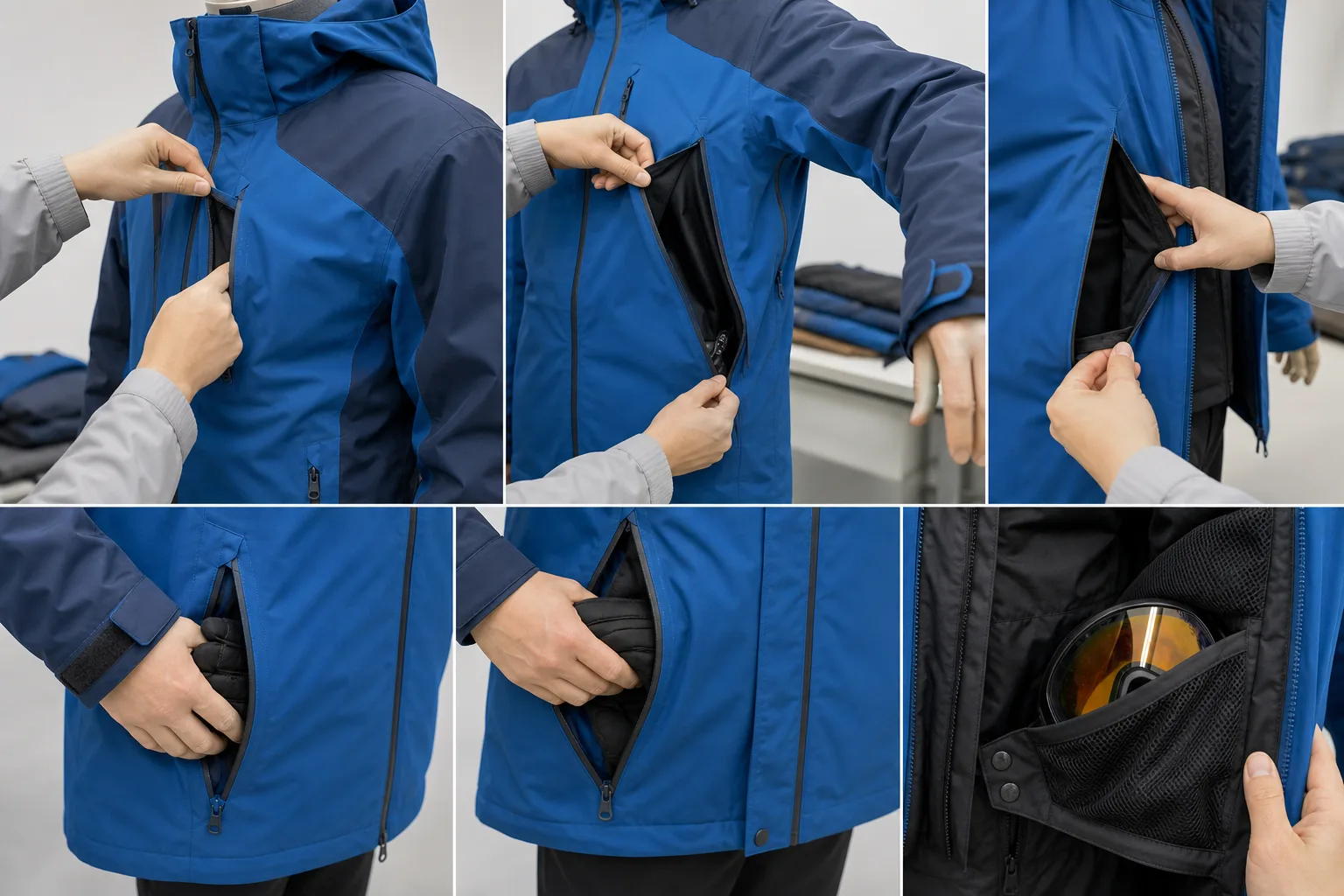
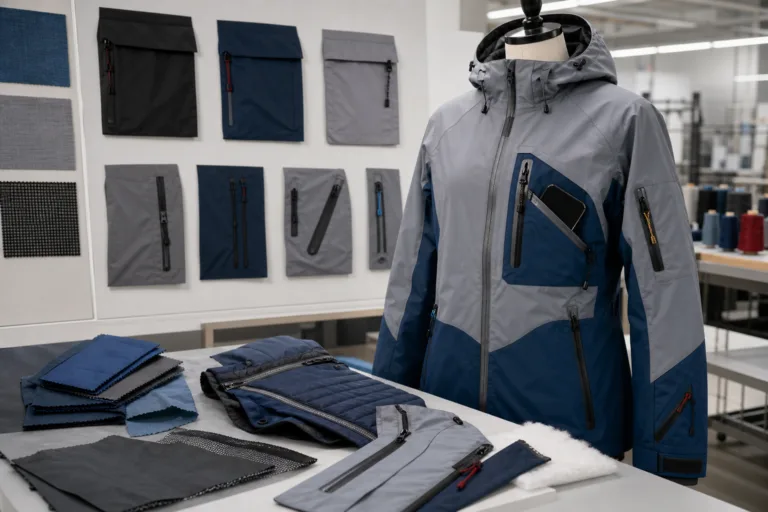
Ski jacket pocket access is the combination of pocket location, opening design, reach path, and usable interior space that allows a wearer to retrieve or store a specific item during skiing or related outdoor activity. To specify it well, start with the action the wearer must perform, then evaluate that action in realistic postures, layers, gloves, and equipment. A pocket label alone does not describe usability.
For example, accessing a phone, pass, goggles, lens, tool, wallet, or spare gloves may require different locations and opening shapes. Access can change when the wearer is standing, seated, leaning forward, wearing a midlayer, or carrying a pack. This guide uses a task-first approach; Apparel Wiki is an independent educational publication, and its Sponsor information does not make the site a manufacturer, testing laboratory, or production-service provider.
What Does Ski Jacket Pocket Access Need to Achieve?
A useful ski jacket pocket design should let the wearer locate the opening, operate its closure, reach the usable pocket space, handle the intended item, and close the pocket again with an appropriate amount of effort. These are separate steps. A pocket may be easy to find but difficult to open with gloves, or it may have a generous opening while its internal bag blocks a bulky item.
Define the intended task before choosing pocket placement. A pass pocket may need frequent, quick access, while a pocket for a wallet or tool may prioritize retention. A goggle or lens pocket may need enough clear interior space to avoid crushing or obstructing the item. A phone pocket may need to remain reachable while the wearer is moving. These requirements should be written as use scenarios rather than inferred from the general category name.
Access is also affected by layered clothing, cuffs, gloves, body position, pack straps, bibs, and the pocket’s internal construction. The opening may be reachable on a flat pattern but difficult to approach when the arm is bent or the garment is compressed by equipment. Pocket bag depth, orientation, lining, and attachment can affect whether an item slides into place or catches during removal.
Keep functional access separate from claims about waterproofing, warmth, security, durability, or safety. A pocket can be conveniently placed without being weather-resistant, and a zipper can close an opening without proving that the assembled pocket is waterproof. Those properties require their own construction decisions, evidence, and finished-garment evaluation. The ski jacket category itself does not establish a particular performance level.
Map the Reach Path Before Choosing Pocket Placement
Reach-path mapping asks how the hand travels from its normal position to the pocket opening and back again. Record whether the wearer can locate the opening by touch, approach it with one hand, operate the closure with that same hand, and stabilize the garment without assistance from the other hand. The sequence matters because a pocket that works only when the wearer stops, removes a glove, or releases equipment may not meet the intended use.
Test the garment in the postures that belong to the product brief. These may include standing, leaning forward, seated use, and skiing-related arm positions. Review access with representative base layers, midlayers, cuffs, ski gloves, liners, and helmet or hood use where relevant. A sample worn over a thin base layer can give a misleading impression of available reach and opening clearance.
Check interference from pack shoulder straps and waist belts, harnesses, bibs, belt lines, elbow movement, and ski-pole handling when those conditions apply. A strap can cover an opening, press contents against the body, or limit the hand’s approach. Sleeve pockets may be affected by cuff construction and wrist movement, while lower-front pockets may become harder to use when the wearer is seated or carrying equipment.
Record each scenario in the specification, including body position, garment layers, gloves, equipment, intended item, and hand used. In a user trial, observe and record locating, opening, retrieval, and reclosure separately. Treat reach and posture as variables to observe with representative wearers, not as assumptions based only on a flat pattern. Any claim about ease of access should be supported by documented observations rather than a single subjective try-on.
Compare Pocket Locations by Access, Interference, and Load
No pocket location is universally best. Compare each zone against the intended item, hand movement, equipment system, garment silhouette, and likely load. The matrix below is a qualitative starting point for development. “Easier” and “more conditional” describe issues to investigate, not universal access ratings.
| Pocket zone | Potential access advantage | Issues to review |
|---|---|---|
| Chest or upper front | Often supports a direct hand approach and can keep small items above some lower-body equipment. | Straps, shell shaping, chest compression, handedness, and limited space for larger contents. |
| Lower front | May provide useful volume and a familiar hand position for standing access. | Seated reach, pack waist belts, hip movement, loaded-pocket bulk, and interference with bibs. |
| Sleeve | Can keep a pass or small item separate from the torso pockets. | Glove clearance, cuff movement, limited volume, and more conditional reach during arm movement. |
| Interior | Can protect contents from external exposure and reduce visible bulk. | Access through shell and layers, limited visibility, and possible interference from insulation or lining. |
| Back or rear-adjacent | May use otherwise available space for selected storage needs. | Seated comfort, pack pressure, reach path, retention, and higher dependence on the use scenario. |
When comparing locations, consider both the shape and weight of the intended contents. A lightly loaded pocket may behave well while a heavier item pulls on the opening, distorts the shell, or presses against a strap. Review left-right symmetry and handedness when quick access matters. A location selected for common industry practice still needs confirmation against the jacket’s particular silhouette, target user, and equipment setup.
Specify the Opening: Direction, Closure, and Puller Details
Specify whether the opening is horizontal, vertical, angled, or another orientation, and explain how that direction supports the hand’s approach and the item’s retention. The choice should be tested with the intended gloves and postures. An opening that is easy to enter may still allow contents to obstruct the slider path or shift toward the edge during movement.
Document the closure type, finished opening length, puller configuration, stop details, and whether the wearer is expected to open and close the pocket with one hand. Also identify the zipper tape, chain or coil construction, slider behavior, welt or flap construction, and relationship between the opening and the shell, lining, or insulation. These details help pattern makers, suppliers, and assembly teams interpret the same requirement.
Treat the zipper and pocket as one installed system. A component description or zipper size does not guarantee the same result across suppliers or finished garments. The assembled pocket should be reviewed for slider operation, attachment, snagging, opening clearance, and compatibility with the shell and lining. Measurement definitions should state how length is taken and whether a dimension refers to the pattern, finished garment, or usable opening.
For supplier communication, include the opening type, location, measurement method, puller requirements, color, and assembly details. If the specification makes claims about strength, durability, water resistance, or other performance properties, use an appropriate validated method and evaluate the finished construction. Hardware documentation can inform selection, but it cannot replace checking the installed pocket on the actual garment system.
Balance Access With Weather Protection, Security, and Garment Load
Easy access is only one pocket requirement. A longer or more exposed opening may make it simpler to reach a phone, pass, or tool, but it can also create greater demands for closure protection, water management, and seam construction. Treat weather protection as a separate requirement from access. Pocket placement or a zipper description alone cannot prove that a finished ski jacket pocket is weatherproof.
Start by matching the pocket bag to the intended contents. A bag that is too small can obstruct the opening, force items against the zipper, or make retrieval difficult with gloves. A bag that is too large can create bulk, sag, or unwanted movement. Review the shape as well as the dimensions, particularly when the contents have corners, thickness, or a rigid form.
Lining or pocket-bag material, drainage choices, seam placement, and reinforcement should be documented as construction decisions. They may support the design intent, but they do not automatically establish water resistance, durability, or secure retention. Those claims require a defined acceptance method and evaluation of the finished pocket using the final shell, lining, hardware, and assembly details.
Also check the effect of a loaded pocket on the garment as a whole. Contents can change the shell appearance, restrict movement, press against the body, or interfere with a pack waist belt. Weight may feel different when the wearer bends, sits, skis, or handles poles. Security is likewise project-dependent: a pocket intended for quick access may need a different solution from one intended to keep contents enclosed during vigorous movement.
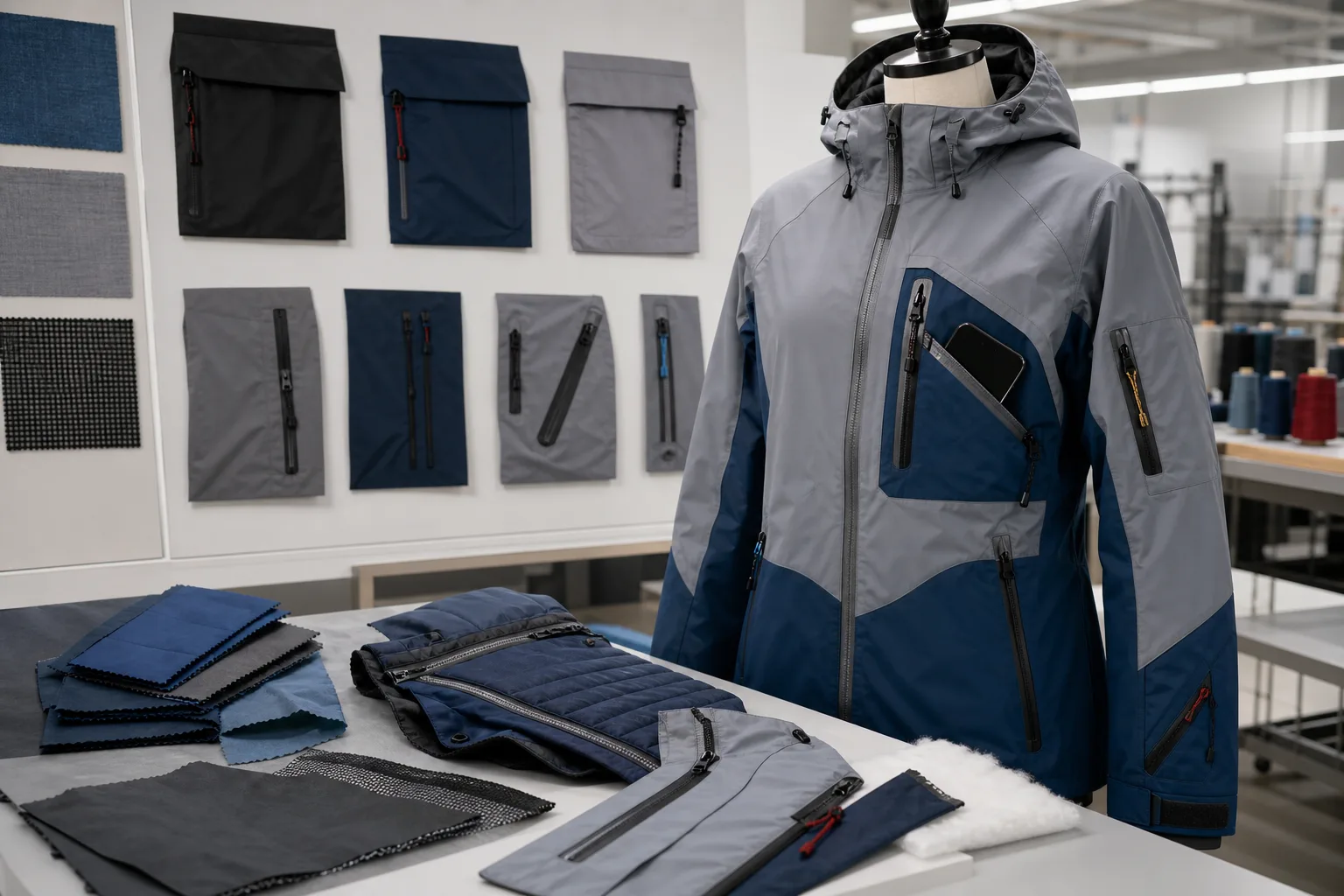
Build a Pocket Access Specification for Suppliers and Pattern Makers
A useful ski jacket pocket specification translates the wearer’s task into information that design, pattern, sourcing, manufacturing, and quality teams can interpret consistently. Begin with the pocket purpose and intended contents. State whether the pocket is for a pass, phone, goggles, tools, wallet, gloves, or another item, because the item’s size, shape, and retrieval frequency affect the design.
Record the location using clear garment reference points rather than a visual description alone. Include the opening orientation, finished opening dimensions, pocket-bag dimensions, closure type, puller details, and any flap or welt construction. Define how each measurement is taken. A length may refer to the pattern, the sewn finished opening, or the usable access area, and those are not interchangeable.
The specification should also describe the evaluation situation. List the relevant body positions, target garment sizes, midlayers, gloves, helmet or hood conditions, pack setup, and equipment that may affect access. Identify whether the wearer should locate, open, use, and close the pocket with one hand. If a pocket is intended for a safety-related item, add the applicable safety review rather than assuming ordinary storage access is sufficient.
Separate fixed requirements from development questions. For example, the location may be approved while the opening direction or pocket-bag shape remains under review. Mark those decisions clearly so a supplier does not treat an unresolved choice as a universal measurement. Include construction notes for reinforcement, seam allowances, lining or bag attachment, and bartacks or other stress points where they apply to the design.
Component information is useful, but it should remain connected to the installed garment. Supplier documentation can describe a selected zipper or puller, while the finished specification must explain how that component is positioned, attached, and operated in the pocket assembly. Apparel Wiki is an independent educational publication, so this type of guidance supports clearer product-development communication; it does not represent factory, OEM, or production-service capability.
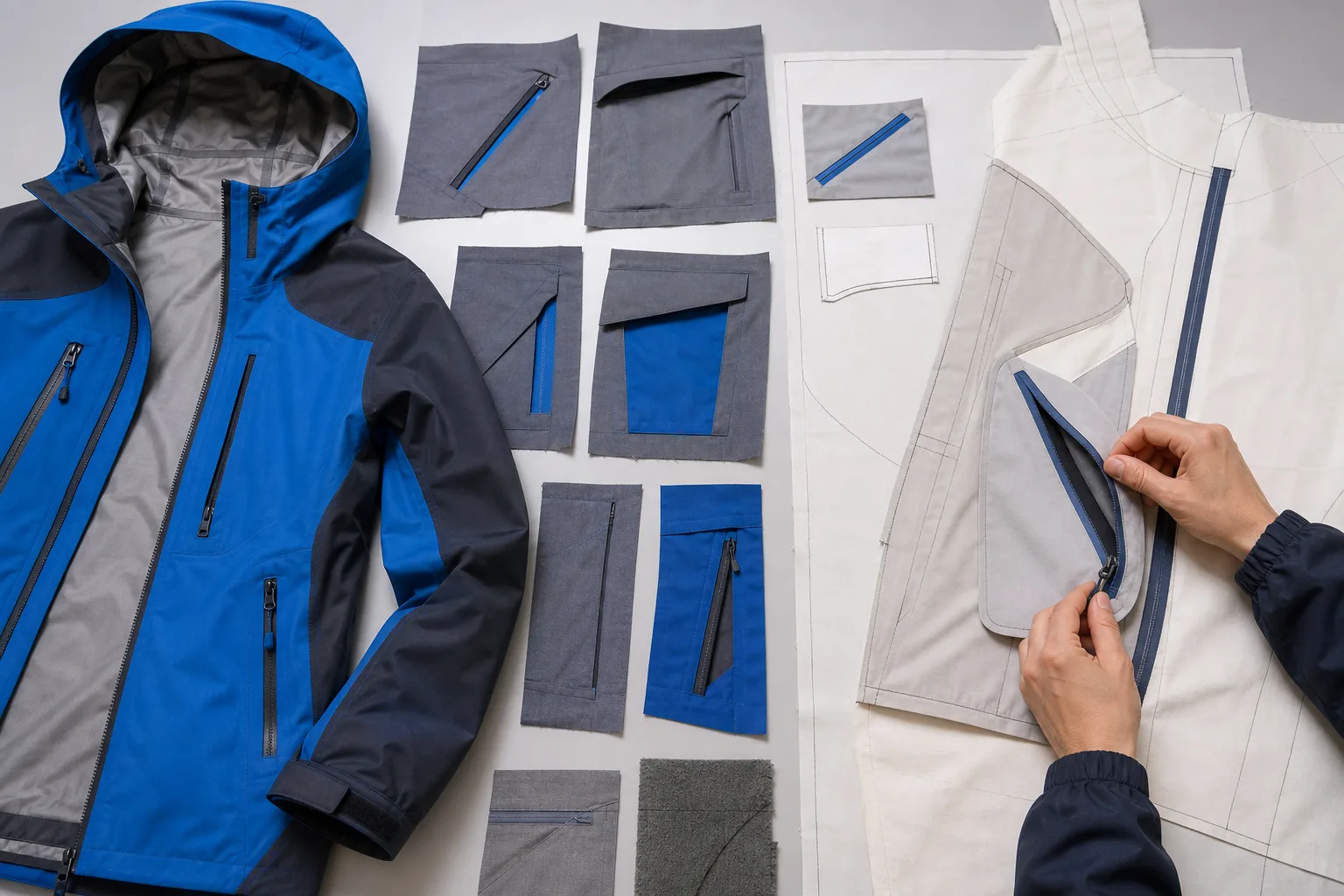
Validate Pocket Access on the Finished Jacket
Validate access on a representative finished jacket, not only on a flat pattern or isolated zipper sample. Use the final materials where possible, including the shell, lining, insulation, pocket bag, closure, and reinforcement. If a substitute is necessary during development, record how it differs from the planned construction and avoid treating the result as final proof.
Test the intended sizes and realistic use scenarios. The wearer should use the planned layers, gloves, pack arrangement, and relevant equipment while standing, bending, sitting, or adopting the posture associated with skiing. Observe the complete sequence: locating the pocket, approaching the opening, operating the closure, placing or removing the intended item, closing the pocket, and moving afterward.
Record observations separately rather than reducing the result to a general opinion about comfort. Note whether the hand can reach the opening, whether one hand is sufficient, whether the puller is easy to control, and whether the item can be retrieved without excessive manipulation. Also check snagging, slider behavior, accidental opening, item retention, pocket distortion, pressure points, and interference with pack straps or other garment features.
Use a repeatable checklist that identifies the sample, size, materials, user scenario, equipment, and acceptance criteria. Comparative statements such as “easier to access” should be tied to the same test conditions. Where durability, water resistance, strength, or compliance is claimed, use an appropriate validated method and test the assembled garment. Component results cannot replace finished-jacket verification.
Repeat the review after relevant care or use cycles when post-use access matters. A pocket can operate well in a new sample and behave differently after laundering, abrasion, compression, or repeated opening. The final record should preserve the observation, the construction tested, and any corrective action, so pattern makers and suppliers can connect the result to a specific design change.
As a next step, turn the approved requirements and trial observations into a controlled technical package, then review related apparel development references in the Apparel Manufacturing Tools collection. Keep access, weather protection, security, and durability as distinct requirements until the finished garment provides evidence for each one.
Where should pockets be placed on a ski jacket for easier access?
There is no universal best location. Compare chest, upper-front, lower-front, sleeve, interior, and rear-adjacent zones against the intended contents, body posture, gloves, pack straps, handedness, and equipment. Confirm the choice with a representative wear trial.
How should ski jacket pocket access be tested with gloves?
Use the planned gloves and layers, then observe locating, opening, using, and closing the pocket. Record one-handed operation, puller control, item retrieval, accidental opening, snagging, and interference with other equipment.
Should a ski jacket pocket open horizontally or vertically?
Choose the direction that best matches the hand approach, item retention, body position, and garment construction. Test the selected orientation on the finished jacket rather than assuming one direction works for every pocket.
How do backpack straps affect ski jacket pocket placement?
Straps and waist belts can block an opening, change reach, or compress loaded contents. Include the intended pack setup in the evaluation and record interference separately from the pocket’s unloaded operation.
What details should a ski jacket pocket specification include?
Include purpose, contents, location references, opening orientation, measurement definitions, finished opening and pocket-bag dimensions, closure and puller details, construction notes, target scenarios, and unresolved development questions.
Does a zipper pocket automatically make a ski jacket weatherproof?
No. Weather resistance depends on the complete pocket system, including materials, zipper installation, seams, construction, and validation. A zipper type or component description alone is not evidence of finished-garment performance.