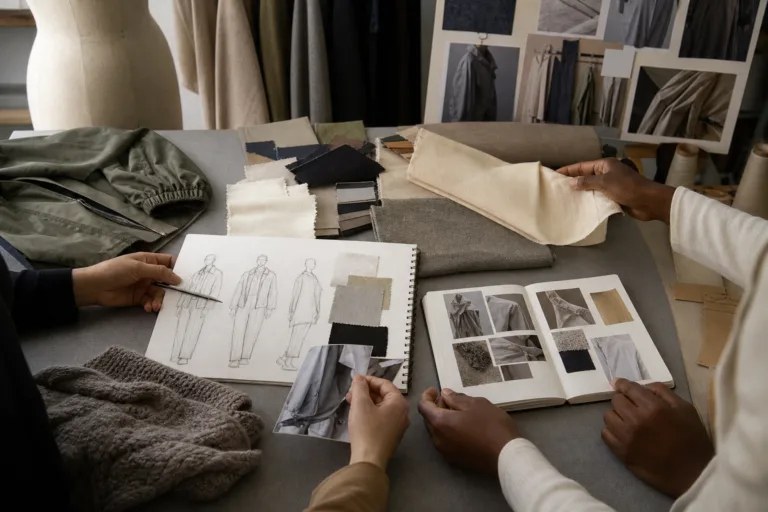
Sponsor support does not determine Apparel Wiki’s editorial guidance. In practical terms, apparel concept development is the work of organizing the first product decisions before detailed pattern making, sample development, or production planning. It turns an appealing reference, sketch, or material idea into a direction that can be discussed and tested: who the garment is for, where it will be used, what it should help achieve, what it should look and feel like, and what limits are already known.
A useful clothing concept is not a promise that the product will sell, fit every wearer, meet every technical need, or be commercially viable. It is a working hypothesis with enough structure to guide the next decision. The framework below can support fashion-led, function-led, or hybrid projects. It is editorial guidance rather than a mandatory development sequence.
What Is Apparel Concept Development Before Sampling Begins?
Apparel concept development begins when a broad idea is organized into a product direction that others can evaluate. Inspiration may suggest a silhouette, color relationship, emotional tone, material character, or styling attitude. A clothing concept goes further. It identifies an intended wearer, a use situation, an outcome worth pursuing, a design direction, and the constraints that may affect the response.
For example, a photograph of a short, sculptural jacket can be a valuable reference for proportion. By itself, however, it does not explain whether the proposed garment is for commuting, social occasions, light outdoor use, or editorial expression. It also does not establish movement needs, layering expectations, care requirements, or the reason that this form is appropriate for the wearer.
A practical apparel design concept can be organized as a chain: wearer and context; problem or opportunity; product promise; possible design choices; constraints; and evidence needed for the next decision. Each link gives the team a question to answer. The wearer and context define the situation. The problem or opportunity identifies what may be improved or expressed. The product promise states the intended result. Design choices are possible responses, not settled facts. Constraints show what cannot be ignored, while evidence identifies what should be checked next.
This distinction matters because a mood board and a single sketch can look complete before the underlying decisions are complete. Treat them as inputs to clothing concept development, not as substitutes for a product brief. A concept may be ready for further evaluation even when it still contains uncertainty, provided the central wearer task, intended direction, and unanswered questions are visible.
At this stage, avoid claiming market demand or broad customer preference unless the project has relevant, documented research. Likewise, do not assume that visual appeal proves technical feasibility, fit performance, or production suitability. Those questions require project-specific review, material information, pattern work, sampling, and focused testing as the project advances.
Define the Wearer, Situation, and Clothing Task
Start a clothing design concept with the person and the situation rather than the proposed feature. A vague brief such as “a better jacket” can become more useful when rewritten as a wearer task: “A person who walks between transit, work, and evening plans needs a lightweight outer layer that accommodates a layer underneath, allows unrestricted arm movement, and still presents a deliberate silhouette.” This statement is a starting hypothesis, not a claim about every potential customer.
The key is to distinguish the desired benefit from the design response. “Easier movement” is a wearer outcome. A dropped shoulder, articulated sleeve, stretch panel, or changed armhole shape could be a response, but none should be treated as the answer before it is assessed. Keeping this distinction open prevents an early feature preference from silently becoming the problem definition.
Context makes the apparel product idea specific. Consider only the variables that matter to the intended task: expected layering, climate exposure, body movement, storage needs, visibility, modesty, compatibility with existing garments, and care expectations. A garment intended for a short indoor event may tolerate a different care burden and level of visual complexity than one intended for frequent travel or active daily wear.
Appearance, identity, confidence, and emotional response can also be legitimate product objectives. A fashion product problem is not always physical discomfort or functional failure. Still, a designer’s personal preference or a few informal conversations should not become evidence that an entire audience shares the same desire. Interviews, observation notes, customer feedback, support requests, and wear trials can help define a project-specific question without proving population-wide demand.
Prompts for defining the task
- Who is the wearer? Describe the relevant habits, clothing context, or role rather than relying only on a broad demographic label.
- What is happening? Identify where, when, and under what conditions the garment is worn.
- What creates friction or opportunity? Note a practical difficulty, an expressive goal, or both.
- What outcome should improve? State the intended benefit in wearer terms.
- What must the garment not compromise? Record limits such as mobility, coverage, care, layering, or visual identity.
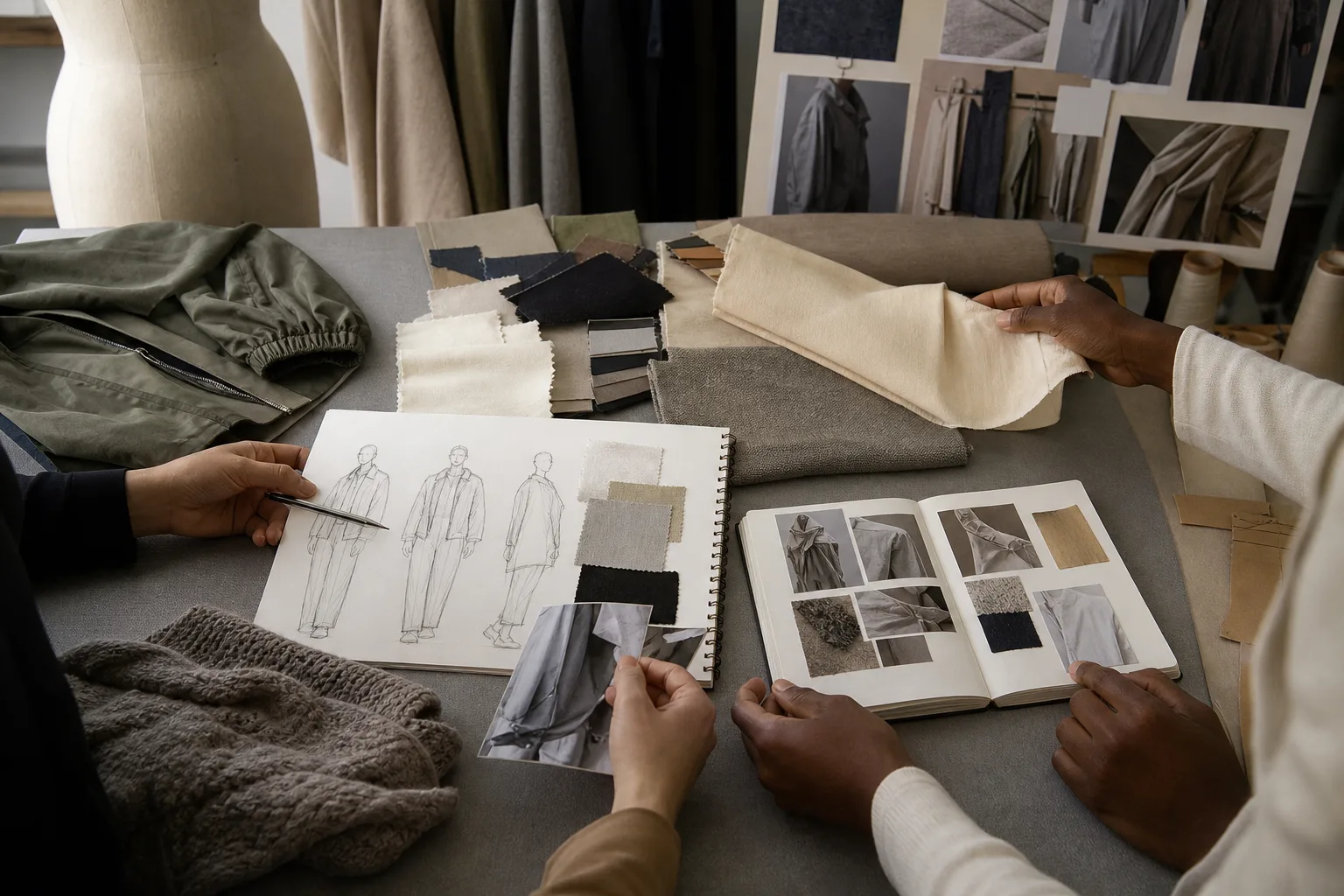
Build an Inspiration Trail That Supports Decisions
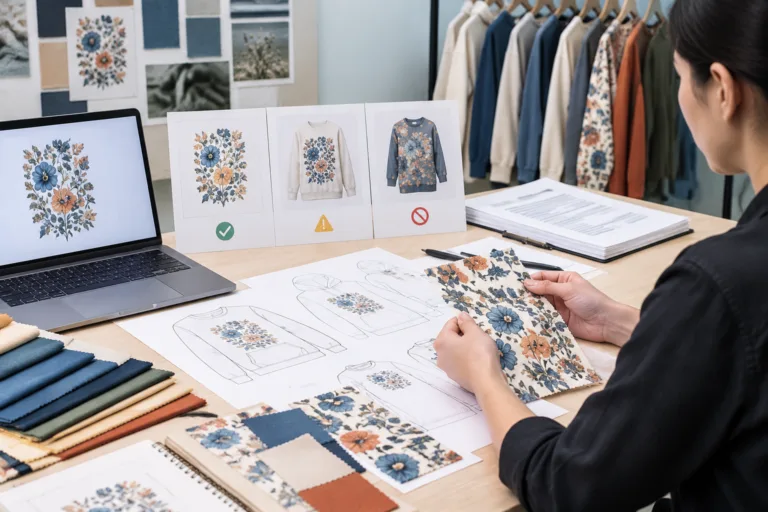
An apparel inspiration board is more useful when every reference has a job. Instead of collecting images as an unannotated collage, record what each image, garment, material swatch, or historical reference contributes. The contribution might be silhouette, proportion, closure placement, surface treatment, material behavior, color relationship, styling, or emotional tone.
For each reference, keep the source and context when known, then add the specific principle being studied and the development question it raises. A reference with an elongated back proportion, for instance, might prompt the question: does this length permit the intended stride and sitting behavior? A brushed surface may prompt a care question: is that visual effect compatible with the expected maintenance routine? The board then becomes a record of decisions to investigate rather than a presentation-only asset.
Separate three kinds of notes. First, record direct visual observations, such as “the closure sits off-center” or “the sleeve is visibly fuller at the crown.” Second, identify factual historical or cultural context only when it has been verified through an appropriate authoritative source, such as a museum, archive, or exhibition catalog. Third, label the designer’s interpretation: for example, “this proportion suggests protective volume.” Keeping these categories distinct makes later review clearer.
Historical influence is not permission to reproduce a garment, photograph, print, logo, or recognizable design detail. Documenting a source and a rights question is a sound development habit, but it is not a legal conclusion. When commercial use of imagery or recognizable material is contemplated, confirm permissions and relevant copyright or trademark considerations with the rights holder or qualified legal guidance.
Separate Observations From Design Assumptions
Early apparel product research becomes more reliable when teams separate what they saw or heard from what they think it means. If a wearer repeatedly pulls at a cuff, the action is an observation. Concluding that the sleeve is too long is an interpretation—a plausible one, but still a hypothesis. The wearer may be reacting to fabric friction, an awkward layer underneath, a styling preference, a particular movement, temperature, or another garment in the outfit.
Record the evidence with enough context to revisit it later: the person’s words, visible action, location, timing, garment condition, surrounding circumstances, and relevant layers or accessories. This does not require a formal research program for every early idea. It does require resisting the urge to convert a single moment into a settled design rule.
| Evidence-log field | What to record |
|---|---|
| Observation | What was said or visibly done, without diagnosing the cause. |
| Possible explanation | More than one reason the behavior may have occurred. |
| Confidence level | How well the current evidence supports each explanation. |
| Unanswered question | The uncertainty that still affects a design decision. |
| Proposed check | A focused next action, such as a pattern review, material comparison, or wear trial. |
A first prototype should answer a defined uncertainty rather than attempt to validate the whole concept at once. It might explore reach and range of motion, pocket access while seated, closure handling with gloves, or how a material behaves with a planned layer. Focused clothing prototype testing creates clearer learning than asking a sample to prove demand, fit, appearance, comfort, feasibility, and final product success in one step. Limited feedback can guide the next revision, but it does not predict broad consumer behavior.
Set Concept Boundaries and Trade-Offs Before Choosing Features
Once the wearer task and the main assumptions are visible, turn them into a short apparel concept brief. This is a shared decision record, not a finished technical package. It helps designers, developers, sourcing teams, and manufacturing partners see what the garment is intended to do before a preferred feature becomes difficult to question.
A useful clothing product brief can state the intended wearer, use situation, product promise, visual direction, required functions, material direction, care assumptions, and known exclusions. For example, an outerwear concept may promise a composed appearance during city commuting while accommodating a light layer underneath. That statement is more useful than a list of details because it gives each later choice a purpose.
- Non-negotiables: conditions the concept must meet to remain relevant to its wearer task.
- Preferences: desirable choices that may change after material review, sampling, or wear feedback.
- Exclusions: features, use situations, or care demands the project does not intend to support.
- Open questions: uncertainties that need a supplier check, pattern review, material comparison, or focused trial.
Not every fashion design requirement has the same status. A requirement for practical pocket access may be central to one concept, while the exact pocket shape remains flexible. Separating these levels prevents a sketch from making an early styling preference look like a proven need.
Trade-offs should also be named before features are selected. Visual complexity may compete with ease of construction. A closely shaped silhouette may affect the movement expected in the use situation. Added detail can change maintenance expectations. Higher performance ambition can introduce more development uncertainty. None of these trade-offs has a universal answer; their importance depends on the project.
Fabric selection, construction complexity, sizing approach, decoration method, and acceptable care burden are likewise project-dependent. Support specific constraints with the intended use, available material information, and relevant development feedback. Before final decisions, confirm any applicable labeling, safety, environmental, or market-access obligations for the destination market through current authoritative guidance.
Revision is not a failure of apparel concept development. If new evidence changes the definition of the problem, the brief should change with it. A visible revision record lets the team understand what changed, why it changed, and which questions still remain.
Compare Apparel Concepts With One Decision Matrix
When two or three directions appear promising, compare them using the same questions. A qualitative decision matrix makes the reasons behind a choice easier to discuss and reduces the risk of advancing an idea only because it looks novel in a presentation.
| Criterion | Rating | Reason and next check |
|---|---|---|
| Wearer benefit | Strong / Uncertain / Weak | State how the direction supports the defined task and what remains unknown. |
| Use-situation fit | Strong / Uncertain / Weak | Consider layering, movement, climate, storage, and styling context where relevant. |
| Technical feasibility | Strong / Uncertain / Weak | Identify construction or pattern questions for review. |
| Material and care direction | Strong / Uncertain / Weak | Record material questions and the proposed comparison or check. |
| Visual direction | Strong / Uncertain / Weak | Explain how the silhouette, proportion, or finish serves the concept. |
| Development uncertainty | Strong / Uncertain / Weak | Name the most useful next validation action. |
Use a short written reason for every rating rather than unsupported numerical scoring. The weighting of criteria is a project choice. A workwear concept may give greater weight to movement and maintenance, while occasionwear may place more emphasis on visual expression. The matrix is a decision aid, not a formula for predicting product success.
Hypothetical example: A team is comparing two outerwear directions for a wearer who needs easy movement while carrying daily essentials. One concept has layered closures and prominent surface details that create a distinctive visual statement. The alternative uses a simpler closure arrangement and a clearer pocket-access approach. The first may be visually strong but uncertain for the defined task and construction review. The second may more directly support the wearer benefit, while still needing material and fit checks. The comparison does not declare either concept better in every context; it explains why one may be the more useful direction to test first.
Mark each unresolved assumption with an action, such as checking material availability, reviewing a pattern approach, comparing fabric behavior, or conducting a focused wear trial. Keep concepts that were not advanced, along with the reasons. A rejected direction may become relevant later if the wearer task, visual strategy, or project constraints change.
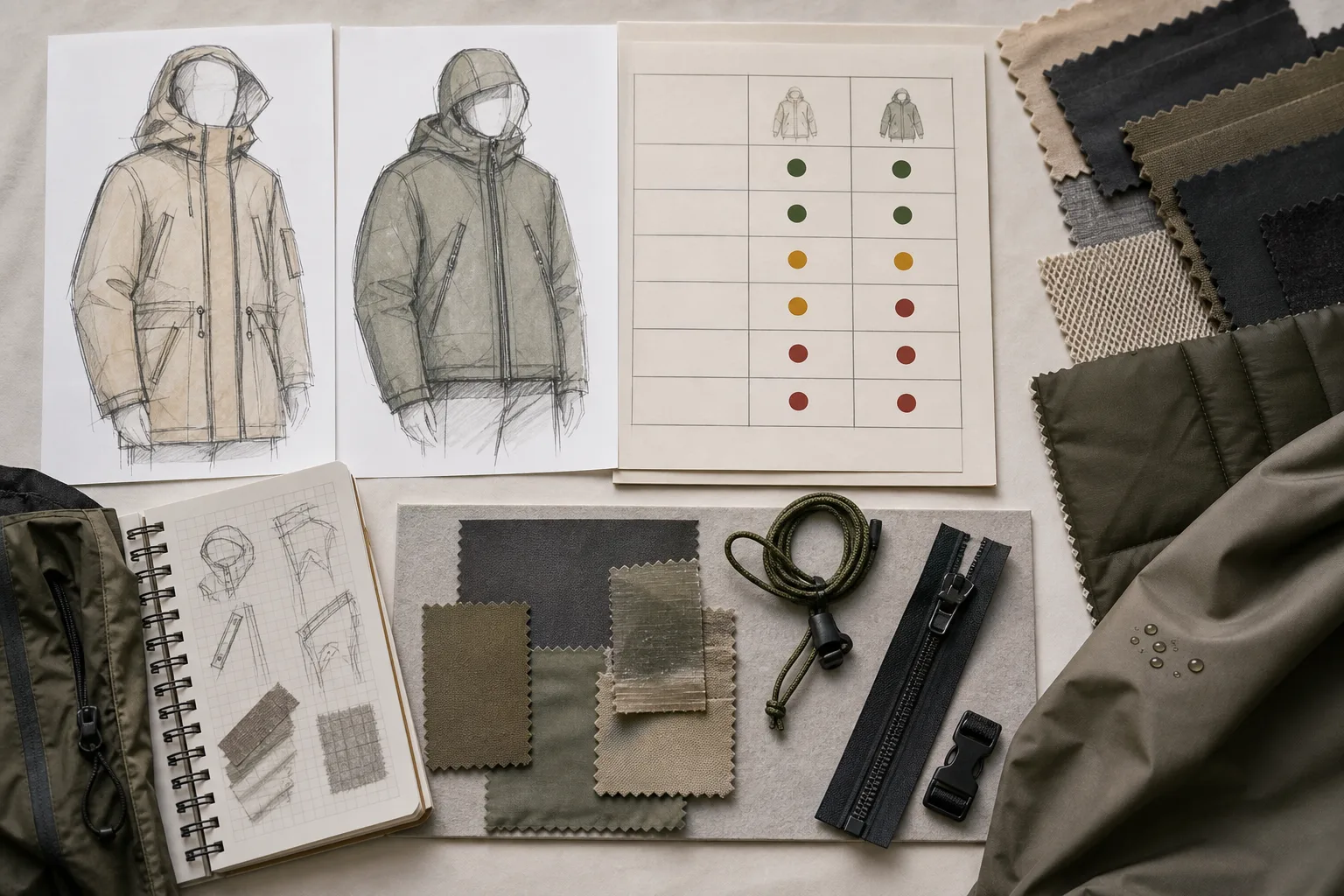
Turn the Selected Concept Into a Focused Development Brief
The selected direction should now fit into one clear statement: identify the wearer, the situation, the intended benefit, and the design direction. For instance, the statement might describe an outer layer for a commuter who needs comfortable reach and accessible storage, expressed through a clean, lightly structured silhouette. This is the handoff point from concept evaluation to a specific learning action.
Prepare an apparel development brief with annotated references; a concept sketch or flats; intended material direction; key features; fit and measurement questions; construction uncertainties; care assumptions; evidence gaps; and revision status. The purpose is to make the next review more focused, not to imply that every decision is final.
A later technical package serves a different role. It translates confirmed design intent into checkable dimensions, materials, construction details, labeling, and packaging requirements. An early concept brief does not replace that documentation, and a technical package should not conceal unresolved concept questions.
Choose the next learning action based on the uncertainty that matters most. It may be a material review, a movement-focused prototype, a construction feasibility discussion, or a first sample. Advance when the wearer task and concept boundaries are clear enough to test. Revisit the concept when its central problem, evidence, or trade-offs are still unresolved. Apparel Wiki is an independent garment-industry knowledge publication; it does not provide factory, OEM, ODM, or manufacturing services.
Next step: Before requesting a sample, review the concept brief with everyone who will interpret it. Ask what is known, what is assumed, and what one next action would create the clearest learning. That small discipline keeps an early clothing idea connected to the wearer task as development becomes more detailed.
FAQ
What is apparel concept development?
Apparel concept development is the early process of organizing a product direction around a wearer, use situation, intended outcome, visual approach, constraints, and questions to test. It happens before detailed pattern making, sampling, or production planning.
What should I decide before creating a clothing sample?
Clarify the wearer task, product promise, visual direction, required functions, material direction, care assumptions, known exclusions, and the specific uncertainty the sample should explore.
How do I turn a fashion mood board into a product concept?
Annotate each reference with the principle it contributes, such as proportion, silhouette, material behavior, or emotional tone. Then connect that principle to the wearer task and a development question rather than treating the board as a finished brief.
How can I tell whether a clothing idea addresses a real wearer need?
Use project evidence such as interviews, observations, feedback, and focused wear trials to investigate the need. Treat limited conversations as discovery input, not proof that a broad market shares the same preference.
Should a clothing concept include material, care, and manufacturing constraints?
Yes. At concept stage, record them as directions, requirements, preferences, or open questions. Confirm product-specific constraints with appropriate material information, supplier feedback, and current market requirements before finalizing them.
What is the difference between an apparel concept brief and a technical package?
A concept brief explains the intended wearer benefit, direction, boundaries, and unresolved questions. A technical package later converts confirmed intent into detailed, checkable product specifications for development and execution.