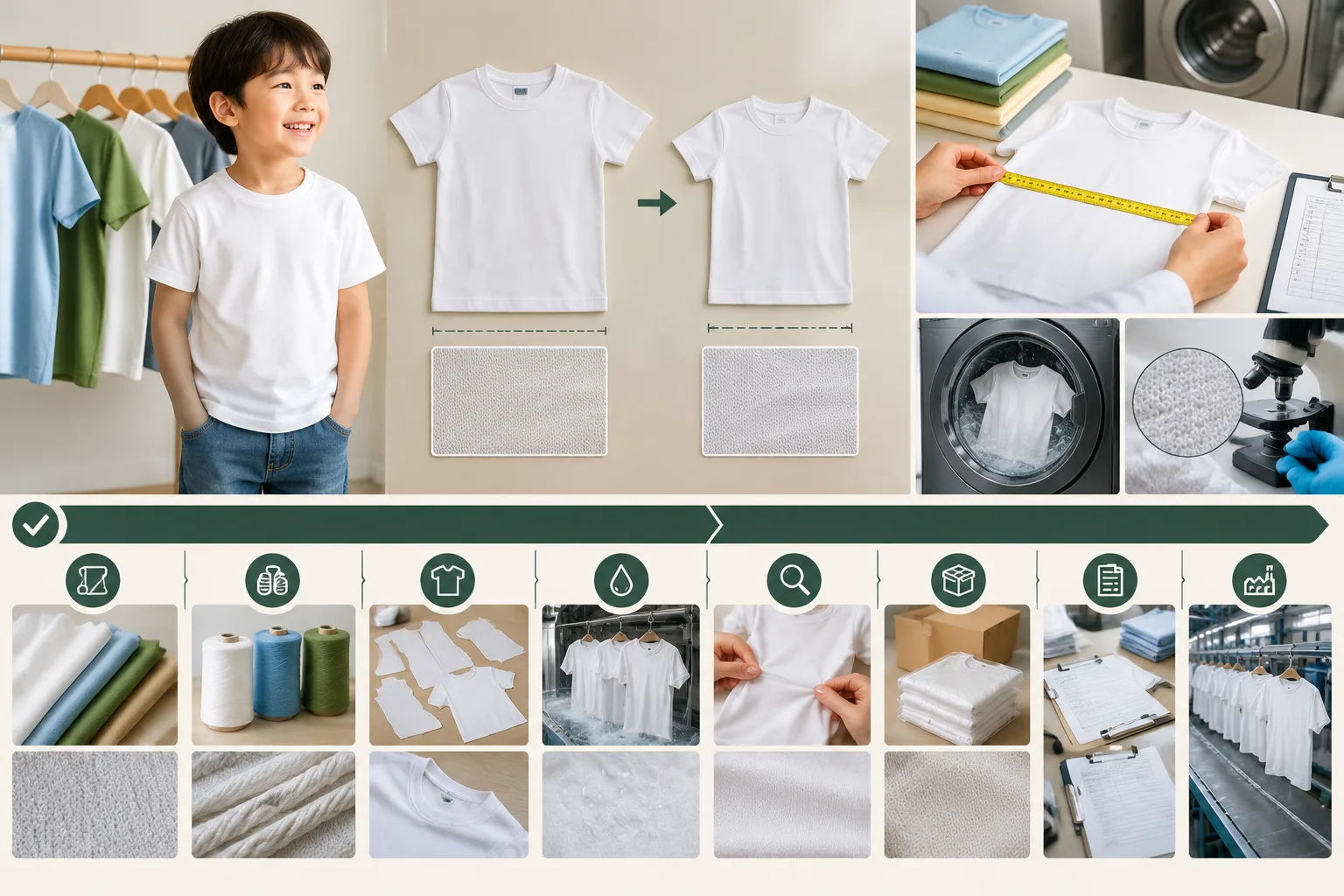
To specify kids t-shirts wash shrinkage properly, define how much each fit-critical garment dimension may change after a documented washing and drying process. Wash shrinkage is the dimensional change that occurs after care, measured separately in directions such as body length and garment width. The requirement should apply to the finished product when fit, coverage, or comfort depends on the complete T-shirt, not only on a fabric report.
This guide is an independent Apparel Wiki knowledge resource, not a factory, testing laboratory, certification body, or legal compliance service. For transparency about editorial relationships, see the Sponsor page. The practical approach below helps product teams convert a fit expectation into a project-specific specification that can be tested and traced.
What Wash Shrinkage Means for Kids’ T-Shirts
Wash shrinkage in kids’ T-shirts is not simply a property printed on a fiber label. It is the measured dimensional change of a particular material and garment after a specified care process. Lengthwise change and widthwise change should be considered separately because a T-shirt may respond differently along its body length, chest width, sleeve length, or neckline.
The result depends on the complete product: fiber content, yarn and knit structure, fabric finishing, relaxation history, cutting direction, sewing method, seam construction, rib components, labels, prints, and the intended washing and drying routine. A fabric panel and a sewn T-shirt can therefore produce different practical results. A favorable fabric result does not automatically prove that the finished garment will retain its approved fit.
For children, a small dimensional change can alter wearing ease, body coverage, sleeve proportions, arm movement, or the opening used for dressing. A shorter body may expose more of the torso during movement, while a changed neckline can affect comfort or ease of dressing. Shrinkage can also disturb size grading if one size changes differently from another. These are fit and product-development concerns, not conclusions that can be inferred from a single universal percentage.
A useful children’s t-shirt shrinkage specification identifies the care condition, garment state, measurement locations, direction of measurement, sample coverage, and acceptance criteria. The phrase “low shrinkage” is too vague for approval because it does not say what is being measured or what product risk the limit controls. Any numerical limit should come from the approved pattern, buyer or brand requirement, fit block, or validated project evidence.
How to Set a Wash-Shrinkage Requirement Before Sampling
Begin with the intended use and fit target. Record the expected wearing period, likely laundering routine, fabric composition, knit structure, silhouette, and size range. A lightweight jersey T-shirt, a heavier knit, and a garment with a close neckline may have different dimensional-change risks even when they share a similar fiber description.
Next, decide what the requirement covers. A team may need a fabric-panel requirement during material development, a finished-garment requirement before production approval, or both. Document the distinction clearly. Fabric testing can help compare materials, while finished-garment testing shows how the approved material behaves after cutting, sewing, pressing, and attachment of components.
Define measurement points that relate to actual fit decisions. Depending on the style, these may include:
- Body length from the approved reference point to the hem.
- Chest width at the specified horizontal location.
- Shoulder width and sleeve length where proportion or mobility is important.
- Neck opening, rib length, or other neckline dimensions where dressing ease and comfort are relevant.
- Additional locations identified by the pattern, fit comments, or construction risk review.
Use the same reference points before and after washing. Record whether each limit concerns lengthwise change, widthwise change, or a specific finished measurement. Direction-specific limits are usually more useful than one combined statement because length and width may behave differently and create different fit problems.
Also decide whether the brief concerns one-time change after the first care cycle or dimensional stability over repeated laundering. Those are different questions. If the product is expected to remain consistent through repeated use, the test plan and acceptance decision must say so rather than treating one post-wash measurement as proof of long-term behavior.
Finally, write down the washing and drying assumption the test represents. It should correspond as closely as practical to the care instruction and intended market. A change in washing process, drying method, fabric finish, pattern, or construction can make an earlier result no longer representative. Project choices should be labeled as project choices, not presented as industry-wide rules.
Which Materials and Construction Variables Affect Shrinkage
Several variables can influence t-shirt dimensional change, and they should be confirmed through supplier information, development records, or testing rather than assumed from fiber content alone. Relevant variables include fiber composition, yarn characteristics, knit density and structure, finishing, pre-treatment, and the time or conditions allowed for fabric relaxation before cutting.
Fabric direction matters because the knitted structure may respond differently along the length and width. Cutting orientation can transfer that behavior into the garment. Sewing tension, seam construction, thread or panel handling, pressing, and the attachment of rib neckbands may also affect the final measurements. Labels, prints, elastics, and other attached components can influence local shape or recovery after care.
These factors are risk variables, not guaranteed outcomes. A cotton label, for example, cannot by itself predict how a particular finished children’s T-shirt will change. Supplier data may explain composition and finishing history, but the final fit decision should use the material and assembly method that represents the product being approved.
Pay particular attention to locations where a small change has a visible or wearable consequence. Body length, chest width, sleeve length, shoulder alignment, and the neckline can affect coverage, proportions, movement, and appearance. A rib neckband may behave differently from the main body fabric, so checking only the body panel may miss a finished-garment issue.
The central principle is combination verification: the main material and attached components jointly determine the garment result. Independent components cannot simply be added together to predict finished fit. When the decision concerns a child’s actual T-shirt, test a representative finished garment or use a documented development method that clearly explains how component results support, but do not replace, garment evaluation.
How to Test Wash Shrinkage on a Kids’ T-Shirt
Before testing, define the sample stage, sample quantity, size coverage, garment condition, and pre-test measurement process. Identify the fabric lot, garment lot, pattern version, construction details, care instruction, and test date. This record makes an unexpected result easier to investigate and helps distinguish a material change from a pattern or production change.
Measure the approved points consistently before washing. Record the direction, location, instrument, reference edge, and rounding convention. The same person or a consistently trained team should use the same method where possible. Measurements that cannot be repeated reliably will not provide a useful basis for a release decision.
Apply the specified washing and drying process using a documented method. Record deviations rather than treating them as equivalent conditions. The test should represent the care assumption being evaluated, while formal buyer or market testing should follow the validated external method or laboratory protocol required for that project. An internal screening test can support development decisions but may not replace a required formal test.
After the defined process and any required conditioning, measure the same points again. Calculate dimensional change separately by direction when a calculation helps the team compare results. Review both the overall pattern and individual outliers when the sample set is large enough to support that comparison. Then compare the results with the approved garment measurements and project limits, keeping measured evidence separate from editorial recommendations.
If the result is unexpected, first confirm that the test conditions and measurements were valid. Then identify where the change occurred and investigate whether the likely source is material, relaxation, cutting, sewing, component attachment, or care processing. Any change to the material, pattern, construction, or process should trigger a new evaluation because the original result may no longer represent the approved product.
How to Interpret Results and Decide Whether to Adjust the Product
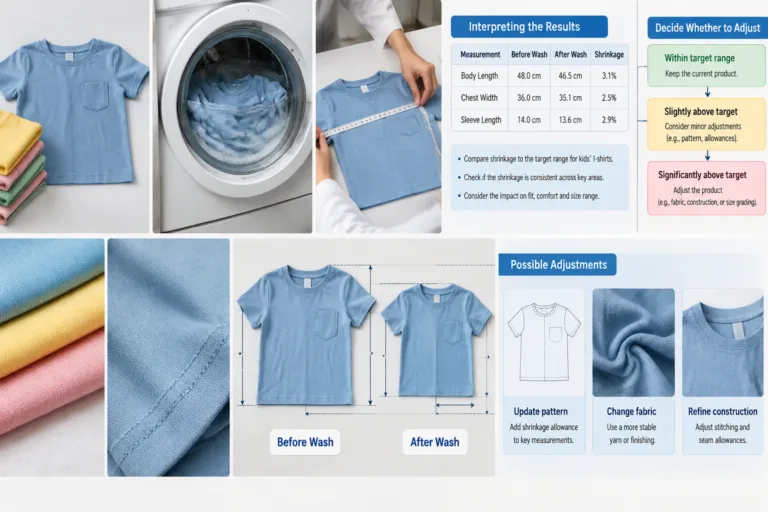
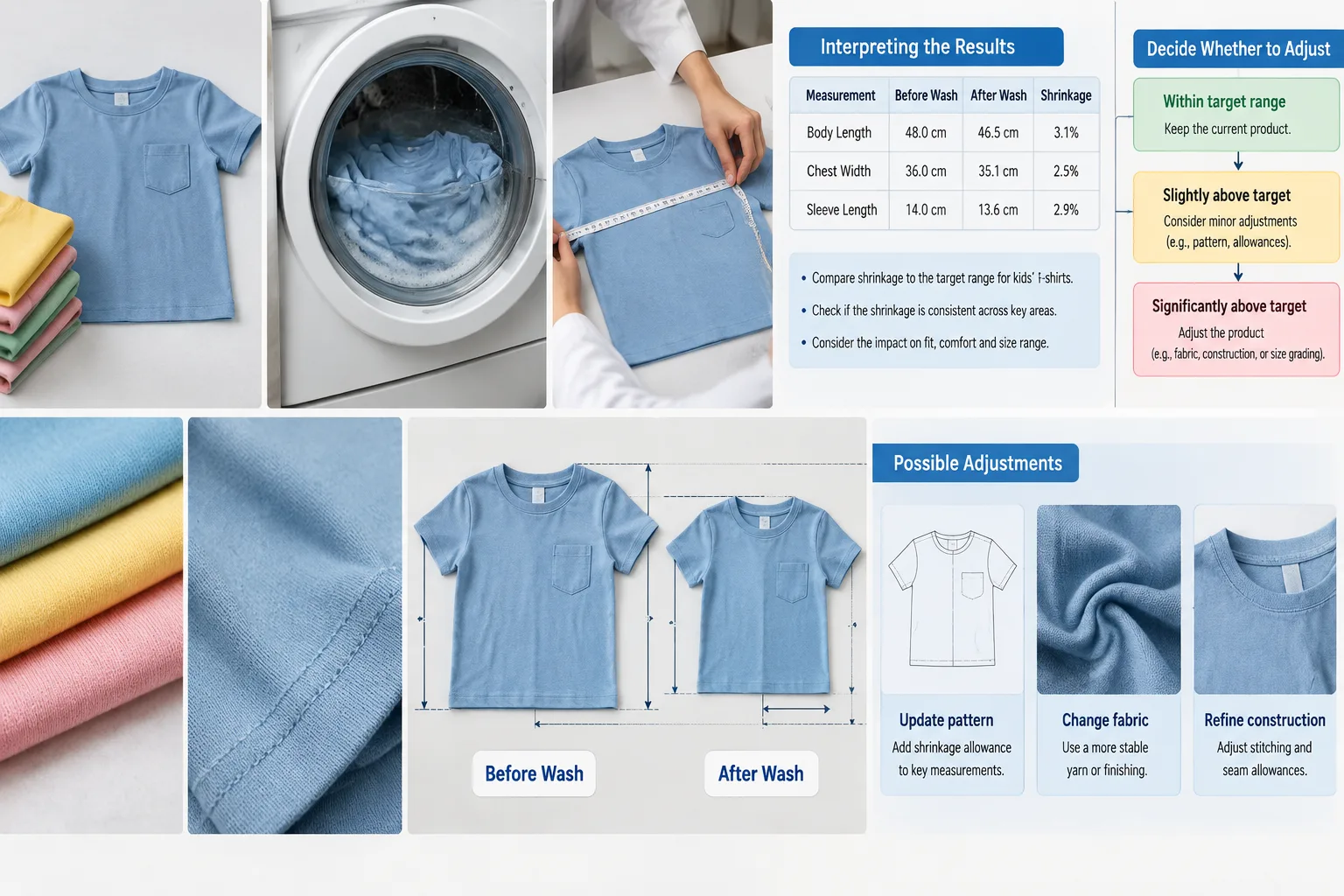
A wash-shrinkage result becomes useful only when it is compared with the approved garment measurements and the project limits. An isolated fabric report may indicate material behavior, but it does not by itself confirm that the finished T-shirt still has the intended body length, chest width, sleeve proportion, neckline, or overall fit. Keep the measured result separate from the recommendation about whether the product should proceed.
Use a simple decision sequence. First, confirm that the sample identity, washing and drying conditions, conditioning, measurement points, and records are valid. Next, identify the direction and location of change. A body-length issue may create a coverage or proportion problem, while a neckline or rib issue may affect dressing and comfort. Then investigate whether the likely source is the fabric, relaxation history, cutting, sewing, component attachment, or care process.
Classify the outcome according to the documented project limits as acceptable, requiring investigation, or requiring correction. The appropriate response may involve revising the pre-wash pattern, changing material finishing or relaxation controls, adjusting construction, or holding or rejecting the affected lot. A care-instruction change is an option only when the revised instruction is accurate, supportable, and permitted for the intended market; it should not conceal a product problem.
Any material, pattern, construction, or process change requires a new evaluation because the original result may no longer represent the approved product. Review appearance, comfort, coverage, and size-to-size consistency alongside the measurements. When enough samples are available, examine both the overall pattern and individual outliers before deciding whether the result reflects a repeatable product risk.
Fit, Safety, and Production Limits to Check Before Approval
For children’s garments, dimensional change should be reviewed as a wearing and movement issue as well as a measurement issue. Check whether the washed T-shirt still provides the intended body coverage and whether the neck opening, sleeve length, arm mobility, and relationship between garment size and child sizing remain appropriate. A small change at a critical location can matter more than a larger change in a less important area.
Do not assume that one tested size represents the complete size range. Review key sizes and the grading logic, or document why the selected size coverage is representative. Where appropriate, fit feedback or user-informed review can help identify problems involving dressing sequence, reach, movement, posture, and comfort. Such feedback supports product understanding; it does not replace the agreed measurement or compliance process.
Evaluate the complete garment, including the main knit, rib neckband, labels, elastics, prints, and other attached components. These elements can respond differently during care and may alter the finished shape or feel. A favorable result from one fabric panel or component cannot be combined with other favorable results to claim that the finished children’s T-shirt is approved.
Wash-shrinkage approval is also separate from broader children’s apparel reviews. Depending on the product and sales market, the team may need to check requirements concerning safety, flammability, chemicals, small parts, labeling, and other product characteristics. Those obligations are market- and product-dependent. Passing dimensional measurements is not proof of legal compliance, certification, or suitability for every market.
A Practical Release Checklist for Kids’ T-Shirt Wash Shrinkage
Before releasing a style or production lot, confirm that the evidence represents the intended product. The following checklist helps development, sourcing, and quality teams keep the decision traceable:
- Confirm the approved fabric lot, fiber composition, knit construction, finishing status, pattern version, sewing method, components, and care instruction.
- Record the test method, sample identification, garment condition, washing and drying assumptions, measurement points, and any deviations.
- Review lengthwise and widthwise change at every fit-critical location against the approved project limits.
- Check more than one relevant size, or document the rationale for the selected size coverage.
- Compare post-wash measurements with the approved garment specification and fit comments, not only with a fabric report.
- Record the disposition as approve, hold for investigation, revise, or reject, including the responsible owner and any re-test requirement.
- Retain the test record, lot information, pattern details, corrective actions, and approved reference for later production comparison.
This checklist is an editorial quality tool, not a substitute for a buyer specification, validated laboratory protocol, or legal review. For related development and quality workflows, consult the Apparel Manufacturing Tools guide and verify any market-specific requirements with current authoritative sources.
What is wash shrinkage in a kids’ T-shirt?
Wash shrinkage is the dimensional change that occurs after a defined washing and drying process. Lengthwise and widthwise change should be considered separately because a T-shirt may respond differently in each direction.
Should wash shrinkage be specified for the fabric or the finished T-shirt?
Specify the subject clearly. A fabric requirement can help control incoming material, while a finished-garment requirement checks the actual pattern, sewing, trims, and care process. When fit is the decision, finished-garment evidence is important.
Which measurements should be checked after washing a children’s T-shirt?
Check the locations identified in the project specification, commonly including body length, chest width, shoulder width, sleeve length, and neck opening. Add other dimensions when they affect coverage, movement, appearance, or dressing.
Can a care label solve a kids’ T-shirt shrinkage problem?
Not automatically. A care instruction may be revised only when it truthfully describes a supportable care process and meets applicable requirements. It should not be used to disguise an unresolved material, construction, or fit problem.
How do you decide whether a shrinkage result is acceptable?
Verify the test first, compare the measurements with the approved project limits, and assess fit-critical locations, appearance, comfort, coverage, and size consistency. If the result exceeds a documented limit or creates a fit risk, investigate before release.
Does a fabric shrinkage result guarantee that the finished T-shirt will fit correctly?
No. The finished result also depends on fabric direction, relaxation, cutting, sewing, seam construction, rib, labels, prints, and other attachments. Test the final material and assembly when the approval decision concerns the complete garment.