Technical fashion sketching design evaluation is a structured comparison between the garment a sketch intends to communicate and the garment or prototype produced from that intent. It asks whether the silhouette, proportions, construction details, material behavior, fit, movement, and practical decisions remain coherent in three dimensions. The sketch is the reference for design intent; the physical garment is evidence of how that intent behaves in use. Apparel Wiki is an independent educational publication, and its editorial work is separate from sponsorship; see the Sponsor page for that distinction.
Evaluating a technical fashion sketch does not mean deciding whether an illustration looks attractive. It means identifying what the drawing shows, what the sample demonstrates, and what still requires development evidence. A sketch can communicate a neckline, seam direction, pocket position, or intended volume, but it cannot by itself prove dynamic fit, durability, regulatory compliance, or production feasibility. Those conclusions depend on the garment, the test context, the target market, and the relevant validation.
What Does Technical Fashion Sketching Design Evaluation Mean?
A technical fashion sketch garment evaluation examines the relationship between visual intent and physical interpretation. The reviewer first reads the sketch for its visible design information, then studies the garment for proportion, balance, component relationships, and behavior during handling or wear. This connects visual design assessment with apparel technical design, where fit and construction are considered alongside design communication. Background on that broader technical-design relationship is available from Arizona State University’s apparel technical design overview.
The review should keep four kinds of information distinct. The sketch supplies observations about intended silhouette, lines, openings, closures, and visible details. The physical garment supplies evidence about three-dimensional shape, seam relationships, material response, and movement in the particular sample. Project decisions determine what counts as an intentional reinterpretation, while editorial recommendations suggest what to clarify, test, or revise. These categories should not be treated as interchangeable.
There is no single universal visual standard that determines whether every technical sketch is successful. A drawing may be appropriate for an early design discussion but too limited for pattern development or production communication. Conversely, a detailed technical drawing may still leave questions about fabric, wear, grading, or assembly. The useful question is whether the sketch communicates enough for its development stage and whether the physical result supports the intended design decisions.
Compare the Sketch With the Garment in a Fixed Review Sequence
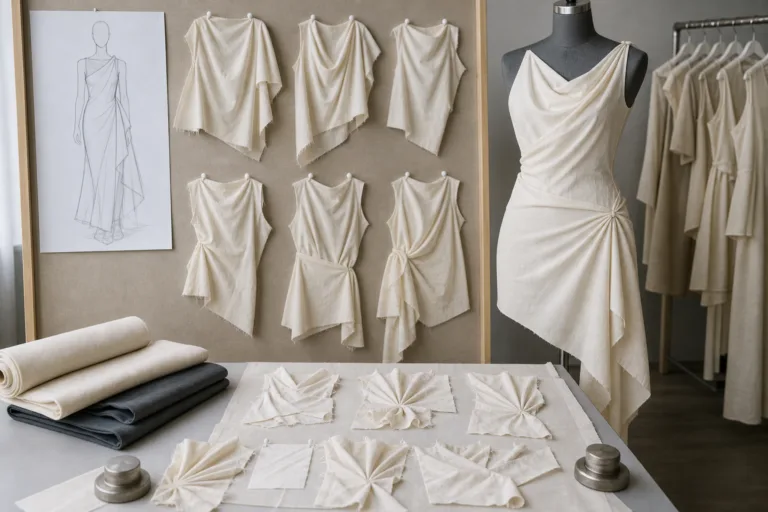
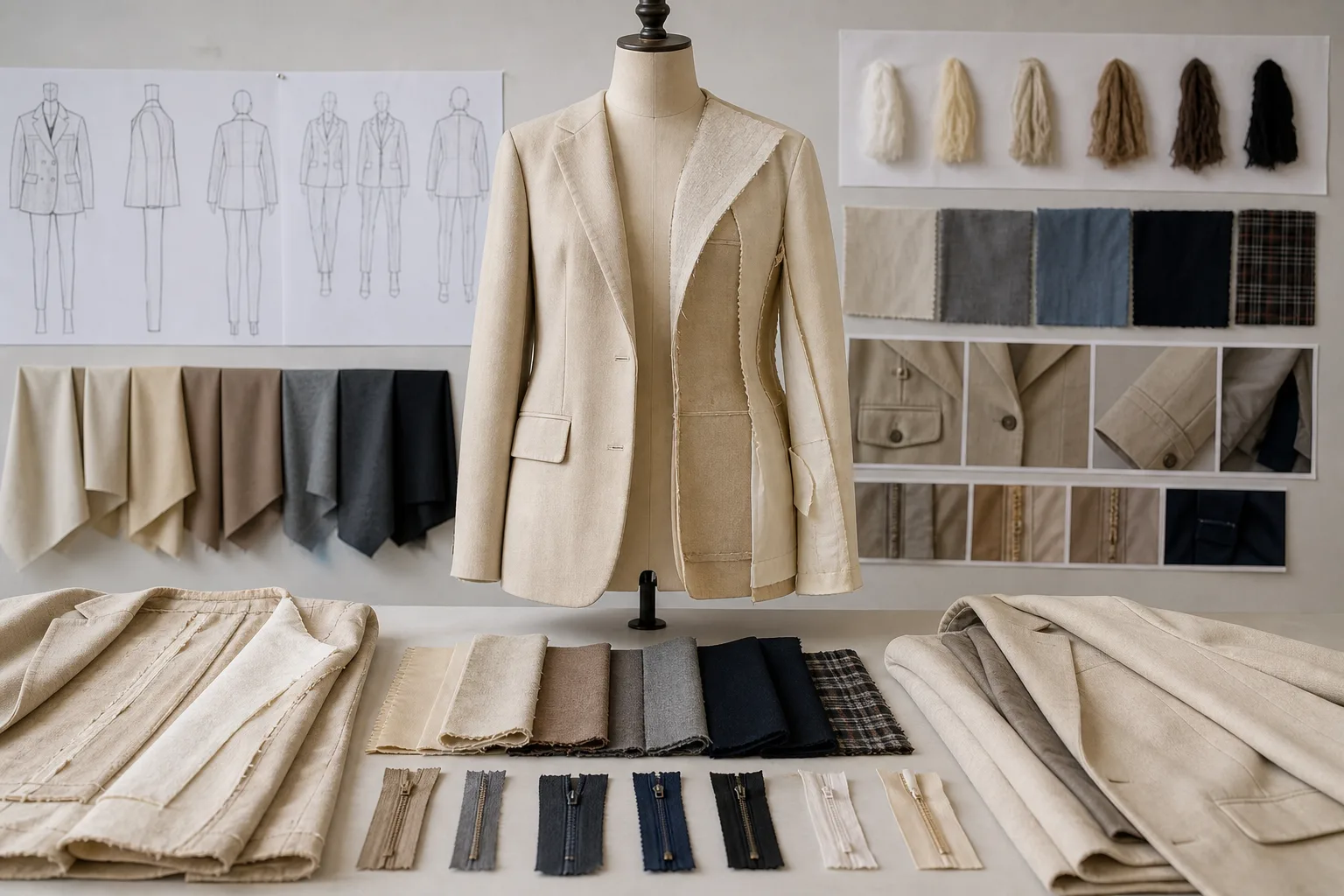
A documented sequence produces more useful findings than an overall first impression. Begin with the sketch and garment in matching views whenever possible: front, back, side, and relevant detail views. Before judging execution, record the intended silhouette, balance, major seam lines, openings, closures, and prominent design features. This preserves the design reference before styling, posing, or construction differences influence the review.
Next, compare landmarks in a consistent order. Examine shoulder position, neckline shape, waist placement, hem outline, sleeve volume, pocket location, panel divisions, and closure direction. Note whether a difference appears to come from pattern interpretation, material behavior, sample construction, styling, or a deliberate design change. A visual mismatch is not automatically a defect; it may reflect an approved revision or an unresolved decision that needs confirmation.
Use consistent photographs, annotations, or review notes so the design and production teams can discuss the same observation. The following compact worksheet can keep the review focused:
- Visual intent: Does the silhouette, proportion, balance, and main feature placement correspond?
- Construction: Do seams, panels, openings, closures, and finishing details appear as intended?
- Fit and movement: What changes when the garment is worn, handled, or viewed in relevant positions?
- Material: Does the actual fabric and component combination create the expected volume, drape, and surface effect?
- Production communication: Which decisions are clear, and which require a supporting view, note, sample, or specialist review?
This is an editorial workflow, not an industry-mandated pass-or-fail certification. Its purpose is to make evidence traceable and decisions discussable before the team moves to a more detailed technical review.
Check Whether Design Lines and Construction Details Survive in Three Dimensions
Technical fashion sketch construction details should be assessed as relationships, not isolated decorations. Check whether panel divisions, darts, pleats, gathers, collars, cuffs, pockets, and closures occupy the intended locations and maintain the intended relationship to the body and surrounding components. A line that appears precise in a drawing may shift, shorten, spread, or distort when it is translated into pattern pieces and sewn sections.
For each prominent detail, ask what it needs to do as well as what it needs to look like. A pocket may need usable access and reinforcement. A closure may affect handling and opening direction. A collar or cuff may require a particular level of structure. A pleat or gather may change movement space and assembly order. These questions connect visual details with function and manufacturability without reducing design evaluation to factory instructions.
Inspect possible changes associated with seam placement, turning, pressing, interfacing, lining, and neighboring components. The physical garment can show whether design lines remain stable during handling and wear, but the cause of a mismatch may still be uncertain. Distinguish a deliberate reinterpretation from unclear sketch communication, an unresolved pattern decision, or a sample-construction problem.
An attractive illustration can omit information needed by a pattern maker or manufacturer, while a technical drawing may require additional views or notes for a complex feature. That does not mean every sketch must contain every production detail. The appropriate level depends on the development stage, audience, and decisions the drawing is expected to support.
Evaluate Fit, Movement, and Ease on the Intended Body
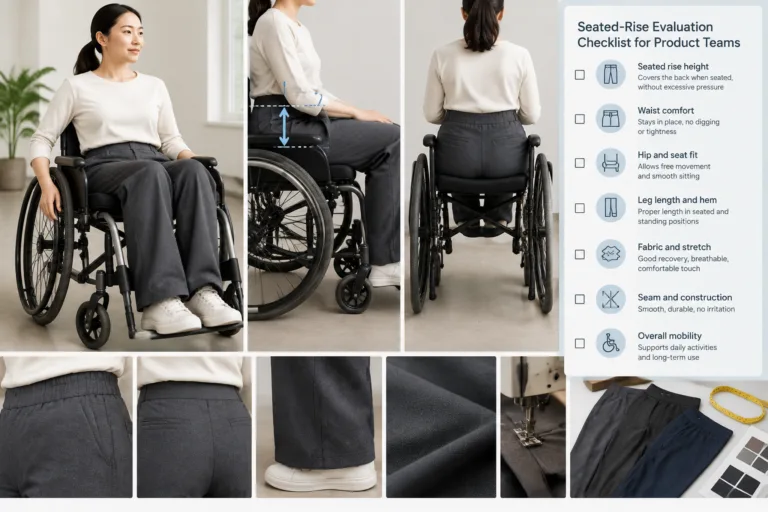
A static sketch cannot demonstrate dynamic fit. Physical wear review adds evidence about balance, restriction, gaping, drag lines, recovery, and comfort during movements relevant to the garment category. Compare the intended silhouette at rest with the worn garment during ordinary movement, seated use, reaching, walking, or another action that reflects its purpose. The relevant actions should come from the product context rather than from one universal procedure.
Separate design ease, movement needs, layering allowance, and fabric stretch. They can all affect the space between a garment and the body, but they represent different design or material decisions. Applying one ease value to every garment category or body context can conceal the actual cause of a fit issue. A loose silhouette, a stretch garment, and a structured jacket should not be interpreted through the same assumption.
Record the context behind each observation: wearer, sample size, available body measurements, posture, styling layers, and sample condition. A single wearer and one sample can show how that particular garment behaves in that particular situation; they cannot establish universal fit across sizes, bodies, or use conditions. Connect each issue to a likely design, pattern, material, or construction cause before recommending a change. Numerical ease guidance should remain project-specific unless the brief or a validated source supplies the necessary assumptions.
Test Whether the Material Supports the Sketched Shape
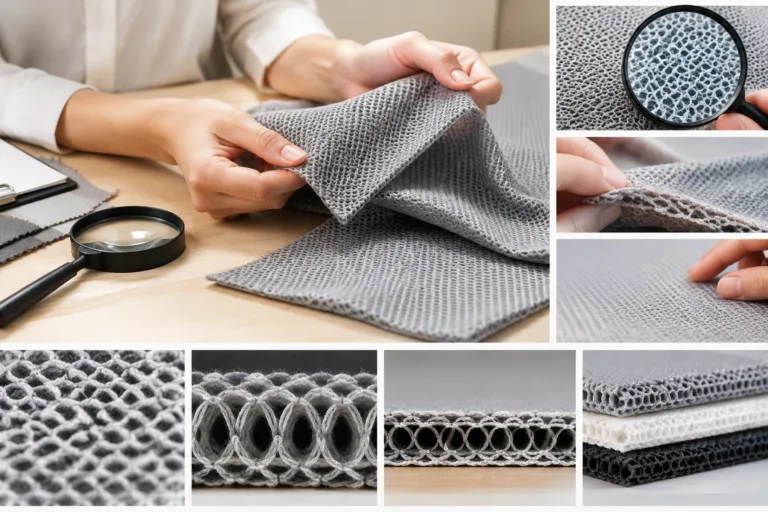
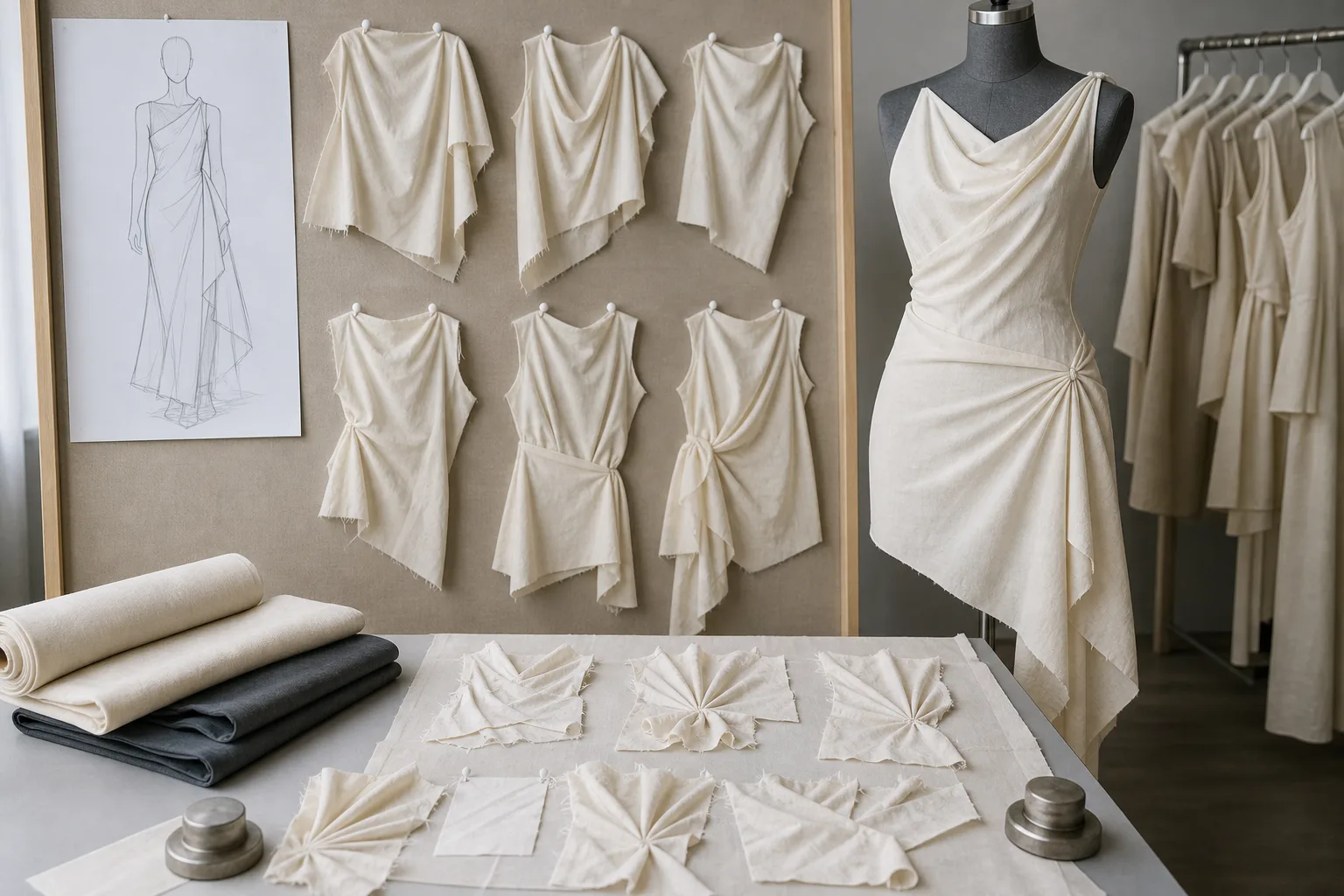
Material behavior is the bridge between a two-dimensional intention and the physical result. Review the candidate fabric and components for weight, thickness, bending, stretch, recovery, drape, surface friction, and structure. These properties affect whether a silhouette holds its volume, whether a sleeve collapses, and whether a collar, cuff, hem, or opening keeps the relationship shown in the sketch.
Compare the sketch’s implied folds, pleats, gathers, fullness, and controlled drape with the actual material. A design that appears crisp in a drawing may become soft or unstable in a flexible fabric, while a structured material may make the same design look sharper or restrict movement. The important evidence is the behavior of the selected material in the relevant construction, not an assumption based only on its fiber name or a single specification.
For high-risk details, use targeted swatches or component samples before relying on the full garment. A collar, pocket opening, cuff, hem, seam junction, or closure can reveal how the fabric interacts with interfacing, lining, trims, fasteners, pressing, and handling. Inspect the finished surface and shape after the relevant construction steps, because the main fabric alone does not represent the complete garment combination.
Record observed behavior separately from general material claims or supplier information. Matching fiber composition, weight, or a basic fabric description does not guarantee the same hand, bending response, drape, or finished appearance. This material evaluation helps determine whether to validate the combination further, adjust the pattern, change the construction, or revise the sketch’s intended shape.
Judge Practical Readiness: Construction, Maintenance, and Communication
Practical readiness asks whether the sketch and its physical interpretation provide enough clarity for the next development decision. Review whether the indicated components, seam relationships, closures, and finishing details can be assembled consistently in the sample being examined. This is not a factory-capability judgment or a production approval; it is an assessment of whether important design decisions are understood and documented.
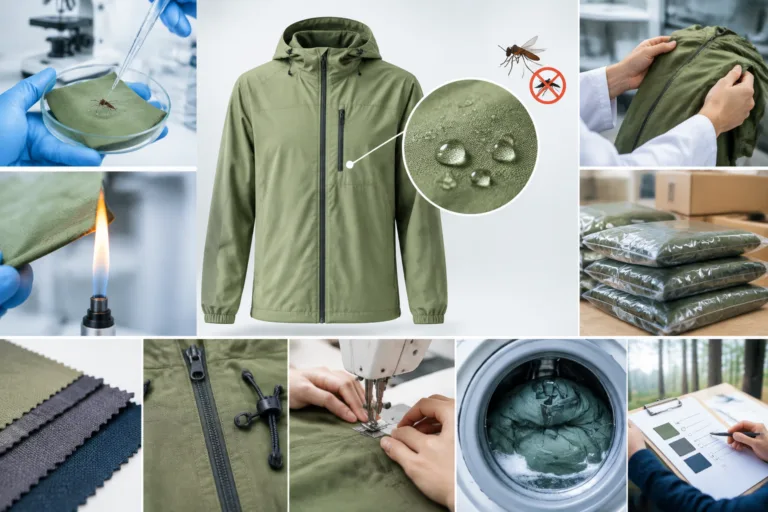
Check the complete garment combination rather than judging the main fabric in isolation. Decorative elements, lining, interfacing, trims, and fasteners should remain compatible with the intended care process for the target product. Washing, durability, color change, shape retention, and accessory behavior are product questions that require suitable evidence. A fabric that appears stable on its own does not automatically establish how the finished garment will respond.
Communication is ready when unresolved details are visible and traceable. Note which observations come from the sketch, which come from the physical sample, which changes were deliberate, and which decisions remain open. This record can support discussions among design, pattern, sampling, sourcing, quality, and production teams without turning a visual review into a vague pass-or-fail label.
A useful outcome may be to revise the sketch, revise the pattern or sample, validate the material combination, clarify a construction detail, or proceed to the next review stage. The correct choice depends on the cause of the mismatch and the evidence available. Care and performance conclusions should remain conditional on the target market, complete garment, and relevant validation rather than assumptions from the drawing.
Common Evaluation Errors and the Right Next Step
One frequent error is judging only the front view, a styled photograph, or a static mannequin presentation. These views can hide balance problems, restriction, collapse, or distortion that appears during wear. Review the garment from relevant angles and actions, then connect each observation to the design, pattern, material, construction, or styling context before recommending a change.
Another error is treating an accurate-looking technical fashion sketch as proof that the pattern, grading, fabric, or construction is resolved. A sketch communicates intent, but it cannot establish dynamic fit, durability, maintenance behavior, regulatory suitability, or production feasibility by itself. Likewise, a visual mismatch is not automatically a defect. It may reflect an approved design change, a development-stage choice, or an unresolved interpretation.
Avoid applying one ease assumption, fabric expectation, or fit conclusion to every garment category and body context. A structured jacket, a loose silhouette, and a stretch garment create different relationships between the body and the garment. Do not label the difference as a construction problem until the wearer, sample condition, material combination, intended use, and change history have been considered.
Prioritize the next action according to the risk. Clarify the drawing when the intent is ambiguous; test a material or component when behavior is uncertain; adjust the pattern when shape or balance is the likely cause; revise construction when a detail cannot retain its intended relationship; or repeat the wear review when movement evidence is incomplete. For consequential regulated or rights-related questions, seek appropriate specialist review rather than inferring an answer from the sketch.
Next step: Turn the review into a short evidence log with the intended feature, observed result, likely cause, open question, and proposed action. That format keeps technical fashion sketching design evaluation focused on decisions that can be checked in the next sample or review.
Can a technical fashion sketch prove that a garment will fit correctly?
No. A sketch communicates design intent and proportions, but physical wear review is needed to examine fit, movement, comfort, and balance for a specific sample, wearer, size, and use context.
What should be compared first when evaluating a fashion sketch against a physical garment?
Begin with the same available views and compare the overall silhouette, balance, major seam lines, openings, closures, and visible landmarks. Then investigate fit, material behavior, and construction causes.
How do fabric properties change the result shown in a technical fashion sketch?
Weight, thickness, bending, stretch, recovery, drape, and structure can change volume, folds, surface appearance, and movement. The selected fabric combination should be observed through relevant swatches, components, or samples.
What is the difference between a visual mismatch and a construction problem?
A visual mismatch describes a difference between the intended sketch and the garment. A construction problem is one possible cause. The difference may instead come from material behavior, pattern interpretation, styling, or a deliberate design change.
Should movement testing be included when evaluating a technical garment sketch?
It should be considered when movement affects the garment’s purpose. Review relevant actions for the product and record the wearer, size, posture, layers, and sample condition so the observation is not treated as universal.
When should a designer revise the sketch instead of revising the pattern or sample?
Revise the sketch when the intended shape or detail is unclear, unrealistic for the selected direction, or changed by an approved decision. Revise the pattern, material, or construction when the intent is clear but the physical result does not support it.