Textile interconnects are conductive pathways or electrical connections integrated into textile structures. In a smart garment, they carry power or signals between components such as sensors, controls, and a removable electronic module. Apparel Wiki’s Sponsor page is separate from this editorial guidance: Apparel Wiki is an independent educational publication, not a manufacturer, testing laboratory, certification body, or service provider.
Textile interconnects durability testing evaluates whether a defined pathway and its connections continue to perform under specified mechanical, environmental, care, and electrical conditions. The result applies to the tested specimen, method, sequence, and limits. It does not automatically establish a garment’s lifetime or prove that every design using the same material will perform similarly.
What Is a Textile Interconnect, and What Does Durability Testing Measure?
An interconnect provides a route between points in an electrical system. In clothing, that route may be formed by a conductive yarn, printed or coated textile feature, flexible conductive strip, stitched pathway, or another textile-integrated construction. The pathway may connect a sensor to a control unit, join a power source to an electronic component, or carry a signal toward an endpoint.
The interconnect is only one layer of a smart garment. It should be distinguished from the sensor that collects information, the control or processing unit that interprets it, the battery or other power source, and the software or data service that may receive an output. It is also different from the garment as a complete system, which includes fabric construction, seams, closures, removable modules, user handling, and care instructions.
That boundary matters when interpreting a textile interconnect durability result. A pathway can remain electrically continuous while a sensor, battery connection, control module, or data function fails. Conversely, a garment may look intact while a connection develops intermittent resistance or loses reliable contact during movement. Durability therefore needs to be defined against the intended electrical function and mechanical role, rather than treated as an absolute property.
Useful observations can include continuity or resistance at defined measurement points, visible pathway damage, movement of a contact, and changes after a planned stress. Research on serpentine e-textile interconnects, for example, examines electrical behavior and failure lifetime under cyclic deformation in a particular construction; it does not create a universal test or acceptance limit for all smart garments. The study on cyclic deformation and e-textile interconnect lifetime illustrates why the specimen and method must be reported with the result.
Why Can Textile Interconnects Fail During Wear and Care?
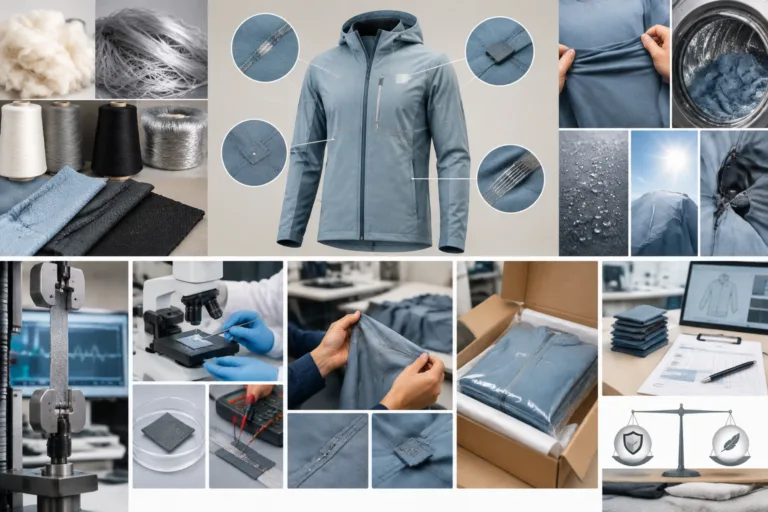
Garments move repeatedly as the wearer bends, reaches, sits, walks, and changes posture. Stretching and repeated bending can load both the conductive route and the points where it transitions to another material or component. Abrasion from use, seams, closures, or adjacent layers may also affect a surface pathway. These are risks to investigate, not inevitable outcomes: the effect depends on the construction, placement, joining method, and expected movement.
Moisture introduces another set of conditions. Sweat, rain, humidity, and laundering can expose the interconnect to water, dissolved substances, detergents, heat, agitation, or drying. The relevant response depends on the materials, encapsulation or protective treatment, textile structure, and care route. A washing study on a particular e-textile device links interconnect lifetime measurements with device-level washing durability, but its procedure and construction should not be presented as a universal garment requirement. This research on washing durability in an e-textile device is best used as a specific example of why care testing should match the intended design.
Connections can be more vulnerable than the visible length of the pathway. A stitched or bonded route may remain present while a contact loosens, a transition develops a crack, or a removable module is reassembled incorrectly. Fit and placement also matter: an interconnect crossing a high-motion area may experience a different strain pattern from one positioned in a relatively stable panel.
Physical appearance and electrical behavior should be recorded separately. Fraying, discoloration, delamination, broken stitching, or a displaced contact may be visible, but an intermittent electrical fault may appear only during movement or after moisture exposure. A brief signal check performed on a stationary sample can confirm an initial function without demonstrating reliable long-term wear, repeated care, or correct user handling.
How Should a Durability Test Reflect the Intended Garment?
Start with the use case before selecting a procedure. Define the garment type, wearer activity, expected fit and movement, care route, removable components, and the electrical function that must be maintained. The purpose is to test a real design question: whether this interconnect, in this location and construction, can support its intended role under documented conditions.
Next, map the complete route from the power or signal source to the endpoint. Mark every conductive segment, contact, connector, transition, attachment, and detachable module. This map helps separate a pathway problem from a contact problem and identifies where measurements should be taken before, during, and after stress. It also exposes dependencies outside the textile layer, such as a battery connection or control component.
Define the observations before testing begins. A project record should state the initial functional check, measurement points, equipment or measurement approach, planned stress stages, post-stress checks, and the criteria used to record a fault. Those criteria should come from the intended function and project requirements, not from an invented universal pass/fail value.
- Specimen: Record the garment construction, textile pathway, joining method, contact design, module configuration, and relevant conditioning.
- Use conditions: Describe the movement, handling, moisture, care, and reassembly conditions the test is intended to represent.
- Sequence: Document the order, duration or extent, equipment, environmental conditions, and any deviations for each stress stage.
- Checks: Compare the same defined electrical and physical observations at the beginning and after each planned stage.
- Records: Keep separate notes for textile damage, connection faults, component behavior, and complete system behavior.
This is a planning framework, not a universal standardized sequence. A test designed to compare two constructions under controlled conditions may not simulate ordinary service, while a realistic wear scenario may be harder to reproduce consistently. The value of the result depends on stating what was tested, why those conditions were selected, and which intended functions the observations address.
Which Variables and Trade-Offs Affect Test Results?
Test results are shaped by more than the conductive material itself. Pathway geometry, textile construction, garment placement, joining method, contact design, and strain relief can all influence how an interconnect responds to movement and handling. A route placed across a high-movement area may experience a different stress pattern from one positioned in a relatively stable panel, even when the same conductive material is used.
Construction details also affect comparability. A stitched, bonded, woven, printed, or mechanically attached pathway may transfer stress differently at its transitions and contact points. The surrounding fabric can support, restrain, or distort the route during wear. These observations do not establish that one construction is universally more durable. They show why a comparison should describe the full specimen rather than identify only a material category.
Fit and movement belong in the test description as well. A close-fitting garment, a loose layer, and a compression area may expose the same interconnect to different combinations of extension, bending, rubbing, and recovery. Care instructions, removable power supplies, detachable electronics, and user reassembly introduce additional variables. A test that leaves out a normal removal or reconnection step may not represent the way the garment is actually handled.
There is a practical trade-off between severity and realism. A severe laboratory condition can reveal a weakness efficiently, but it may not represent ordinary use. A mild or highly controlled condition may be repeatable while missing a failure mode that occurs during movement, laundering, or reassembly. For controlled comparison, keep the specimen description, conditioning, stress sequence, measurement points, and deviations consistent. For use simulation, explain why each condition represents the intended garment.
Record enough detail for another team to understand what the result means: pathway and garment construction, contact and joining design, module configuration, environmental or conditioning conditions, stress applied, observation points, and any changes made during testing. This supports textile interconnect test variables without turning a project-specific evaluation into a universal specification.
How Can Teams Evaluate Results and Diagnose Failure?
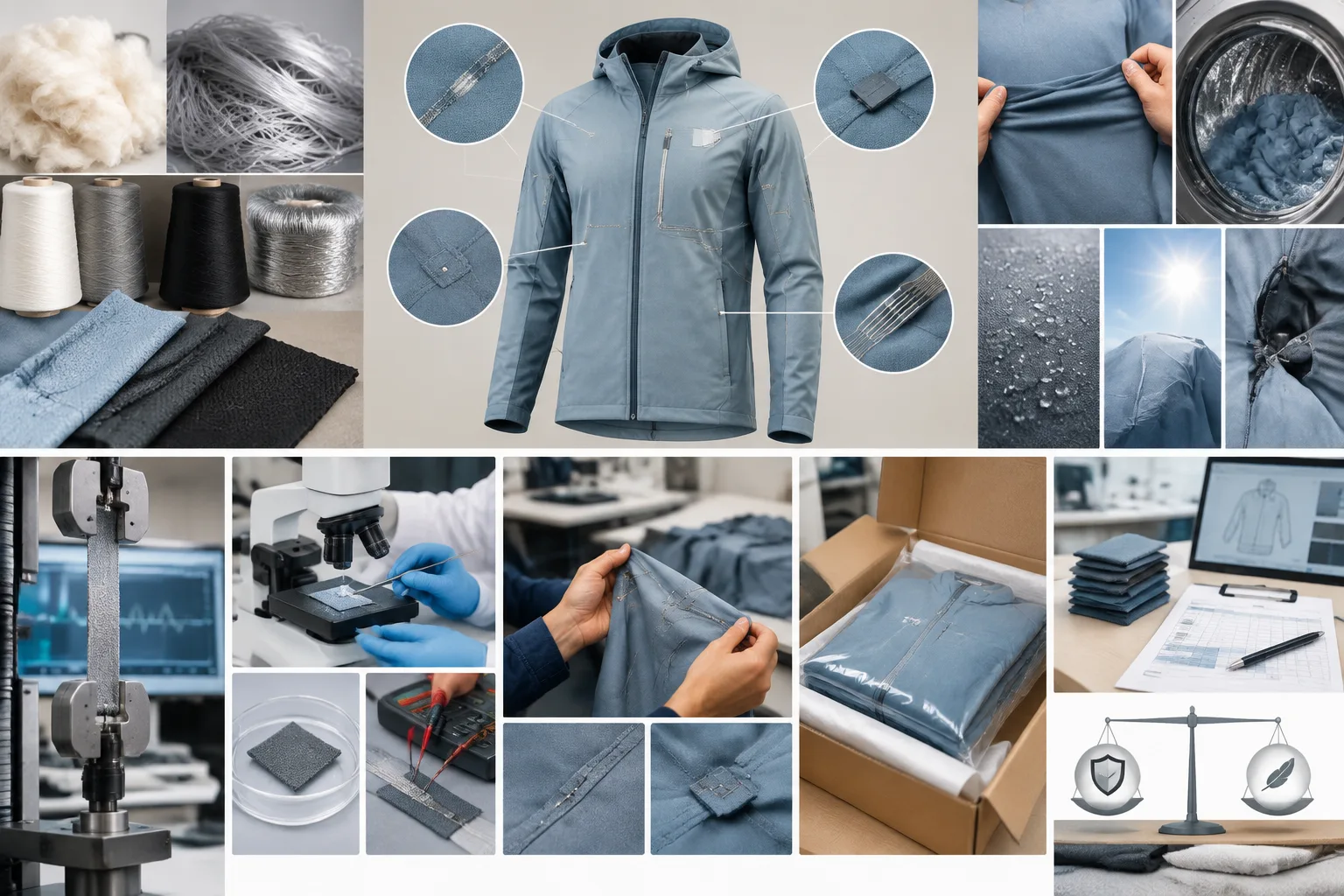
Begin with a functional check before the first stress stage and repeat it at the same defined measurement points after each planned stage. Use a consistent measurement approach and document the equipment or setup used. The objective is to compare like with like, not simply to record whether the garment appeared to work at the beginning and end.
Record intermittent behavior as carefully as complete loss of function. A signal that drops during movement, a connection that works only after repositioning, or a pathway whose electrical behavior changes after care may be important evidence even when a later static check appears normal. Note the conditions under which the fault appeared, including movement, moisture, module attachment, and user handling where relevant.
Physical inspection should accompany functional checks, but appearance alone is not a diagnosis. Look for pathway damage, fraying, separation, deformation, displaced contacts, loosened joins, and changes around strain-relief areas. Then compare those observations with the electrical and system records. A visible mark may be incidental, while an intermittent fault may identify a connection problem that is difficult to see.
Fault records should help separate several possibilities: damage to the textile pathway, failure at a contact or joining point, a component problem, a power or reassembly issue, or a system-level fault elsewhere in the signal path. Checking the interconnect in isolation may help localize the issue, but the complete garment can behave differently when sensors, controls, power, and software-dependent functions are included.
When a design changes, retest it under the same defined conditions where practical, then record what changed and which failure observation improved or remained. One successful specimen does not establish production consistency. Broader release decisions require evidence appropriate to the product, its manufacturing variation, and its intended use; this article does not assign a universal sampling plan or pass/fail limit.

What Do Durability Tests Not Prove, and What Should Happen Next?
A durability test applies to the specimen, method, sequence, and conditions stated in its record. It does not automatically predict every wear pattern, care practice, user behavior, or product lifetime. Even a useful result should therefore be read as evidence about a defined evaluation, not as a blanket guarantee for every garment made from a similar material or design.
Textile-level durability is also different from complete electronic-garment performance. An intact conductive pathway does not by itself establish that a sensor, controller, power source, data service, or user interface will operate correctly. Conversely, a system fault does not automatically mean that the textile interconnect failed. Teams should keep pathway, contact, component, and whole-system findings distinct.
Maintenance and reassembly deserve specific attention. If a power source or electronic module is removable, evaluate whether users can disconnect and reconnect it as intended and whether an incorrect connection can be recognized. Care instructions should match the tested configuration. If the garment cannot be washed with a module attached, that limitation needs to be clear in the product information rather than inferred from a textile test.
Health-related applications require an additional boundary. A measured electrical or sensor output is not automatically a diagnosis, treatment result, or clinical claim. The evidence needed depends on the intended use and market. Safety, regulatory, privacy, and performance obligations should be checked against authoritative requirements for the complete product and each intended market.
Use the findings to decide what should change next: pathway geometry, placement, joining, strain relief, module attachment, care instructions, maintenance procedures, or the test scope itself. Apparel Wiki is an independent apparel knowledge blog, not a manufacturer, testing laboratory, certification provider, or regulatory adviser. Project teams should obtain product-specific technical and compliance evidence before making release or safety decisions.
The most useful next step is to turn the test record into a decision document: state the intended function, list the observed failure modes, connect each observation to a likely location in the signal path, and identify the additional evidence needed before redesign or release. That keeps textile interconnects durability testing connected to practical garment development without overstating its conclusions.
What is a textile interconnect in a smart garment?
It is a textile-integrated conductive pathway or connection that carries electrical power or signals between parts of a smart garment. It is distinct from the sensor, control unit, power source, data service, and garment as a complete system.
Which stresses should a textile interconnect durability test consider?
Consider stresses relevant to the intended garment, such as stretching, repeated bending, abrasion, moisture or sweat exposure, laundering, connection movement, module removal, and user reassembly. The appropriate combination depends on construction, placement, fit, care route, and intended use.
Does passing a short test prove that a smart garment will last through long-term wear and washing?
No. It shows how the tested specimen behaved under the stated conditions and sequence. It does not automatically predict every wear pattern, washing practice, handling error, production variation, or service-life outcome.
How should teams distinguish a damaged conductive pathway from a loose connection or component failure?
Use consistent measurement points before and after each stress stage, record intermittent as well as complete faults, inspect physical transitions and contacts, and test the relevant parts separately when appropriate. Compare pathway, connection, component, and whole-system records rather than relying on appearance alone.
Do textile interconnects have one universal durability test or pass/fail limit?
No universal test or limit applies to every textile interconnect. The evaluation should reflect the garment, intended function, construction, care route, stress conditions, and project requirements, with any formal method or acceptance criterion supported by appropriate authoritative evidence.