A small parts risk assessment change review is warranted when a product, component, supplier, process, or presentation change could alter a small-part hazard, user access, exposure, detachment risk, or the evidence supporting the original assessment. In practice, that means a new review may be needed even when the garment still looks substantially the same. For background on Apparel Wiki’s independent editorial model, see the Sponsor page.
This review is an internal product-safety decision process. It is not automatically a laboratory test, a certification, or a legal conclusion. The applicable outcome depends on the market, product category, intended user, age classification, design, foreseeable use, and current rules. Apparel Wiki is an independent garment-manufacturing knowledge platform, not a regulator, manufacturer, factory, testing laboratory, or supplier. Teams should confirm current requirements with the relevant authority, customer, qualified specialist, or laboratory.
What Is a Small Parts Risk Assessment Change Review?
A small parts risk assessment examines whether a component could become detached, accessible, or otherwise hazardous during foreseeable use. A change review compares the approved product and its evidence with the proposed version to determine whether that risk has changed. The review may conclude that the existing assessment remains applicable, that the records need updating, that inspection or testing is appropriate, or that release should pause while an uncertainty is resolved.
In apparel, a potentially relevant small part may be a button, snap, rivet, bead, sequin, toggle, cord end, applique, badge, label, decorative hardware item, or another attached element. Packaging and presentation can also matter if they change how a child or another intended user reaches a component. The relevant definition and test scope are not universal, so a component should be assessed against the actual product and applicable market rules rather than an informal industry list.
The central question is not simply, “Was the supplier changed?” It is whether the change could create, expose, enlarge, detach, or otherwise modify a hazard, or weaken the evidence used to support the original conclusion. A review is therefore especially important when the change affects:
- the component’s material, dimensions, finish, strength-related characteristics, or accessibility;
- the attachment method, construction sequence, reinforcement, adhesive, stitching, or placement;
- the intended user, age group, product use, market, or foreseeable handling; or
- the identity, traceability, specification, sample, or test configuration represented by the supporting evidence.
For example, U.S. Consumer Product Safety Commission guidance addresses small-parts requirements for toys and certain children’s products. That guidance can help teams identify when product scope, age considerations, testing, or labeling require attention, but it does not establish a single requirement for every apparel product or every market. A third-party report likewise supports only the product, component, configuration, method, and scope it actually covers. It does not by itself prove global compliance.
Which Product and Supplier Changes Should Trigger a Review?
Use change control to separate high-signal triggers from administrative updates. A change to an internal document number may only require record confirmation. A change to the component or the conditions under which it is used may require a substantive reassessment. The decision should be based on the actual garment, its foreseeable use, and the evidence available for the changed version.
| Change type | Possible risk effect | Evidence to check |
|---|---|---|
| Trim or component | Different access, breakage, separation, or exposure | Current specification, approved sample, drawings, and relevant inspection or test records |
| Attachment or construction | Changed force transfer, seam security, placement, or attachment behavior | Technical pack, workmanship details, production sample, and construction comparison |
| Material, finish, tooling, or adhesive | Changed physical behavior, surface condition, degradation, or consistency | Supplier specification, declarations where applicable, and evidence for the actual configuration |
| Supplier or production site | Uncontrolled variation, reduced traceability, or different process controls | Supplier change notice, revised BOM, sample identity, and approval records |
| Packaging or presentation | Different access or interaction before or during use | Packaging artwork, pack-out instructions, samples, and applicable market requirements |
Review changes to buttons, snaps, rivets, beads, sequins, toggles, cords, appliques, badges, labels, and decorative hardware where those elements are relevant to the product. Also review changes in component dimensions, substrate, finish, tooling, adhesive, stitch configuration, washing, finishing, or assembly sequence. A design drawing can remain unchanged while production-site changes, process drift, or repeated quality failures create a reason to reassess the original conclusion.
Supplier substitution deserves particular attention. A visually identical replacement is not automatically risk-equivalent. The new supplier may use different raw materials, tooling, finishes, dimensions, controls, or traceability practices. An approved alternate should be compared with the controlled specification and the approved sample, not accepted solely because its description or appearance is similar.
Keep a practical change log. For instance, record the original snap supplier and attachment instruction, the proposed supplier and revised instruction, the affected styles and markets, the samples compared, and the person responsible for the decision. Then classify the outcome as document confirmation, sample inspection, additional investigation, testing or specialist review, or release hold. This avoids treating every administrative revision as a full reassessment while preserving a clear reason for the decision.
How to Reassess Small Parts Risk After a Change
Begin by recording the original assessment boundary: product identity, intended user, market, age classification where relevant, component specification, attachment method, supplier, and evidence basis. Without that baseline, a team may compare the new sample with an incomplete or outdated description and miss why the original conclusion was reached.
Next, describe the proposed change precisely. Compare the old and new technical-pack revisions, BOM entries, drawings, supplier specifications, approved samples, and production instructions. Link the assessment to revision-controlled records because the sample, technical pack, BOM, and factory instructions can diverge over time. Identify which styles, colors, packaging versions, sites, or markets are actually affected.
Then consider credible failure modes. Could the part detach, break, separate after foreseeable handling, become newly accessible, or interact differently with another component? Consider whether the change affects severity, likelihood, exposure, user access, or the validity of prior evidence. Do not assume that a part is safe or unsafe based only on material name, appearance, or supplier history.
Choose the next action according to the evidence:
- Document the rationale when the controlled specification, configuration, exposure, and evidence remain relevant and the risk basis is unchanged.
- Inspect samples when physical construction, workmanship, access, or production consistency needs confirmation.
- Obtain new or expanded testing when the applicable requirement, changed configuration, or evidence gap makes the earlier report insufficient.
- Consult a qualified specialist when failure-mode interpretation, test scope, product classification, or regulatory application is uncertain.
- Stop release pending resolution when a credible hazard is identified, traceability is missing, or required evidence cannot support the changed product.
Close the review with the decision owner, date, sample or lot identity, evidence examined, conclusion, limitations, and follow-up actions. This is an internal decision framework, not a substitute for requirements imposed by a regulator, customer, or testing laboratory. Any conclusion about mandatory testing, declarations, labeling, or release should be checked against current requirements for the specific product and market.
How Material, Construction, and Supplier Variables Affect the Decision
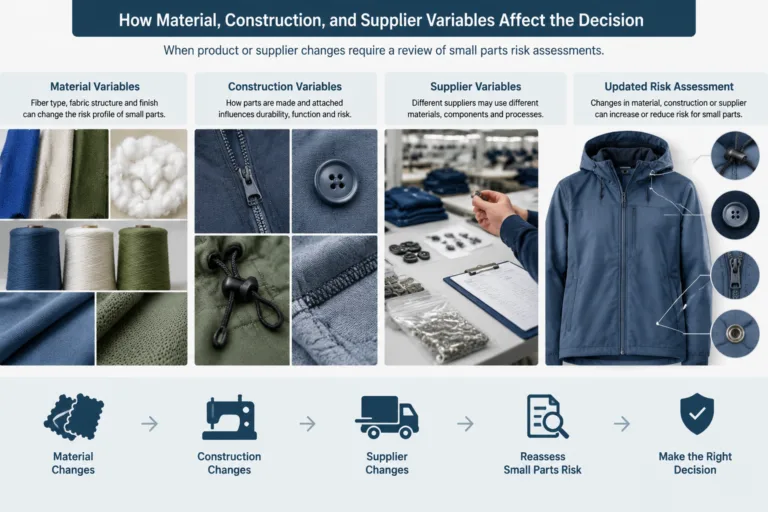
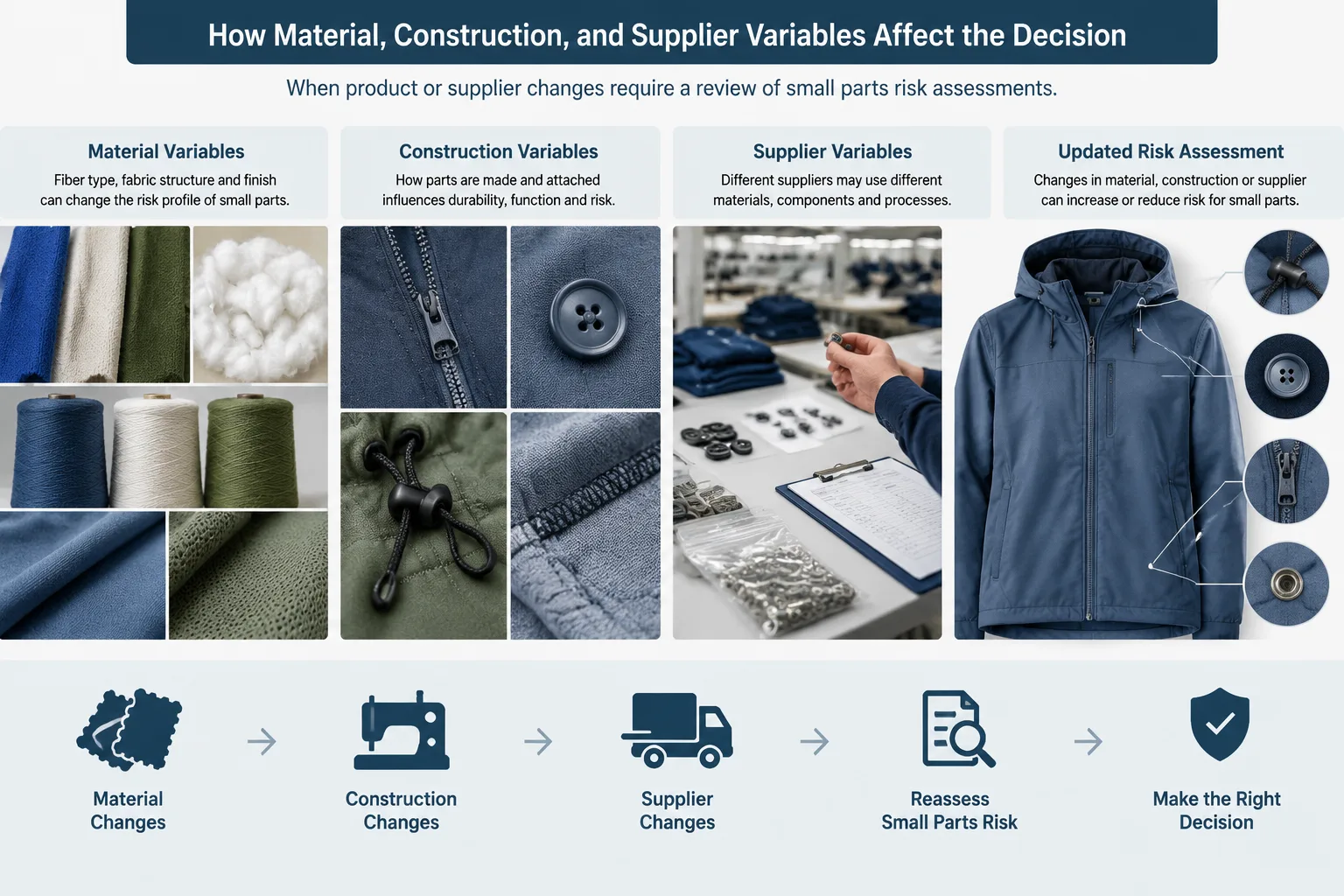
A change should be judged by its effect on the finished product, not by the name or appearance of the replacement part alone. Material changes can alter strength, brittleness, surface condition, degradation behavior, or the way a component interacts with fabric and thread. These effects may change how easily a part breaks, detaches, or becomes accessible during foreseeable handling.
Construction changes can be equally important. A different stitch configuration, seam allowance, reinforcement, adhesive coverage, placement, or assembly sequence may change the forces transferred to a button, badge, applique, snap, or other trim. Laundering, finishing, packaging, transport, and repeated handling can also interact with the attachment method. Review the component as part of the product configuration rather than treating it as an isolated item.
Supplier substitutions deserve specific attention even when the approved description appears unchanged. A new source may use different dimensions, raw materials, finishes, tooling, quality controls, or traceability practices. A visually identical replacement is therefore not automatically risk-equivalent. Compare the controlled specification, supplier information, approved sample, production instructions, and relevant evidence before deciding whether the existing assessment remains applicable.
A simple comparison matrix can keep the decision focused:
- Change type: material, dimensions, finish, attachment, supplier, process, packaging, or placement.
- Possible risk effect: altered access, detachment, breakage, exposure, or evidence validity.
- Evidence to check: technical-pack revision, BOM, supplier specification, sample, inspection, or report.
- Likely next action: document, inspect, test, consult, or hold release.
This matrix supports an engineering judgment; it does not establish that a particular material or attachment method is universally safe or unsafe. The conclusion must remain specific to the product, intended user, market, foreseeable use, and available evidence.
What Evidence Supports the Updated Assessment?
An updated assessment is stronger when its evidence file shows exactly what changed and which product version was reviewed. Retain the current technical pack, BOM, artwork, component specifications, supplier identity, approved sample, revision history, and change rationale. Where a label, package, instruction, or presentation change affects access to a component, retain the applicable revised version as well.
Map each changed item to the record that supports the decision. Depending on the product and market, that record may be an inspection finding, supplier declaration, certificate, laboratory report, internal sample review, or other controlled document. One third-party report should not be treated as proof of every requirement. Safety testing, technical files, traceability, and responsibility records may be separate evidence categories.
Check whether each report or record identifies the product or component examined, its configuration, sample or lot information where relevant, the method used, the date, and any limitations. Evidence from a pre-change component, different attachment method, different product type, or unrelated market may not support the changed product. Flag incomplete, mismatched, expired, or unclear records instead of carrying them forward silently.
Version control is especially important when a change affects several connected records. The BOM, technical drawings, care or warning information, packaging, and approved sample should identify the same component revision. Internal change-control records should show who requested the change, why it was made, which alternatives were considered, what evidence was reviewed, and who approved the conclusion.
For market-specific obligations, verify current official requirements for the product category, jurisdiction, intended user, rule status, and effective date. For example, the U.S. Consumer Product Safety Commission guidance on small parts addresses toys and certain children’s products, but it does not establish a universal rule for every apparel product or market.

When a Review Is Not Enough: Escalation and Release Decisions
An internal review may be enough to document a conclusion, but it is not automatically a legal determination or a substitute for required testing. Escalate when a change affects an intended child product, introduces a new component or possible hazard, invalidates the tested configuration, produces inconsistent samples, or leaves the responsible party unclear. Specialist advice may also be appropriate when product classification, failure-mode interpretation, or test scope is uncertain.
Consider pausing release when required evidence is missing, the change cannot be traced, a component can detach or become accessible in foreseeable use, or the applicable rule is unclear. A release hold is a risk-control decision while the facts are resolved; it does not by itself establish that the product fails a legal requirement.
A practical decision framework is:
- Unchanged risk basis and relevant evidence: document why the existing assessment remains applicable.
- Changed exposure or uncertain evidence: investigate through controlled samples, inspection, additional records, or qualified advice.
- Credible hazard, failed evidence, or unresolved traceability: hold release and escalate before distribution.
Before relying on regulatory language, confirm the applicable jurisdiction, product scope, intended user, rule status, effective date, and responsible business entity. Requirements can differ between markets and product categories, and a conclusion for one jurisdiction should not be presented as global compliance. After approval, monitor production findings, complaints, incidents, and corrective actions. Later information can reopen an assessment even when the original change review was properly documented.
Use this framework as a disciplined next step: connect every change to the current technical pack, BOM, sample, evidence file, and release decision. Apparel Wiki is an independent garment-manufacturing knowledge publication, not a regulator, laboratory, factory, supplier, or compliance service provider. Confirm any mandatory testing, declaration, labeling, or specialist requirement with the relevant authority or qualified professional for the product and market.
Does every supplier change require a new small parts risk assessment?
No. Every supplier change should be screened, but the outcome may be a documented confirmation rather than a full reassessment. Compare specifications, construction, traceability, samples, and evidence before deciding.
Which apparel trims and components should be considered in a small parts review?
Consider buttons, snaps, rivets, beads, sequins, toggles, cords, appliques, badges, labels, decorative hardware, packaging elements, and other attached or detachable components where the product and intended use make them relevant.
Is a new test report always required after changing a component or attachment method?
No universal answer applies. The need for new or expanded testing depends on the product, market, user group, changed configuration, applicable requirement, and validity of earlier evidence.
Can an existing small parts assessment cover a visually identical supplier replacement?
Possibly, but appearance alone is insufficient. Confirm the controlled specification, material, dimensions, attachment, production controls, traceability, and evidence before relying on the existing assessment.
What documents should be kept after reviewing a small parts risk assessment?
Keep the revised technical pack, BOM, specifications, supplier records, approved sample identity, change rationale, inspection or test records, revision history, decision owner, date, conclusion, limitations, and follow-up actions.
Who should approve a small parts risk assessment change review?
The responsible organization should assign an appropriately qualified decision owner, with quality, product safety, regulatory, or laboratory input when the change or applicable requirement exceeds internal expertise.