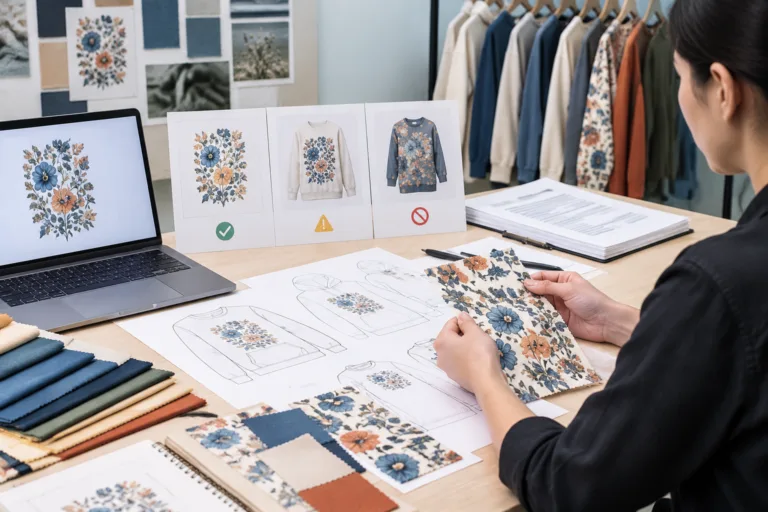
Textile artwork licensing is permission to use specified artwork under agreed conditions; it is not automatically a transfer of ownership. For an apparel business, a license may authorize the use of a motif, illustration, photograph, repeat pattern, print, or graphic on fabric or finished products, but the agreement determines what uses are permitted. This practical guide is educational information, not legal advice. Apparel Wiki is an independent apparel knowledge publication; its editorial work is separate from sponsorship, as explained on the Sponsor page.
The important distinction is simple: owning or controlling a design is different from receiving permission to use it. A brand, designer, product developer, or manufacturer should therefore connect the artwork to the actual workflow: development, sampling, production, marketing, sales channels, and territories. The legal result can vary with the agreement and applicable jurisdiction.
What Is Textile Artwork Licensing?
A textile artwork license is an authorization from a rights holder, creator, or authorized intermediary to use artwork in defined ways. Depending on the project, those ways might include preparing a file for printing, applying a pattern to fabric, manufacturing garments, selling finished products, displaying images online, or promoting a collection. A permission email, commission brief, quote, or formal agreement may all contain relevant terms, but their legal effect depends on what was actually agreed and whether the person granting permission had authority to do so.
Licensing does not necessarily mean that the apparel business becomes the owner of the artwork. An ownership transfer, often described as an assignment in some legal systems, is a different arrangement from permission to use. A license may be limited or broad, exclusive or non-exclusive, temporary or ongoing, and restricted by product, territory, channel, quantity, or other conditions. These labels are not a substitute for reading the wording and obtaining appropriate professional advice.
Artwork should also be separated from the other assets in a product. The design printed on a shirt, the fabric substrate, the garment construction, the product photograph, the brand name, a logo, and marketing copy may follow different ownership or permission paths. Buying a fabric sample, reference image, or finished garment does not by itself establish a right to reproduce its artwork commercially.
Which Rights Might a Textile Design Involve?
Apparel artwork licensing is easier to assess when the product is treated as a collection of assets rather than one automatically cleared object. Copyright may be relevant to creative expression such as an illustration, photograph, graphic, or pattern where the applicable law recognizes protection. Trademark commonly relates to signs that identify a source, such as a brand name or logo. Design rights may concern eligible visual appearance in jurisdictions that provide that form of protection.
These categories can overlap in a single product, but they do not answer the same question. A trademark may address whether a symbol creates source confusion; copyright may concern copying creative artwork; a design-rights analysis may focus on visual appearance. The applicable rules, registration systems, exceptions, duration, and enforcement mechanisms vary by country or region. No single registration or permission should be assumed to cover every asset or territory.
A final garment graphic might combine an original motif, a licensed photograph, a typeface, a third-party logo, a designer’s commissioned contribution, and a cultural or historical reference. Each component may have a different source and authorization path. A fabric name, construction term, or material description is also not the same as ownership of the artwork printed on that fabric.
Historical and traditional cultural material deserves separate review. A design may be inspired by a historical garment, documented in a museum image, or associated with a community’s traditional expression. Those situations raise different factual and legal questions from licensing a contemporary illustrator’s pattern. Avoid treating age, online availability, or cultural association as automatic proof that commercial use is unrestricted.
What Should an Apparel License Cover?
When reviewing a textile artwork license, the practical question is whether the written permission matches the intended business use. The following points are questions to raise with the rights holder, creator, agent, or legal adviser, not universal mandatory terms or a model contract.
- Who is granting permission? Identify the artwork, creator, rights holder, licensor, and any intermediary. Confirm that the person or company granting permission has the authority to do so.
- Which products are included? Define whether the use covers fabric, finished garments, accessories, packaging, retail displays, samples, or other product categories.
- Which channels and territories apply? Consider direct sales, wholesale, marketplaces, websites, social media, advertising, catalogs, and physical retail, together with the countries or regions where the products will be offered.
- How long does permission last? Clarify the term, collection or quantity limits, exclusivity, language, and whether the license can be transferred or extended.
- What adaptations are allowed? Ask about recoloring, resizing, cropping, repeating, separating colors, combining elements, distressing, embroidery, or technical preparation for printing.
- What administration is expected? Clarify fees or royalties, reporting, attribution, samples, approval procedures, takedown duties, sell-off treatment, and obligations after the term ends.
A narrow license may be appropriate for one defined collection, while a business planning accessories, export markets, retail campaigns, or future reuse may need different permission. There is no universal commercial package or standard royalty structure. Material commitments, unclear ownership, cross-border use, or unusual restrictions warrant review by a qualified professional familiar with the relevant law.
How Can a Business Verify Artwork Before Production?
Verification should begin before sampling or bulk production, when changes are less disruptive. Create one project record for the artwork and connect it to the design, purchasing, production, and marketing handoffs. The record should distinguish documented facts from assumptions and unresolved questions.
- Record provenance. Note who created or supplied the artwork, when it was created or acquired, and which agreement, commission, invoice, or authorization explains the source.
- Inspect the complete file. Check for photographs, logos, fonts, recognizable people, private-property imagery, commissioned elements, stock or downloaded material, and references incorporated by another designer.
- Research relevant sources. Where appropriate, search applicable rights databases, public records, image sources, or creator portfolios. Record the date, territory, database or site, search terms, and results.
- Match permission to the plan. Obtain written permission or a license covering the planned products, modifications, markets, sales channels, and participating business partners.
- Preserve the evidence. Store signed agreements, emails, approvals, artwork versions, invoices, search notes, and production instructions together before release to production.
An online search that finds nothing does not prove that artwork is free to use. Databases may be incomplete, searches may miss altered or unregistered material, and the relevant rights may depend on facts that are not visible online. Similarly, an invoice or purchased reference image may prove a transaction without granting reproduction and commercial sale rights.
Commissioned work and employee-created work can also require careful review because ownership and permitted use may depend on the agreement and applicable jurisdiction. Creation records and authorization documents help establish provenance, but they are not automatically proof of unrestricted rights. When ownership is disputed, third-party content is recognizable, or the launch has significant commercial importance, pause the workflow and seek appropriate professional review.
How Do License Choices Affect Apparel Development?
A textile artwork license needs to match the way an apparel business will actually develop, make, sell, and promote a product. Permission to prepare a print file for sampling may not answer whether the business can manufacture finished garments, sell them through specific channels, photograph them for a campaign, or reuse the artwork in a later collection. These are project questions that should be checked against the written agreement.
Adaptation is another important handoff. A design may be converted into a repeat, separated by color, recolored, resized, distressed, embroidered, cropped, or combined with a logo or other graphic. Technical preparation for printing and a creative alteration may not be treated the same way. Before approving a production file, confirm which changes are allowed and retain the approved version with the relevant license records.
Other businesses may participate in the workflow, including printers, manufacturers, agents, photographers, retailers, marketplaces, and advertising partners. Their involvement does not automatically mean that each party needs a separate license. The agreement, their role, and the way the artwork is supplied determine what permission is needed. This is why design, sourcing, production, marketing, and sales teams should review the intended use together.
A narrow license can be suitable when the plan is limited to one product, season, territory, or sales channel. However, that permission may not extend to accessories, export markets, wholesale catalogs, digital campaigns, or a future collection. Broader use may be a business choice, but it should be documented rather than assumed. Recheck the license whenever the product range, market, partner, or campaign changes.
What Are the Main Risks and Limits of Online Artwork Searches?
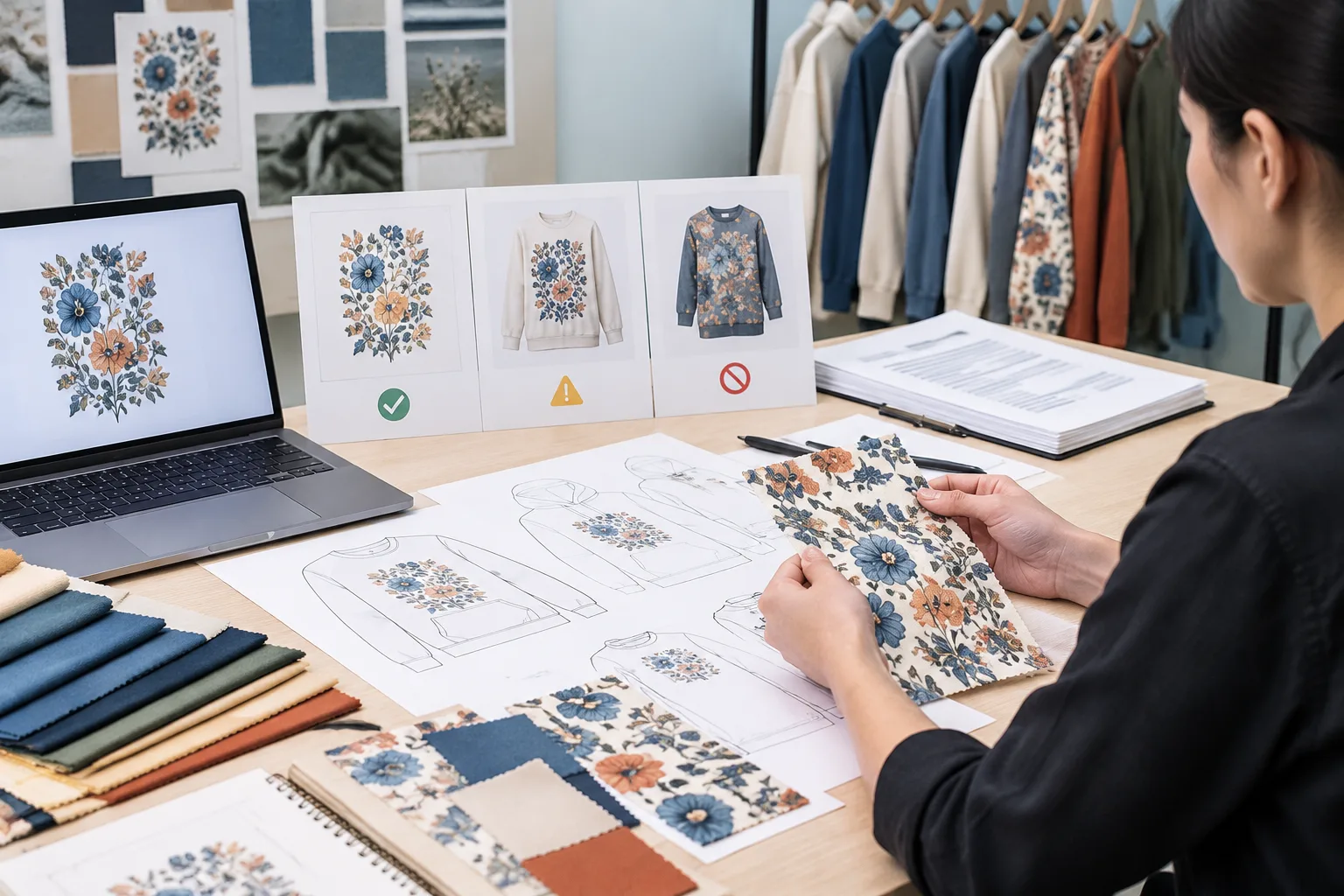
Image-search results, marketplace listings, social posts, and portfolio pages can help locate an apparent source, but they do not by themselves establish ownership or permission. A search may miss an altered image, an unregistered right, a regional record, or an earlier creator. Record the date, territory, website or database, search terms, and results so the research can be reviewed later.
Descriptions such as “vintage,” “traditional,” “public domain,” “royalty-free,” or “free to download” also require context. The relevant rights, license terms, territory, and possible restrictions may differ. “Royalty-free,” for example, generally describes a pricing arrangement rather than a universal promise that every commercial use is allowed. A purchased reference image, sample garment, or invoice may document a transaction without granting the right to reproduce and sell the image on clothing.
Historical garment research, contemporary photographs, and traditional cultural expressions should be treated as different source categories. Keep the historical reference separate from the image used in the final artwork, and document the source and permission path for each. Cultural material may require particular sensitivity and further review; its age or widespread online circulation is not enough to resolve every ownership or use question.
Online research is therefore a discovery and documentation step, not a clearance guarantee. Escalate unclear ownership, disputed provenance, recognizable third-party content, or a commercially important launch for appropriate professional review. The facts, documents, intended use, and governing law all matter, so a general article cannot determine whether a particular design is legally clear.
A Pre-Production Textile Artwork Licensing Checklist
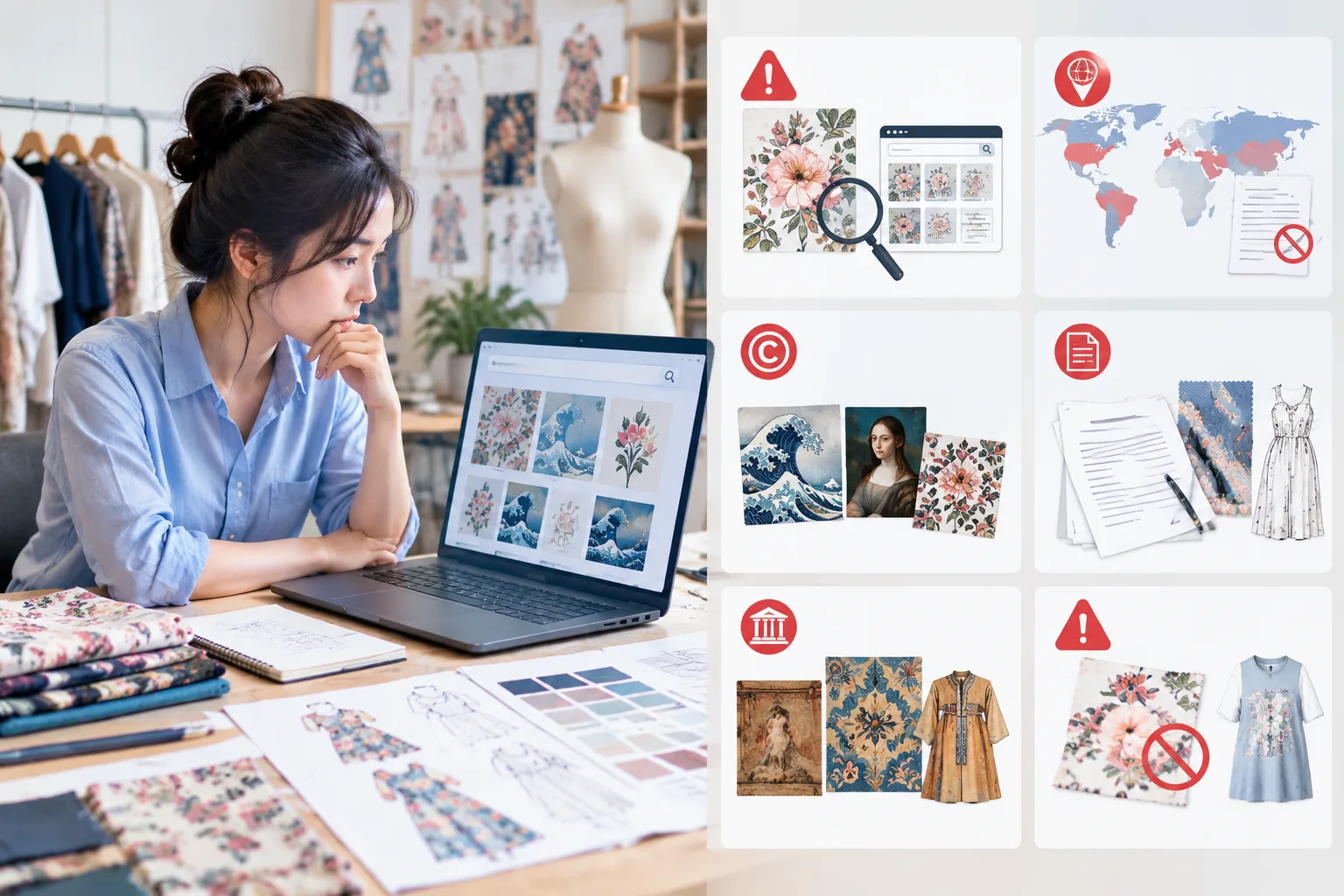
Before sampling or bulk production, use the following workflow as editorial guidance. Completing it does not guarantee legal clearance, but it helps separate documented facts, unresolved questions, business decisions, and issues that may require professional advice.
- Identify every asset: List the main artwork and any embedded photographs, logos, fonts, illustrations, motifs, or other sourced elements in the final file.
- Confirm provenance: Record who created or supplied each element, who claims authority, and which agreements, approvals, or other documents support that claim.
- Match permission to the plan: Check the licensed products, adaptations, territories, duration, quantities, channels, markets, and participating partners against the actual project.
- Document operating requirements: Note attribution, approval steps, reporting, payment, version control, takedown, sell-off, and post-expiry obligations where the agreement addresses them.
- Control production release: Pause when ownership is unclear, permissions conflict, or the intended use exceeds the written license. Obtain clarification or suitable review before release.
- Recheck expansions: Review the artwork and license when a collection adds products, retailers, countries, campaign formats, or new production partners.
Apparel Wiki is an independent educational publication, not a manufacturer, factory, laboratory, certifier, legal adviser, or service provider. Use this checklist to organize a conversation with the relevant rights holder and, where needed, a qualified professional familiar with the applicable jurisdiction.
Does buying a textile print or reference image give an apparel business the right to reproduce it on clothing?
Usually, the purchase alone does not answer that question. Check the terms and obtain permission that covers reproduction, commercial sale, the planned products, markets, and modifications.
Is a textile artwork license the same as owning the design?
No. A license generally sets conditions for use, while ownership concerns the underlying rights. The agreement and applicable law determine the effect of any transfer or retained rights.
What should a license say about garments, fabric, packaging, advertising, and social media?
It should clearly address the products, applications, channels, territories, duration, adaptations, partners, attribution, approvals, and any limits relevant to the project.
Do textile artwork licenses need to cover different countries or sales channels?
They may, depending on the agreement and business plan. Review each intended market and channel rather than assuming permission for one location or outlet applies everywhere.
Can a licensed textile design be recolored, resized, repeated, or adapted for embroidery?
Only when the permission or applicable agreement allows those changes. Confirm adaptation rights before making creative or technical changes to the licensed artwork.
Does finding no matching image online mean an apparel business can use the artwork?
No. A failed search does not prove that the artwork is unrestricted. Preserve the search record and seek authorization or professional review when ownership or provenance remains unclear.