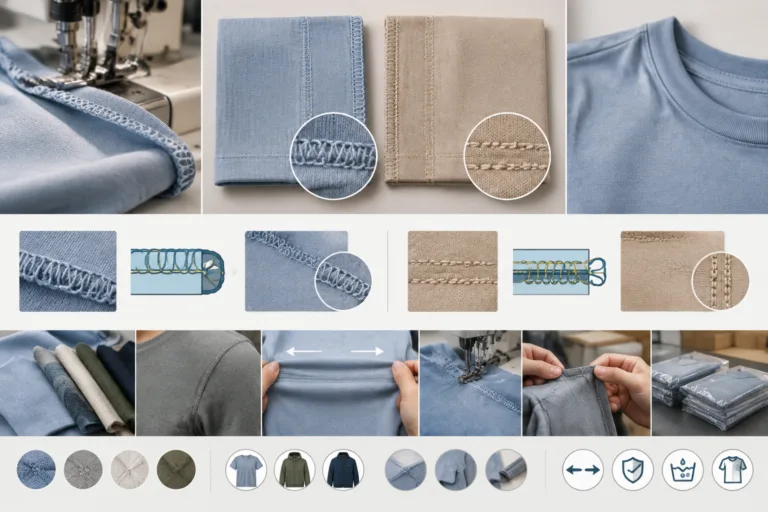
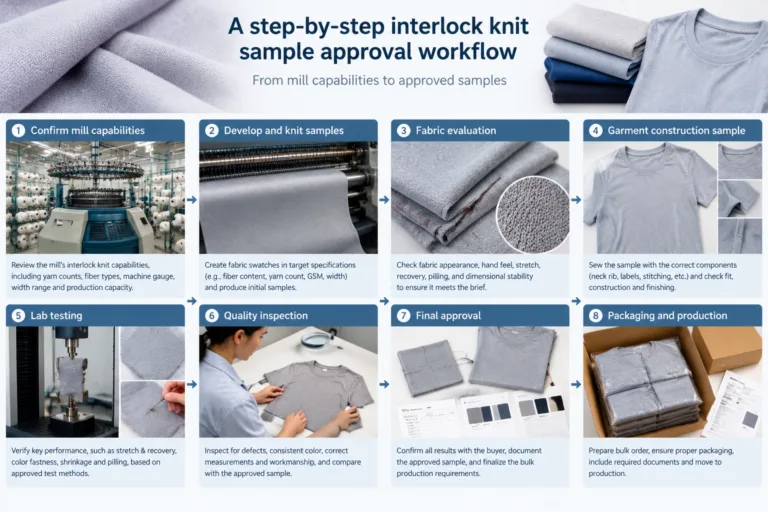
Interlock knit is a weft-knit fabric construction made by intermeshing needle loops on opposing needle beds. In practical sourcing, that name is only the starting point: fiber content, yarn, weight, usable width, finishing, color, and intended garment use still need to be specified. Interlock knit fabric sourcing therefore means evaluating both the material and the supplying mill against a documented brief. Apparel Wiki is an independent educational publication; readers can review its Sponsor information for editorial transparency.
What interlock knit fabric is and what buyers should specify
When someone asks, “What is interlock knit fabric?” the useful answer is a construction description rather than a fiber description. Interlock belongs to the weft-knitting family, where yarn is formed into rows of loops. Its opposing needle beds produce intermeshing loop structures that give the fabric a distinct face-and-back relationship compared with many simpler single-knit constructions.
That construction can provide useful clues about appearance, hand, and behavior, but it does not guarantee a particular level of stretch, breathability, durability, opacity, or recovery. Those outcomes depend on the combination of construction, fiber, yarn, machine settings, weight, finishing, dyeing, and care conditions. A cotton-rich interlock and a synthetic-blend interlock may carry the same construction name while behaving differently in a garment.
Separate the construction from the specification
A workable set of interlock knit fabric specifications should identify the following layers separately:
- Construction: interlock, with any relevant structure or development description supplied by the mill.
- Fiber and yarn: target fiber content, blend, yarn details, or count information when required for the product.
- Physical dimensions: target GSM, total width, and usable width, with the measurement basis stated.
- Processing: dyeing, printing, brushing, compacting, softening, or other finishing that may affect the finished material.
- Product requirements: color, care route, garment use, silhouette, opacity, drape, stretch direction, and relevant performance tests.
GSM is mass per unit area, not a direct measure of thickness or quality. Likewise, total width may include selvedges or other unusable areas, while usable width is the portion available for pattern cutting. These distinctions matter when reviewing marker efficiency, fabric consumption, and the relationship between a sample and a finished garment.
The commercial name may also vary between suppliers or markets. Treat “interlock” as a construction claim that must be checked against the sample and technical record, not as a complete performance category. A clear brief allows a buyer to compare like with like and prevents a familiar fabric name from concealing important differences.
How to screen an interlock knit mill before requesting samples
Mill screening should begin with a capability brief rather than a broad request for “good-quality interlock.” State the intended garment, target construction, fiber content, yarn requirements, expected weight range, usable width, color or print needs, finishing, and care conditions. The more clearly the intended use is described, the easier it is to determine whether a supplier has understood the request.
Turn capability claims into questions
Ask the mill to identify which stages it performs directly and which are handled by another company. A knitting mill may not control dyeing, finishing, inspection, testing, or packing, and the production route can affect the material ultimately approved. This is not automatically a problem, but the route should be visible before a sample is treated as representative of bulk production.
Request development records, sample references, lot identification, technical data, and a clear response to each required specification. Look for consistency in how the mill describes construction, composition, GSM, width, finishing, and color. A capability list is a statement of what the supplier says it can do; a sample demonstrates a specific development; testing provides evidence for selected performance claims. Keep these three levels distinct.
A standardized interlock knit RFQ also makes commercial responses comparable. Use the same measurement basis and ask each candidate to identify included and excluded services. Record the unit of quotation, packaging assumptions, expected loss, trade terms, testing responsibility, and any stated production constraints. These items should be confirmed with each supplier rather than treated as universal textile practice.
Use a pre-sample screening checklist
- Can the mill describe the proposed construction and target fiber content precisely?
- Can it identify the intended knitting, dyeing, finishing, inspection, and packing route?
- Will the sample carry a development, lot, or internal reference?
- Can the supplier provide stated GSM, width, finishing, and composition information with the relevant measurement status?
- Can it explain which requirements are demonstrated by the sample and which still require testing?
- Will changes to yarn, composition, finishing, width, or production route be disclosed before bulk release?
Use the answers to classify the supplier as suitable for further sampling, requiring clarification, or unsuitable for the current brief. This approach does not prove repeatability or bulk control, but it reduces ambiguity before time and testing costs are committed.
Which interlock knit sample documents and swatches to request
Request more than an unlabeled swatch. A representative sample package should include a fabric swatch or yardage, construction description, composition, color reference, lot or development reference, stated GSM, width, and finishing information where available. Ask whether the sample represents the intended production route, including dyeing, finishing, brushing, compacting, or any other process expected for bulk fabric.
The mill’s technical data sheet should identify the status of each value. Clarify whether a result is measured, estimated, specified as a target, or copied from an earlier development. Where a test result is supplied, record the test method, conditioning or test condition, sample direction, and whether the result applies to fabric or to a finished garment. A number without that context is difficult to compare responsibly.
Distinguish sample purposes
A development sample may help establish construction and hand. A lab dip primarily supports color development. A bulk-like sample may be intended to represent a production route, while an approved reference defines the material against which later deliveries are reviewed. These terms are useful working descriptions, but they are not automatically standardized across all suppliers.
Inspect the face and back, hand, cover, surface uniformity, edge behavior, shade, odor, and visible defects against the written brief. A small swatch can support preliminary visual and hand evaluation, but it may not reveal full-width behavior, roll variation, or production consistency. Retain the approved reference and record whether approval covers appearance, color, construction, dimensions, performance, or only development direction.
Visual approval should not be mistaken for complete performance approval. If recovery, dimensional change, pilling, colorfastness, abrasion, bursting strength, or another property is important to the garment, identify the appropriate validated test or agreed internal method before final approval. The required test depends on the product and use conditions.
How to compare interlock knit samples against the garment brief
Evaluate each sample against the garment rather than judging the fabric in isolation. Compare composition, yarn or count information when supplied, construction, GSM, usable width, stretch direction, recovery, drape, opacity, surface appearance, and hand. Then consider how those observations interact with the pattern, seam construction, care route, target silhouette, and expected use.
Check dimensional behavior after the relevant care process and distinguish fabric results from finished-garment behavior. Weight and width may affect marker efficiency and fabric consumption, but higher GSM does not automatically mean higher quality. Review shade consistency, spirality or skew, edge curling, holes, slubs, barré, contamination, and other visible issues using the same documented inspection approach for each sample.
| Comparison item | Record | Decision question |
|---|---|---|
| Construction and composition | Supplier statement and sample reference | Does the material match the brief? |
| GSM and usable width | Value, measurement status, and method | Will the fabric support the pattern and planned consumption? |
| Stretch, recovery, and drape | Direction, test condition, and observation | Does behavior suit the fit and garment construction? |
| Appearance and defects | Shade, surface, edges, and inspection notes | Are unresolved visual risks acceptable? |
| Care response | Relevant process and dimensional observations | Does the result align with the intended care route? |
Set acceptance criteria for the specific product and agree any tolerances with the mill; do not substitute a universal interlock standard. A useful comparison record includes the requirement, sample result, test condition, acceptance decision, evidence source, and open action. That record makes approval traceable and shows which conclusions are based on observation, supplier documentation, or validated testing.
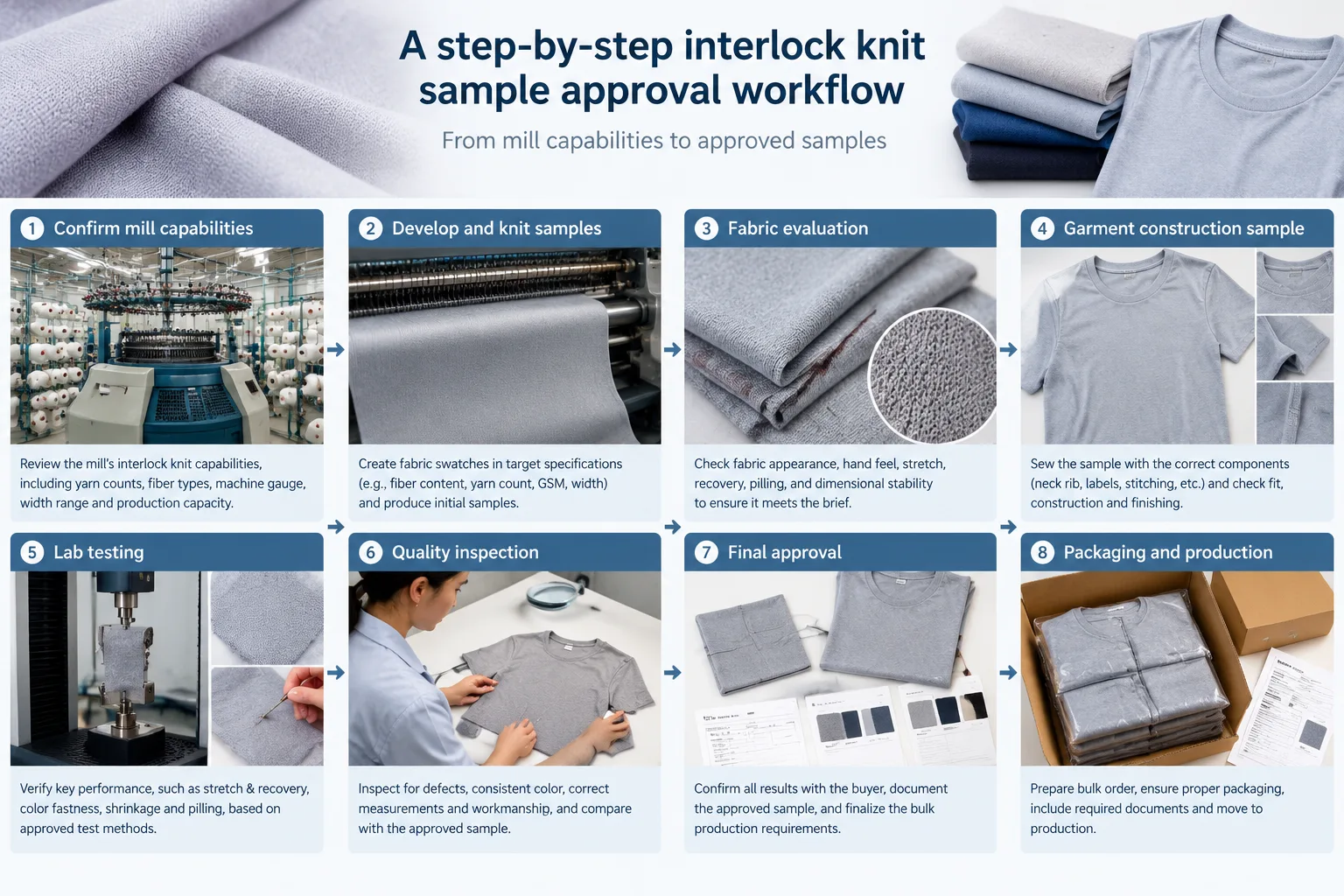
A step-by-step interlock knit sample approval workflow
A reliable interlock knit sample approval process begins before a sample is ordered. Freeze the intended garment use, construction, care route, target fiber content, and essential fabric requirements. Include the characteristics that could affect fit, cutting, sewing, appearance, or care performance. This creates a decision brief that the mill can answer directly and gives the review team a defined basis for approval.
- Issue one standard brief. Send the same technical and commercial request to each candidate mill. Identify the requested construction, composition, yarn information when relevant, target weight range, usable width, color or print requirements, finishing, intended use, and requested documentation.
- Log every sample. Record the supplier reference, lot or development information, date received, stated specifications, and intended production route. A retained reference is more useful when its identity and history are clear.
- Review the fabric systematically. Check construction, face and back, hand, surface uniformity, shade, edge behavior, visible defects, dimensions, and other properties relevant to the garment. Preliminary observations should be separated from measured or laboratory-supported results.
- Test where the product requires it. Select relevant checks for dimensional change, stretch and recovery, color, pilling, abrasion, bursting strength, or other concerns. Use a qualified laboratory or an agreed internal method, and record the method, conditioning, direction, and specimen boundary with each result.
- Resolve differences with evidence. If the sample does not match the brief, ask for clarification, corrective action, or a revised sample. Do not convert an unresolved difference into approval through an informal conversation.
- Define the decision. Mark the result as approved, conditionally approved, approved for development only, rejected, or pending required evidence. The decision should state whether it covers appearance, construction, composition, dimensions, performance, color, or a specific combination.
- Control future changes. Identify the approved reference, agreed tolerances, test requirements, and people authorized to approve changes. A substitution that changes composition, weight, width, finishing, shade, wash behavior, or fit-related performance should trigger review and may require a new sample or test.
This workflow is a sourcing control practice, not a universal legal requirement. Its value is traceability: the team can see what was requested, what was received, what was tested, and which limitations remain before bulk release.
Common sourcing trade-offs and supplier warning signs
Compare quotations against the complete offer rather than unit price alone. The comparison may need to include the specified construction, usable width, expected loss, testing, packing, measurement basis, trade terms, and any included or excluded processing. A lower quoted price can become less attractive if the specification is incomplete or if unresolved differences create rework, extra testing, or garment fit risk.
Material changes also require more than a nominal fiber comparison. Changing fiber content, yarn, finishing, GSM, usable width, or dyeing route may affect hand, shade, shrinkage, recovery, pilling, surface appearance, and fit. Even a replacement described as the same composition should be reviewed against the approved reference because construction and processing details can still differ.
Warning signs include incomplete technical data, changing descriptions between samples, unexplained substitutions, inconsistent lot references, unsupported performance claims, and reluctance to identify the production route. A supplier that can produce an attractive development sample may still need verification for repeatability and bulk control. Capability statements are useful screening information, but they are not equivalent to demonstrated performance.
Use a simple decision framework for each concern: accept the evidence, request more evidence, request a revised sample, or reject the option. The appropriate response depends on the requirement’s importance and the risk left unresolved. Keep the reasoning beside the comparison record so a commercial decision does not appear to be a technical approval.
What to include in the final interlock knit sourcing file
The final interlock knit sourcing file should preserve the approved specification, retained swatch or yardage reference, technical data, test reports, color reference, inspection records, and correspondence that changes the requirements. Include supplier and lot or development references wherever available. Documentation supports traceability, but it does not by itself prove that every bulk delivery will conform.
State the approval scope precisely. For example, approval may cover visual appearance and color for development, while composition, dimensional behavior, or performance remains pending. This distinction prevents a visual sign-off from being interpreted as complete technical approval. Keep open actions visible, including missing test evidence, unresolved width information, or a required wash or fit review.
Link every approved substitution to the checks it requires. Depending on the garment, those checks may include repeat sampling, laboratory testing, pattern review, a wash trial, or fit confirmation. Define who may authorize a change and which information must be rechecked before bulk fabric is released. Production, quality, pattern, and merchandising teams should all work from the same identified reference.
For a reusable record structure, an Apparel Manufacturing Tools resource may help organize specifications, comparisons, and open actions. Use any tool as an aid to internal control, while keeping the acceptance criteria and decision authority specific to the product and project.
Next step: Turn the approved brief into a one-page RFQ and sample review sheet. Send it consistently, retain the material reference, and require each approval or change to point back to a documented requirement, observation, or test result.
Is interlock knit a fiber or a fabric construction?
Interlock knit is a fabric construction, not a fiber. It can be made with different fiber contents and processing choices, so the construction name alone does not specify weight, width, handle, recovery, or care behavior.
What information should be included when requesting an interlock knit sample?
Include the intended garment use, construction, target composition, yarn information when relevant, weight range, usable width, color or print needs, finishing, care route, requested production route, and required technical records.
How can a buyer verify an interlock knit mill’s capabilities?
Ask which operations are performed directly, request relevant development records and technical data, and compare stated capabilities with representative samples and validated test results. Treat supplier claims as information to verify.
Does a higher GSM mean an interlock knit fabric is better?
No. GSM measures mass per unit area, not a universal quality level. Suitability depends on the garment brief, composition, construction, width, finishing, care behavior, fit, and required performance.
What should be approved before ordering bulk interlock knit fabric?
Approve a clearly identified reference and define the scope covering the required combination of construction, composition, dimensions, appearance, color, performance, and tolerances. Confirm any required tests and change-control rules before release.
When should an interlock knit fabric substitution require a new sample or test?
Review a substitution whenever it changes composition, yarn, construction, weight, width, finishing, shade, care behavior, or fit-related performance. The review may require a new sample, laboratory test, wash trial, pattern check, or fit confirmation.