Escrow arrangements ambiguity usually means that an agreement does not clearly state what is being held, who holds it, which conditions trigger release, what evidence proves those conditions, or who makes the decision. In apparel purchasing, that uncertainty can affect deposits, approved samples, shipment documents, production files, tooling, or finished goods. The practical response is to identify each asset and decision point in writing before relying on the arrangement. Apparel Wiki is an independent educational publication; it is not an escrow provider, manufacturer, testing laboratory, or legal service. Readers can review the site’s Sponsor information separately from this editorial guidance.
What Are the Common Ambiguities in Escrow Arrangements?
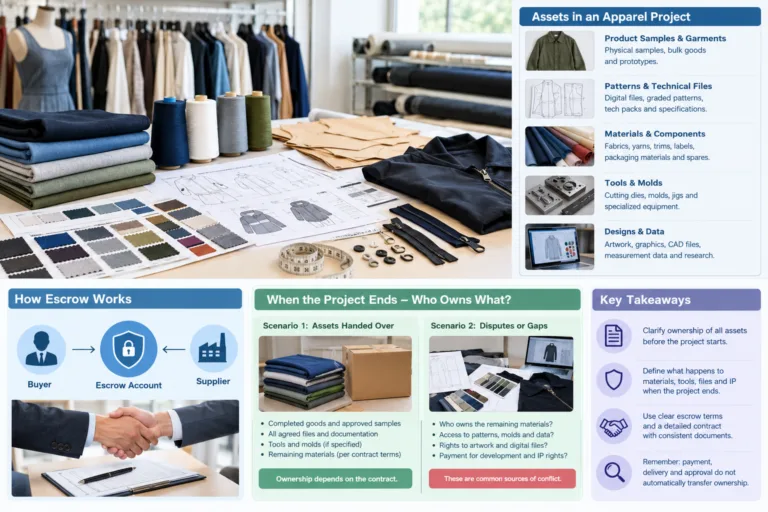
An escrow arrangement is generally a conditional holding and release structure. A third party holds money, documents, goods, data, samples, tooling, or another asset until specified conditions are satisfied. Cornell’s Legal Information Institute describes an escrow agreement as an arrangement in which property, funds, or documents are held by a third party until stated conditions are met. The exact duties of the holder, and the legal effect of the arrangement, depend on the agreement and applicable law.
Ambiguity appears when the agreement uses broad terms without assigning observable meaning. For example, “release after approval” leaves several questions unanswered: Which approval is required? Is an approved sample enough, or must the shipment also pass inspection? What record proves approval? Does the escrow holder decide whether the condition is met, or must the buyer and supplier give joint instructions? A deadline, decision owner, and response process may also be missing.
A hypothetical apparel order illustrates the problem. A buyer might place money into a conditional holding arrangement, expecting release after the supplier submits shipment documents and goods matching the approved sample. The supplier might understand “approved sample” as the only relevant condition, while the buyer might believe that measurements, shade, labels, carton records, and quantity must also be confirmed. Neither expectation should be treated as a universal industry rule. The agreement needs to state the intended conditions and evidence.
Escrow should also be distinguished carefully from an ordinary advance payment, deposit, retention amount, letter of credit, or payment against documents. These structures can differ in who controls the funds, what documents are required, when payment occurs, and what happens if the parties disagree. The labels alone may not determine the legal result. A project-specific assessment requires the actual wording, provider terms, transaction documents, and relevant jurisdictional review.
Which Parts of an Escrow Arrangement Usually Need Clearer Wording?
A useful audit begins with the people involved. Identify the payer, beneficiary, supplier, buyer, agent, escrow holder, and any person authorized to confirm a condition. State whether the holder is independent, selected by one party, or subject to joint instructions. Also clarify whether an agent is merely communicating instructions or has authority to approve goods, documents, or release requests.
Next, describe the asset precisely. “Funds for the order” may need an account reference, currency, amount, deposit event, and handling instructions. “Production files” may need a file list, format, version, date, and method of transfer. For apparel development, the relevant items could include patterns, graded files, artwork, technical packs, approved samples, molds, dies, materials, or finished goods. The agreement should address identification, custody, preservation, and permitted access where those issues matter.
Document control is another common source of escrow contract ambiguities. A garment transaction may refer to a purchase order, technical package, measurement chart, approved sample, specification sheet, amendment, general terms, and later email instructions. If two documents conflict, the parties need a stated method for identifying which version controls. Change-control language should explain who may approve a revision, how it becomes effective, and whether the escrow holder receives the updated record.
Delivery wording should cover more than a calendar date when delivery forms part of the release trigger. Relevant details may include location, quantity, partial shipments, packaging, shipment records, and treatment of delay. Quantity variance is especially important: an agreement may need to distinguish a complete shipment from a short shipment or a split shipment, while avoiding assumptions about what tolerance is acceptable. Any recommendation about document priority or delivery terms is editorial guidance, not a jurisdiction-free legal requirement.
When Should Funds, Goods, or Documents Be Released?
Release conditions may be based on time, delivery, document submission, inspection, acceptance, dispute resolution, or a combination of these events. The condition should be written so a reviewer can ask a factual question and identify the supporting evidence. “Release when shipment is satisfactory” is difficult to administer. “Release after the specified shipment documents are received and the named inspection record confirms the stated criteria” is more structured, although the underlying documents and criteria still need to be defined.
For every trigger, identify who confirms completion, what evidence is sufficient, and whether the holder acts automatically or waits for written instructions. A document trigger might require a named document, version, issuer, and delivery method. An inspection trigger might require the inspection record, lot identification, location, date, and authorized reviewer. The agreement should also address what happens if the evidence is incomplete or the parties give inconsistent instructions.
Edge cases expose ambiguous escrow terms quickly. Consider a hypothetical order shipped in two lots, with the first lot complete and the second lot late. Does release apply to the whole amount, each lot separately, or neither? If documents are missing but the goods arrive, can release proceed? If the quantity differs from the order, does the holder retain all funds or only the disputed portion? These are contractual choices, not universal outcomes.
Parties should be cautious with silence and subjective approval language. “No objection within a reasonable time” may leave the response period and method uncertain. “Accepted if satisfactory” may leave quality, reviewer, and evidence undefined. Whether silence counts as approval, whether one party can block release, and what notice periods apply must be assessed against the governing agreement and law. An escrow provider’s own rules may also control its procedure.
How Do Inspection, Acceptance, and Defects Affect Escrow?
Inspection and escrow address related but different questions. An inspection evaluates goods or records against an agreed method; an escrow condition determines whether an asset should be released. The agreement should identify the inspection event, location, timing, responsible party, sample or lot, records, and acceptance criteria. Without those details, a reference to “inspection passed” may support competing interpretations.
Inspection findings should also be separated from final acceptance, payment release, warranty rights, latent-defect claims, and other remedies. A shipment may appear to meet a visible requirement while a later issue concerns construction, durability, hidden damage, or incomplete records. Depending on the contract and applicable law, passing an inspection may not automatically resolve every later claim. Apparel Wiki does not treat a passing inspection as proof that all contractual or legal questions have ended.
Useful diagnostic examples include incorrect garment measurements, shade variation, workmanship defects, missing labels, or incomplete shipment records. Each example should lead to a defined question: What was inspected, against which version, using what method, and with what result? A photograph or isolated inspection result may document a symptom without establishing its cause or deciding whether the supplier, buyer, specification, handling, or another factor is responsible.
Reinspection, retesting, repair, replacement, credit, rejection, and partial acceptance should be addressed only when the arrangement defines how those steps work. The parties may need to specify who may request a review, what evidence is retained, whether release is paused, and how an unresolved disagreement reaches the provider or another decision process. These are project-specific contract matters, not universal apparel rules.
Who Owns the Assets and What Happens When the Project Ends?
Escrow discussions often focus on money, but an apparel project may also involve patterns, molds, dies, samples, artwork, technical files, product data, materials, or finished goods. The agreement should identify each asset precisely, including its format, version, quantity, and condition. A phrase such as “development materials” may be too broad if the parties have different ideas about whether it includes editable pattern files, physical samples, or production-ready artwork.
Several questions should be kept separate. Physical possession does not necessarily answer who owns an asset. Ownership is also different from a license to use it, permission to modify it, confidentiality obligations, and intellectual-property rights. For example, a supplier may physically hold a pattern while the contract gives another party limited use of the related files. Paying a development fee does not, by itself, establish ownership of every related intellectual-property right.
The arrangement should also address custody and exit costs. State who pays for storage, maintenance, transfer, return, or destruction, and who bears the risk of loss or damage while an asset is held. Then define the process for cancellation, termination, a supplier change, insolvency, or an unresolved dispute. Retrieval instructions should identify the recipient, delivery method, required records, and any approval needed before a handover.
These outcomes vary with the contract and applicable jurisdiction. Apparel Wiki treats asset ownership and exit planning as review questions, not universal legal rules. A buyer or supplier should compare the escrow wording with the development agreement, confidentiality terms, purchase order, and any applicable intellectual-property advice before relying on an assumption.

A Practical Review Method for Resolving Escrow Ambiguity
A useful review begins by treating ambiguity as a document and decision problem rather than as evidence that one party acted improperly. Inventory every party, asset, contract document, version, and event connected to the arrangement. Include the escrow holder, buyer, supplier, agent, inspection party, decision-maker, purchase order, technical package, approved sample, payment terms, and dispute clause.
Next, rewrite each release condition as an observable question. What evidence shows that the condition is met? Who confirms it? By when? What happens if the evidence is incomplete, disputed, or unavailable? Test the wording against partial shipments, quantity variance, late documents, failed inspection, retesting, disputed defects, and termination. A condition that appears clear for a complete shipment may not explain what happens when only part of the order is delivered.
Reconcile the escrow text with every referenced document. Record which version controls if the purchase order, technical pack, approved sample, general terms, or later instruction conflicts. Document-precedence and change-control recommendations are editorial guidance for review; their legal effect depends on the agreement and governing law. Unresolved interpretations should be recorded and referred for qualified legal or escrow-provider review before the arrangement is relied upon.
| Issue | Ambiguous wording | Competing interpretation | Evidence needed | Decision owner | Proposed clarification |
|---|---|---|---|---|---|
| Release | “After approval” | Approval of inspection, sample, or documents | Named approval record and document version | Defined party or escrow holder | Identify the exact condition and evidence |
| Delivery | “Goods delivered” | Handover to carrier or receipt at destination | Delivery record, quantity, and location | Named logistics or purchasing contact | Define delivery event and partial-shipment treatment |
| Defects | “Nonconforming goods” | Visible defect only or any unresolved claim | Inspection record, sample basis, and notice | Defined quality or dispute decision-maker | Separate inspection, acceptance, and remedies |

What an Escrow Arrangement Cannot Solve by Itself
Escrow can organize custody and conditional release, but it does not independently determine product quality, ownership, causation, damages, or regulatory compliance. Holding funds or files does not establish whether a measurement deviation resulted from production, an outdated specification, handling, or a later alteration. Similarly, placing tooling or technical data with a third party does not settle ownership or permitted use unless the relevant agreements do so.
Some questions require steps beyond clearer wording. Depending on the agreement and jurisdiction, the parties may need provider procedures, an independent inspection, document examination, mediation, arbitration, court guidance, or qualified legal counsel. The appropriate route may also depend on the escrow holder’s terms, the dispute-resolution clause, and whether the issue concerns payment, goods, intellectual property, insolvency, or regulatory duties.
Apparel Wiki is an independent educational publication, not a manufacturer, escrow provider, laboratory, certifier, or legal service. This review method is not a legal opinion, payment guarantee, quality certification, or assurance that funds or assets will be recoverable. It is a way to expose unclear assumptions before they become harder to resolve.
Next step: Pause reliance on an unclear trigger, preserve the relevant records, compare all referenced documents and versions, and list each unresolved interpretation. Then choose the appropriate action: clarify the wording, amend the agreement in writing, obtain qualified legal or provider review, or consider a different payment or custody structure. Keep any amendment linked to the asset, evidence, decision owner, and event it changes.
What does escrow arrangement ambiguity mean in an apparel purchase?
It means the agreement leaves important questions open, such as what is held, who holds it, what evidence triggers release, who decides whether a condition is met, or what happens when the project changes or ends.
Which release conditions should an apparel escrow agreement define?
It should identify the relevant delivery, document, inspection, acceptance, or dispute condition, the evidence required, the responsible confirmer, the applicable response process, and the treatment of partial or disputed performance.
Does passing a garment inspection automatically require escrow funds to be released?
Not necessarily. Inspection findings, final acceptance, payment release, warranty rights, and latent-defect claims are separate questions that depend on the agreement and applicable law.
Who owns patterns, molds, samples, or technical files held under an escrow arrangement?
The answer depends on the contract and applicable intellectual-property rules. Physical custody, ownership, licensing, permitted use, confidentiality, and return or destruction obligations should be stated separately.
What should a buyer or supplier do when the escrow documents conflict?
Identify the conflicting versions, preserve the records, check any precedence and change-control wording, pause reliance on the unclear instruction, and obtain appropriate contract, provider, or legal review.
When should an apparel business obtain legal advice about an escrow arrangement?
Seek qualified advice when enforceability, ownership, insolvency, cross-border issues, disputed release, damages, statutory rights, or the meaning of conflicting contract terms could materially affect the transaction.