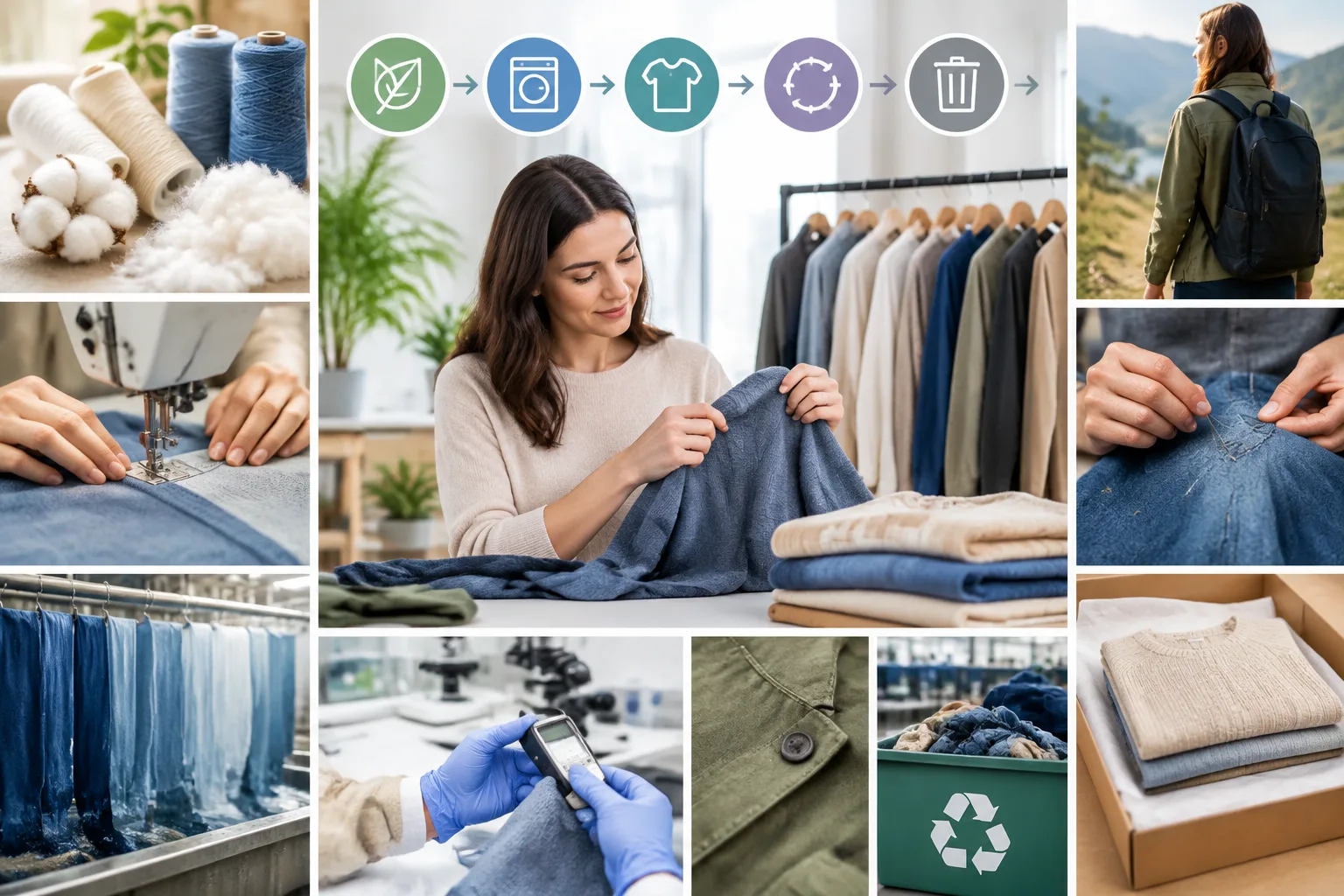
A product use phase impacts framework is a structured way to examine what happens to a garment after production and while it remains in service. It covers wearing, washing, drying, ironing, repair, reuse, and related decisions, then connects those activities with impact dimensions, evidence, assumptions, and product decisions. This guide presents the concept in practical apparel terms for designers, developers, sourcing teams, and quality professionals. Apparel Wiki is an independent educational publication; editorial support, including the information described on its Sponsor page, does not make it a manufacturer, laboratory, certifier, or sustainability assessor.
What Is a Product Use Phase Impacts Framework?
In clothing, the product use phase is the period when a garment is worn, cared for, maintained, repaired, reused, or otherwise kept in service after production and before final disposal or recovery. The boundary can include routine care and continued use by another wearer, depending on the purpose of the assessment. It is distinct from raw-material production, garment manufacturing, transport, and end-of-life activities, although decisions in one stage can influence another.
A framework does not automatically produce one correct sustainability score. Instead, it organizes the questions that must be answered: which activities apply, which impacts are being examined, what evidence is available, what assumptions are necessary, and which decision will follow. A use-phase assessment may consider energy, water, emissions, chemicals, material loss, labor involved in care or repair, and user burden. These are separate dimensions, not interchangeable measures.
The U.S. Department of Energy’s guidance on use-phase assessment describes the need for explicit analytical boundaries and assumptions when estimating use-phase energy and emissions. That principle also matters in apparel: the result depends on the garment’s function, care pathway, service-life assumption, and context. The framework can support product development, care-label review, sourcing discussions, and consumer education, but it does not replace a validated life-cycle study or a regulatory review.
Comparisons should therefore be based on equivalent functions. Comparing one kilogram of fiber with one garment worn repeatedly answers a different question from comparing two garments that perform the same role over a comparable period. A product use phase impacts framework is best understood as a transparent decision structure, not as a universal ranking system.
Which Apparel Activities Belong in the Use Phase?
A practical activity map begins with how the garment is used and maintained. Relevant activities may include:
- Wear frequency, number of wears, and duration of ownership.
- Washing, rinsing, stain treatment, drying, ironing, and steaming.
- Repairs, alterations, replacement of components, and other maintenance.
- Resale, donation, hand-me-down use, and continued wear by another person.
Not every activity applies to every product. A tailored jacket may follow a different care pathway from an athletic base layer, denim item, or delicate knit. The product’s fiber blend, color, construction, finish, comfort, washability, drying needs, durability, and repairability can all affect which activities are relevant. These attributes are product characteristics; the actual care routine is influenced by users, households, commercial laundries, and available infrastructure.
Care instructions describe intended handling, but they do not prove how garments are used in homes or commercial settings. A framework should record the recommended care pathway separately from observed or estimated behavior. It should also avoid inserting unsupported average wash frequencies, water temperatures, drying shares, or garment lifetimes into a product comparison.
Environmental and social considerations should remain distinct. Washing or drying may be evaluated through energy, water, emissions, or material-loss questions when suitable evidence exists. Repair may also involve labor, access, cost, skills, and user convenience. Those social or user considerations cannot be converted into an environmental result without a defined method and appropriate evidence.
What Variables Change a Garment’s Use-Phase Profile?
Use-phase impacts are shaped by several interacting groups of variables:
| Variable group | Examples to document |
|---|---|
| Product design | Fiber blend, construction, color, finishes, trim, durability, comfort, and repairability |
| User behavior | Wear frequency, wash interval, stain treatment, drying choice, ironing, repair, and replacement timing |
| Care infrastructure | Available washing, drying, repair, and reuse services or household equipment |
| Service life | Ownership duration, number of wears, continued use, resale, donation, and hand-me-down pathways |
| Context | Geography, household conditions, local systems, data age, and assessment assumptions |
A change in one variable can alter the interpretation of another. Greater durability and longer service may change the denominator used in a comparison, while a garment designed for lower-care handling may have different implications from a material choice made during production. These relationships require product-specific or comparative evidence; they should not be treated as universal rules.
Teams should also expect trade-offs. A change intended to reduce one concern may affect care performance, durability, comfort, color retention, or repair complexity. Water, climate impact, chemical considerations, material loss, recycled content, and labor conditions are not a single score. A material or care choice should be evaluated against the decision being made and the boundary used to evaluate it.
How to Build a Product Use Phase Impacts Framework
Product teams can build a repeatable framework by documenting the following sequence:
- Define the function. State the garment’s intended role, user, functional unit, ownership period, and service-life assumption. The comparison should describe what service the garment provides, not only what material it contains.
- Set the boundary. List the applicable wear, care, maintenance, repair, reuse, and replacement events. Identify which upstream or downstream stages are excluded so that results are not presented as a complete garment life-cycle result.
- Collect product inputs. Use the tech pack, bill of materials, care instructions, construction details, durability evidence, and relevant labeling or packaging decisions to define the product. A BOM describes what the product uses; it does not, by itself, establish use-phase impacts.
- Classify the evidence. Separate measured company or product data, validated external data, database averages, model estimates, and editorial or project assumptions. These evidence types have different levels of uncertainty and should not be presented as equivalent.
- Match dimensions and units. Describe or calculate selected dimensions using consistent boundaries and units. Do not directly rank results when one covers a complete service period and another covers only a single care event.
- Test important assumptions. Examine how conclusions change when variables such as wash frequency, drying method, ownership duration, repair, or reuse pathway change. This identifies which assumptions deserve product testing or better user data.
- Record the decision basis. Document the data date, geography, allocation method, exclusions, uncertainty, and decision made from the analysis. The framework is most useful when another reviewer can understand what is known, estimated, recommended, and still unverified.
This procedure can serve as an internal apparel development or sustainability review tool. A formal assessment, claim, or compliance decision may require an established methodology and a qualified practitioner. The framework improves consistency and transparency, but it does not turn incomplete product information into verified performance evidence.
How Should Teams Evaluate and Compare Use-Phase Results?
Use functional equivalence as the starting rule when comparing clothing use phase impacts. Two options should perform a sufficiently similar role and be evaluated over a comparable period of service. Comparing one kilogram of fiber with one garment worn repeatedly answers a different question from comparing two garments that provide the same function. The comparison should therefore state the garment role, expected service, care pathway, and system boundary before results are ranked.
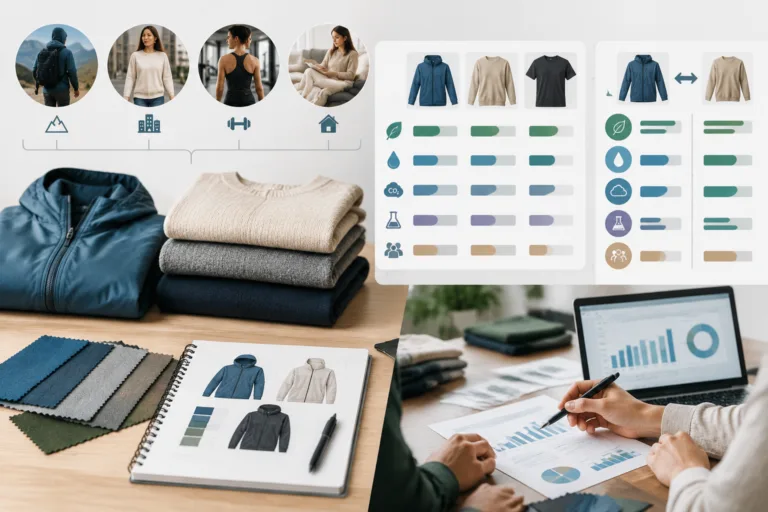
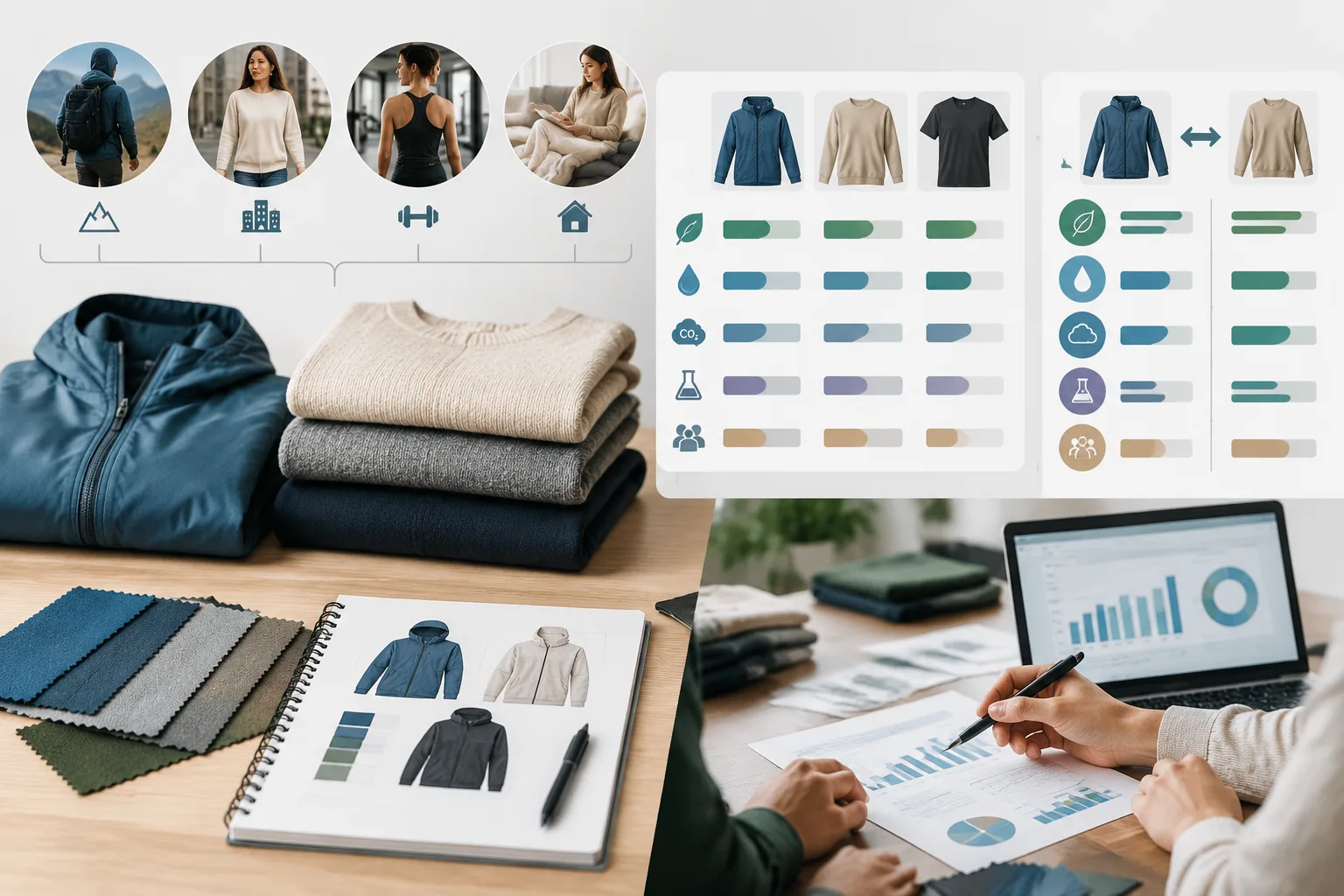
A neutral comparison matrix helps keep different concerns visible instead of reducing them to one sustainability score. Useful columns include product function, service-life assumption, wearing pattern, care pathway, impact dimensions, evidence type, data date, geography, exclusions, and trade-offs. Keep climate impact, water, chemicals, material loss, labor, and user burden as separate categories. A favorable result in one category does not automatically establish an overall environmental or social advantage.
| Comparison area | Question to document |
|---|---|
| Function and service | Do the products serve a comparable purpose for a comparable period? |
| Care pathway | Are washing, drying, ironing, stain treatment, repair, and reuse assumptions aligned? |
| Evidence quality | Is the result measured, modeled, drawn from a database average, or assumed? |
| Impact dimensions | Which environmental, social, and user-related dimensions are included? |
| Uncertainty | Which variables could materially change the conclusion? |
Classify the evidence before interpreting it. Product-specific records and test results may answer a narrower question than a model, while a database average may describe a broader context rather than the garment under review. None should be presented as equivalent. Guidance from the U.S. Department of Energy on use-phase assessment boundaries also illustrates why operating assumptions and analytical scope need to be made explicit.
When a decision depends on durability, dimensional stability, colorfastness, pilling, repairability, or care performance, record the unresolved evidence gap and consider product-specific testing. Sensitivity checks can show whether a conclusion changes when wash frequency, drying method, ownership duration, repair, or reuse assumptions change. This does not create certainty, but it identifies which assumptions deserve better evidence.
How Can Product Teams Reduce or Manage Use-Phase Impacts?
Use the framework to assign practical actions to product-development and sourcing decisions. A garment may be easier to manage when its intended use and care pathway are clear, durable, repairable, and realistic for the target user. The relevant solution depends on the product. A tailored jacket, athletic layer, denim item, and delicate knit should not be forced into the same care strategy simply because they belong to the same apparel category.
Review care instructions alongside verified product performance. Instructions should be understandable, technically justified, and consistent with the garment’s construction, materials, trims, color, finish, and expected care conditions. A care recommendation is not proof of actual household behavior, and a design intention is not proof of reduced impact. Where market-specific labeling or environmental claim requirements apply, check current guidance before publication or commercial use.
Consider the whole product rather than optimizing one input in isolation. A material or finish that appears favorable for one impact dimension may affect durability, comfort, color retention, repair complexity, or care performance. Product teams can connect assumptions to wear testing, care testing, quality records, returns information, repair feedback, and customer research. These inputs help distinguish a verified result from an editorial recommendation or an internal hypothesis.
Longer service can be supported through durable construction, maintainability, repair information, realistic reuse pathways, and component planning where applicable. However, these actions should be described specifically. State which product, metric, baseline, evidence source, and conditions support the claim. Broad terms such as “green” or “sustainable” conceal the comparison and make the statement difficult to verify. A more defensible description identifies the measured or intended improvement without implying that every impact dimension has been solved.
Limitations, Evidence Gaps, and Next Steps
A product use phase impacts framework improves consistency, but it cannot remove uncertainty from incomplete information. Enterprise records, external databases, model estimates, and project assumptions have different origins and confidence levels. Common limitations include missing consumer-use data, regional differences in care infrastructure, changing energy systems, unclear allocation, incomplete reuse pathways, and variation among seasons, sizes, colors, and constructions.
Document those limitations with the result. Record the scope, assumptions, data sources, date, geography, allocation method, exclusions, and confidence level. Also state whether a conclusion is known, estimated, recommended, or still unverified. This is especially important when an internal analysis may later inform product communication, sourcing decisions, or a public environmental statement.
A framework should not be used to make a formal claim or compliance conclusion when the decision requires a validated study, established methodology, or qualified practitioner. It is an organized decision tool, not a certification and not a substitute for laboratory, factory, consulting, or assessment services. Apparel Wiki is an independent clothing industry knowledge publication, so readers should verify formal requirements with the relevant current authority.
For a practical next step, create an evidence checklist for one product: confirm its function and expected service, map the applicable care and reuse events, identify the highest-impact assumptions, and mark each input as measured, externally validated, modeled, or assumed. Teams can then connect the findings with relevant Apparel Manufacturing Tools and decide which product tests, user research, or technical reviews are worth pursuing.
What does the product use phase mean in clothing lifecycle analysis?
It is the period after production in which a garment is worn, cared for, maintained, repaired, reused, or otherwise kept in service before final disposal or recovery.
Which clothing activities should a product use phase impacts framework include?
It may include wearing, washing, rinsing, drying, ironing or steaming, stain treatment, repairs, alterations, resale, donation, and continued use by another wearer. The relevant list depends on the product and context.
Why do washing and drying assumptions change apparel impact results?
Care pathways can differ in energy, water, emissions, chemicals, material loss, labor, and user burden. Results therefore depend on the stated garment, care method, location, and comparison boundary.
How can I compare two garments without making an unfair sustainability claim?
Compare garments with sufficiently aligned functions, service-life assumptions, care pathways, and system boundaries. Keep separate impact dimensions visible and identify whether each result is measured, modeled, or assumed.
What is the difference between measured use-phase data and modeled estimates?
Measured data comes from a defined product, process, or record. A modeled estimate applies calculations or assumptions to represent a situation. Both can be useful, but they should not be presented as equivalent evidence.
Can a product use phase framework prove that one garment is more sustainable?
Not by itself. It can organize evidence and clarify trade-offs, but a defensible comparison requires matching functions, boundaries, data quality, impact dimensions, and conditions. A formal claim may require additional validated assessment.