A clothing manufacturing agreement is the working document that turns a product idea into a production commitment. For beginners, the biggest mistake is assuming the supplier quote, sample comments, chat history, and purchase order together are “good enough.” In real apparel sourcing, problems usually start when important details are not written clearly in one place: which fabric was approved, what shrinkage is acceptable, when bulk starts, who pays if goods fail inspection, or what happens if delivery slips. A clear agreement does not replace product development work, but it helps connect product specs, business terms, and accountability before money and time are locked in.
If you are still checking whether a factory is ready for your project, this manufacturer checklist covering MOQ, sampling, lead time, payment, and QC is a useful supporting resource. It helps readers connect contract terms with the practical questions that should be clarified before sampling and bulk production, especially around minimums, development flow, approval stages, payment exposure, and how quality control will actually be handled once production begins.
What a clothing manufacturing agreement is and why it matters
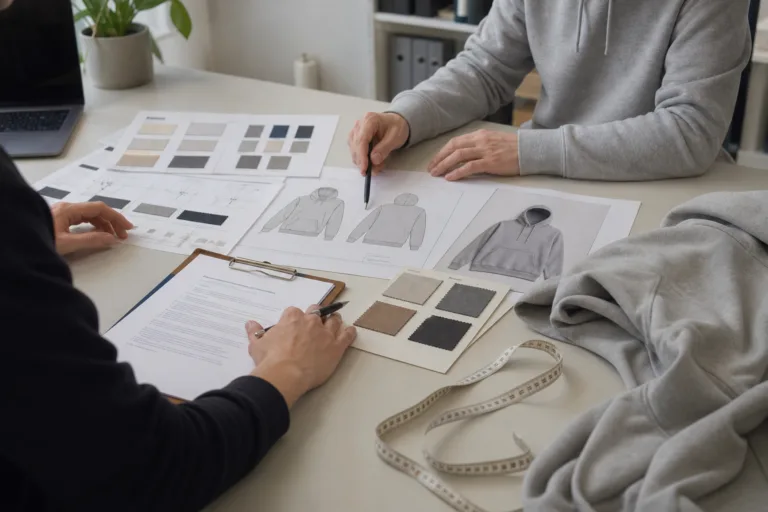
At a basic level, a clothing manufacturing agreement explains what the factory will make, how it will be made, when it will be delivered, how it will be checked, how it will be paid for, and what happens if something goes wrong. That sounds simple, but in apparel projects each of those points includes many technical details. A hoodie order, for example, is not just “make 2,000 hoodies.” It may involve fleece composition, GSM range, rib quality, drawcord type, print hand feel, chest measurement tolerance, wash result, carton packing ratio, and delivery split by color or size.
From an apparel sourcing perspective, the agreement matters because factories, brands, and trading teams often work from different documents. The contract should identify which documents control the order if there is a conflict. If the sample looks different from the tech pack, which one wins? If the quote lists 280 GSM but the approved bulk fabric comes in lighter, is that acceptable? These are not legal theory questions. They are production questions that affect cost, approval, and whether you can sell the garment as planned.
In many beginner projects, the problem is not bad intent. The problem is incomplete definition. A well-written agreement reduces the number of assumptions in the project.
Who should use an apparel production contract

Brands, startups, schoolwear programs, uniforms buyers, merch teams, and suppliers all benefit from a written apparel production contract. Small orders need it just as much as larger programs, because smaller buyers often have less leverage once production starts. If the buyer is new, the document becomes even more important since it helps translate verbal discussions into confirmed obligations.
For startups, the agreement also acts as a discipline tool. It forces the team to answer questions early: Are labels supplied by the brand or factory? Is packing polybagged individually? Is there one pre-production sample or several? Is color approval based on lab dip, strike-off, or physical fabric? These details may look minor, but they create real delay if left open.
For readers who need broader terminology support across garment development, sourcing, specs, and production communication, Apparel Wiki helps organize the basics in one place so contract review is not happening in isolation from the product itself.
Product specifications must be written before production starts
The most important section of a clothing supplier contract is often the product definition section. If the product is not described properly, every other clause becomes harder to enforce. “Premium oversized tee” is not a specification. A usable product description should point to actual development documents and approved standards.
What should be attached or referenced
- Style name or style code
- Garment category and intended use
- Approved tech pack version and date
- Bill of materials and trim list
- Fabric composition, construction, finish, and target GSM
- Color references and approval method
- Measurement chart with tolerances
- Label, hangtag, barcode, and packaging requirements
- Approved sample type that controls bulk production
A practical agreement should list the exact attachments and version numbers. If the factory receives a revised neck label artwork or size chart, the agreement should make clear that only written, dated approvals are valid. This avoids the common argument that “we used the earlier file because we did not know the update was final.”
Tech pack, BOM, size specs, colors, materials, and approved samples
For most apparel programs, the contract should point directly to the technical package. If your spec set is still weak, review this section-by-section tech pack guide before signing anything. The reason is simple: the contract can only protect what has been defined. If your chest width, body length, neck drop, care label wording, embroidery size, and carton marking are missing or unclear, the contract will not magically solve that later.
Approved samples should also be identified by type. In apparel development, “sample approved” can mean very different things. A fit sample confirms shape and measurement direction. A salesman sample may confirm appearance but not final material. A pre-production sample usually has the strongest value because it is intended to represent bulk construction, fabric, trim, artwork, labeling, and finishing. The agreement should say whether bulk can start only after written pre-production approval.
Material wording needs particular care. Instead of writing “cotton fleece,” the agreement should define whether that means 100% cotton face with cotton-rich body, a cotton-poly blend, brushed fleece, loopback French terry, enzyme wash, compact yarn, or another structure. If opacity, stretch recovery, pilling, or shrinkage performance matters, those expectations should be written as measurable criteria rather than informal comments.
| Specification area | What to write clearly | Why it matters |
|---|---|---|
| Fabric | Composition, knit or woven structure, GSM, finish, width, color standard | Controls hand feel, cost, shrinkage, and consistency |
| Measurements | POM chart, sample size, grading rules, tolerance | Reduces fit disputes and size inconsistency |
| Artwork | Placement, size, colors, print method, strike-off approval | Avoids logo and placement errors |
| Trims | Zippers, cords, snaps, labels, thread, packaging | Prevents substitution without approval |
| Sample approval | Which sample authorizes bulk and who signs off | Defines the production start gate |
Delivery terms and lead times
Lead time should never be written as one vague total number only. A better agreement breaks the timeline into stages: lab dip approval, material booking, fabric in-house, pre-production sample, bulk cut date, sewing completion, inspection window, ex-factory date, and shipping date. This makes delay easier to identify and discuss before the whole schedule fails.
Buyers should also check whether dates are calendar dates or estimated windows. If a launch depends on a specific event, retail drop, school opening, or sports season, the agreement should state whether time is of the essence and what happens if the deadline is missed. Otherwise, a supplier may treat delivery timing as flexible while the buyer treats it as critical.
Another point beginners miss is shipping term responsibility. If the goods are delayed because packing was incomplete, inspection failed, or export documents were not ready, who absorbs the cost? The contract does not need complex trade-law wording to be useful, but it should define milestone responsibility and document handover clearly.
Payment terms should match production milestones
Payment structure affects risk on both sides. Many apparel orders use a deposit plus balance model, but the exact trigger points matter. A 30% deposit against confirmed order can be reasonable in some projects. However, beginners should ask what activities that deposit covers: yarn booking, fabric knitting, dyeing, trim purchasing, pattern work, or line allocation. If the factory requires a larger advance, the agreement should explain why.
Milestone payments can reduce confusion. For example, one arrangement may use a deposit on order confirmation, a second payment after fabric approval and pre-production sample sign-off, and the final balance after inspection but before shipment. Another may keep a simple deposit/balance structure. The point is not that one model fits all. The point is that the trigger events must be written clearly.
Currency, bank charges, tax treatment, and exchange-rate assumptions should also be stated. This becomes important when a quote is discussed in one currency but invoiced in another. For buyers reviewing supplier numbers, this guide on how to compare clothing manufacturer quotes helps separate unit price from the hidden contract and service assumptions behind that price.
Do not forget cancellation cost logic. If the buyer cancels after custom fabric is dyed or branded trims are produced, the agreement should explain what non-recoverable costs are payable. Without that clause, cancellation often becomes an emotional dispute instead of a documented commercial process.
Quality standards, tolerances, inspection rules, and acceptance criteria
Quality language in beginner contracts is often too vague. Words like “good quality,” “export quality,” or “premium finish” are not inspection standards. A useful quality section should explain what will be checked, how much variation is allowed, when inspection happens, and what the buyer can do if goods fail.
In apparel production, quality usually includes several layers:
- Material quality, such as composition, GSM, shade consistency, shrinkage, pilling, or colorfastness
- Construction quality, such as seam security, skipped stitches, puckering, raw edge exposure, or incorrect SPI
- Measurement quality, based on the approved spec sheet and tolerance
- Visual quality, including stains, holes, print defects, embroidery issues, or label mistakes
- Packaging quality, such as size ratio, assortment accuracy, fold method, barcode placement, and carton marking
If the goods must meet safety or compliance expectations, that should be written directly rather than assumed. For example, children’s or specialty apparel may need defined testing, document review, or shipment holds until compliance evidence is provided. In quality-sensitive projects, it is useful to state expected apparel safety testing, inspection criteria, and compliance documentation so acceptance is tied to something measurable rather than a general promise.
The contract should also define the inspection method. Will the buyer inspect at inline stage, final packed stage, or both? Is third-party inspection allowed? What happens if the factory passes its internal check but fails the buyer’s final inspection? These are process points, not legal decoration.
If you need a more practical framework for defects, checkpoints, and approval logic, review this clothing quality control checklist for beginners. It helps convert broad quality expectations into line-by-line checkpoints that can be referenced during sampling and bulk review.
Sampling, pre-production approval, and bulk production authorization
A strong agreement separates sample stages instead of treating “sampling” as one step. In many projects, the right sequence is concept sample, fit sample, size set if needed, pre-production sample, then bulk. Not every style needs every stage, but the agreement should show the approval path used for that program.
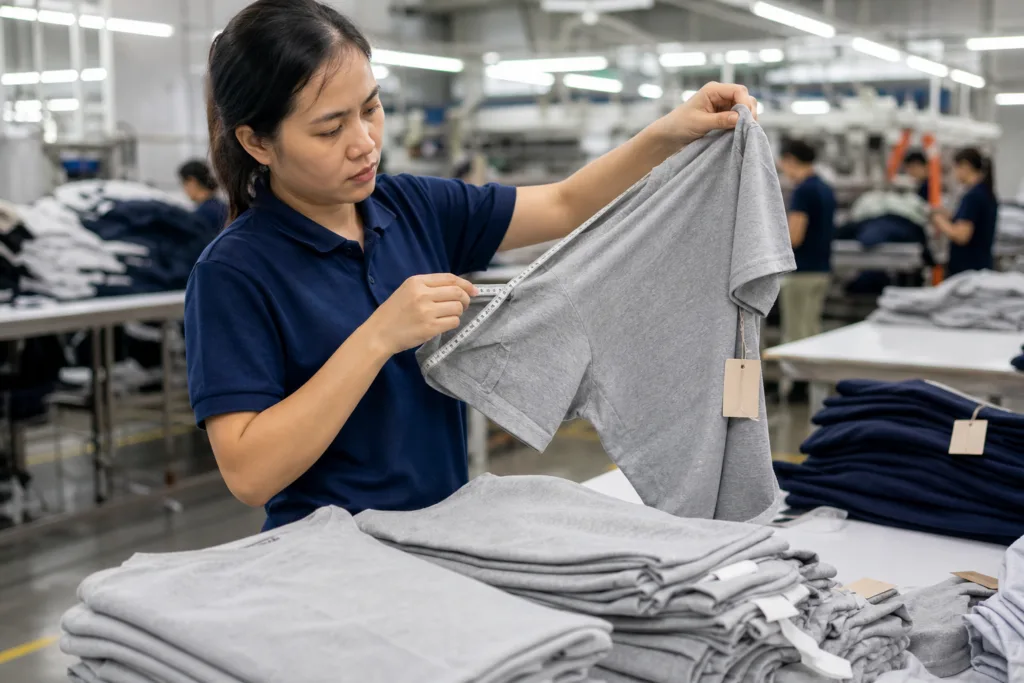
The key control point is bulk authorization. The contract should say who can approve production start, what documents or samples must be approved first, and whether verbal approval counts. In beginner projects, goods are often cut before final artwork, care label wording, or measurement comments are closed. Once fabric is cut, flexibility drops fast.
A useful clause may say that bulk production begins only after written approval of the pre-production sample, print strike-off, trim card, measurement chart, and packaging details. That may sound strict, but it usually saves time by reducing rework later.
Defects, rework, returns, and remedies for quality failures
Even with a good process, defects can happen. The agreement should explain remedies in practical terms. If the goods fail measurement tolerance, is the remedy repair, replacement, sorting, discount, rejection, or credit against a future order? If logos are printed incorrectly, does the factory rework at its own cost? If only one colorway fails, can the buyer accept the rest?
Remedy wording should also cover logistics. Who pays for return freight, local disposal, reinspection, repacking, or air freight required to replace failed goods? If rework happens at destination, who approves the method and checks the result? Beginners often focus on unit price and forget that failure cost can be much larger than the original manufacturing margin.
Another overlooked point is response time. If defects are found, how many days does each party have to notify the other, submit evidence, and agree a solution? A short, clear process keeps problems from drifting while the commercial impact gets worse.
Breach clauses: delays, non-performance, cancellation, and liability
A breach clause explains what counts as a serious failure under the agreement and what the non-breaching party can do. In apparel projects, common breach situations include failure to deliver on time, unauthorized material substitution, refusal to correct rejected goods, non-payment, repeated quality failure, or disclosure of confidential product information.
From a buyer’s perspective, it helps to separate minor breach from material breach. A small documentation error may be fixable. Shipping bulk goods made from the wrong fabric is more serious. The agreement should also define cure periods when appropriate. That means the supplier or buyer gets a defined number of days to fix the issue before stronger remedies apply.
Liability language should be practical. If the supplier delays and the buyer misses a campaign, the contract may not cover every business loss, but it can still define credits, cancellation rights, refund triggers, or responsibility for direct rework cost. Clear limits help both sides understand the real exposure before production starts.
Intellectual property, logos, patterns, tech packs, and ownership
Intellectual property is often treated casually in startup apparel projects, but it should not be. If the brand supplies artwork, size labels, original prints, technical drawings, pattern files, packaging graphics, or custom wash concepts, the agreement should state who owns those assets and how the supplier may use them. This matters even when the relationship is friendly.
In plain English, do not assume that sending a file means ownership and usage rights are already understood. The contract should state whether the supplier is receiving a limited production license only, whether they can use the asset for no other customer, whether molds or patterns must be returned, and what happens to digital files after the order ends. For readers reviewing design ownership, artwork rights, patterns, and tech pack IP, it is useful to understand that clothing can involve both functional and artistic elements, so ownership and usage language should be written clearly instead of assumed.
This section is especially important for private label and custom development programs. If the supplier contributes pattern engineering or fit corrections, the agreement should say whether those modifications become part of the buyer-owned package or remain shared know-how. Otherwise, a later supplier transfer becomes more difficult.
Confidentiality and non-disclosure for designs and product information
Confidentiality is related to IP, but it is not exactly the same. IP ownership says who owns the asset. Confidentiality says the factory should not disclose, copy, share, or use the information outside the authorized order. A contract should cover artwork, tech packs, size charts, customer lists when shared, pricing, sourcing details, and launch timing where relevant.
For apparel products, a good confidentiality clause also addresses physical samples and overrun risk. Can the supplier keep marked samples? Can they photograph the style for their portfolio? Can leftover branded labels or printed panels be sold or used elsewhere? These are practical controls, not abstract legal ideas.
Common clauses beginners often miss
Several useful clauses are often missing from a beginner clothing manufacturing agreement:
- Subcontracting approval: Can the supplier move cutting, printing, washing, or sewing to another unit without permission?
- Material substitution restriction: No change to fabric, trim, thread, or packaging without written approval.
- Excess and shortage allowance: What quantity variance is acceptable on delivery?
- Record retention: How long must approvals, test reports, and production records be kept?
- Tooling and pattern custody: Who owns graded patterns, molds, screens, or embroidery files?
- Label and packaging accuracy: Who signs off legal wording, care content, and barcode data?
- Dispute process: What is the communication and escalation path before formal action?
These details matter because many production failures happen through side decisions. A factory may not think moving embroidery to a different subcontractor is a big issue, but that change can affect stitch density, thread shade, lead time, and defect risk.
Red flags to watch for before signing
Watch for contracts that stay vague where the supplier keeps flexibility but the buyer carries the risk. Examples include open wording around fabric substitution, broad delivery windows, no inspection method, no remedy for failed goods, or a deposit requirement with no milestone visibility. Another red flag is resistance to attaching the approved tech pack or pre-production sample reference. If a factory is unwilling to tie the order to the approved specification, that creates avoidable ambiguity.
Be cautious if the supplier insists that sample approval automatically waives all later quality claims. Sample approval should confirm the approval point, not remove the supplier’s responsibility to match the approved standard in bulk. Also be careful if the factory wants the right to substitute “equivalent” materials without defining what equivalent means.
Beginners should pause when a contract is copied from another industry or another product type. Apparel needs garment-specific detail. Fabric behavior, color matching, measurement tolerance, trim consistency, and packing errors are normal apparel issues and should be addressed directly.
Final pre-signature checklist for beginners

Before signing, read the document against the real production flow rather than the legal wording alone. Ask yourself whether a new merchandiser, factory planner, QC team member, or freight coordinator could follow the file and understand what must happen next. If not, the document is still too abstract.
- Are the exact style codes and document versions listed?
- Is the approved sample type identified?
- Are fabric, trim, color, measurement, and packaging standards attached?
- Are lead time milestones written instead of one vague delivery promise?
- Are payment triggers tied to real production events?
- Are inspection stage, tolerance, and acceptance criteria clear?
- Are defect remedies and cost responsibility stated?
- Are IP ownership and confidentiality terms specific?
- Are cancellation, delay, and breach consequences defined?
- Is subcontracting or material substitution controlled?
At Apparel Wiki, the practical view is simple: a clothing manufacturing agreement works best when it is treated as an operating document, not just a signature form. If product details are weak, strengthen the product file. If supplier responsibilities are unclear, write them. If timing is critical, define milestones. The goal is not to make the document complicated. The goal is to make fewer things arguable later.
Frequently asked questions about clothing manufacturing agreements
Do I need a clothing manufacturing agreement for a small startup order?
Yes. Small orders often need clear written terms even more than large programs because beginners usually have less leverage once fabric is booked or production starts. A simple agreement can still cover specs, sample approval, payment timing, delivery dates, quality standards, and what happens if the goods are late or defective.
What document is more important, the contract or the tech pack?
They do different jobs and both matter. The contract should define responsibilities, payment, timing, remedies, and ownership, while the tech pack defines the garment itself. In practice, the contract should reference the approved tech pack version so there is no confusion about which specifications control bulk production.
How detailed should quality standards be in an apparel contract?
Detailed enough that a QC person can inspect against them without guessing. That usually means measurable tolerances, approved fabric and trim standards, workmanship expectations, packaging rules, and a clear inspection stage. Terms like premium quality are not enough on their own because they do not explain how acceptance will be decided.
Can a factory change fabric or trims if the replacement looks similar?
Not unless the agreement allows it and the buyer gives written approval. Similar appearance does not guarantee the same GSM, shrinkage, hand feel, durability, colorfastness, or cost. Material substitution should be controlled because it can change fit, performance, and customer satisfaction even when the garment looks close at first glance.
What is the biggest payment mistake beginners make?
Paying against vague promises instead of defined milestones. A beginner-friendly agreement should state what triggers each payment, such as order confirmation, approved pre-production sample, passed inspection, or shipment release. That keeps the money flow connected to actual progress and reduces disputes about whether the supplier has earned the next payment.
Why should IP and confidentiality be included in a clothing manufacturing agreement?
Because apparel projects often involve custom artwork, private label branding, patterns, measurements, and development files that should not be reused or shared freely. The agreement should state who owns those assets, how the supplier may use them, whether use is limited to the order, and what happens to files, samples, and branded leftovers after production ends.