
A clothing manufacturer quote is not just a price per piece. In apparel sourcing, it is a summary of assumptions about fabric, trims, construction, order quantity, packing, delivery terms, and production risk. Two factories can quote the same T-shirt or hoodie style with a similar unit price while covering very different things. That is why buyers who compare quotes only by the headline number often run into problems later.
If you are also trying to understand how quote inputs connect to margin planning, target FOB, and style budgeting, the apparel costing and pricing tools hub is a useful supporting resource. It helps readers connect specification decisions with costing logic, compare pricing structures more clearly, and think through the numbers that usually affect development, bulk production, and final sourcing decisions.
What a clothing manufacturer quote really means
When a factory sends a clothing manufacturer quote, they are usually pricing a specific combination of product details and business conditions. That includes the garment type, fabric construction, composition, GSM, color count, size range, artwork method, order volume, and shipping term. A quote can also reflect assumptions the factory made because the tech pack was incomplete.
For buyers, the key is not only whether the quote looks cheap or expensive. The real question is whether the supplier priced the same product you think you asked for. In many projects, the problem is not that the buyer chose the wrong supplier. The problem is that some production details were not clarified before sampling or bulk confirmation.
From an apparel development perspective, a quote should be read as a technical and commercial document. It tells you what is included, what is excluded, what is estimated, and what may change later. If those points are not clear, the unit price alone has very little value.
What a clothing manufacturer quote should include

A usable apparel quote should break down enough detail for the buyer to understand cost drivers and commercial conditions. Some factories provide only one final price, but that format makes comparison difficult. A better quote usually includes at least the points below.
| Quote element | What it should clarify | Why it matters |
|---|---|---|
| Garment description | Style type, gender or fit block, fabric type, colorway, size range | Prevents the factory from pricing a different product basis |
| Fabric details | Composition, GSM, knit or woven type, finish, dyed or heather basis | Fabric is often the largest cost component |
| Construction | Seams, rib, placket, lining, pocket count, reinforcements | Labor time changes with complexity |
| Decoration | Print method, embroidery stitch count, patch type, placement count | Decoration can change setup cost and unit cost |
| Trims and labels | Main label, care label, hangtag, drawcord, zipper, polybag, carton | Missing trims create after-quote add-ons |
| Sampling charges | Pattern fee, development sample fee, fit sample fee, pre-production sample fee | Development cost may be separate from bulk price |
| MOQ | Per style, per color, per size set, per fabric | Low quantity often increases cost sharply |
| Lead time | Sampling timeline and bulk production timeline | Short lead times may require surcharges or different materials |
| Price term | EXW, FOB, DDP, named port or destination | Needed for real cost comparison |
| Payment terms | Deposit, balance timing, sample payment, tooling payment | Affects cash flow and supply risk |
If the quote is for a package service rather than cut-make-trim only, the buyer should also confirm the full-package quote scope and pricing basis. Some suppliers include fabric sourcing, pattern support, labels, packing, and export documents in one number, while others treat several of those items as separate charges.
FOB, EXW, and DDP change the real cost
One of the biggest quote comparison mistakes is judging prices across different incoterms as if they were equal. An EXW price may look lower than an FOB or DDP price, but that does not automatically mean it is cheaper. It may simply exclude more responsibilities. In practice, buyers need to normalize freight, customs handling, delivery responsibility, and import-related costs before deciding which supplier is actually more competitive.
Compare quoted prices under EXW, FOB, and DDP before making any decision. The commercial term affects who handles export formalities, main transport, import process, and final delivery. A factory offering a low EXW price may still lead to a higher landed cost once local transport, freight, customs brokerage, duty, and final-mile delivery are added.
FOB is common in apparel sourcing, but buyers should still confirm the named port and exact responsibility split. An FOB Shenzhen quote and an FOB Shanghai quote are not identical if inland transport and export handling differ. A DDP quote can be easier for some small brands because more logistics are bundled, but the buyer should understand whether duties, taxes, and destination charges are really included or only estimated.
If the goal is budget accuracy rather than just supplier screening, use a consistent landed-cost framework. Apparel Wiki often recommends comparing supplier quotes only after they are converted into the same basis. The related guide to landed cost and import duties is useful when the buying team needs to see how freight, duty, and import charges change the final cost per unit.
Sample fee, pattern fee, and development fee are not the same thing
Factories use development charges in different ways, and this causes confusion for new buyers. A sample fee may cover the physical sample sewing, basic materials, and handling. A pattern fee may cover pattern making or pattern adjustment if the style is new. A development fee may be broader and include technical review, sourcing work, mockups, or repeated sample revisions.
These charges are not always hidden costs. In many cases, they reflect real labor and development time before bulk production exists. The practical issue is transparency. Buyers should ask whether each fee is one-time, per revision, per colorway, or refundable against a bulk order.
For example, a hoodie sample may require a pattern adjustment for dropped shoulders, a custom rib color, an embroidery test, and a wash trial. If the supplier quotes only a low sample fee without explaining those tasks, later revision charges may appear. A better approach is to ask for a simple development cost structure upfront.
Fabric cost in the quote needs more context than composition alone
Fabric cost can move significantly even when two materials sound similar on paper. A 100% cotton single jersey at 160 GSM is not the same cost basis as a 100% cotton compact-spun jersey at 220 GSM with enzyme wash and reactive dyeing. The quote should show whether the price is based on actual approved fabric, a previous bulk reference, or an estimated market fabric.
The most important fabric questions usually include:
- Is the fabric knitted or woven to order, or taken from stock?
- Is the GSM finished GSM or greige estimate?
- Does the composition require certification or special yarn sourcing?
- Is the fabric brushed, peached, washed, moisture-wicking, or otherwise finished?
- Does the quote assume shrinkage allowance or post-wash measurement change?
This detail may look small, but it can create problems later if it is not confirmed early. A T-shirt quoted on a 180 GSM estimate may become more expensive after the buyer approves a heavier fabric with lower torque and better opacity. A hoodie quoted in standard fleece may change once the buyer asks for cotton-rich face quality suitable for screen printing.
To compare quotes properly, buyers should line up the exact bill of materials basis. If one supplier priced based on broad assumptions and another priced line by line, the more detailed quote may initially look higher even though it is more realistic. In many development workflows, a clear apparel BOM preparation guide helps reduce this mismatch before quotations are requested.
Labor, decoration, and construction details drive pricing more than many buyers expect
Fabric is often the biggest component, but labor complexity still matters. A basic tubular T-shirt with a neck rib and hem coverstitch is very different from a panelled performance top with mesh inserts, flatlock seams, reflective transfer, and zipper pocket. The garment category may sound similar, but the labor minutes are not.
Common labor and construction factors that increase quote cost include:
- More pattern panels and more seam operations
- Lined hoods, plackets, collars, cuffs, or bindings
- Pockets, bartacks, zip guards, or reinforced stress points
- Special stitch types, seam taping, or flatlock construction
- Garment wash, softener wash, pigment wash, or other post-sewing finish
- Tight measurement tolerances or strict shade consistency requirements
Decoration can also be quoted in very different ways. Screen printing may be priced by number of colors, print size, and print positions. Embroidery may depend on stitch count, backing, thread colors, and run speed. Heat transfers can vary by material type, size, and application count. If one factory says “logo included” and another breaks out print setup and per-piece application, the cheaper-looking quote may simply be less transparent.
This is one reason a sourcing team should not rely on a short email summary alone. Use a structured check process and ask the right follow-up questions. The article on questions to clarify manufacturing quotes is especially useful when a quote looks acceptable at first glance but still leaves technical or commercial gaps.
Common unit price traps in apparel quotes
The most common quote trap is a low unit price built on a different assumption set. That can happen intentionally or simply because the factory was not given enough information. Either way, the result is the same: the buyer thinks they are comparing equal offers, but they are not.
Low MOQ pricing that is not scalable
A quote for 100 pieces may be far higher than a quote for 1,000 pieces because fabric wastage, setup, and labor efficiency change with volume. Some suppliers quote attractively at a headline MOQ but expect style simplification or stock fabric usage. Others quote a low trial quantity, then reprice sharply when the size ratio or color breakup becomes clear.
Excluded trims and labels
Main labels, care labels, hangtags, size stickers, polybags, warning labels, and export cartons are often treated as small details. In real projects, they can become a measurable cost difference. If one quote says “packing included” and another specifies exact bag thickness, barcode sticker count, and carton standards, the second quote is easier to trust.
Freight or shipping assumptions missing
If no incoterm or named destination appears, the quote is incomplete for cost comparison. Even where buyers plan to handle shipping separately, the quote should at least say whether inland transport to port, export paperwork, and loading are included.

Vague tolerance or quality basis
Pricing can change when a buyer requires tighter shrinkage limits, shade matching, pilling resistance, or wash consistency. A low quote may assume general commercial quality, while another assumes testing and tighter controls. If quality expectations are not aligned, the comparison is weak.
After-quote add-ons
These usually appear as mold charges, strike-off charges, embroidery tape charges, carton upgrades, label application fees, or document fees. Not all add-ons are unreasonable. The issue is whether they were visible early enough for the buyer to budget properly.
How to compare quotes on the same specification basis
The practical method is simple: normalize the inputs before you compare the outputs. Ask each factory to quote from the same tech pack, same BOM, same quantity ladder, same size ratio, same color count, same decoration requirement, and same delivery term.
Then compare on these points:
- Unit price by quantity break
- Development charges and refund conditions
- Fabric assumptions and whether swatches were approved
- Included trims, labels, and packing materials
- Incoterm and named port or destination
- Lead time from approval, not from inquiry date
- Payment terms and currency basis
- Quality assumptions, tolerances, and test expectations
From a garment sourcing perspective, this is where structured knowledge matters. Buyers who are still building their internal process can use Apparel Wiki as a reference point for terminology, construction details, sourcing logic, and production planning concepts that often affect quote accuracy.
Quote comparison table template
A side-by-side table helps remove emotion from supplier decisions. It forces the team to compare what is actually included rather than reacting to the lowest visible number.
| Comparison point | Factory A | Factory B | Factory C |
|---|---|---|---|
| Style and version quoted | |||
| Quantity and color breakdown | |||
| Fabric composition and GSM | |||
| Fabric source basis | |||
| Decoration details included | |||
| Labels and packaging included | |||
| Sample fee | |||
| Pattern or development fee | |||
| Incoterm and named location | |||
| Bulk lead time after approvals | |||
| Payment terms | |||
| Key exclusions | |||
| Likely cost risks |
This kind of comparison is especially useful when sourcing teams receive quotes in different formats. One factory may submit a formal PDF, another may use a spreadsheet, and another may send a short message. The format should not decide credibility by itself. The level of technical clarity should.
How to judge if a quote is realistic or risky
A quote that is too high may simply reflect a premium fabric, stricter quality basis, or higher service level. A quote that is too low may reflect missing costs, unapproved fabric assumptions, or a factory trying to win the order first and solve pricing later. Neither extreme should be accepted without review.
Signs that a quote may be realistic include clear material assumptions, quantity breaks, identified exclusions, sensible lead times, and answers that remain consistent when follow-up questions are asked. Signs that a quote may be risky include round-number pricing with no breakdown, no mention of trim or packing, no incoterm, and major changes each time the buyer asks for clarification.
For example, if three factories quote a fleece hoodie and one is 25% below the others, do not assume it is a better deal. Check whether the low quote used a lower GSM fleece, a polyester-heavy blend instead of cotton-rich fleece, or omitted lining, drawcord ends, labels, or print setup.
Red flags that suggest poor transparency
Some red flags are commercial, and some are technical. Both matter.
- The supplier cannot explain what is included in the unit price.
- The quote does not mention fabric composition, GSM, or trim basis.
- The supplier avoids naming the incoterm clearly.
- The lead time sounds very short but no material source is identified.
- Sample charges keep changing without a clear development scope.
- The supplier says quality will match the reference photo without asking for specifications.
- The unit price is valid for very little time because the quote was built on uncertain assumptions.
These issues do not always mean the supplier is unreliable, but they do mean the buyer should slow down. In apparel sourcing practice, fast quotation without detail often leads to slow problem-solving later.
Example: comparing three quotes for the same hoodie
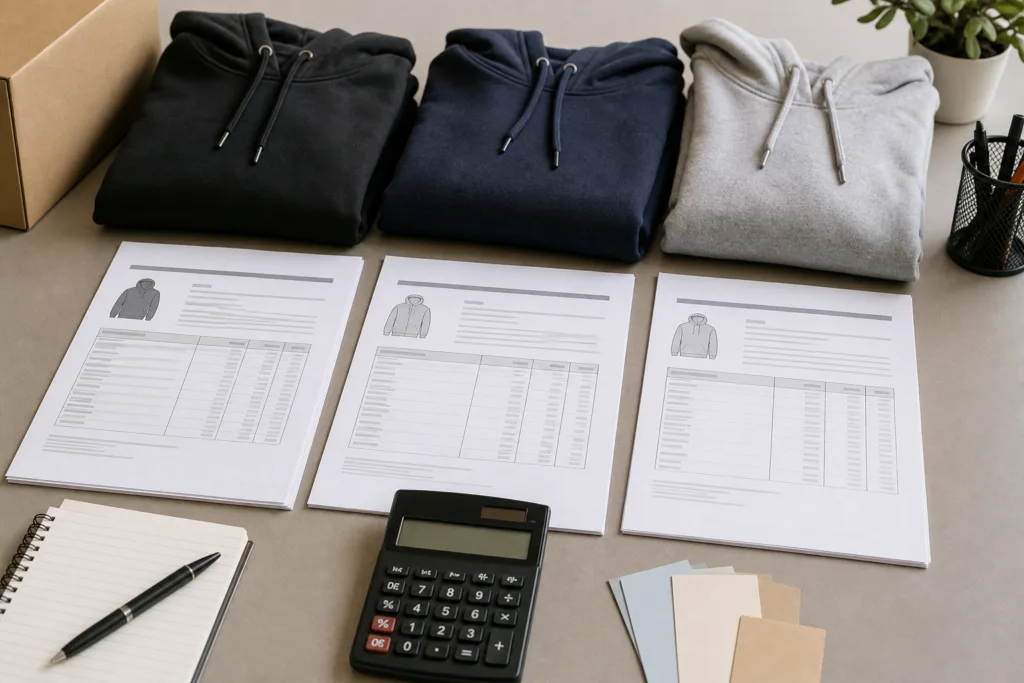
Let’s look at what actually affects the result. Imagine three factories quoting a 320 GSM brushed fleece pullover hoodie with chest print, kangaroo pocket, self-fabric hood, rib cuff and hem, woven main label, care label, hangtag, polybag, and export carton. Quantity is 1,000 pieces across 2 colors.
| Item | Factory A | Factory B | Factory C |
|---|---|---|---|
| Unit price | $8.40 EXW | $9.10 FOB | $10.20 DDP |
| Fabric basis | 300 GSM estimate | 320 GSM approved swatch | 320 GSM approved swatch |
| 1-color included | 1-color included with setup | 1-color included | |
| Labels and packing | Basic labels only | All specified trims included | All specified trims included |
| Lead time | 25 days | 35 days | 35 to 40 days |
| Development fees | Sample fee only | Sample plus refundable pattern fee | Sample included in service package |
| Risk note | Likely reprice after fabric approval | More reliable comparison basis | May simplify import handling for buyer |
At first glance, Factory A looks cheapest. But once the fabric is corrected from 300 GSM estimate to approved 320 GSM fleece, labels and packing are upgraded, and shipping responsibility is normalized, the cost gap may become small or disappear. Factory B may be the clearest quote for direct supplier comparison. Factory C may be useful for a buyer who values simpler import handling and wants a delivered-cost basis.
How to turn a quote into a more accurate budgeting number
For budgeting, do not stop at the supplier’s unit price. Build a working landed estimate that includes development cost allocation, freight assumptions, duty, inspection cost if needed, banking fees where relevant, and a buffer for likely quote changes. This is especially important when the style is still under development.
A practical budgeting method is:
- Start with the quote on a normalized basis such as FOB or landed basis
- Add one-time development charges divided over expected order quantity
- Add testing, inspection, and approval sample courier cost if relevant
- Add duty, taxes, and freight according to destination
- Add a contingency for material adjustment if fabric is not yet locked
This approach gives a working cost closer to reality. It also helps brand teams decide whether they need to adjust the garment spec, reorder quantity, fabric choice, or target retail price before moving into sampling or bulk commitment.
Questions to ask before accepting a quote
Before approval, ask the factory to confirm the exact version quoted, fabric basis, decoration method, included trims, production lead time starting point, and all exclusions. Also ask what factors would trigger a reprice. This question alone often reveals whether the quote is stable or only provisional.
Useful questions include whether the fabric is based on approved swatch or estimate, whether testing or shade band approval is assumed, whether packaging follows buyer spec or factory standard, and whether the MOQ applies per style, per color, or per color-size ratio. If the supplier answers clearly and consistently, the quote is much easier to trust.
Conclusion
A clothing manufacturer quote should be treated as a production decision document, not just a price tag. The useful comparison is not who sent the lowest number first. It is which supplier quoted the same product basis, stated the same responsibilities, and gave the clearest picture of what will happen in development and bulk production.
For apparel brands and sourcing teams, better quote comparison usually comes down to three habits: define the specification basis clearly, normalize the commercial term, and challenge anything vague before approving the order. When those steps are done properly, it becomes much easier to separate a realistic quote from one that only looks attractive at first glance.
FAQs
What is the most important thing to check in a clothing manufacturer quote?
The most important point is whether the quote is based on the exact same product specification you want to buy. That means fabric composition, GSM, trims, decoration, MOQ, and delivery term must be clear. If those assumptions are vague, the unit price alone is not reliable for comparison.
Why are two quotes for the same garment sometimes very different?
Two quotes can differ because the factories priced different fabric qualities, construction methods, packaging levels, or shipping terms. One supplier may also include setup, labels, or testing assumptions while another excludes them. The difference is often not just margin; it is the specification basis behind the price.
Is a lower clothing manufacturer quote always better?
No. A lower quote may exclude trims, use estimated material quality, apply a different incoterm, or assume looser quality control. In apparel production, a quote that looks cheaper at the start can become more expensive once missing items, revisions, or logistics costs are added.
Should sample fees be refundable in apparel manufacturing?
Sometimes, but not always. Some factories refund sample or pattern charges when a bulk order reaches an agreed quantity, while others treat development work as a separate non-refundable service. The practical step is to confirm refund conditions in writing before sampling starts.
How can I compare FOB and EXW quotes fairly?
You need to convert them to the same basis by adding the missing logistics and handling costs to the EXW quote or by stripping non-comparable delivered costs from the other quote. A fair comparison only happens when transport responsibility, export handling, import costs, and destination charges are normalized.
What usually causes a quote to change after sampling?
The most common reasons are fabric upgrades, GSM correction, trim changes, revised artwork, added operations, adjusted measurements, or order quantity changes. In many projects, the quote changes because the first price was based on estimated inputs rather than approved production specifications.