Stretch wrapped yarn count is not a universal number that describes every part of a yarn. Yarn count indicates fineness or linear mass, while “stretch wrapped” describes a construction in which a stretch component may be covered or wrapped by another yarn. The direct answer is to specify both the construction and the count system: state whether the number applies to the complete wrapped yarn, the elastic core, or a covering yarn, and identify the unit or numbering convention.
That distinction matters when a sourcing team compares quotations, prepares a product specification, or checks a sample. A number such as 90 may refer to denier, a component count, or a supplier’s commercial notation; it cannot be interpreted reliably without its basis. Apparel Wiki is an independent educational publication, and its Sponsor page explains the site’s editorial independence. The guidance here is for specification and review, not manufacturing, testing, or supply.
What Does Stretch Wrapped Yarn Count Mean?
Yarn count is a way to describe yarn size through either mass per unit length or length per unit mass. In a direct system, the measurement expresses how much a specified length weighs. In an indirect system, it expresses how much length corresponds to a specified mass. These descriptions concern the yarn’s linear size; they do not, by themselves, identify diameter, stretch recovery, covering security, hand, or fabric behavior.
A stretch wrapped yarn is generally understood as a yarn construction involving a stretch element and one or more covering or wrapping elements. The exact arrangement may vary by product and supplier, so the construction should be confirmed from technical documentation rather than inferred from the phrase alone. A covered stretch yarn may therefore have several relevant counts: one for the finished yarn and separate counts for its core or covering components.
For procurement, the key question is: what does the stated count apply to? A finished-yarn count describes the assembled yarn as supplied. A core count describes only the elastic or stretch component. A covering count describes a yarn before or during the wrapping arrangement. Those values are not interchangeable, even when they use the same unit. The construction, component identity, and measurement basis must remain attached to the number.
A usable yarn count specification should therefore identify the count system, unit, yarn basis, component or finished-yarn status, ply or covering structure, and any relevant test or conditioning information. If a supplier provides only a bare number, record it as incomplete rather than silently assigning a meaning. A short clarification request at this stage can prevent a converted component value from being entered as the count of the complete stretch wrapped yarn.
Direct and Indirect Yarn Count Systems Explained
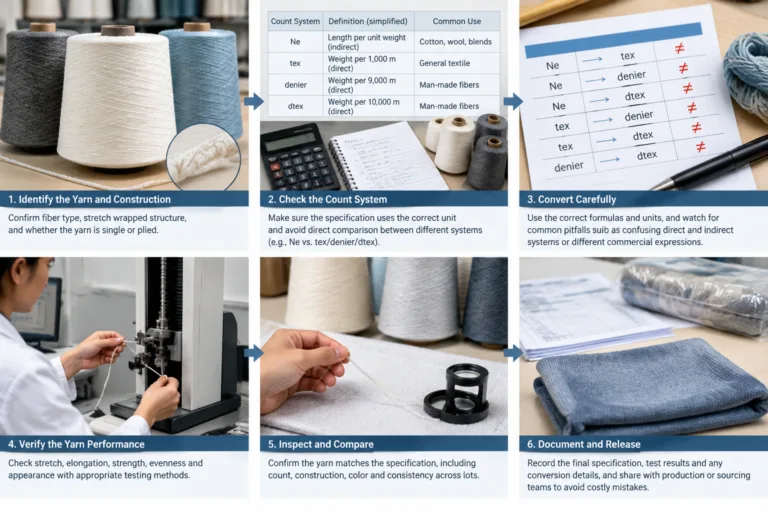
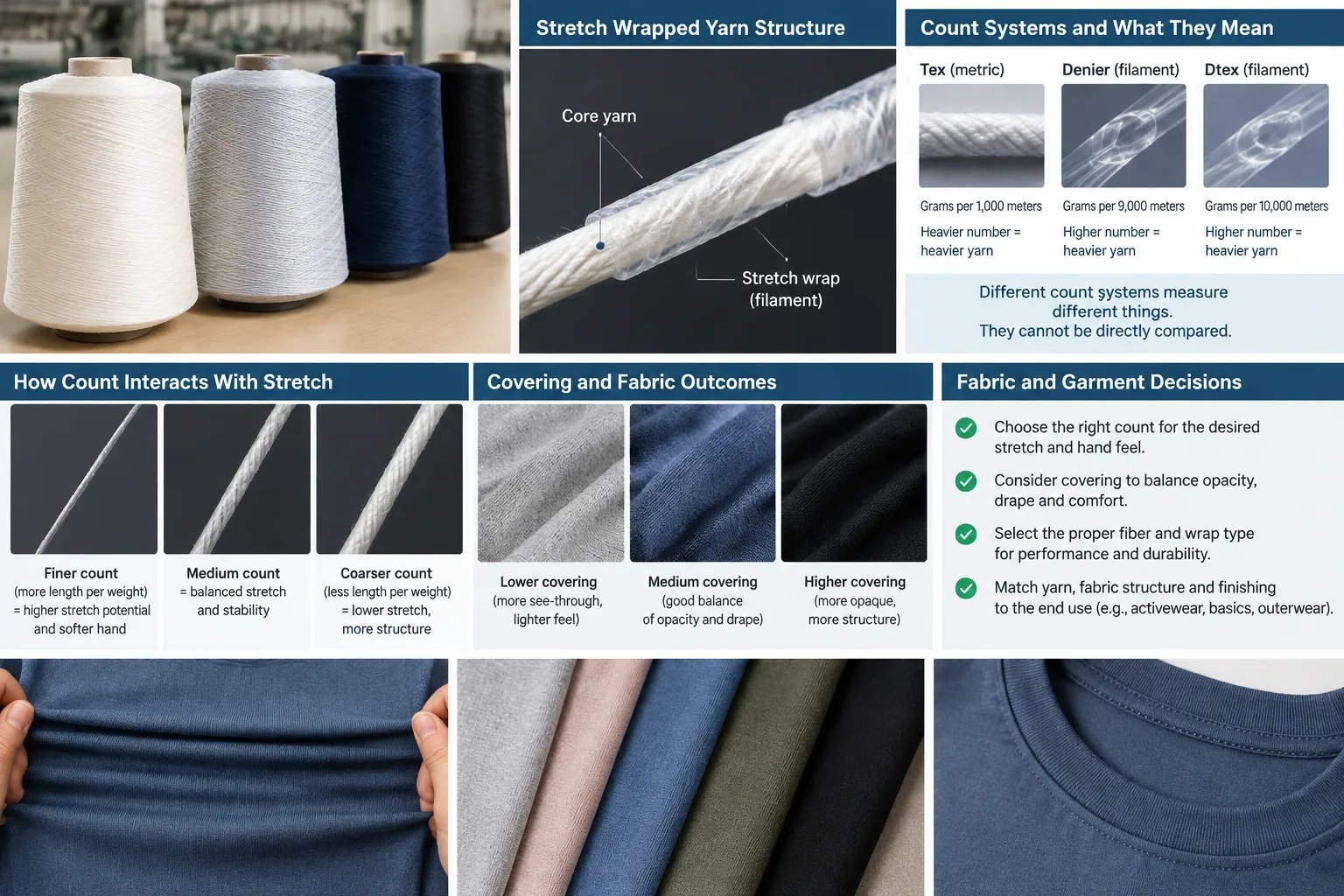
The main families of yarn numbering systems differ in what their numbers represent. Tex is the mass in grams of 1,000 meters of yarn. Denier is the mass in grams of 9,000 meters. Dtex is the mass in grams of 10,000 meters. These are direct count systems because they express mass against a fixed length.
Within the same direct system and the same yarn basis, a larger number indicates greater mass per unit length. That does not mean the yarn will always have a proportionally larger diameter. Fiber density, construction, twist, packing, and the presence of multiple components can affect the physical form of the yarn. The number should be read as a linear-mass description, not as a complete visual or performance prediction.
Indirect systems work in the opposite numerical direction. They express the length associated with a fixed mass, so a larger count generally indicates a finer yarn within that particular system and convention. Metric count and English cotton count are examples of indirect approaches, but their calculation bases and notation must be stated precisely. The same-looking number can carry a different meaning when the system, fiber convention, or market notation changes.
This is why direct and indirect counts cannot be compared by looking only at their numbers. A direct value becomes numerically larger as mass per fixed length increases; an indirect value becomes numerically larger as length per fixed mass increases. When reviewing a stretch wrapped yarn, first identify the system and then confirm whether the value refers to the complete construction or one component. Neither tex, denier, dtex, nor an indirect count is automatically preferable; suitability depends on the specification and application.
How to Convert Stretch Wrapped Yarn Counts Without Losing the Meaning
Conversion is useful when two specifications use different direct units, but it is only a unit translation. Before calculating, confirm that the original value is a direct count and that both values refer to the same yarn basis. Do not convert the elastic core count and label the result as the finished wrapped-yarn count. Keep the supplier’s original notation beside any converted value in purchase records and technical files.
For a hypothetical direct-count example:
tex = denier / 9dtex = tex x 1090 denier = 10 tex = 100 dtex
The example is mathematical only. It assumes that “90 denier” is a direct count for the same yarn basis being expressed in tex and dtex. It does not establish the yarn’s diameter, stretch percentage, covering ratio, bulk, hand, or expected knitted or woven performance. Two yarns with mathematically equivalent linear mass can behave differently if their fibers, component proportions, twist, covering arrangement, or fabric use differ.
Do not apply the direct-count relationships to Ne or another indirect count without identifying the relevant convention and using its system-specific relationship. An indirect count requires more than substituting its number into a denier-to-tex equation. If the supplier’s notation is unclear, preserve the original value and request the calculation basis before entering a converted figure into a comparison sheet.
The Count Details Suppliers Commonly Leave Ambiguous
The first clarification is whether the stated count belongs to the finished wrapped yarn, the elastic core, the covering yarn, or a component before wrapping. Ask the supplier to name the measured object in words, not only through a product code. This is especially important when a quotation uses a familiar number without stating whether it is a component count or the linear mass of the assembled yarn.
Next, separate single-yarn count from ply or doubled-yarn notation. A format such as a number followed by a slash and another number may describe a construction, but its meaning can vary by product and supplier. Do not assume that the notation identifies the finished count, the count of each single, or the number of components. Require the supplier to explain the format and retain that explanation with the specification.
A complete record should also identify the fiber or polymer type, relevant component ratio, construction terminology, and whether the value is nominal or measured. Clarify whether the number is mass-based or length-based, whether a conditioning or test procedure applies, and whether it is a technical measurement or a commercial designation. These details are not administrative extras: they determine what can legitimately be compared.
Place the count system and unit directly beside the value on quotations, lab submissions, purchase orders, and approved specifications. If the supplier uses a market-specific convention, record that convention rather than normalizing it without explanation. Supplier clarification is a quality-control step, not an accusation of error. The goal is a traceable description in which the original notation, yarn basis, construction, and measurement context remain connected.
A Practical Workflow for Checking a Stretch Wrapped Yarn Specification
A reliable specification starts with preserving the supplier’s information before trying to standardize it. Copy the original value, unit, notation, product name, and construction description exactly as provided. This creates a traceable reference and prevents a later conversion from replacing the information needed to interpret the yarn.
- Identify the count system. Confirm whether the value is expressed as denier, tex, dtex, an indirect count, or a commercial designation. Do not infer the system from the number alone.
- Identify the yarn basis. Ask whether the count applies to the complete wrapped yarn, the elastic core, the covering yarn, or another component before assembly.
- Convert only when necessary. If another unit is needed for a buyer, pattern, machine, or comparison, show the equation and retain the original value beside the converted result.
- Compare like with like. Match the finished-yarn basis, count system, construction description, fiber or polymer identity, and relevant test conditions before treating two specifications as comparable.
- Request supporting information. Obtain a technical data sheet or representative sample when the yarn will affect product development or quality decisions. Record the method used to verify the count or other selected properties.
- Reconcile the record. Approve the specification only when the original notation, converted value, construction details, and available quality documentation describe the same product.
A compact yarn specification checklist should include the unit, count system, yarn basis, component-versus-finished-yarn distinction, ply notation, fiber identity, construction terminology, measurement status, test method, and sample traceability. If a detail remains unresolved, record it as an open question instead of silently normalizing the supplier’s terminology. Sourcing, product development, and quality teams can then work from the same technical description.
How Count Interacts With Stretch, Covering, and Fabric Decisions
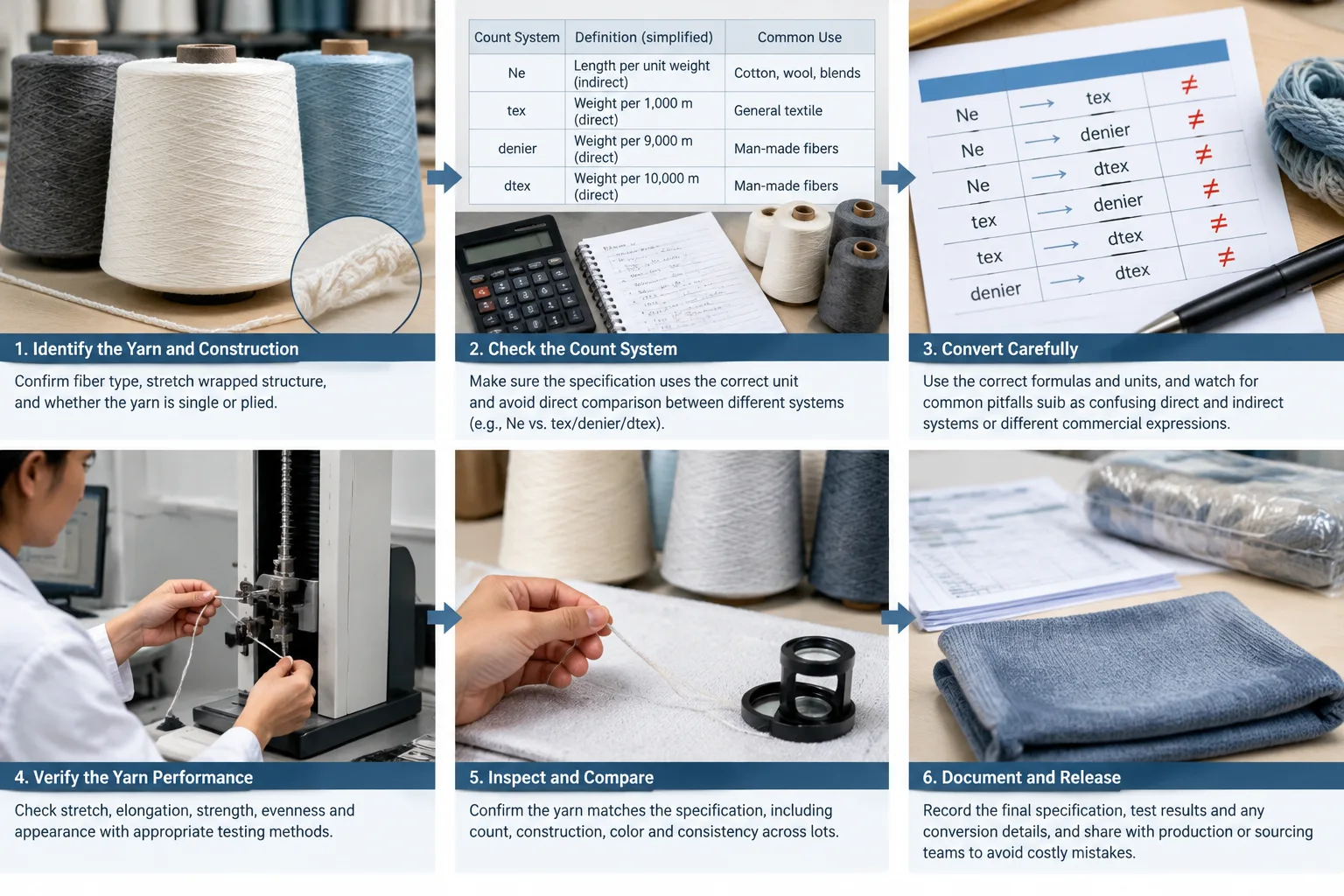
Count describes a size-related property, but it does not describe every feature that determines how a stretch wrapped yarn behaves. Stretch recovery, elongation, covering integrity, appearance, hand, abrasion behavior, and process compatibility require separate consideration. A count should therefore be treated as one input in a yarn-selection decision, not as a complete performance rating.
Two yarns with mathematically similar linear mass may produce different knitted or woven results when their core, covering arrangement, fiber or polymer identity, component ratio, twist, and fabric structure differ. The same count can also be interpreted differently if one value refers to the assembled yarn and another refers only to a component. This is why a converted number cannot by itself establish diameter, stretch percentage, fabric weight, or garment performance.
A practical decision sequence is to define the fabric and end-use requirement first, identify the required construction next, compare count only among comparable yarns, and then validate the choice through samples or appropriate testing. Where performance matters, compare results produced under matched application conditions. A change in fiber or component proportion may alter the balance of properties, so no single count or fiber choice is automatically superior for every garment.
Apparel Wiki provides educational guidance rather than manufacturing, testing, certification, or supply services. Teams making a project decision should connect the count record to their own sample evaluations and technical requirements. The relevant Apparel Manufacturing Tools may help organize related development work, but they do not replace supplier documentation or project-specific verification.
Common Conversion Mistakes and What to Do Next
The most common mistakes are usually interpretation errors rather than arithmetic errors. Treating denier, tex, dtex, and an indirect count as interchangeable numbers can make a specification appear precise while hiding the system behind it. Converting the elastic core or covering yarn and then labeling the result as the finished wrapped-yarn count creates a different kind of error: the calculation may be correct for the component but irrelevant to the assembled product.
- Do not compare direct and indirect count values by their numerical size alone.
- Do not use a converted count as a substitute for diameter, stretch, fabric weight, or performance evidence.
- Do not remove the supplier’s original unit or notation after creating a converted value.
- Do not assume a slash notation, ply description, or commercial designation has the same meaning across suppliers or markets.
- Do not treat an unresolved construction detail as a minor administrative issue when it changes the yarn basis being compared.
The recommended next step is to create one specification record that preserves the original notation, states the count basis and unit, documents any conversion and its assumptions, and links the result to a sample or test record. This record should remain attached to quotations, lab submissions, purchase orders, and approved product documents. Questions about labeling or other legal requirements should be checked separately for the relevant market and current rules.
What is stretch wrapped yarn count?
It is the yarn count information read together with the construction of a wrapped or covered yarn that includes a stretch component. The count may describe the complete yarn or only one component, so the supplier must identify the basis.
What is the difference between denier, tex, and dtex for stretch wrapped yarn?
They are direct count systems based on mass per fixed length: denier uses 9,000 meters, tex uses 1,000 meters, and dtex uses 10,000 meters. A larger value indicates more mass per unit length within the same system.
Can I convert denier to tex for a wrapped stretch yarn?
Yes, when the denier value and the tex value refer to the same yarn basis. For example, 90 denier is mathematically equivalent to 10 tex and 100 dtex. Keep the original denier and state that the result is a unit conversion.
Does yarn count tell me the yarn’s diameter or stretch performance?
No. Count indicates linear mass or length per mass, depending on the system. It does not independently establish diameter, elongation, recovery, covering integrity, hand, or fabric performance.
Should I specify the count of the elastic core or the complete wrapped yarn?
Specify the basis required for the application, but state it explicitly. If the complete yarn is being purchased or compared, identify its finished-yarn count and separately record any available core or covering counts.
What information should I request from a supplier before approving a stretch wrapped yarn?
Request the original count and unit, count system, yarn basis, construction and ply notation, fiber or polymer identity, component information where relevant, measurement status, test method, technical documentation, and a traceable sample when verification is needed.