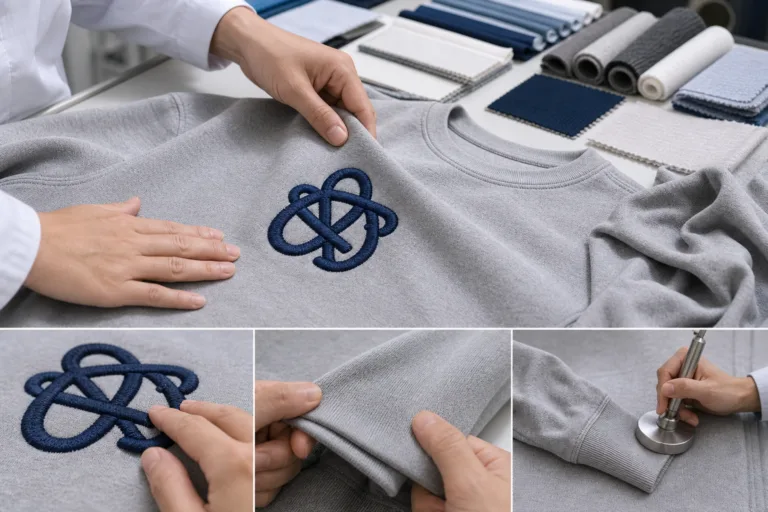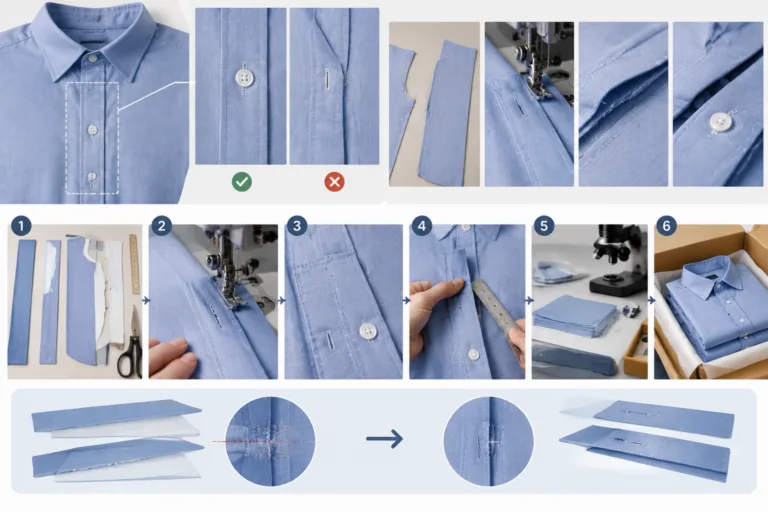
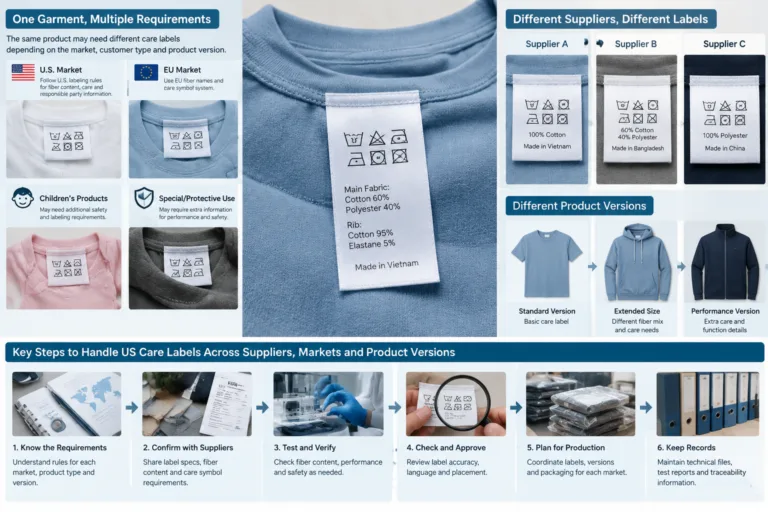
A US clothing care labeling change review is a documented check that existing care instructions still fit the garment after a product, material, supplier, production, or business change. In practical terms, an apparel business should not treat an old approved label as permanently valid when the product or its care-relevant inputs have changed. The review connects the current garment specification to accurate, supportable care instructions and to the applicable US requirements.
Apparel Wiki is an independent educational publication, not a manufacturer, factory, testing laboratory, certification body, or compliance service provider. Its editorial work is separate from sponsorship, as explained on the Sponsor page. Businesses should verify current requirements against official sources and obtain specialist advice when product classification, responsibility, or regulatory interpretation is uncertain.
What a US Clothing Care Label Change Review Is
A care-label review asks whether the instructions still describe the actual textile wearing apparel, including its fibers, finishes, construction, trims, decoration, and likely care outcomes. It is a product-and-document review, not simply an artwork check. The reviewer compares the current technical information with the proposed washing, bleaching, drying, ironing, or professional-care instructions and identifies whether any instruction is unsupported, incomplete, or no longer appropriate.
The federal starting point is the current US care-labeling rule, together with the Federal Trade Commission’s care-labeling guidance. The rule concerns care information for covered textile apparel and identifies manufacturer and importer responsibilities in the relevant circumstances. The exact applicability still depends on the product, its intended use, the sales market, and the business role involved.
Care labeling is only one layer of apparel labeling. Fiber content, country of origin, responsible-party information, safety requirements, packaging statements, and market-specific language or symbol rules may arise from different requirements. A care-label review should therefore identify which obligations are being reviewed instead of assuming that one approved label proves overall apparel-label compliance.
This distinction matters when ownership or production arrangements change. A brand, importer, factory, material supplier, subcontractor, or trade intermediary may each have a defined role, but those roles should not be confused. A business should document who controls the product specification and who is responsible for the applicable label decision, then confirm the current rule rather than relying on a historical approval or a generic supplier template.
Which Business Changes Should Trigger a Care Label Review?
The strongest trigger is any change that could alter how the garment responds to care. Changes to fiber composition, yarns, trims, coatings, dyes, finishes, linings, laminations, prints, elastic, closures, or bonding can affect cleaning, drying, ironing, bleaching, appearance, or dimensional behavior. Even where the main fabric is unchanged, a newly added decoration or finish may become the most vulnerable component and should be included in the review.
Construction changes also deserve attention. A revised pattern, seam, padding arrangement, adhesive, embellishment method, seam allowance, or assembly sequence can change how a garment behaves during care. The same principle applies to a change in material mill, factory, subcontractor, or production location when the change affects inputs, processing, or the approved product specification.
A supplier change is not automatically a label change. If the replacement source provides an equivalent material and the business has verified that the relevant composition, finish, construction, and performance remain equivalent, the existing instruction may still be appropriate. That conclusion should be recorded rather than assumed. A supplier assurance can inform the decision, but it does not replace the business’s responsibility to connect the label to the garment actually being sold.
Review triggers can also arise without a physical garment change. Treat revised label wording, translation, care symbols, placement, responsible-party information, packaging, sales channel, target wearer, product category, intended use, or geographic market as document-control events. Some are internal policy triggers rather than automatic legal requirements, but they can expose a mismatch between the approved label, the product file, and the market in which the product is offered.
How to Check Whether Existing Care Instructions Still Fit the Garment
Begin with the current technical package: bill of materials, fiber information, material specifications, construction details, finish descriptions, approved artwork, and the previous label version. Identify the exact style, colorway, material version, supplier, production site, and market under review. A style number alone may not distinguish a regional version or a revised component, so the review record should identify the product with enough detail to trace the decision.
Next, map every proposed care operation to the garment’s components. Consider the shell, lining, trim, decoration, elastic, closure, padding, coating, print, and finish. Ask which component is most likely to be damaged or changed by washing, bleaching, drying, ironing, or professional care. The resulting instruction should not promise more durability than the evidence supports, and it should not omit a limitation that a reasonable user needs to avoid foreseeable damage.
Use representative production materials and construction wherever evaluation is needed. A development sample, generic fabric swatch, or supplier statement may not reflect the finished garment. Internal assessment, supplier documentation, laboratory testing, and regulatory evidence are different forms of information; they can complement one another but should not be treated as interchangeable. Where a named test method, performance claim, or numeric criterion is involved, verify it against an authoritative laboratory or standards-body source before presenting it as a requirement.
Keep a concise evidence record. It should identify the sample or product version, the evaluation or test method, the result, the reviewer, the decision, and the date. The purpose is not to make every review look like a laboratory report. It is to show why the business retained, narrowed, or changed an instruction and to make the decision traceable when a supplier, factory, product team, or regulator later asks how the label was established.
A Change-Control Procedure for Updating US Care Labels
Care-label governance works best as a cross-functional change-control process rather than as a task assigned only to graphic design or a factory. The following workflow is an editorial control framework; it should be adapted to the business’s documented procedures and checked against current official requirements.
- Log the change. Record what changed and identify affected styles, colorways, materials, suppliers, production sites, markets, and label versions.
- Confirm applicability. Check the current US rule and official guidance, then establish the product scope, intended use, sales market, and business role involved.
- Compare the evidence. Compare the current label with the current technical package and proposed instruction. Document the reason for each change or the decision to retain the existing wording.
- Complete technical review. Obtain input from the appropriate product, quality, sourcing, and compliance owners. Resolve conflicts between specifications, supplier information, samples, and evaluation results.
- Approve controlled artwork. Assign a clear version to the approved label and prevent obsolete artwork from being selected for production. Check wording, symbols, language, placement, attachment, and other applicable label details.
- Verify production release. Inspect initial production units and packaging against the approved version, then retain the supporting records according to the business’s documented policy and any applicable requirements.
A controlled record supports traceability, but it does not replace the technical or regulatory evidence behind the decision. The review should also distinguish a company’s preferred approval route from a legal obligation. Current rule status, product facts, and responsibility assignments should be verified each time the change could affect the care instruction or the market-facing label.
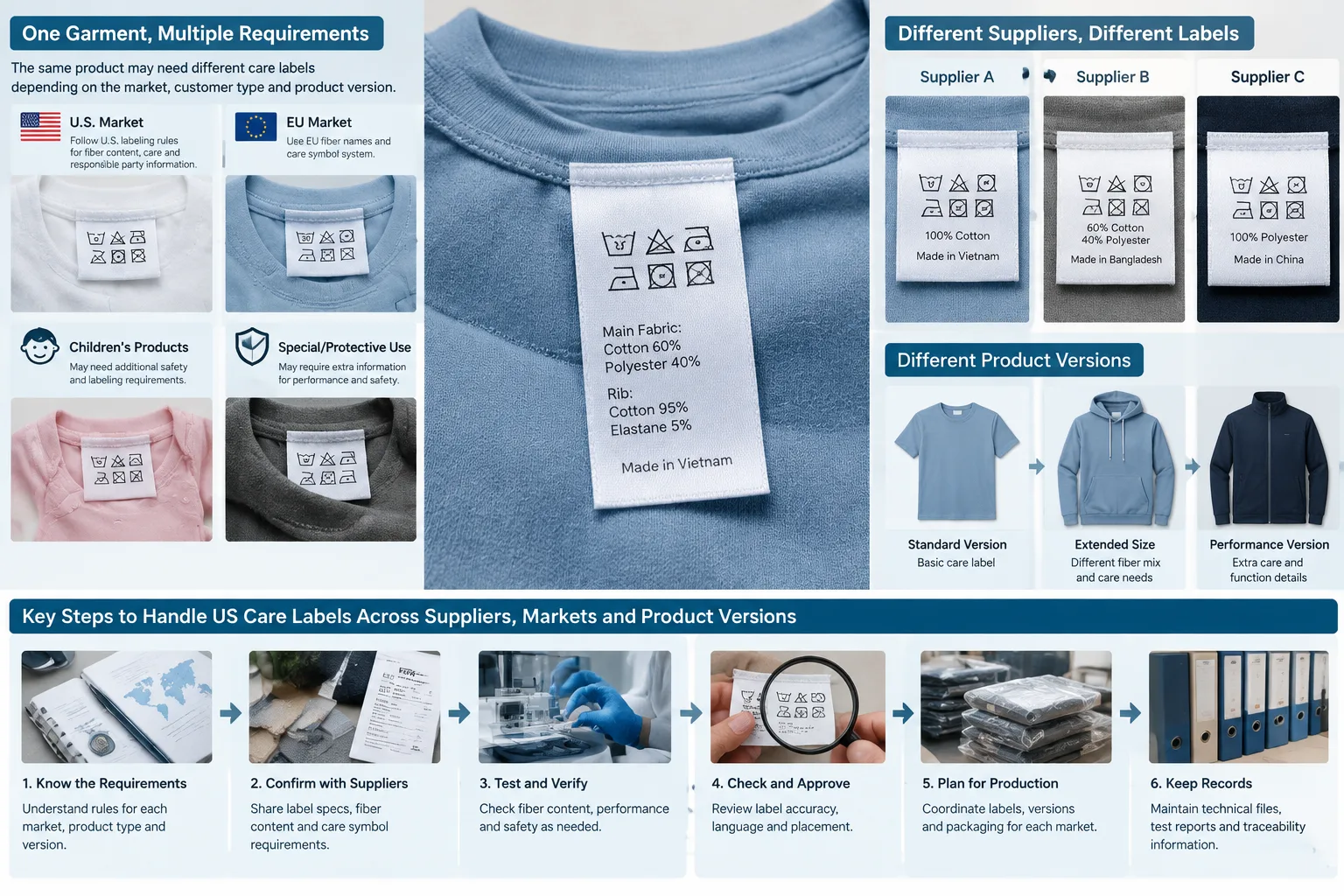
How to Handle US Care Labels Across Suppliers, Markets, and Product Versions
A care decision should follow the exact product version, not only a style number. The same style may use different shell fabrics, linings, trims, finishes, construction methods, or suppliers. Create a clear link between the approved care instruction and the relevant bill of materials, technical package, colorway, production site, and market. This makes it easier to identify whether a later version is genuinely equivalent or needs a new review.
Information may come from the brand, importer, factory, material mill, subcontractor, or testing provider. Those parties can have different commercial and production roles, so their involvement should not be treated as proof that one party has made the final compliance decision. Confirm who owns the product information, who approves the market-facing label, and who controls production release for the transaction.
Applicability comes before a checklist. Establish the sales market, intended wearer, product use, and business role before selecting label content. US care-label requirements should not be replaced casually with another jurisdiction’s terminology, symbols, language, or assumptions. Fiber content, country of origin, responsible-party information, safety information, and care instructions may be governed by separate requirements.
International sales can require a comparison record showing which content is shared, which content differs, and why. One label may be workable for more than one market in some product situations, but that conclusion requires checking the applicable rules and the actual label format. Regional versions should remain traceable, especially when a product includes unusual materials, performance finishes, detachable parts, or market-specific packaging.
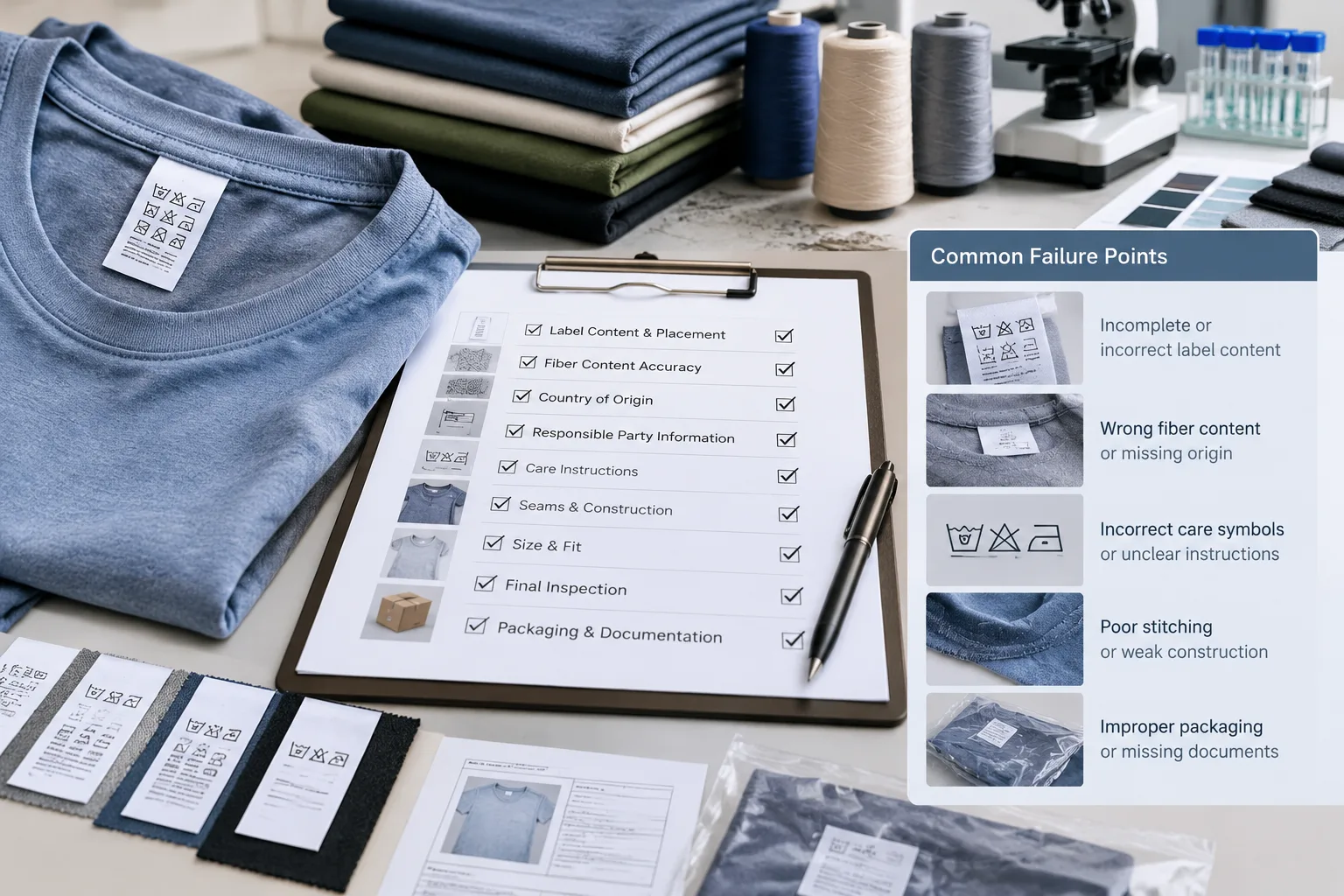
Practical Review Checklist and Common Failure Points
Before releasing a changed label, confirm the sales market, product type, intended wearer, responsible business role, affected style or SKU, and exact product version. Then compare the material composition, trims, finishes, construction, decoration, supplier, factory, and production location with the version covered by the existing care decision.
- Confirm that each care instruction is supported by the current garment specification and appropriate evaluation.
- Check wording, symbols, language, placement, attachment, durability, and artwork version against current applicable requirements.
- Separate regulatory checks from technical evidence and internal approval controls.
- Record the reviewers, decision, supporting documents, date, and reason for changing or retaining the label.
- Release one controlled version, withdraw obsolete artwork, and inspect initial production units and packaging.
A checklist is a decision aid, not automatic proof of compliance. Common failures include copying a competitor’s label, accepting a supplier’s generic template without product-specific support, evaluating a development sample that does not represent production, or changing materials after approval without reopening the review. Another frequent weakness is treating a third-party report as a complete compliance solution when the product scope, label artwork, responsibility assignment, or market requirements remain unresolved.
Internal controls also need clear ownership. Product development may define the garment, sourcing may manage supplier information, quality may evaluate production samples, and compliance may interpret applicable requirements. The exact organization will vary, but the approval route should show who reviewed the evidence and who authorized the label for production.
When a Business Should Escalate the Review
Escalate the review when unusual materials, complex finishes, protective or performance claims, detachable components, or conflicting care outcomes make a general workflow insufficient. A label may look complete while the underlying evidence does not explain how the most vulnerable component will respond to the stated cleaning, drying, ironing, or bleaching process.
Escalation is also appropriate when the intended use, wearer category, sales market, or regulatory status is unclear. Conflicting information from a supplier, laboratory, product team, or internal reviewer should be resolved before production release. Do not treat a pending policy, proposed rule, enacted rule, and effective requirement as interchangeable. Check the current official source and its status before changing a market-facing label.
When uncertainty remains, freeze the affected label version, gather the current technical package and representative product evidence, verify the applicable official requirement, and document the decision. Qualified regulatory or legal advice may be needed for jurisdiction-specific questions, while specialist technical evaluation may be appropriate for unresolved material or construction behavior. Neither type of support guarantees compliance by itself; the conclusion still needs to match the actual product and market.
Apparel Wiki is an independent educational publication, not a manufacturer, factory, laboratory, certifier, or compliance service provider. Use this guide to organize a review, then verify current requirements and product-specific evidence through the appropriate official sources and qualified specialists. The Apparel Manufacturing Tools collection may help organize related product and production information, but a tool or checklist does not replace regulatory judgment.
How often should an apparel business review its US care labels?
Review them whenever a product, material, construction method, supplier, market, business role, or approved label document changes in a way that could affect care information. Businesses may also schedule periodic rule and document checks, but there is no universal interval that replaces change-based review.
What product changes should trigger a clothing care label review?
Changes to fiber composition, linings, trims, finishes, dyes, coatings, laminations, decoration, seams, bonding, padding, closures, or assembly can trigger review. A change in intended use, wearer, product category, or sales market should also be assessed.
Does changing a fabric supplier always require a new care label?
No. A supplier change is not automatically a label change. Compare the new material and production details with the approved version and document whether they remain equivalent for care purposes. If equivalence is not established, reopen the review.
Can one care label be used for products sold in the US and other markets?
Sometimes, but not automatically. Compare the applicable requirements for each market, including language, terminology, symbols, content, and product scope. Keep a record showing why a shared label is suitable or why regional versions are needed.
What evidence should support revised garment care instructions?
Use the current technical package, bill of materials, material information, construction details, representative samples, relevant evaluations, and applicable regulatory guidance. Record the method, sample identity, result, reviewer, date, and decision rather than relying only on a generic supplier statement.
Who should approve a changed care label before production?
The business should assign approval to the appropriate product, quality, sourcing, and compliance owners for its organization. The controlled record should identify the decision-makers and confirm that the approved artwork matches the reviewed product version and market.