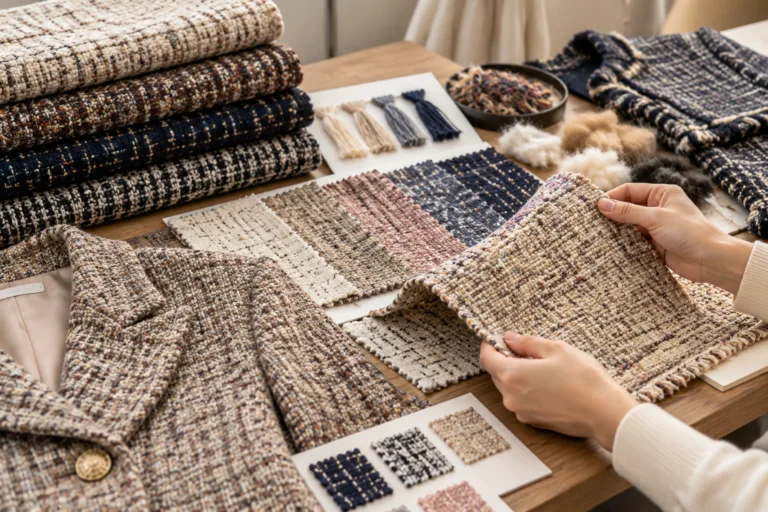
Tweed construction is the combined system of fiber content, yarns, interlacement, fabric density, and finishing that gives a particular tweed its appearance and handling characteristics. In practical terms, tweed is generally a woven fabric associated with textured yarns, mixed colors, and traditional tailored clothing, but “tweed” does not identify one fixed fiber, weave, weight, or performance level. This independent Apparel Wiki guide explains the subject; readers can also review the Sponsor page for the publication’s editorial independence principles.
That distinction matters when a designer or buyer is evaluating fabric. Two materials sold as tweed may differ in softness, drape, warmth, abrasion behavior, dimensional change, and care requirements. A supplier’s specification sheet and a physical sample are therefore needed to confirm the construction of a particular fabric.
What Is Tweed Construction?
Tweed construction describes how the material is built, rather than simply what it is called. The commercial name may refer to a visual effect, a collection name, a regional tradition, or a supplier’s product description. Its meaning can vary by region, historical usage, mill, and market. The name alone cannot confirm whether the fabric is made from wool, a blend, or another fiber, and it does not establish the weave structure or finish.
Four descriptive layers should be kept separate:
- Fiber composition: The raw material or combination of materials used in the yarn, such as animal, plant, regenerated, synthetic, recycled, or blended fibers.
- Yarn construction: The thickness, twist, blend, color arrangement, hairiness, and regularity of the yarns placed into the fabric.
- Weave structure: The way warp and weft yarns interlace to form the base woven fabric.
- Finishing: Processes applied after weaving that can change surface definition, softness, compactness, loft, or dimensional response.
These layers interact, but none should be used as a substitute for the others. Wool may be common in some tweed products, for example, but tweed is not a synonym for wool. Likewise, a textured surface does not prove that the fabric uses a particular weave. The appropriate description is the complete construction recorded for the specific sample.
A fabric specification may identify composition, width, mass per unit area, construction description, and finishing information. The sample allows a product team to inspect the actual hand, surface, color arrangement, irregularities, and behavior during cutting and sewing. Together, these sources provide a more reliable basis for development than the word “tweed” alone.
How Weave Structure Creates Tweed Texture
Woven fabric is formed by the interaction of two yarn systems. Warp yarns run in the lengthwise direction, while weft yarns pass across the width. Their arrangement, or interlacement, creates the fabric’s base structure. In tweed, the visible result also depends heavily on the character of the yarns, so the weave is only one part of the explanation for the surface.
Yarn thickness can create raised or uneven areas, while hairiness can soften the visual outline of individual yarns. Twist affects how compact or open a yarn appears. Slubs and other irregularities can introduce variation, and differently colored fibers or yarns can produce a mixed, flecked, or heathered appearance. These effects may be visible before any finishing is applied.
Tweed-like fabrics may use plain, twill, basket, or more complex patterned weaves. A plain structure may provide a relatively direct crossing of warp and weft, while twill arrangements can create diagonal lines. Basket structures group yarns in a way that changes the visual scale of the interlacement. Patterned constructions can combine several effects. These examples describe possible approaches, not a universal recipe for tweed.
Surface texture may also be added or modified after weaving. Brushing, milling, napping, compacting, or related finishing processes can change the feel and visibility of the yarns. A fabric may therefore look fuzzy or substantial because of its finish even when its underlying weave is relatively regular.
For this reason, appearance provides clues but does not identify construction conclusively. A close inspection, technical specification, or examination of the fabric structure may be needed to distinguish yarn-created texture from weave-created texture and from finishing effects. Neither a named weave nor a textured appearance should be treated as a complete predictor of strength, stretch, air permeability, warmth, or durability without relevant evidence.
Which Variables Change Tweed’s Hand and Appearance?
Two fabrics can look similar on a product page and still feel or perform differently in a garment. Fiber content influences possible softness, resilience, moisture response, heat response, and care requirements, but composition alone does not determine the finished fabric’s behavior. Yarn design, weave, density, finishing, garment construction, and use conditions all contribute.
Yarn count, twist, blend, color placement, and surface hairiness can change visual depth and handle. A compact, highly twisted yarn may present differently from a loftier or more irregular yarn. Color effects can make a surface look more complex without changing the underlying weave. Subjective terms such as “rustic,” “dry,” “lofty,” “substantial,” or “soft” are useful descriptions, but they should be supported by a sample and, where relevant, measurable information.
| Variable | What it helps describe | What it does not prove by itself |
|---|---|---|
| Mass per unit area | How much the fabric weighs over a defined area | Thickness, quality, warmth, or durability |
| Thickness | Fabric bulk and separation between surfaces | Mass, softness, or insulation in every garment context |
| Density | How closely yarns are arranged in the fabric | A fixed performance level without testing |
| Usable width | The area available for pattern placement | Overall fabric weight or construction quality |
| Finishing | Surface definition, compactness, softness, and dimensional response | The original yarn or weave structure |
GSM, or grams per square meter, describes mass per unit area. It should not be treated as a measurement of thickness, quality, or warmth by itself. Width also needs careful description because total width and usable cutting width may differ. For development and sourcing, it is practical to request composition, construction description, usable width, mass per unit area, finishing information, colorway, and sample status together.
The finished garment adds another layer of variation. Lining, interfacing, seam construction, pressing, silhouette, climate, movement, and care can all affect the wearer’s experience. A fabric’s measured properties remain important, but they should be interpreted in the context of the product brief rather than converted into universal grades.
Where Is Tweed Used in Clothing?
Tweed clothing uses depend on the specific fabric and garment brief. Jackets and coats are common application areas because a textured woven surface can support a structured or tailored appearance. Depending on weight, drape, bulk, and seam behavior, tweed may also be considered for skirts, trousers, vests, caps, bags, and other accessories. These are possible applications, not automatic recommendations.
For a jacket or coat, the product team should assess how the fabric behaves at seams, closures, edges, and areas that receive repeated movement. A stable fabric may suit a structured silhouette, while a softer or more open construction may require additional support. Climate and layering also matter, so visual association with outerwear should not be treated as proof of insulation, weather resistance, or universal seasonal suitability.
Texture can affect manufacturing as well as appearance. Bulk may influence seam allowance and pressing. Hairy or irregular surfaces may require careful handling during cutting. Pattern matching can be more complicated when yarn effects, checks, stripes, or mixed color arrangements are prominent. If the surface has a directional nap or finish, pieces may also need to be placed consistently.
Lining, interfacing, seam finishing, edge treatment, and pressing methods should be developed on the actual fabric. A toile or sewing trial can reveal issues that are not apparent from a swatch, including seam appearance, fraying, closure interaction, lining movement, garment bulk, and fit. Visual suitability for a design is therefore separate from tested suitability for repeated wear and care.
How to Evaluate Tweed Before Product Development
Evaluate tweed against the intended garment rather than relying on the fabric name. Define the silhouette, wearer, climate, care route, expected wear conditions, target price, and required visual effect first. A soft, irregular surface may suit one design while creating unwanted bulk or handling difficulties in another. The same sample can therefore be appropriate for one product and unsuitable for a different construction.
Begin by requesting a fabric data sheet and checking what each description actually covers. Useful information may include fiber composition, construction description, usable width, mass per unit area, finishing, colorway, and production-lot information where available. Treat supplier information as one evidence level. It should be compared with the physical sample, garment trial, and any testing selected for the product risk.
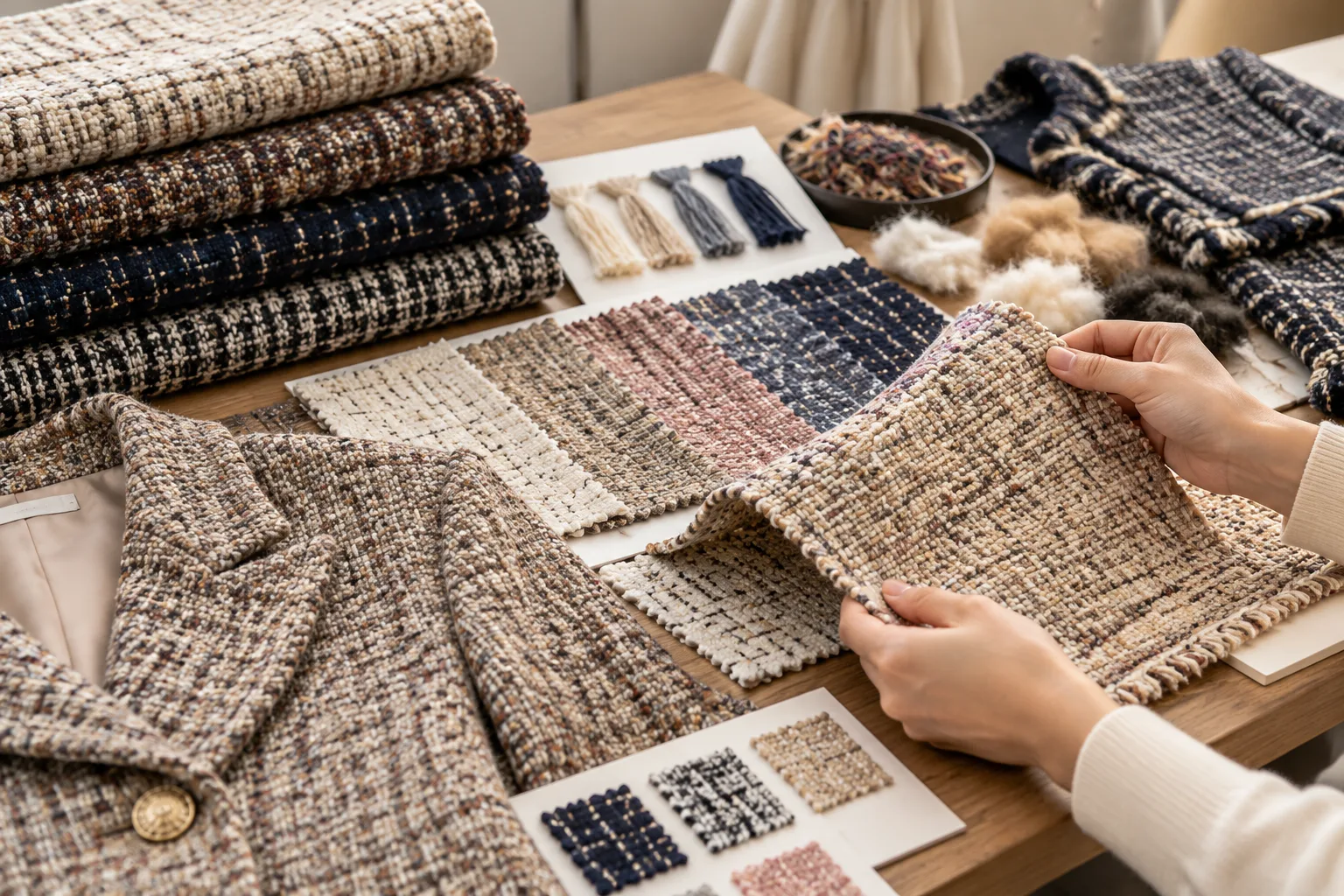
Inspect the sample in both directions under consistent lighting. Look for shade variation, yarn irregularity, slubs, holes, distortion, fraying, surface damage, and differences between the face and reverse. Check whether checks, stripes, or mixed yarn effects create a repeat that could affect cutting and pattern matching. If the fabric has a directional surface or finish, record the direction before planning marker placement and yield.
Verify the properties that matter to the product. Depending on the garment, this may include usable width, mass per unit area, dimensional change, colorfastness, pilling, abrasion, or seam performance. These are separate questions: GSM describes mass per unit area, for example, but does not establish thickness, quality, warmth, or durability. Select evaluation methods according to the end use, care instructions, customer expectations, and consequences of failure.
Make a toile or sewing trial with the actual fabric, not only a substitute of similar appearance. Review drape, bulk, pressing response, seam appearance, edge treatment, closures, lining interaction, and fit. A textured surface may behave differently at a seam or under an interfacing than it does as a loose swatch. Record the sample condition, test conditions, observations, and acceptance criteria so later lots can be compared with the approved reference.
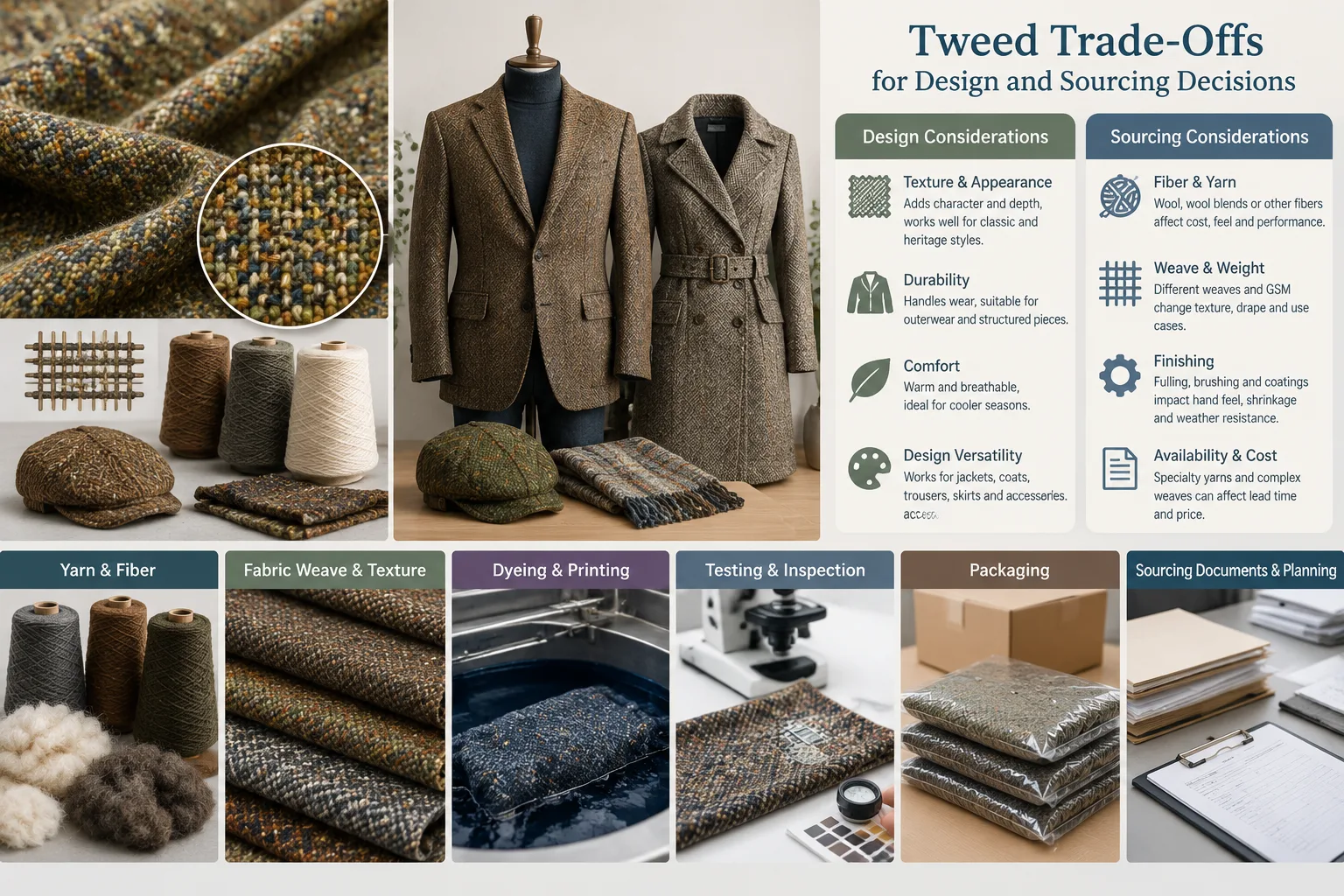
Tweed Trade-Offs for Design and Sourcing Decisions
Choosing tweed is a comparison exercise, not a universal ranking. Smoother surfaces may present a cleaner outline and be easier to handle in some designs, while more textured surfaces can create stronger visual depth but require closer attention to snagging, abrasion, pressing, or cutting. These are possibilities to investigate on the actual fabric, not fixed outcomes of the word tweed.
Lighter and heavier constructions can also change the design conversation. A lighter fabric may support a softer drape or reduced bulk, while a heavier one may contribute more body to a structured silhouette. Neither description proves warmth, quality, durability, or seasonal suitability. Lining, garment shape, layering, fiber content, finishing, and use conditions all affect the final product.
Complex yarn colors, checks, stripes, and irregular effects may strengthen a design concept while increasing development questions. The team may need to review pattern matching, cutting yield, shade continuity, piece placement, and lot-to-lot appearance. Blended, recycled, or alternative fibers can change questions about care, dimensional response, surface behavior, and documentation. They should be assessed against evidence rather than assumed to be better or worse.
A practical decision matrix can keep these trade-offs visible. Compare each candidate by intended use, appearance, handle, drape, bulk, care route, available width, yield, test results, and supplier consistency. Separate what was observed in the sample from what was measured in testing and from what is an editorial or design recommendation. The preferred fabric is the one that satisfies the defined garment brief with acceptable development and production risk.
Limits of Tweed Construction Descriptions
The word tweed cannot confirm fiber content, exact weave, fabric weight, finish, origin, sustainability characteristics, or regulatory compliance. A photograph and a short product description are even less conclusive: they cannot reliably establish hand feel, dimensional stability, colorfastness, abrasion resistance, or sewing behavior. Construction descriptions provide useful clues, but they do not replace relevant evidence.
A specification also applies to the stated sample and conditions. It may not represent every colorway, finish, production lot, or finished garment. Before bulk approval, document the approved fabric sample, composition, construction information, care route, planned test work, and production tolerances. Keep records clear enough that a later review can distinguish a change in material from a change in garment construction or care.
Apparel Wiki provides independent apparel education and is not a mill, factory, manufacturer, laboratory, certifier, or sourcing supplier. Product teams should use supplier documentation, physical sampling, prototype review, and risk-based testing together. The appropriate evidence depends on the garment, market, care expectation, and consequences of a performance problem.
The next useful step is to turn the garment brief into a short tweed evaluation checklist. Request the relevant documents, approve a defined physical sample, run a sewing trial, and select only the property checks needed for the product risk. This creates a traceable basis for comparing fabrics and approving production.
FAQ
Is tweed a fiber, a weave, or a fabric name?
Tweed is generally used as a fabric category or commercial name for textured woven fabrics. It does not identify one fiber, one weave structure, one weight, or one finish. The specific construction must be confirmed from documentation and the physical fabric.
Does all tweed contain wool?
No. Wool is associated with many tweeds, but the name alone does not establish fiber content. A particular tweed may use a blend or another fiber composition, so check the supplier specification and applicable product labeling information.
What weave structure is commonly used for tweed?
Tweed-like fabrics may use plain, twill, basket, or more complex patterned weaves. Yarn character and finishing also contribute to the visible texture, so appearance alone cannot identify the weave. Confirm the construction from technical information or examination of the fabric.
Does heavier tweed always provide more warmth or durability?
No. Mass per unit area is not the same as thickness, warmth, quality, or durability. Fiber content, yarns, density, finishing, lining, garment design, care, and use conditions also affect performance. Relevant properties should be evaluated for the intended product.
How should a designer test tweed before making a garment?
Inspect a representative sample, verify relevant specifications, and make a prototype or sewing trial with the actual fabric. Review drape, bulk, seams, pressing, closures, lining interaction, fit, and care-related risks. Add targeted property testing where the end use requires it.
What fabric information should a buyer request from a tweed supplier?
Request composition, construction description, usable width, mass per unit area, finishing information, colorway details, sample status, and production-lot information where available. Also clarify the care route and any test documentation relevant to the garment brief.