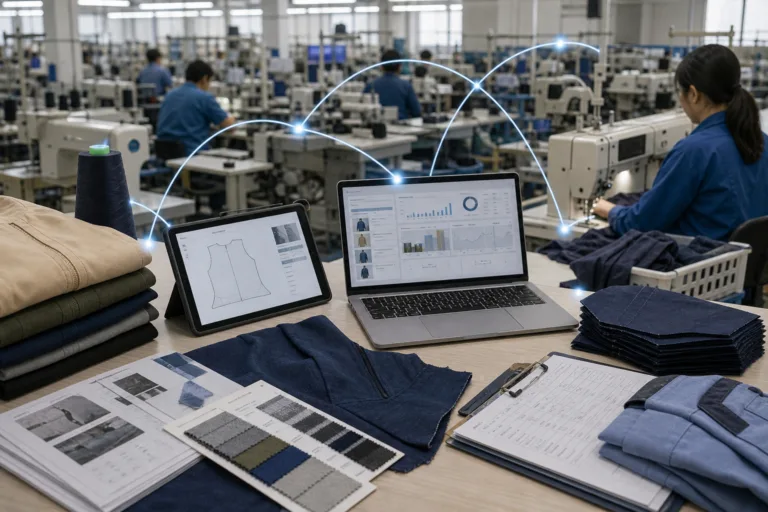
A connected sewing machine is a sewing machine or machine setup that can capture, transmit, or receive operational data or digital instructions. The exact capability depends on the machine, connection method, software, and configuration. For a business, the important question is not whether the equipment is described as “smart,” but whether a specific connected sewing machine capability can address a measurable production, quality, maintenance, traceability, planning, or reporting problem.
This guide treats the topic as a business-planning decision, not a product recommendation. Apparel Wiki is an independent educational publication, not a machine manufacturer, factory, testing laboratory, or service provider. Its editorial work is supported separately from editorial control; see the Sponsor page for that distinction. Any feature, compatibility claim, price, or expected return must still be confirmed through the relevant supplier documentation and the buyer’s own records.
What Is a Connected Sewing Machine, and What Business Case Does It Support?
In practical terms, connected sewing machine technology adds a way to collect, send, receive, or use information related to sewing operations. Depending on the product and configuration, that information could include machine status, production events, operating instructions, maintenance-related signals, or records associated with a work order. These are examples of possible functions, not a universal specification. A buyer should verify what a particular machine can capture, how the data is structured, and whether it can be exported or exchanged with other systems.
Connectivity by itself is not a business benefit. A credible connected sewing machines business case starts with a defined problem: supervisors may spend significant time compiling production reports, maintenance teams may lack timely machine-status information, or production records may be difficult to trace back to an operation. The proposed capability then needs a measurable link to a decision, such as how quickly an issue is identified, how completely an order is reported, or how consistently an approved instruction reaches the operator.
Machine-level connectivity should also be separated from broader factory software. PLM, ERP, MES, and WMS commonly refer to different business functions, although actual product boundaries can overlap. A label does not prove that a system includes every expected feature. The decision should therefore follow the buyer’s workflow, data ownership, integration requirements, and operating context rather than the technology label alone.
Which Business Problems Could Connected Sewing Machines Address?
The most relevant use cases are operational and specific. A factory might investigate connected sewing machines to collect machine-status data, monitor production progress, support maintenance workflows, improve operation traceability, or transmit approved digital instructions. Each possibility should be tested against the current process rather than accepted as an assumed benefit.
| Possible use case | Current question | Outcome to track |
|---|---|---|
| Production-status data | How are operators or supervisors recording progress now? | Reporting time, data completeness, and reporting delays |
| Maintenance workflow | How are machine problems identified, assigned, and closed? | Response time, unresolved events, and maintenance effort |
| Operation traceability | Can a completed operation be linked to the relevant order, style, or process step? | Record availability, investigation effort, and exception handling |
| Digital instructions | How are approved instructions distributed and updated? | Version accuracy, changeover administration, and adoption effort |
The affected user may be an operator, line supervisor, maintenance technician, quality professional, planner, or manager. The decision that could improve might involve reallocating work, investigating a delay, responding to a machine issue, confirming an operation, or updating a production plan. Defining that user and decision helps prevent a vague proposal based only on the desire to modernize.
Potential effects also occur at different levels. A machine may provide more timely status information, but any resulting improvement in planning depends on supervisors and planners using that information. Similarly, traceable production records may support a quality investigation, but they do not automatically prevent defects. Better data cannot correct inconsistent operation definitions, inaccurate style records, or unreliable master data without additional process work.
The strongest case usually begins with a costly, repeated, and observable workflow problem. Benefits should remain conditional until they are supported by a relevant product document, controlled pilot, or organization-specific measurement. A supplier demonstration can show how a system is intended to work, but it is not evidence of the buyer’s actual productivity, quality, downtime, or financial result.
How to Build the Baseline Before Calculating Value
Before selecting equipment or calculating return, document the current state. Record the workflow, machine population, operators, shifts, product mix, reporting method, existing systems, and the people responsible for each step. This establishes what the proposed connected process would replace, supplement, or leave unchanged.
Choose measures that match the problem being investigated. Depending on the workflow, a baseline might include reporting time, downtime-response time, rework or defect-handling effort, data completeness, changeover administration, or supervisor time spent reconciling records. No single metric is universally decisive. The useful metric is the one that represents the decision the business is trying to improve.
Define the unit of analysis and keep it consistent. A baseline may be organized by machine, line, order, operation, shift, or reporting period, but the same basis should be used when the proposed process is tested. Also record the observation period, sample, exclusions, assumptions, and data owner. Without those details, a later comparison can confuse different products, operators, workloads, or reporting practices.
Include the effects that may shape the future state. Training, process changes, integration work, maintenance, connectivity, cybersecurity responsibilities, and data administration can all require time or money. They should appear in the assumptions even when their final values are not yet known. Keep operational records, directly sourced product facts, editorial recommendations, and hypothetical examples visibly separate.
A baseline is not a promise of future savings. It is a disciplined reference point. Comparing like-for-like tasks is more useful than applying an unverified industry benchmark or treating a demonstration result as the expected outcome.
What Costs Belong in a Connected Sewing Machine Business Case?
A connected sewing machine cost analysis should cover the full proposed operating model, not only the purchase price. Separate equipment and connectivity costs from software subscriptions, implementation, integration, data preparation, training, maintenance, support, and eventual replacement. Supplier quotations or contracts are needed for actual commercial terms; internal finance and operations records are needed for the buyer’s labor and process costs.
Compatibility requires particular attention. Existing machines may or may not support the proposed connection. A project could require compatible equipment, gateways, sensors, network infrastructure, controls, or other components, depending on the design. Do not assume that an existing machine can be connected simply because it performs the required sewing operation. Confirm supported models, interfaces, data fields, and supplier responsibilities.
Include internal effort that may not appear on a supplier quote. Process mapping, master-data cleanup, testing, operator adoption, exception handling, and ongoing data ownership can affect the total cost of ownership. Classify costs as fixed, variable, usage-based, site-specific, or dependent on the final scope so that different proposals can be compared on a consistent basis.
For early screening, a simple payback calculation can be useful:
Simple payback period = initial investment ÷ annual net cash savings
This is only a hypothetical screening method, not a forecast. Net savings must include incremental maintenance, training, integration, support, and other relevant costs. Simple payback does not account for discounting, residual value, or unstable cash flows. A decision should therefore combine the calculation with baseline quality, operational, technical, and ownership evidence.
How Do Data, Integration, and Interoperability Affect the Decision?
A connected sewing machine business case depends on more than whether a machine can send or receive data. The information must remain understandable and consistent across the workflow. Relevant fields may include machine records, production orders, style or article numbers, colors, sizes, materials, operation versions, and status fields. The exact field set depends on the proposed process, but the ownership of each field should be clear.
Master-data inconsistency can move an error from one system into another. A mismatched article number, material code, operation version, or size reference may affect production planning, quality reporting, purchasing, or fulfillment. Automation does not resolve different meanings assigned to the same field. Before integration, define field names, permitted values, change rules, responsible owners, and the process for correcting an error.
Software boundaries also require careful review. PLM, ERP, MES, and WMS are useful functional categories, but their capabilities can overlap or vary by product and configuration. A connection to one system does not prove that the entire production workflow is integrated. Ask which records are exchanged, in which direction, at what point in the process, and with what error handling.
Interoperability testing should use representative complexity rather than a simple demonstration file. Test import, editing, transmission, return, version changes, incomplete records, and recovery from an exception. A file that opens successfully may still lose dimensions, material information, version identity, or other operational data. Treat file compatibility as one test result, not as proof of complete and accurate information exchange.
Before rollout, assign data owners and document access permissions, retention expectations, cybersecurity responsibilities, and manual fallback procedures. Request clear answers about what the supplier collects, where it is stored, who can access it, how it can be exported, and what happens when a network connection or hosted service is unavailable. These questions may affect operational continuity as much as the machine features themselves.

How to Run a Pilot and Compare Results Fairly
A pilot should answer a defined business question, not simply demonstrate that a connected sewing machine works. Select a narrow workflow with representative machines, operators, products, and production conditions. A pilot based only on an easy product or highly experienced operator may show technical potential while hiding the training, exception, and administration work required in normal production.
Set the baseline and evaluation rules before implementation. Record the comparable tasks, sample size, observation period, success metrics, decision thresholds, and exit conditions. Depending on the business problem, measures may include reporting time, data completeness, response to downtime, quality-handling effort, changeover administration, integration exceptions, or supervisor workload. Keep definitions consistent with the baseline established earlier in the business case.
Compare like-for-like work and record both benefits and additional effort. Include quality, time, cost, adoption effort, exceptions, integration work, maintenance, and support requirements. Operator and supervisor feedback matters because a technically functional system may still create too much administrative work or require impractical exception handling. Document what happened during normal variation and recovery, not only during a successful production run.
At the end of the pilot, classify each result as proven, plausible, unverified, or dependent on a broader process change. Calculate the observed net impact using actual incremental costs rather than a supplier demonstration or an assumed saving. A positive result in one workflow does not establish a universal return for every machine, product type, or facility.
The decision can then take several forms: proceed with a defined rollout, expand the pilot, renegotiate the scope, postpone the project, or reject it. A pilot is a decision method, not a promise that all facilities will achieve the same outcome.
When Should a Business Reject or Delay the Investment?
Delay the project when the problem cannot be measured, the data owner is undefined, or the proposed benefit depends on unreliable master data. Unknown integration requirements are another warning sign. If the business cannot explain which records must move between systems, who maintains them, and how failures will be handled, the investment case is not ready for approval.
Question the case when training, maintenance, support, connectivity, exception handling, or internal implementation time has been left out. A low equipment price may not represent a low total cost. Review supplier dependency, service continuity, data export, upgrade obligations, replacement requirements, and fallback procedures. Contract terms and supplier documentation are needed for conclusions about these issues.
Also ask whether the underlying problem is genuinely machine-level. Process standardization, production planning, quality controls, or data governance may address some problems more directly. Connectivity should not be treated as a substitute for clear work methods, trained personnel, accurate records, or accountable supervision.
Proceed only when the organization has a defined problem, credible baseline, validated technical fit, acceptable total cost, measurable pilot result, and accountable ownership. Rejection or postponement can be the responsible business outcome when one or more of these conditions remains unresolved.
The next practical step is to turn the proposal into a short decision record: state the problem, identify the affected workflow, list the required data, assign owners, document costs, and define the pilot evidence needed for approval. An independent reference such as Apparel Manufacturing Tools may help organize related production questions, but it does not replace supplier documentation or organization-specific testing.
What is a connected sewing machine?
It is a sewing machine or machine setup that can capture, transmit, or receive operational data or digital instructions. Capabilities vary by machine, connection method, software, and configuration, so the practical definition should be confirmed against supplier documentation.
What should be included in a connected sewing machines business case?
Include the measurable business problem, current baseline, proposed capability, expected workflow effect, equipment and software costs, integration and training effort, maintenance, support, data ownership, risks, pilot criteria, and decision conditions.
How can a company measure the ROI of connected sewing machines?
Compare a consistent baseline with pilot results for relevant time, quality, cost, data, or maintenance measures. Subtract incremental training, integration, maintenance, support, and other costs. Do not treat a vendor demonstration or an assumed productivity gain as organization-specific ROI evidence.
Do connected sewing machines work with existing ERP, MES, or PLM systems?
They may, but compatibility depends on the specific machines, interfaces, data fields, versions, and system configurations. Test representative records through import, editing, transmission, return, version changes, and error recovery before claiming interoperability.
What costs are commonly overlooked when evaluating connected sewing machines?
Commonly missed items include data preparation, process mapping, integration, network or connection requirements, training, adoption time, exception handling, maintenance, support, upgrades, replacement, and the internal effort required to own the data.
Should a garment factory run a pilot before buying connected sewing machines?
A representative pilot is often a useful decision method when the workflow, costs, and success measures are defined in advance. It should include realistic products, operators, machine conditions, complexity, exceptions, and recovery procedures rather than only an ideal demonstration.