Apparel sourcing manager skills combine product knowledge, supplier communication, quotation analysis, material control, quality coordination, risk judgment, and disciplined documentation. An apparel sourcing manager coordinates the path from product requirements to workable decisions about suppliers, materials, cost, quality, and delivery. The role is successful when those decisions are clear, supportable, and usable by the teams that must execute them, not simply when a low unit price is negotiated. For independent apparel education and related material references, see Sponsor.
The title does not describe one universal job. Depending on the employer, product category, and sourcing model, the same position may include elements of merchandising, product development, technical coordination, production follow-up, procurement, or commercial management. The most reliable way to understand the responsibilities is to look at the deliverables: a sourcing-ready product package, comparable supplier quotations, controlled material decisions, documented approvals, and resolved cross-functional issues.
What Skills Does an Apparel Sourcing Manager Need?
The skills needed for an apparel sourcing manager fall into two connected groups. The first is practical apparel knowledge: garment terminology, construction, measurements, fabrics, trims, fit, finishing, care information, and the way design choices affect production. The second is decision execution: preparing requests for quotation, questioning supplier assumptions, comparing offers, managing alternatives, coordinating quality work, tracking changes, and communicating decisions across teams.
A sourcing manager does not necessarily replace a pattern maker, product developer, quality professional, or production manager. The role is to connect their information and decisions so that commercial choices do not separate from product requirements. Software can help organize specifications, costing, and approvals, but software familiarity cannot substitute for understanding what a measurement, material, construction detail, or intended use means.
Strong apparel sourcing skills therefore include the ability to ask precise questions. What exactly is being quoted? Which information is approved? What has the supplier assumed? What could change the garment or its delivery conditions? Which team owns the next decision? Reliable records matter because a verbal agreement that is not tied to a product version, quotation, sample, or approval can easily be misunderstood later.
Product and Garment Knowledge: Turning a Design Brief Into Sourcing Information
Before requesting offers, a sourcing manager must help turn a design brief into information that suppliers can interpret consistently. Common working documents may include sketches, measurement specifications, construction details, a bill of materials, color information, labeling and packaging instructions, and sample comments. The exact document set and format depend on the company; no single package should be treated as universal.
These elements are connected. A change to fabric can affect measurements, drape, fit, construction, finishing, care information, or the appearance of a sample. A trim may affect attachment methods or the garment’s intended use. A packaging instruction may affect how the finished product is presented or protected. Practical garment construction knowledge helps the sourcing manager notice when a request is incomplete and bring the right technical stakeholder into the discussion.
Vague design language also needs translation. Instead of forwarding a request for a “soft,” “structured,” or “premium-looking” fabric as though it were a complete requirement, the manager can ask what observable characteristics matter: appearance, weight, drape, surface, intended use, care expectation, or compatibility with the construction. The supplier may then propose an option, while the internal team identifies what must be sampled, checked, or approved before acceptance.
Version control is part of apparel sourcing technical skill. The supplier, product team, and quality team should be able to identify which specification, sample comment, material reference, or approval is current. A sourcing manager should flag superseded information, record open questions, and connect any change to the affected quotation or sample. This prevents a familiar but outdated file from becoming the basis for a new commercial or production decision.
Supplier Communication and RFQ Skills That Make Quotes Comparable
An RFQ, or request for quotation, creates a basis for suppliers to respond to the same product and commercial assumptions. Where applicable, the request should use the same product information, quantity assumptions, delivery context, packaging requirements, and commercial terms for each supplier. The purpose is not to force every supplier into identical capabilities; it is to make differences visible and explainable.
Comparing garment supplier quotes requires more than placing headline prices in a spreadsheet. The review should check the specification being priced, the costing unit, included and excluded items, material assumptions, waste assumptions, packaging, delivery terms, proposed substitutions, quotation validity, and unresolved supplier questions. Trade terms, quantities, and inclusions are project variables, so they need to be defined before the comparison is treated as meaningful.
| Quote review area | Question to record |
|---|---|
| Product basis | Which specification, material version, and sample information did the supplier use? |
| Commercial scope | What is included, excluded, or dependent on a later decision? |
| Alternatives | Has the supplier proposed a substitute, different construction, or other assumption? |
| Open points | Which questions, approvals, or confirmations remain unresolved? |
This structure supports transparent apparel sourcing negotiation skills. Negotiation is not only pressure for a lower number; it is clarification of scope, assumptions, alternatives, and risk. After a call or meeting, concise written follow-up should state what was agreed, what remains open, who owns the next action, and which version or sample is affected. That record reduces version confusion and gives later decisions a traceable basis.
Material Substitution, Quality Risk, and Approval Decisions
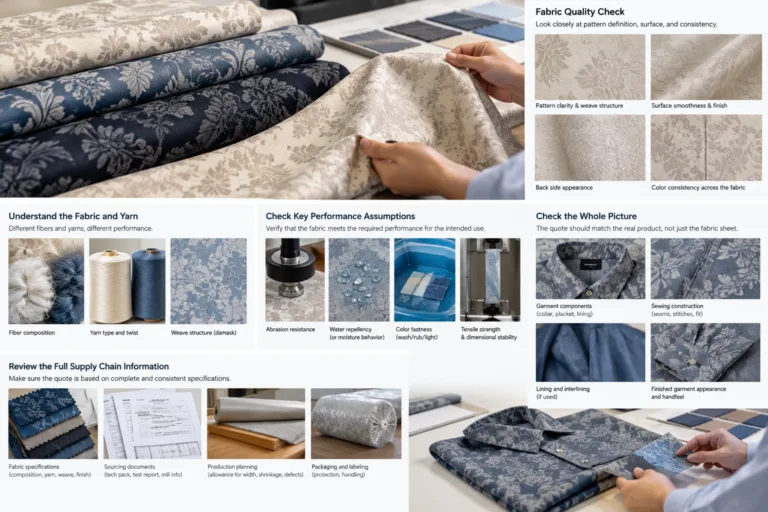
A proposed substitute may look equivalent while changing the final product. Similar appearance or the same nominal fiber content does not by itself establish identical hand feel, weight, color behavior, dimensional behavior, care performance, fit, or garment appearance. The practical issue is whether the alternative continues to meet the approved product requirements for its intended use.
A useful substitution review begins by identifying the proposed change and comparing it with the approved material. The sourcing manager then assesses which product requirements could be affected, requests appropriate samples or supporting evidence, coordinates any necessary technical or quality review, obtains the decision from the authorized stakeholders, and updates the relevant records. The required work depends on the material, product, market, and level of risk.
Material approval is also distinct from a test result, a buyer preference, and a regulatory requirement. A test may provide evidence about a particular characteristic; it does not automatically approve every commercial or design consequence of a change. Likewise, an internal preference does not replace a requirement that applies in a specific market. The sourcing manager’s responsibility is to keep these categories distinct and make the decision path visible.
Substitution control is not a blanket prohibition on alternatives. It is a decision and documentation skill. When a proposed change could affect fit, appearance, care, quality, or delivery, the sourcing manager coordinates with product development, technical, quality, merchandising, and the supplier so that the option is evaluated before it becomes an unrecorded production assumption.
Cost, Capacity, Timing, and Risk Trade-Offs
Commercial judgment in apparel sourcing means understanding what a quote does and does not cover. A sourcing manager considers price alongside specification compliance, supplier assumptions, material availability, quality risk, order flexibility, development status, and the timing constraints of the project. These factors are connected: a proposed cost may depend on a material that has not been approved, while a schedule may depend on decisions that are still open.
A lower unit price does not necessarily mean a lower overall delivery cost. Exclusions, proposed substitutions, packaging, transport, possible rework, or schedule uncertainty can change the comparison. Instead of treating an unresolved assumption as a confirmed saving, record it and establish what evidence or decision is needed. Capacity and timing are also project-dependent; they should be discussed with the supplier against the specific product, materials, order context, and current development status.
A simple decision record can keep those trade-offs visible. For each supplier or option, note the requirement, supplier assumption, commercial effect, product or quality risk, evidence needed, owner, and approval status. For example, if one offer relies on an alternative material, the comparison can show that its price is conditional while the material and product implications remain under review. This supports a reasoned decision without implying that one option guarantees a particular outcome.

Cross-Functional Communication, Documentation, and Issue Resolution
Sourcing managers often translate between teams that use different language and prioritize different outcomes. Design may focus on appearance, technical teams on construction and fit, quality colleagues on requirements and evidence, and commercial teams on cost and timing. The sourcing manager does not need to replace these specialists; the role is to make sure questions and decisions reach the right people in a form they can act on.
Useful comments identify the issue, refer to the relevant sample or document version, state the requested change or clarification, assign an owner, and name the next confirmation point. “Please review the sleeve” is difficult to act on. A more useful note identifies the sleeve detail and sample version, explains what remains unclear, and asks the responsible person to confirm the intended construction before the next review.
Records vary by company, but working files may include quote comparisons, sample comments, approval status, change logs, risk lists, and open-question trackers. Keep supplier proposals, internal preferences, supporting evidence, and final approvals distinguishable. When a problem arises, confirm the facts, identify the affected requirement, consider the available options with relevant stakeholders, document the decision, and verify the updated result. Apparel Wiki’s About page describes the publication’s educational role; the site is not a sourcing service or manufacturer.
How to Build and Demonstrate Apparel Sourcing Manager Skills
A practical self-assessment should test whether you can explain and use core skills, not just name them. Check your confidence with garment terminology, specifications, materials, RFQs, quote comparisons, supplier questions, substitution review, quality coordination, cost reasoning, documentation, and stakeholder communication. Note where you can show a work sample or explain a decision, and where you still need practice or feedback.
A portfolio case can demonstrate those skills even when it is based on an educational exercise. Show the starting problem and available information, the questions you raised, the options you compared, the decisions made, how you would verify them, and what limitations remain. Label simulated work clearly as simulated; do not present it as client or employer work. A polished garment image alone says little about how you handled assumptions, risks, or approvals.
For a focused learning path, study garment and material fundamentals, assemble a sourcing-ready product information package, compare hypothetical supplier quotations, and document a material-change decision. Ask relevant technical or commercial professionals to review your reasoning. Then compare your checklist with current job descriptions in your target region: responsibilities and expectations differ by employer, product category, and sourcing model.
To continue, choose one skill gap and build a small, clearly labeled practice case around it. Apparel Wiki’s Apparel Manufacturing Tools page may help you find relevant learning resources; check each tool’s scope and limitations before applying it to a sourcing decision.

Frequently Asked Questions
What is the most important skill for an apparel sourcing manager?
Reliable judgment is central: the ability to clarify requirements, evaluate supplier assumptions, coordinate appropriate reviews, and document decisions. Its practical expression depends on the product and the employer’s division of responsibilities.
Does an apparel sourcing manager need to know garment construction and fabric technology?
Working knowledge is useful for spotting unclear specifications and asking informed questions. The sourcing manager may coordinate with pattern, product development, technical, or quality specialists rather than replacing their expertise.
How should an apparel sourcing manager compare supplier quotations?
Compare offers against the same product information and stated commercial assumptions. Review the costing unit, inclusions, exclusions, proposed substitutions, packaging, delivery context, and unresolved questions rather than ranking headline prices alone.
How can a beginner demonstrate apparel sourcing manager skills without factory experience?
Build a simulated case that shows the inputs, questions, comparison method, decisions, verification plan, and limitations. Label it as an educational exercise and do not imply it represents client or employer work.
What is the difference between apparel sourcing, merchandising, and production management?
The focus often differs: sourcing emphasizes supplier and commercial options, merchandising may coordinate product and order information, and production management may follow manufacturing execution. Actual duties overlap and vary by company.
How do apparel sourcing manager responsibilities vary by company and region?
Employers may combine sourcing with merchandising, technical coordination, production follow-up, or commercial work. Product category, sourcing model, and regional hiring practices also affect expectations, so use current local job descriptions for comparison.