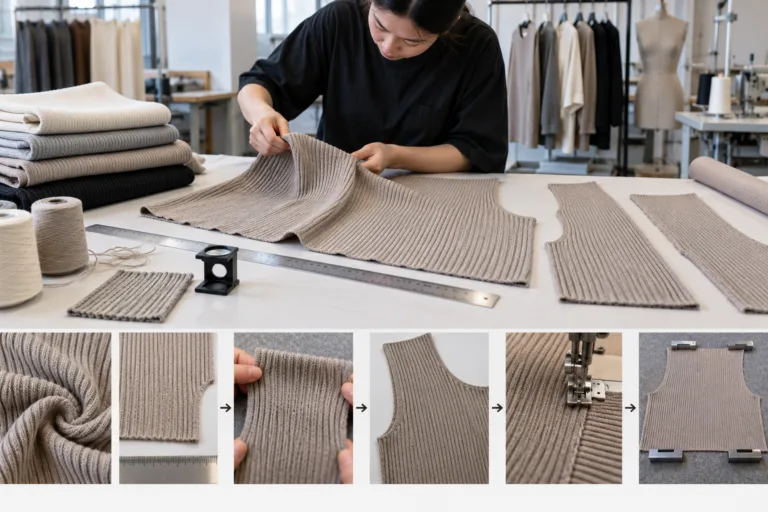
Milano rib cutting distortion is a change in a cut panel’s shape, alignment, or dimensions that appears during cutting or after the panel is moved and handled. The fastest way to investigate it is to record the symptom before changing the pattern or recutting: note where the panel departs from its intended geometry, which direction it moves, how often it occurs, and when it first becomes visible. This evidence-aware approach supports Apparel Wiki’s independent educational work; its editorial position is explained on the Sponsor page.
A distorted Milano rib panel does not automatically identify its cause. Fabric state, knit structure, pattern geometry, spreading, cutting, bundling, movement, or measurement conditions can produce similar appearances. The sections below organize those possibilities so you can compare them without treating a photograph or one affected panel as proof.
What Milano Rib Cutting Distortion Looks Like
Start by defining the departure from the intended panel. A cut panel may show a skewed edge, a bowed cut line, shifted symmetry, uneven length, or a different shape after it is lifted from the cutting surface. Record whether the change is local to one area or repeated across matching panels. Also record whether it was visible at the cutting table, immediately after separation, or only after resting or further handling.
The minimum observation record should identify the panel, its orientation, and its layer or ply position when that information is available. Note the cut direction, the fabric condition before cutting, and the time of each observation. Take photographs from a consistent viewpoint and make comparisons in the same measurement state. A panel photographed while suspended may not present the same geometry as one lying flat, so the observation condition belongs with the evidence.
Keep the symptom separate from the diagnosis. A bowed edge is an observation, not proof of fabric relaxation. Repeated directional displacement may justify checking alignment or the lay, but it does not rule out a pattern issue or a shared fabric condition. A photograph can show where the shape differs; by itself, it cannot establish why.
Milano rib is a description of knit construction, not a complete material specification. Fiber content, yarn, finishing, width, fabric state, and handling can differ between materials sold under a similar construction name. The construction can provide useful clues, but it does not independently determine stretch, stability, or dimensional behavior.
If matching panels distort in the same direction, check the reference edges, grain or course alignment, and the way the fabric was positioned. Treat that pattern as a reason to investigate, not as a confirmed root cause. The useful diagnostic description includes location, direction, frequency, and occurrence conditions.
Separate Fabric Behavior from Panel Geometry
Compare the panel with its pattern or marker in a consistent state. Check the overall length and width, symmetry, notches, center lines, and reference edges. Then describe the apparent displacement and its direction. The purpose is to determine whether the panel was already unlike the intended geometry at the cutting table or whether its shape changed after movement, resting, or handling.
A panel that changes shape after it is moved provides different evidence from one that is incorrectly shaped before separation. Neither observation proves a cause. Fabric relaxation, tension, compression, or spreading movement may be variables to check. So may pattern revision, marker placement, cutting behavior, or a difference between the state used for measurement and the state used for visual inspection.
| Observable input | Implication to investigate | Initial check | Variable that could change the choice |
|---|---|---|---|
| Repeated distortion in one direction | Shared alignment, fabric-state, pattern, or lay condition | Compare reference edges, orientation, and corresponding panels | Layer position, fabric direction, or pattern revision |
| Distortion limited to one panel | Local handling, layer movement, cutting, or measurement issue | Compare its location and layer position with nearby panels | Panel identity, operator sequence, or post-cut movement |
| Shape changes after resting or movement | State-dependent material or handling behavior | Repeat the comparison under a recorded, consistent condition | Time, support surface, tension, or handling state |
| Cut geometry does not match the pattern | Pattern, marker, alignment, or cutting-process issue | Place the panel and reference together using the same orientation | Pattern version, reference line, or measurement method |
Use these comparisons to keep hypotheses separate. An apparently accurate cut line can still produce a panel that looks wrong later if the reference state changes. Conversely, a fabric that changes shape does not prove that the pattern was correct. Structure offers clues, but it does not by itself establish the fabric’s dimensional response.
Trace Distortion Through Cutting and Handling
Review the material’s condition before the lay was prepared. Record whether it was stored, unrolled, flattened, rested, or handled differently from the comparison material. These details are investigation variables, not universal procedures. Avoid assuming that one preparation period or handling sequence is correct for every Milano rib fabric.
Next, follow the directional references through the lay. Compare the selvage or usable width, visible courses or ribs, and the pattern’s grain or course instructions where provided. Ask whether the intended reference remained consistent across the layers. If several panels share the same directional change, that repeatability may point toward a shared fabric, pattern, or alignment condition rather than one isolated panel event.
Review spreading and cutting observations for tension, drag, compression, shifting layers, unstable edges, tool behavior, and movement before panels were secured. Each is a hypothesis that needs an observable clue. For example, distortion concentrated in one layer or location supports a different line of inquiry from distortion repeated throughout the lay, although neither pattern confirms the cause alone.
Finally, record what happened after cutting. Note bundling, stacking, hanging, movement within the work area, and the moment the distortion was first seen. A panel can be inspected in several states, and those states should not be treated as interchangeable. Compare the affected pieces with apparently unaffected ones while remembering that the latter are not automatically perfect controls.
This trace turns a list of possible cutting mistakes into a process record. It helps distinguish a change associated with fabric preparation from one associated with alignment, cutting, or later handling. Keep the result bounded: the record narrows competing explanations, but a visual similarity alone does not establish a production-wide conclusion or guarantee that one process change will correct every panel.
Use a Controlled Diagnostic Workflow
A controlled workflow helps organize evidence before anyone changes the pattern, adjusts the cutting process, or recuts affected pieces. The aim is to narrow competing explanations. A visual comparison or small trial does not, by itself, prove how every panel in the lay will behave.
- Preserve the original condition. Separate affected panels where practical. Mark the panel identity, orientation, and layer position when those details are known. Photograph the distortion and record when it was first seen. Note whether the panel was flat, bundled, moved, or otherwise handled when it was measured. Use the same reference state for later comparisons.
- Describe the symptom consistently. Record its location, direction, frequency, and occurrence condition. Note whether the issue affects an edge, center line, notch, length, width, or overall symmetry. Compare affected pieces with apparently unaffected pieces, but do not treat the latter as perfect controls. They may differ in layer position, fabric state, or handling.
- Check geometry separately from material state. Compare the pattern or marker with the intended panel geometry, including reference edges, notches, center lines, orientation, and revision status. Then compare the cut panel with that reference in a consistent state. Keep pattern, fabric, spreading, cutting, and measurement questions as separate lines of inquiry.
- Build a short hypothesis log. For each possible explanation, write the observation that supports it, the observation that could weaken it, and the smallest useful comparison. For example, repeated directional change may justify checking alignment and lay conditions, while a change after movement may justify comparing fabric state and handling. Neither observation confirms a cause on its own.
- Change one meaningful variable at a time. Retain the original records and comparison pieces before changing several settings or procedures. Repeat the comparison on a limited, representative set when appropriate, documenting the input condition and result. If visual checks cannot distinguish the causes, consult a suitable technical or testing resource and check the applicable project method.
This process improves traceability, but it cannot establish a universal tolerance, guarantee a correction, or replace a validated method when a formal specification or pass/fail decision applies.
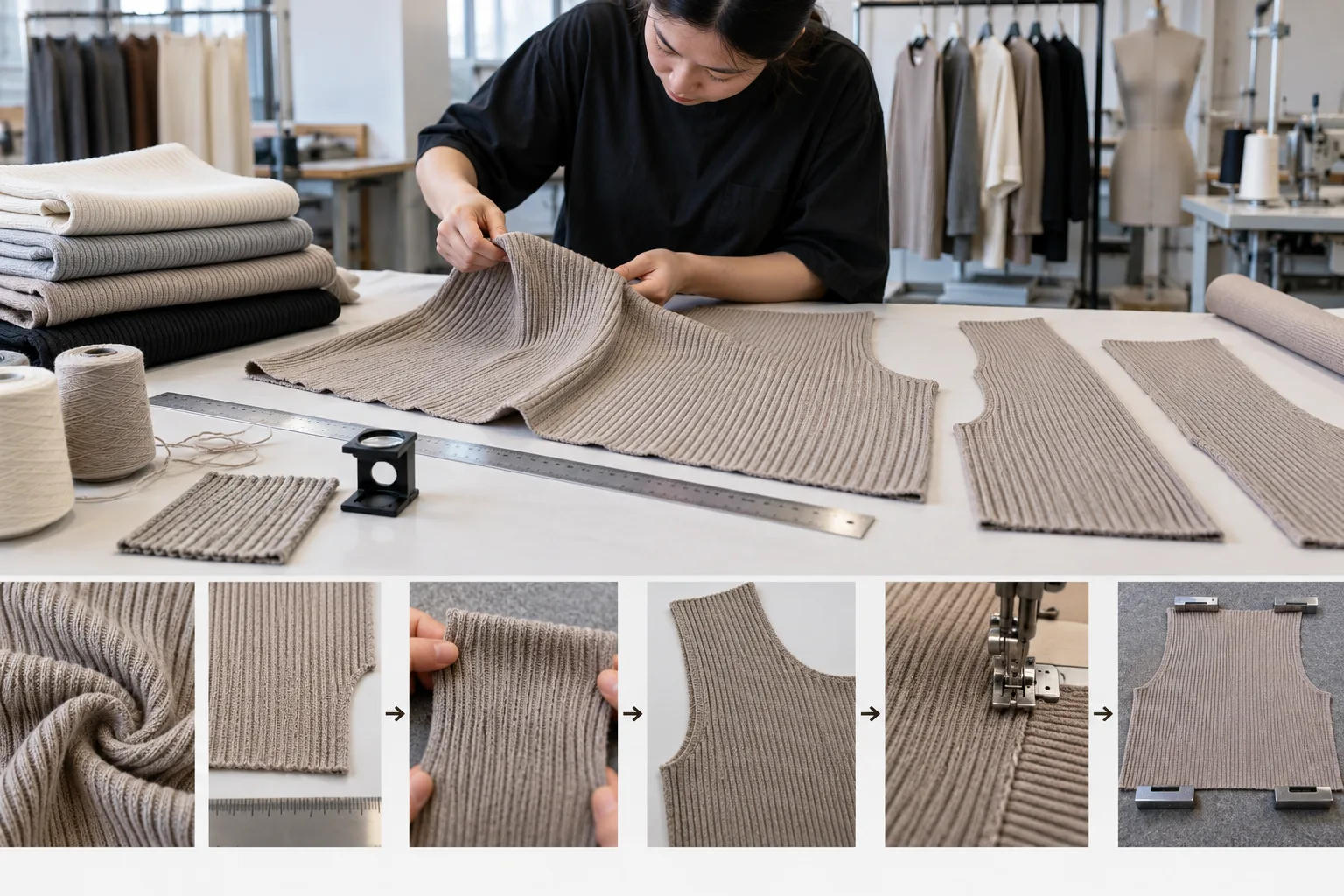
Match the Corrective Action to the Confirmed Cause
Corrective action should follow the strongest available evidence rather than the most familiar explanation. A material name, fabric weight, or visible symptom is useful context, but none independently establishes the required production response.
| Evidence pattern | Proportionate first action | What to recheck | Variable that could change the decision |
|---|---|---|---|
| Pattern or marker evidence | Compare approved geometry, orientation, seam references, and revision status before altering the fabric. | Cut geometry, notches, center lines, and reference edges. | A different pattern revision or measurement state. |
| Fabric-state evidence | Document the fabric condition and compare consistent preparation conditions. | Shape before cutting, after cutting, and after movement or resting. | Fiber, yarn, finishing, width, or handling differences. |
| Spreading or cutting evidence | Review alignment, layer movement, tension, drag, compression, and tool interaction one variable at a time. | Lay position, direction, affected layers, and repeated locations. | Equipment condition, operator sequence, or securing method. |
| Post-cut handling evidence | Compare the panel before and after bundling, stacking, transport, or other movement. | Timing, support surface, orientation, and storage state. | Handling duration or a change in the reference condition. |
| Mixed or unresolved evidence | Preserve the records and run the smallest comparison that separates the leading hypotheses. | Whether the same symptom repeats under a consistent input condition. | Unrecorded fabric, pattern, process, or measurement differences. |
If the evidence points to a marker mismatch, review the approved geometry before blaming the cutting operation. If the shape changes with fabric state, movement, or resting, compare those conditions before revising the pattern or assigning a universal relaxation time. If the issue follows a layer, direction, or cutting interaction, review that process step while retaining a comparison record.
For example, a lightweight knit panel may look aligned immediately after cutting but change shape during movement. That observation supports comparing fabric state and handling before changing the pattern. If the result changes under a consistent comparison, the next action should change with it. If only the measurement state changes, define that state clearly and report the limitation rather than creating an unsupported defect threshold.
Do not recut immediately when the evidence is mixed. First preserve the affected pieces and identify what result would support or weaken each proposed correction. GSM, width, and construction can be documented as material information, but they are not standalone predictors of distortion.
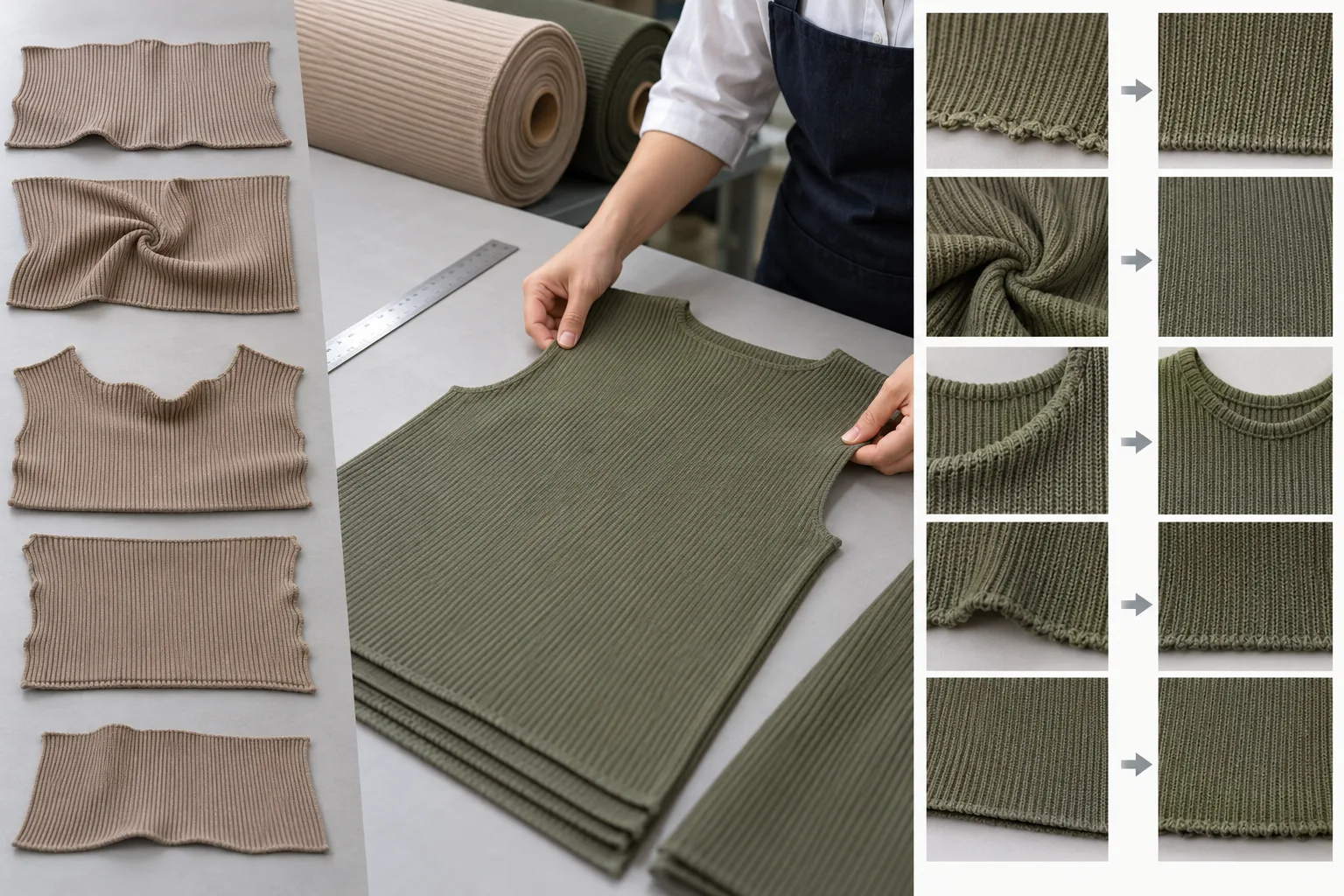
Record the Diagnosis Before the Next Cut
Create a one-page comparison record with panel orientation, symptom location and direction, fabric and pattern identifiers, process observations, timing, measurement state, and unresolved hypotheses. Compare the applicable project specification or test method before assigning pass or fail. When visual evidence cannot separate the causes, seek an appropriate technical resource rather than making a universal claim about Milano rib.
Frequently Asked Questions
What is the first thing to record when a Milano rib panel looks distorted?
Record the panel identity, orientation, layer position when known, symptom location and direction, fabric condition, timing, and measurement state. Photograph the panel in that same state so later comparisons do not mix different conditions.
How can I tell whether the problem is in the pattern or in the fabric state?
Compare the approved pattern or marker with the cut geometry first, then observe whether the panel changes after movement or a consistent period in the same reference state. These observations can support different hypotheses, but neither confirms the cause alone.
Can fabric relaxation change the apparent shape of a cut Milano rib panel?
A change in fabric state may alter the apparent comparison between a panel and its reference. Treat this as a variable to document and compare, because the effect depends on the material specification, preparation, handling, and measurement condition.
Why might distortion appear only in some layers or panels?
Layer position, local handling, alignment, cutting conditions, or differences in fabric state may create a localized pattern. The distribution helps narrow the investigation, but it does not identify one cause without supporting observations.
Should I recut the panels immediately when the distortion is found?
Usually, preserve the affected pieces and record the original condition before recutting. A quick comparison of pattern geometry, fabric state, process conditions, and handling may show which variable needs review and prevent the same uncertainty from being repeated.
When is a visual inspection not enough to diagnose cut panel distortion?
Visual inspection is limited when competing causes produce similar shapes, when the measurement state changes, or when a formal tolerance or pass/fail decision applies. In those cases, use the applicable project method or obtain suitable technical or testing guidance.