

Sponsor button loop security for blouses as a closure-system requirement: the button should remain engaged during the blouse’s intended wear, while the wearer should be able to release it as the use case requires. These are separate outcomes. A loop that is difficult to open is not automatically secure in a useful way.
The result depends on the interacting button, loop, attachment points, surrounding fabric, and garment construction, as well as how the blouse moves on the wearer. Define the wearing task before setting expectations: a blouse opened repeatedly presents a different use case from one worn with little adjustment. The guidance below offers qualitative decision criteria, not a universal performance specification.
What Button Loop Security Means in a Blouse
Here, button loop security means how well the complete closure retains the button during intended wear and releases when the intended opening action is performed. This is a working description, not a claim that the apparel industry uses one formal definition. Retention and release should be stated separately: the first concerns staying engaged under expected movement, while the second concerns opening for dressing, undressing, or adjustment.
Consider the closure as a system. Button shape and size interact with the loop’s dimensions and material. The loop’s attachment points, supporting seam or facing, and nearby fabric also matter. Wearer movement and access influence how the closure is engaged and released. No single component establishes the finished blouse’s security in every use.
Start with the task. Record how the garment is worn, where the closure sits, how often it is opened, and what movement or local pulling is expected. If a particular wearer or use requires a specific release behavior, treat that as a project requirement to establish, not an assumed rule. A garment category alone does not establish a performance level.
A useful specification vocabulary includes intended use, retention condition, release condition, materials, construction, inspection observations, and validation evidence. These terms turn “secure” into questions a product team can answer: What should keep the button engaged? What action should release it? Which finished materials and construction will be evaluated? Without validated project data or an applicable authoritative requirement, keep criteria qualitative rather than inventing a universal threshold.
Identify Loads, Movements, and Garment Variables
Map the closure area through the intended wearing and opening sequence. Note where the blouse may bend, stretch, rub against an adjacent layer, or catch on an accessory. Separate expected movement from accidental events outside the stated use. This map helps define the conditions worth considering without treating every possible snag as a design requirement.
Separate choices the specification can identify from questions that need evaluation. The document can state the button and loop materials, loop dimensions, attachment design, reinforcement, seam placement, and surrounding fabric. Whether that combination retains and releases as intended remains a question for the finished garment. Shell fabric, lining, interfacing, loop material, button, and assembly method should be considered together.
For a lightweight or more extensible blouse fabric, consider whether movement around the opening could change how the loop engages or releases. The construction to investigate may change with button shape, loop dimensions, reinforcement, and intended movement; the fabric description alone does not determine the answer.
Record the wearing task, opening frequency, wearer access, adjacent garments or accessories, and relevant garment sizes. A secure-looking component may behave differently when attached to the final fabric and facing with the intended seam allowance and production method. Treat the opening as a local movement and load area, then evaluate the assembled blouse rather than inferring performance from the category or component alone.
Build a Button Loop Security Specification
A button loop security specification should identify the garment style and size range, closure location, button and loop materials, attachment and reinforcement, intended engagement state, intended release action, and use conditions. Add the workmanship observations and validation records the project will use. This documentation structure is an editorial recommendation, not a legal, contractual, or universal requirement.
Make the requirement observable. A project might describe unintended disengagement, damaged attachment, distorted surrounding fabric, or inability to release as intended as conditions for review. Define the wording and acceptance decision within the applicable project documentation. Do not imply that these examples constitute a recognized inspection standard.
Use the following decision aid to identify choices for investigation. It is not a standard, factory instruction, certification checklist, or approval record.
| Observable input | Likely implication | Initial choice to investigate | What could change it |
|---|---|---|---|
| Fabric extensibility near the opening | Engagement and release may vary with local movement. | Evaluate the loop and support with the intended fabric. | Button shape, reinforcement, garment movement |
| Button geometry | The loop must engage with the selected button and release as intended. | Specify the button alongside the loop. | Loop dimensions, closure location, user access |
| Loop construction | Material and attachment form part of the closure system. | Document material and attachment details. | Fabric, seam or facing support, opening frequency |
| Attachment support | The surrounding construction is part of the assembly being specified. | Identify the seam, facing, or reinforcement used. | Fabric behavior, production method, closure position |
| Wearer access | Retention alone does not describe whether release is usable. | State the intended release action. | Fit, closure location, wearing sequence |
Specify the complete, production-representative assembly. Avoid unsupported dimensions, force values, tolerances, or cycle counts; define measurable inputs only when the project has a justified basis for them.
Evaluate Security on the Finished Blouse
Evaluate the closure as part of a representative finished blouse, not as an isolated button or loop. The surrounding fabric, facing or reinforcement, attachment, garment size, and closure position all contribute to the assembly being considered. A component check may help compare parts, but it cannot establish how the complete blouse behaves during its intended use.
Start with the final materials and construction, relevant sizes, and the wearing and opening sequence defined for the style. Observe the closure before, during, and after that sequence. Record whether it disengages unexpectedly, releases as intended, or becomes difficult to open. Note visible loop deformation, button damage, shifting attachment, and stitch or surrounding-fabric damage. If repeated opening is part of the intended use, record any changes observed over that sequence.
Keep a development comparison distinct from a validated test result. A team can document observations to inform design choices, but those observations are not laboratory evidence or certification. If a formal method, numeric threshold, or pass/fail criterion is needed, identify the applicable authoritative requirement before using it; do not substitute an informal check for that evidence.
Consider variables likely to affect the outcome, including fabric construction, size range, closure position, button and loop combination, reinforcement, and wearer access. For a blouse intended for frequent opening, compare candidate constructions using the defined sequence and record what differs. Treat the comparison as project evidence, not as a universal result.

Balance Retention, Release, and Failure Risk
A closure that resists unintended disengagement can still be unsuitable if the intended wearer cannot reach or release it comfortably. A tighter-feeling engagement may also affect the surrounding fabric or the blouse’s appearance. The appropriate balance depends on the garment’s use, fit, closure location, and opening sequence; no single retention level applies to every blouse.
Describe what happened rather than recording only that the loop “failed.” Unintended disengagement calls for a different investigation than loop deformation, damaged stitching or fabric, button damage, a shifting attachment, or difficulty reaching the closure. These observations identify where to look, but do not by themselves prove a material-specific cause.
Trace the condition across the complete assembly. Review button geometry, loop dimensions and material, attachment support, reinforcement, surrounding fabric, and wearer movement before changing the loop alone. For a blouse opened frequently, compare the retention need with the wearer’s ability to reach and release the closure. The choice may change with fit, closure placement, and intended use.
Use a simple revision cycle: document the observed condition, identify which design variable may be involved, adjust the specification or construction, and evaluate the representative finished blouse again. Keep the observation separate from any conclusion that requires a validated method or project-specific evidence.
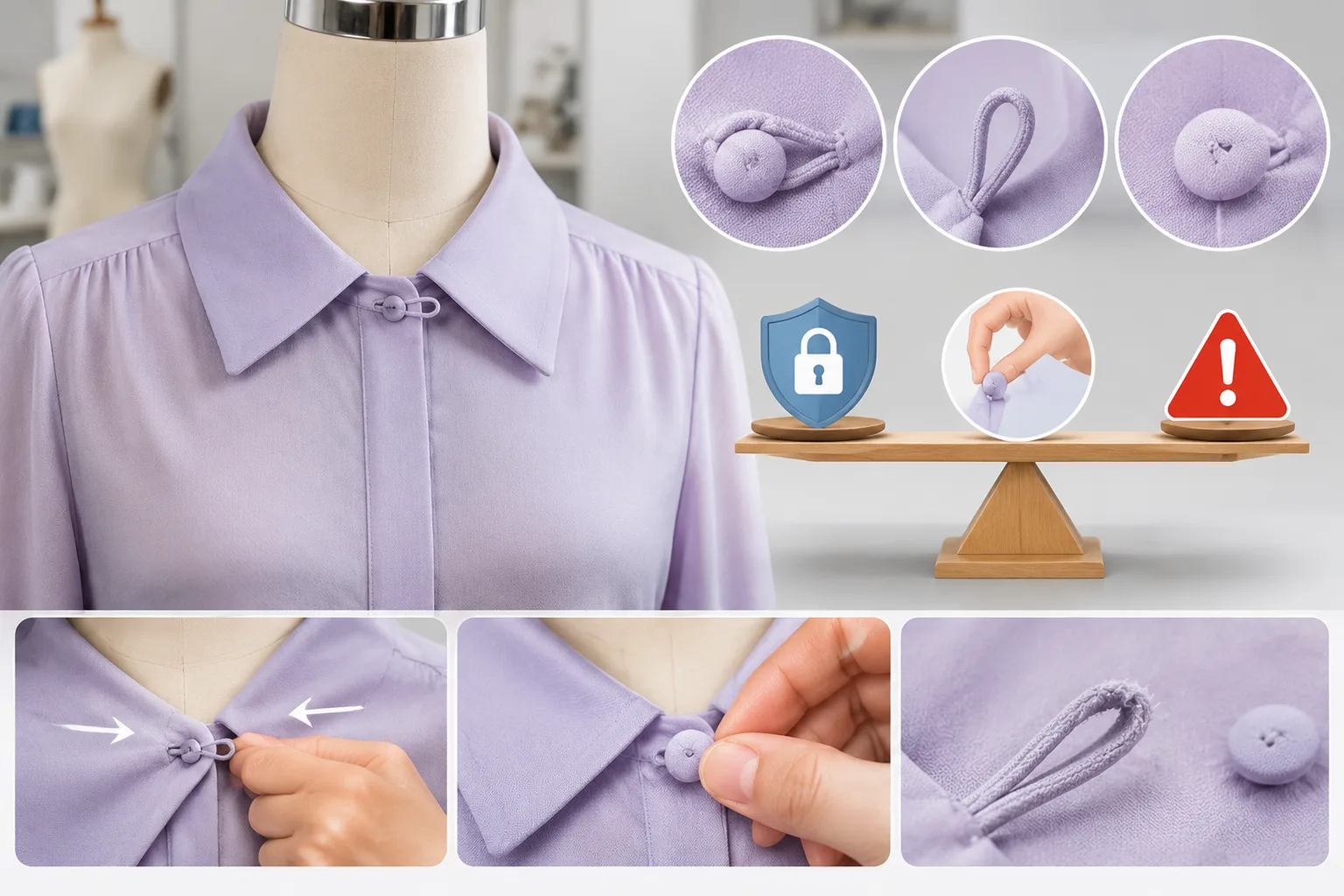
Record the Requirement and Choose the Next Check
Compare the written retention and release conditions with the final button, loop, fabric, reinforcement, attachment, size range, and wearing sequence. Choose an evaluation approach suited to that use. Before assigning a numeric threshold, check the applicable authoritative method or product requirement; otherwise, record qualitative observations and unresolved variables. Use the specification to guide the next design review, not as a claim of certification.
Frequently Asked Questions
What does button loop security mean for a blouse?
It describes how the complete closure retains the button during intended wear while allowing the intended opening action. The result involves the button, loop, attachment, surrounding fabric, garment construction, and use conditions.
Which blouse and closure details should a button loop security specification include?
Document the style and relevant sizes, closure location, button and loop materials, attachment and reinforcement, intended engagement and release, use conditions, inspection observations, and validation records. Set project-specific acceptance language rather than assuming universal limits.
Can a secure button loop still be unsuitable for the wearer?
Yes. Retention and usable release are distinct outcomes. Reach, fit, closure location, and the intended opening sequence can affect whether a closure suits its wearer and use.
Should button loop security be evaluated on the component or the finished blouse?
Evaluate the finished blouse for conclusions about the garment. Component checks can inform comparisons, but they do not account for the final fabric, attachment, reinforcement, construction, and wearing sequence.
What should be recorded when a blouse button loop opens unintentionally?
Record when and how it opened, the garment and closure configuration, and any visible changes to the loop, button, attachment, stitching, or fabric. Use those observations to guide investigation; do not infer a cause without supporting evidence.


