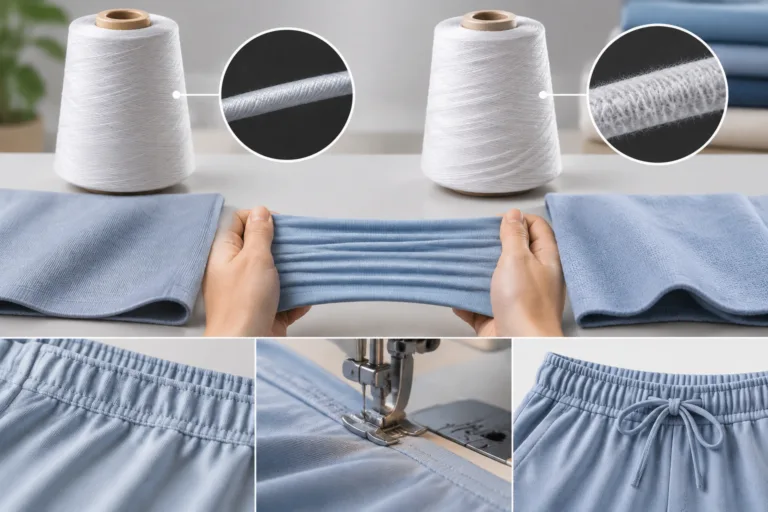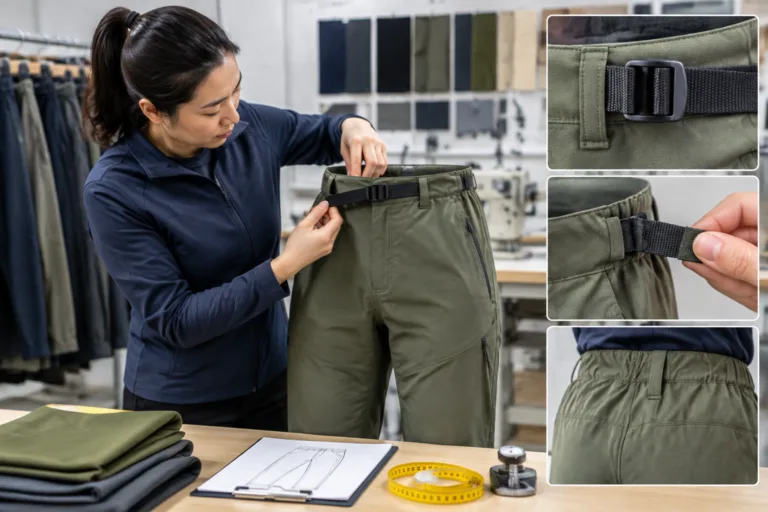
Hiking pants waist adjustability is the garment’s ability to accommodate the intended wearer and use conditions through the waistband, adjustment components, and pattern relationship. A production check should confirm that the selected setting holds, feels comfortable, stays positioned, offers the intended usable range, and releases cleanly without restricting movement. This independent Apparel Wiki guidance follows the publication’s editorial boundaries; its Sponsor page is not evidence of manufacturing or inspection services.
The check begins with the wearer’s task, not the category label. Movement, posture, layering, and carried equipment can change how the waist interacts with the body. Review the assembled pants across relevant sizes and use conditions, then separate design intent from a verified production result.
What Hiking Pants Waist Adjustability Needs to Control
An adjustable hiking pants waist must work as part of a garment system. The waistband shape, rise, front closure, belt loops or other attachments, seam placement, and material combination all affect how the waist behaves. An adjuster that looks satisfactory by itself may feel bulky, shift position, or interfere with the closure after it is installed in the finished garment.
Start by defining the fit task. Is the wearer expected to adjust the waist over a base layer, during repeated bending, or while carrying equipment? The answer determines which observations matter most. A close-fitting pattern may require careful attention to pressure and balance, while a looser pattern may make access and setting retention more important. These are development choices, not universal requirements for every pair of hiking pants.
Early review can use four practical questions:
- Can the intended wearer reach, operate, and reverse the adjustment without awkward handling?
- Does the adjustment hold the selected setting during ordinary movement?
- Does the waistband avoid sharp, concentrated, or unnecessarily bulky pressure?
- Does the garment remain balanced while the wearer stands, bends, sits, and steps?
Also inspect the relationship between the waist and nearby details. A tab, drawcord, elastic section, or webbing path can alter the front closure, pocket access, belt-loop position, or waistband edge. The relevant result is the behavior of the final garment in its intended sizes and materials, not a presumed performance based on the product name.
Calling a garment hiking pants does not establish a particular adjustment performance. The design may express an intended fit or operating concept, but production review must show whether the assembled garment supports that concept. Record the use condition, size, setting, and material combination beside each observation so a pattern issue can be distinguished from a component or sewing issue.
Map the Waistband and Adjustment Components Before Inspection
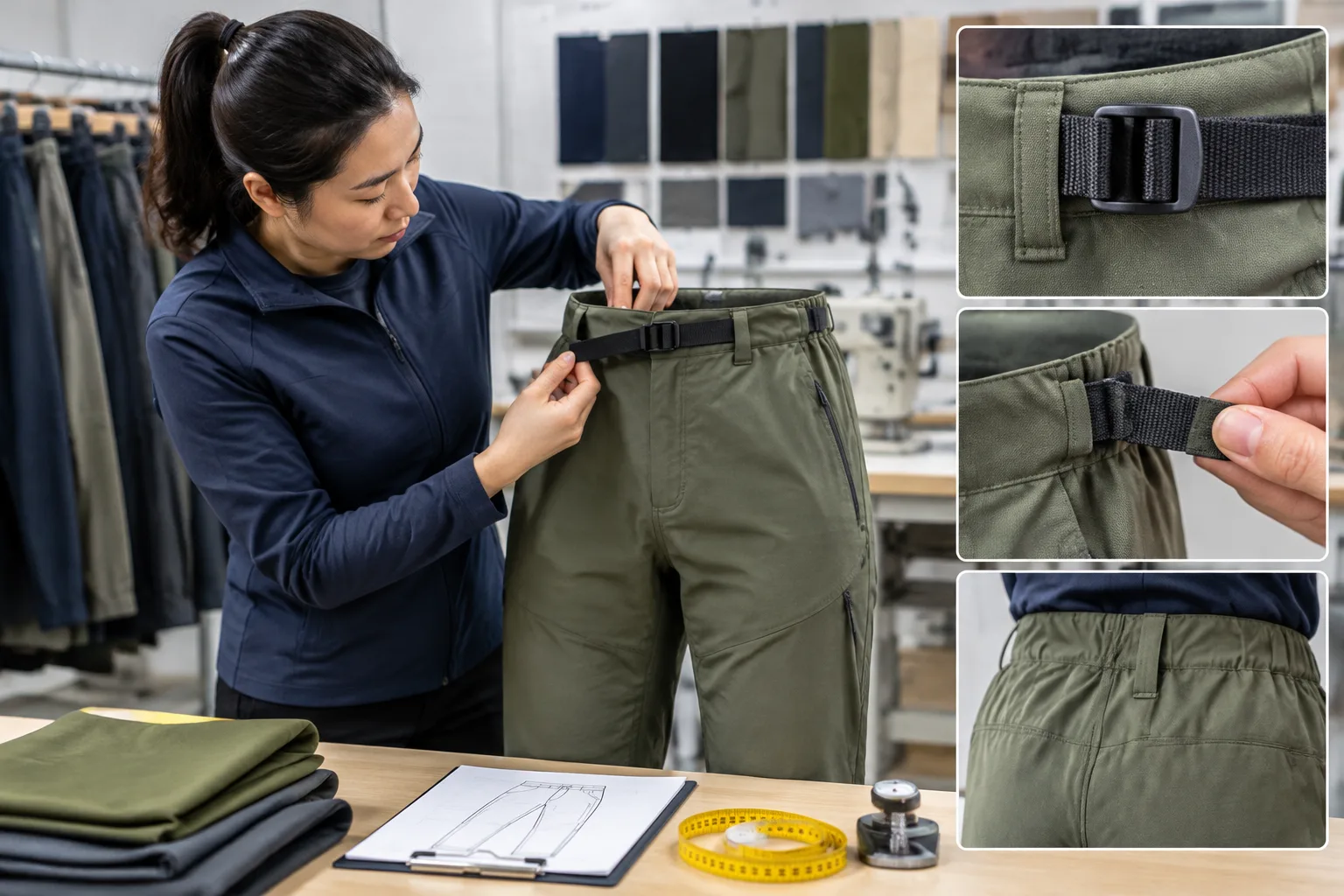
Before inspecting operation, turn the waist design into a component map. List the waistband body, support or interfacing layers where present, elastic or other flexible elements, adjusters, reinforcement, seams, closures, belt loops, and nearby pockets. Note where repeated handling, extension, pressure, or attachment force is expected. This makes the inspection traceable without assigning an unsupported stitch count or tolerance.
For each part, record what should be visible and what must function after assembly. Appearance checks can include alignment, symmetry, edge finishing, stitch continuity, attachment security, and exposed ends. Function checks concern whether the adjustment follows its intended path, remains accessible, and can be tightened or released without twisting, snagging, or creating concentrated discomfort.
Inspect interfaces rather than treating each item as independent. The adjuster may operate smoothly before insertion but bind against a seam after assembly. A flexible element may feel comfortable alone but alter the waistband shape when combined with a rigid fabric. A belt loop or pocket edge may obstruct access even when its own workmanship is acceptable.
Use the final fabric, lining, elastic, hardware, and assembly method for the review. Combination validation matters because a satisfactory individual component does not establish satisfactory performance in the finished pants. Where possible, keep separate records for size, colorway, and material combination when grading or material behavior changes the waist result.
A useful map can include these fields:
- Component and location: identify the waistband area, adjustment route, attachment, or neighboring detail.
- Expected interaction: note handling, extension, pressure, closure, or movement demands.
- Visual condition: record alignment, finish, continuity, exposed ends, and attachment appearance.
- Operating condition: record access, path, release, setting retention, and interference after assembly.
- Variation: identify whether the observation changes by size, material, colorway, or adjustment setting.
This map is an inspection framework, not a claim that one hardware type or reinforcement method is superior. If a construction choice is presented as standard or required, compare it with the applicable product specification or technical construction reference.
Compare Waist Adjustment Approaches for the Intended Use
Adjustment selection should connect the intended wearer and activity to the waistband construction, available space, material stretch, operating access, bulk, and required stability. The table below compares production inputs and conditional implications. It does not rank one approach as universally best.
| Adjustment approach | Observable production inputs | Likely implications to review | Initial use-case choice | Variables that could change the choice |
|---|---|---|---|---|
| Integrated elastic or side adjustment | Elastic path, extension, recovery, access, and attachment points | Review waist balance, edge comfort, bulk, and whether the setting remains stable | May suit a design prioritizing flexible movement and low handling complexity | Fabric recovery, waistband shape, pattern ease, and layering |
| Webbing or tab-based adjustment | Routing, anchor points, exposed ends, release path, and closure clearance | Review operating access, concentrated pressure, bulk under layers, and setting retention | May suit a design needing direct manual adjustment at a defined location | Webbing stiffness, hardware geometry, attachment construction, and wearer reach |
| Drawcord-style adjustment | Cord route, exit position, securing method, ends, and interference with nearby details | Review smooth tightening and release, twisting, edge pressure, and cord placement | May suit a waistband with room for a flexible adjustment route | Cord behavior, channel construction, rise geometry, and operating conditions |
| Fixed waistband with belt-loop reliance | Waistband shape, loop placement, closure relationship, and belt clearance | Review balance, access, local bulk, and whether the intended belt interaction is practical | May suit a garment where adjustment is expected through a separate belt | Belt dimensions, wearer preference, garment fit, and equipment or layering |
For a lightweight stretch hiking pant, low bulk and comfortable movement may receive more attention during initial review. That does not prove the approach is suitable: fabric recovery, pattern balance, and adjustment retention can change the result. A rigid woven or a layered-use garment may create different priorities.
Inspect each option on the assembled pants. Check the adjustment path and access, attachment points, selected-setting retention, bulk under relevant layers, edge comfort, closure interference, and whether the waist remains balanced when adjusted. Treat these observations as inputs to the next design decision, not as certification or a guaranteed performance result.
Evaluate Adjustability on the Moving Garment
Waist adjustability should be evaluated on the assembled pants, because the waistband, rise, closure, fabric, lining, and adjustment components work together during wear. Begin with the selected waist setting on a representative garment size. Observe the pants while standing, bending, sitting, stepping, and moving through the intended range of motion.
Look for visible changes in the waistband and nearby construction. The waistband may roll, gap, dig in, shift, or alter the relationship between the waist adjustment and front closure. These observations do not establish a universal pass or fail result by themselves. They identify conditions that need comparison with the approved pattern, construction specification, or intended use.
Check adjustment access while the pants are worn. The evaluator should be able to reach the adjustment, operate it, and reverse the setting under the conditions relevant to the garment. Layering or carried equipment may matter when they change access or add pressure near the waist. Record whether operation requires awkward reach, excessive effort, or handling that causes the adjustment path to twist or snag.
Review more than one size when the product includes a graded size range. A single sample cannot show whether the adjustment position, waistband shape, rise relationship, or nearby details remain usable at smaller and larger settings. Compare the same movement and operating conditions across sizes, and note whether the issue follows the size, the material, the pattern, or the adjustment construction.
Wearer feedback is useful when it is recorded separately from measured or laboratory results. Ask evaluators to identify pressure points, slippage, operating difficulty, and interference with movement. Do not treat one person’s response as representative of every wearer. Relevant users and postures should be included according to the product’s intended application.
For pants intended for repeated bending, stability and comfort during bending deserve particular attention. Fabric stretch, recovery, rise geometry, and adjustment construction can change the result, so this movement review is an editorial evaluation framework rather than a certified test method. Record each issue by location, garment size, adjustment setting, movement condition, material combination, and suspected cause. That record helps separate pattern, material, component, and sewing decisions during the next review.
Inspect Workmanship and Document Waist Defects
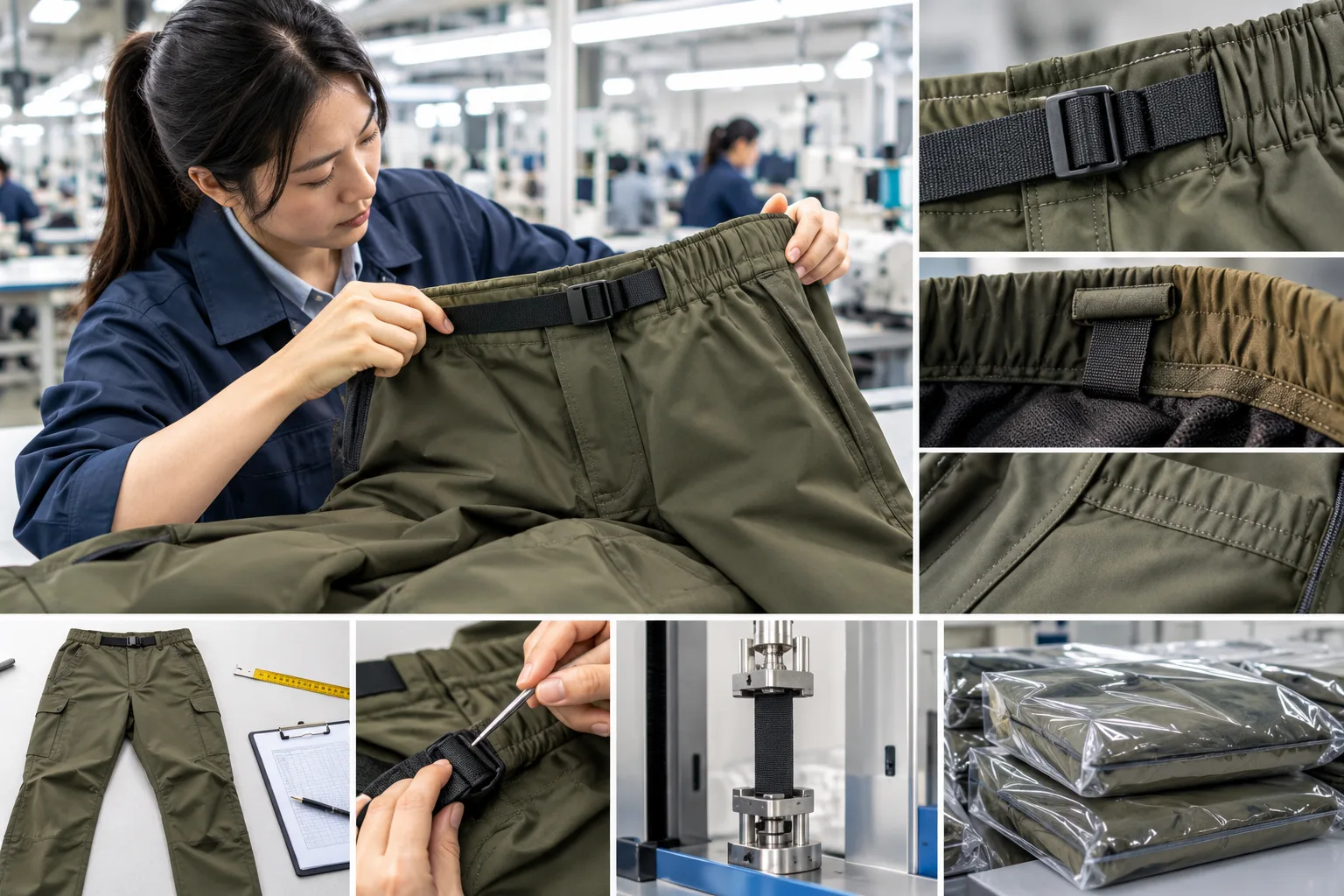
A useful production record separates what is visible from what happens during operation. Organize observations by location and defect type: waistband shape, seam or edge finish, adjustment path, attachment, hardware or flexible element, front-closure interaction, comfort, and setting retention.
First review visual workmanship. Check alignment, symmetry, edge finishing, stitch continuity, exposed ends, and attachment placement against the approved construction information when it exists. Then operate the adjustment and observe whether the path remains accessible, the selected setting holds during the review, and the waistband stays balanced. A visible sewing irregularity and a functional failure may occur in the same area, but they require different corrective discussions.
Compare the sample with the approved pattern, construction specification, trim information, and size grading rather than applying an invented universal tolerance. If no approved measurement or tolerance exists, record the observation as a review item. Do not label it legally noncompliant, unsafe, or outside an industry requirement without the applicable jurisdictional rule, product specification, or authoritative standard.
Describe or photograph the condition consistently. Include the garment size, adjustment setting, movement or operating condition, material combination, and whether the issue repeats across samples. Also note whether the issue appears only at a particular setting, colorway, fabric, or graded size. Consistent records make it easier to distinguish a repeatable production defect from a sample-specific observation.
Use a simple disposition sequence:
- Confirm the observation under the same condition and identify its exact location.
- Identify the affected component or interface, such as the waistband, adjuster, attachment, closure, or fabric assembly.
- Check whether the issue changes by size, material, adjustment setting, or movement condition.
- Decide whether the next review belongs to pattern development, construction correction, component selection, or additional validation.
A design question is different from a confirmed defect. For example, a bulky but consistently sewn adjustment may require a use and comfort decision rather than a workmanship correction. An incomplete attachment or obstructed adjustment path is a more direct construction concern. An inspection record supports a production decision, but it does not by itself prove regulatory compliance, certification, or long-term field performance.
Turn Waist Checks Into the Next Development Decision
Start with the use and fit task, map the adjustment system, inspect the assembled garment in movement, compare relevant sizes and materials, and document findings against the approved specification. Then compare the waist construction drawing, sample record, and applicable evaluation method to identify which observation still needs verification. Confirm unresolved numeric, regulatory, or performance claims from the responsible source, or omit them.
Frequently Asked Questions
What should be checked first on an adjustable hiking-pants waistband?
Start with the assembled garment at a selected waist setting. Check adjustment access, setting retention, waistband balance, front-closure interaction, and visible pressure or bulk while standing and moving. Then compare the observation with the approved pattern and construction information.
How can waist adjustability be evaluated while the pants are being worn?
Observe the wearer standing, bending, sitting, stepping, and performing relevant movements. Check whether the waistband rolls, gaps, digs in, shifts, or restricts adjustment access. Record wearer feedback separately from measured results or formal laboratory testing.
Should the adjustment system be checked differently across sizes and fabric types?
Yes. Review relevant graded sizes and material combinations because fabric behavior, rise geometry, pattern balance, and adjustment placement can change the result. Use the same documented conditions where possible so differences can be traced to size, material, construction, or component choice.
How do you distinguish a waistband construction defect from a poor design choice?
Compare the sample with the approved construction information and confirm whether the issue is visible, repeatable, and located in a component or assembly. A sewing or attachment problem may be a construction defect. A consistently made feature that creates unsuitable bulk or access may require a design review.
What production records help document a waist-adjustability problem?
Record the garment size, material combination, adjustment setting, movement or operating condition, defect location, observed effect, and whether the issue repeats. Add photographs or consistent descriptions, then identify whether the next action concerns the pattern, material, component, sewing method, or further validation.