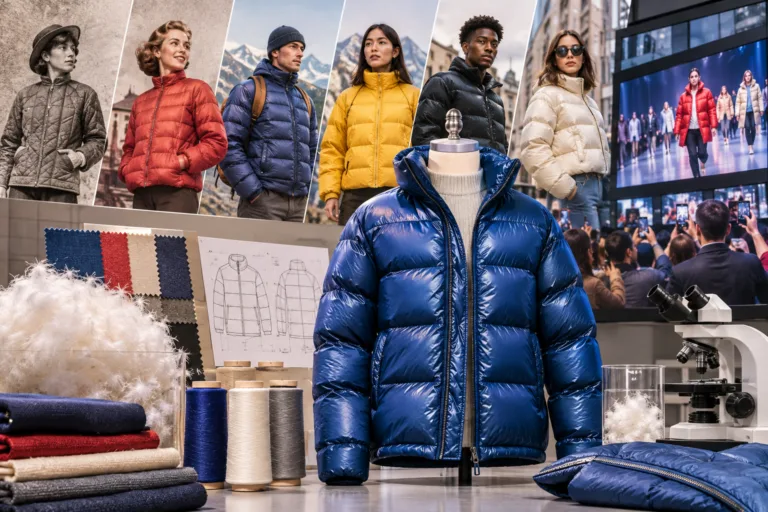
The social meaning of a puffer jacket is not fixed inside its padded construction. It develops through use, access, styling, representation, and the circumstances in which people encounter the garment. Across different periods, similar jackets can suggest protection from cold, technical competence, occupational purpose, leisure, fashion awareness, or social distinction. Apparel Wiki approaches this as an independent, evidence-led fashion-history question; its Sponsor page explains that sponsorship does not give a sponsor editorial control.
For this discussion, a puffer jacket is broadly an outer garment with quilted or compartmented areas designed to hold insulating material. Shapes, fillings, names, and construction methods vary. Understanding puffer jackets social history therefore requires more than finding an old example. It requires asking what evidence establishes, who used the garment, how it was presented, and which conclusions remain interpretive.
What Counts as a Puffer Jacket, and What Counts as Its History?
A working definition should identify the garment without pretending that every padded coat belongs to one uninterrupted category. A puffer jacket usually has an outer layer divided into stitched or otherwise formed compartments that control insulation. Its visible volume often results from the insulating layer, but the amount of loft, quilting pattern, length, closure, shell material, and intended activity can differ substantially.
Historical terminology also creates problems. A source may describe a garment as padded, quilted, down-filled, insulated, or intended for cold conditions without using the modern phrase “puffer jacket.” Conversely, a present-day catalog may apply a familiar label to an older object. Researchers must examine the object’s construction and the wording of its original record rather than relying only on a later category name.
The history of puffer jackets is built from several evidence types, each answering a different question:
| Record type | What it can establish | What it cannot establish alone |
|---|---|---|
| Surviving garment | A documented object with recorded materials, construction, dating, and provenance | That it was the first example or widely worn |
| Dated image | That a related garment was represented in a particular setting | How common it was or how audiences understood it |
| Patent or design record | A documented proposal or protected feature at a stated time | Commercial success, unique invention, or general adoption |
| Product record or advertisement | Commercial availability and the way a seller presented the garment | Actual sales, everyday use, or public reception |
| Multiple contemporary sources | Potential evidence of broader visibility or use within a defined context | Universal popularity beyond that place, group, or period |
This evidence ladder prevents an early documented object from becoming an unsupported “first.” A surviving garment proves that the particular object exists and has been recorded. It does not automatically identify a sole inventor, establish an exact beginning, or show when related garments entered ordinary wardrobes.
Collection information must also remain object-specific. Estimated dates, attributed makers, altered components, uncertain provenance, and restoration can affect interpretation. The strongest account connects material evidence with contemporary records, while clearly separating documentation from suggested social meaning.
Practical Protection, Technology, and Changing Uses
Protection from cold is an important starting point in puffer jacket history, but practical function does not create one universal meaning. An insulated jacket worn during demanding outdoor activity may communicate preparedness or specialized purpose. A visually similar garment used for routine travel may instead appear ordinary, convenient, or seasonally necessary. Climate, activity, access, and local clothing customs all affect the association.
Construction choices influence what a garment can do and how people perceive it. Compartment shape can help control the position of insulation. Shell and lining materials affect weight, feel, appearance, and resistance to everyday wear. Length, hood design, closures, cuffs, and fit can support different uses. These features may also make a jacket look more technical, more formal, or more closely connected to a particular activity.
However, technical development and social change should not be treated as the same event. A new material or construction method may be documented before manufacturers can produce it at useful scale. Commercial availability may then begin in a limited market. Wider adoption may take longer, occur unevenly, or not follow at all. Meanwhile, people can continue using established alternatives because of cost, availability, habit, performance needs, or cultural preference.
A careful account therefore separates at least four stages:
- Development: a material, construction, or design concept is created or documented.
- Commercial availability: a garment using that concept is offered in a defined market.
- Broader adoption: evidence shows use extending across more consumers, activities, or locations.
- Coexistence: newer insulated garments remain alongside older coat types and layering systems.
This sequence matters when studying puffer jacket origins. A patent can document an idea, but it cannot show that people immediately purchased or recognized the resulting garment. A product listing can demonstrate availability, but not its importance within a whole society.
To connect practical use with social perception, researchers need contextual evidence. Useful records might identify the wearer or intended user, the activity, the location, the season, and how the garment was described at the time. Without that context, a technical-looking jacket may suggest specialized use to a modern viewer even when its original role is unknown.
Practical meaning can also persist after a garment enters fashion settings. Technical associations do not necessarily disappear when silhouettes, colors, or styling change. Function and fashion can overlap, giving the same jacket different meanings to different observers.
From Functional Garment to Visible Social Signal
A puffer jacket becomes a social signal when people read its appearance, use, or presentation as information about the wearer. That signal does not reside in insulation alone. It emerges from the relationship between the garment, the person wearing it, the setting, and the expectations of an audience.
Context can change the message quickly. A bulky insulated jacket combined with activity-specific equipment may indicate preparation for cold or exposure. The same jacket styled with coordinated garments in a commercial image may emphasize silhouette, color, novelty, or brand identity. In a daily urban setting, it may communicate little more than seasonal practicality. None of these readings automatically applies everywhere.
Visible details can shape interpretation. Pronounced quilting may draw attention to volume and construction, while a restrained surface can make insulation less visually dominant. Oversized or close-fitting proportions can alter the wearer’s outline. Color, surface finish, length, logos, and accessories can connect the jacket to particular forms of self-presentation. Yet these features do not prove the wearer’s identity, class, occupation, gender expression, or group membership.
Historical images are valuable because they preserve a specific representation. They may show who was pictured, how the garment was styled, and which setting the photographer, editor, or advertiser selected. Promotional imagery can also reveal the audience a seller hoped to address. What an image depicts, however, is narrower than what people commonly wore or believed.
An advertisement featuring a puffer jacket in a prestigious setting establishes a commercial framing. It may suggest that the seller wanted to associate the garment with status, modernity, leisure, or technical performance. It does not establish that audiences accepted the message, that most owners used the jacket in that way, or that the association crossed national and social boundaries.
The same caution applies to photographs of identifiable communities or activities. One documented image can establish presence in that moment. A series of dated records may support a stronger account of recurring visibility. Claims about a broader social group require additional evidence, including contemporary reporting, oral histories, sales records, personal accounts, or specialist scholarship relevant to the defined place and period.
The social meaning of puffer jackets is therefore best expressed as a contextual interpretation, not a permanent label. Researchers should first describe what a source shows. They can then explain what the source may suggest and identify what it cannot demonstrate. This method preserves meaningful connections between clothing and identity without turning one image, wearer, market, or country into a universal history.
Fashion Visibility, Media, and Mainstreaming
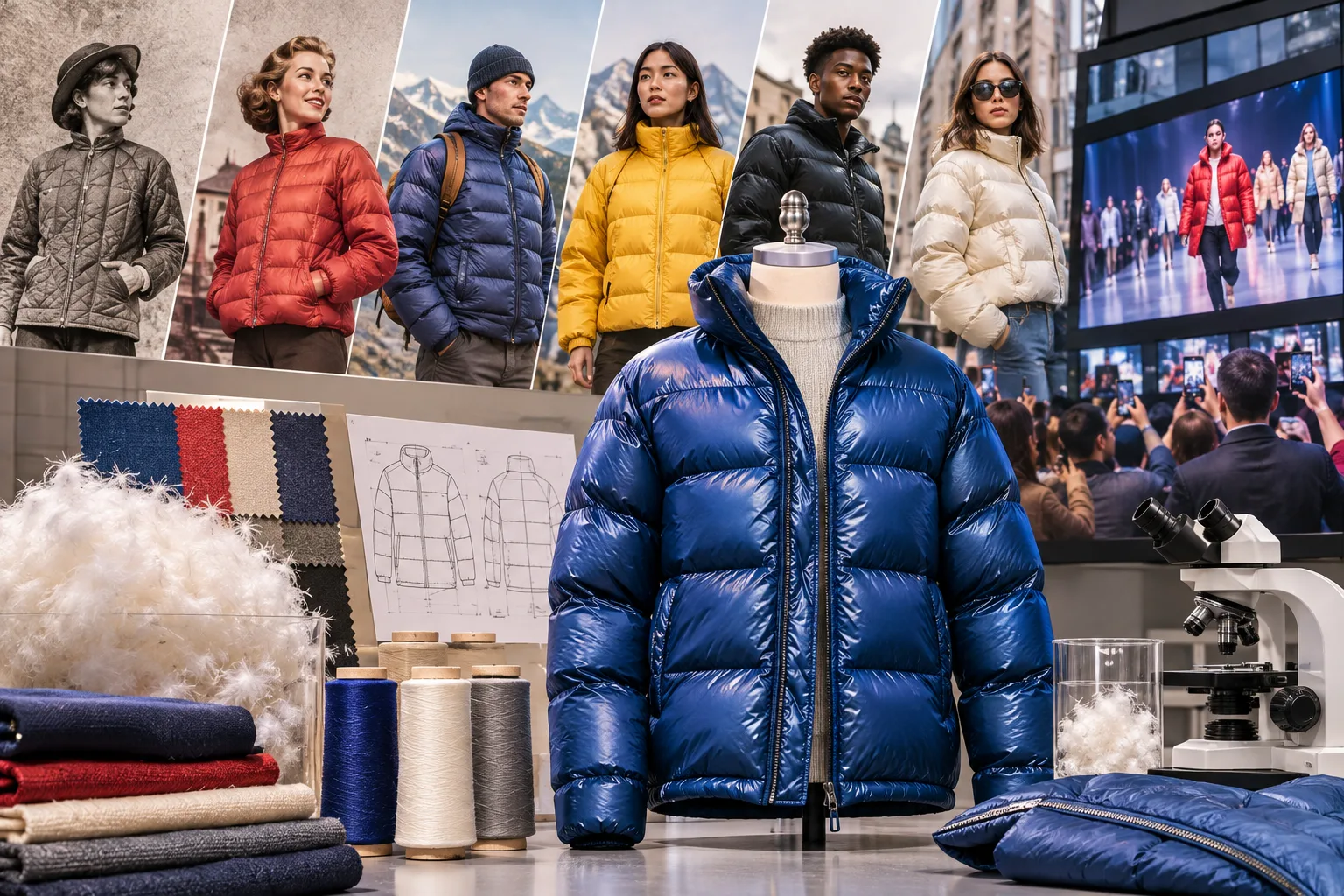
Fashion presentation can give a practical garment meanings that exceed insulation and protection. A puffer jacket shown in a styled editorial, advertisement, catalog, film, or public appearance may be framed as fashionable, prestigious, youthful, rebellious, technical, or deliberately ordinary. Those meanings come from the complete presentation, not from the quilted structure alone.
Researchers should therefore separate the garment from the visual choices surrounding it. Silhouette, color, proportion, branding, pose, location, accompanying clothing, and the identity assigned to the wearer can all guide interpretation. An oversized jacket photographed in an urban setting communicates differently from a similar insulated garment shown during outdoor work. The image may emphasize different qualities even when both garments provide practical protection.
A dated fashion image can establish that a particular representation existed at that time and place. A commercial campaign can also show how a company wanted audiences to perceive its product. Neither source, by itself, proves that the jacket was widely purchased, commonly worn, or understood in the intended way. Evidence of broader adoption usually requires multiple records, such as recurring street photographs, retail information, personal accounts, press coverage, or other contemporary material.
This distinction matters when discussing mainstreaming. A prominent appearance may increase visibility without producing immediate or universal adoption. Availability may expand at different speeds across markets, price levels, climates, and consumer groups. Earlier forms of cold-weather clothing may also remain in use, while puffer jackets enter only selected activities or fashion settings.
Fashion framing does not necessarily replace functional meaning. The same general garment type can continue to signal warmth and protection while gaining associations with status, design awareness, leisure, or group identity. These meanings may coexist, compete, or change with styling. A useful account of puffer jackets in fashion history should therefore ask two separate questions: how was the jacket represented, and how widely was that representation reflected in everyday use?
Why Meanings Differ Across Places and Periods
Puffer jackets do not carry one global meaning. Their interpretation can change with climate, work, mobility, retail access, local dress practices, media exposure, and the availability of other outerwear. These are factors to investigate, not automatic explanations. Their importance must be established for the particular place and period under study.
Climate can influence why insulation is useful, but it does not determine social meaning on its own. In one context, an insulated jacket may be closely associated with routine winter wear. Elsewhere, it may appear mainly in travel, sport, specialized work, or fashion imagery. Even within one city, meanings can differ between occupational, recreational, and social settings.
Access also shapes interpretation. A garment that is inexpensive and widely distributed in one market may function as ordinary protective clothing. A similar-looking jacket may carry novelty or status elsewhere if it is scarce, imported, strongly branded, or available through limited retail channels. Such conclusions require period-specific evidence about prices, distribution, ownership, and consumer response. Appearance alone cannot establish accessibility.
Trade arrangements, labor systems, and public policy can form part of the historical setting, but their effects should not be assumed. A change in manufacturing or import conditions does not automatically explain how people used or understood puffer jackets. Researchers need a documented connection between the broader development and the garment’s production, availability, price, or representation in the market being discussed.
A concise interpretive checklist helps prevent overgeneralization:
- Identify the source: Is it a surviving garment, photograph, advertisement, catalog, patent, personal account, or later commentary?
- Locate it: What date and place can the record support, and how certain are those details?
- Describe the people and institutions: Who produced, sold, displayed, photographed, owned, or wore the jacket, if known?
- Read the context: Was the garment connected to work, protection, leisure, fashion, performance, status, or another purpose?
- State the limit: What can the record not reveal about frequency, reception, motivation, or wider adoption?
Comparisons across countries or periods are strongest when the sources are reasonably comparable. An advertisement from one market and a personal photograph from another answer different questions. The first documents commercial representation; the second documents a particular instance of wear. Either may be valuable, but placing them side by side does not automatically demonstrate a broad cultural difference.
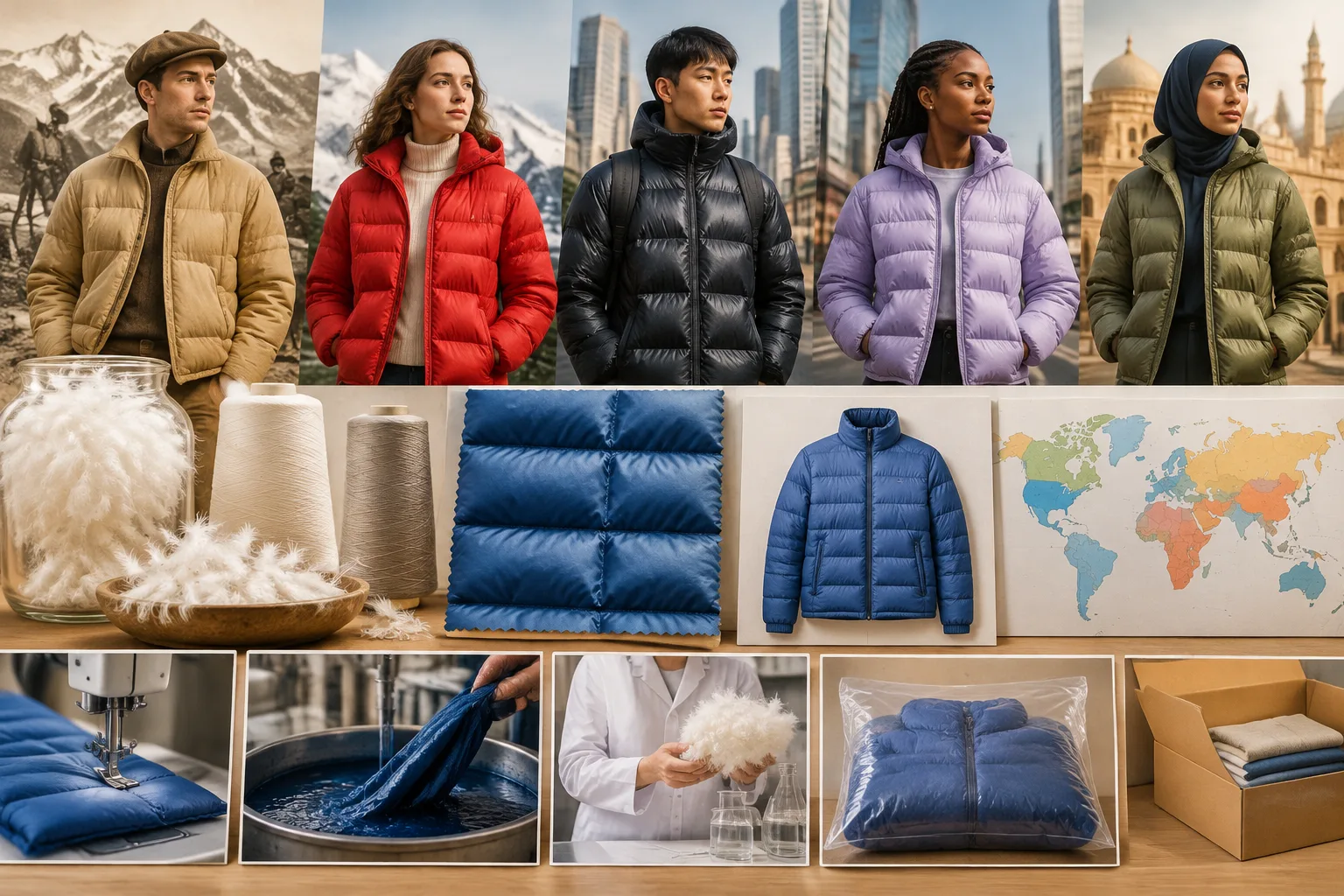
The puffer jackets social history is therefore better understood as a collection of connected local histories. Practical needs, technologies, markets, and representations can travel, yet their meanings are interpreted within particular communities and moments. A global account should preserve those differences rather than treating one country, social group, or fashion image as representative of an entire era.
A Careful Way to Read the Puffer Jacket’s Social History
The social meaning of a puffer jacket emerges from overlapping evidence about practical use, technology, representation, access, and local context. None of these factors supplies a universal explanation. Meanings can remain functional, become fashionable, or carry several associations at once.
As an educational next step, select two dated garments or images and compare their collection records or original contexts. Record the date, place, source type, known wearer or producer, visible styling, and unanswered questions. This simple comparison makes interpretations more transparent and reduces the risk of turning one documented example into a general history.
Frequently Asked Questions
What is the difference between an early surviving puffer jacket and the first puffer jacket?
An early surviving jacket is a documented object that remains available for study. Calling it the first puffer jacket requires stronger evidence that no earlier example existed. Survival is uneven, so an early collection record does not automatically establish invention or worldwide priority.
Can a patent date show when puffer jackets became widely worn?
No. A patent can document a filed design or technical claim within its legal context. It does not prove commercial production, retail availability, consumer acceptance, or adoption across different regions. Those stages require separate records and may occur at different times.
Why can the same puffer jacket have different social meanings in different places?
Meaning depends on local conditions, including climate, availability, price, work, leisure, styling, media representation, and existing dress practices. A jacket viewed as routine winter protection in one setting might appear specialized, fashionable, prestigious, or unfamiliar in another.
How can historical images help explain the cultural history of puffer jackets?
Images can document a garment’s visible form, setting, styling, wearer, or commercial presentation at a particular moment. They cannot independently establish how common the garment was, why it was worn, or how every viewer interpreted it. Captions and source context are essential.
What kinds of sources are useful for researching a puffer jacket’s history?
Useful sources include surviving garments and their collection records, dated photographs, advertisements, catalogs, patents, product records, newspapers, personal accounts, oral histories, and specialist scholarship. Combining different source types helps separate documented examples, commercial visibility, everyday use, and later interpretation.