
Apparel review credibility is the degree to which a reader has good reason to believe a review accurately describes the reviewer’s experience and gives enough relevant detail to assess its claims. A credible account is not the same as a verified product claim: it can reliably report what one person experienced without proving a garment’s performance for everyone. Apparel Wiki is an independent educational publication; its sponsorship information describes the site’s editorial position.
To assess what makes a clothing review trustworthy, separate what the reviewer did from what they noticed, what happened, and what they concluded. “I wore the shirt to work” describes experience; “the sleeve seam rubbed under my arm” reports an observation; “it was uncomfortable” expresses an outcome; and “the construction is poor” interprets it. Those statements may all matter, but they do not carry the same kind of evidence.
What Makes an Apparel Review Credible?
A useful working definition is justified confidence, not certainty. The reader should be able to see how the reviewer’s experience supports the claim and where the account leaves questions open. Research on online review credibility examines characteristics of reviews and their sources, but this does not establish a universal credibility score—or mean any single signal proves that a review is true.
Positive sentiment, a high star rating, polished writing, or agreement with a reader’s expectations may make a review appealing. None alone establishes that it is accurate. A critical review can be well supported, and a favorable one can be vague. The more practical question is whether the account provides relevant, inspectable evidence rather than simply sounding confident.
Several drivers help readers judge that evidence: the reviewer’s relationship with the garment, the specificity of the account, its use context, consistency between claims and reported details, transparency about relevant circumstances, and the boundaries of the review sample. These are lenses for assessment, not a checklist that guarantees truth. They help distinguish a believable report of one experience from a verified technical finding or a broad claim about a product.
How Reviewer Experience Shapes the Evidence
Start by asking what the reviewer actually did with the garment. Buying or receiving it establishes a different relationship than trying it on in a store. Wearing it may support an account of fit or comfort in a stated setting; washing it may support a report of what happened during that care experience. Altering or returning it can explain a fit decision or return experience, but does not by itself establish why other customers would make the same choice.
Keep self-reported preferences distinct from observed behavior and transaction evidence. A reviewer may say they like a relaxed fit, describe how often they wore a jacket, report that they returned it, or document a purchase. Each answers a different question. Stated preference is not proof of purchase, and a purchase does not establish frequent use or long-term satisfaction.
Experience is context, not automatic proof of accuracy. A reviewer who describes wearing a rain jacket during a particular activity may offer relevant evidence about that use, but the account does not automatically establish performance in other conditions. Professional status, audience size, or identity alone cannot settle whether a particular claim is supported. Researchers should record the reviewer’s stated relationship to the item, activity, time frame, care, and conditions where available.
Transparency also affects interpretation. If a garment was gifted, sponsored, or connected to another material relationship, readers need enough disclosure to understand that context. When ownership or the circumstances of wear are unclear, treat the gap as uncertainty rather than assuming either independence or bias. A missing detail limits what can be concluded; it does not, by itself, prove deception.
Why Specific Details Matter More Than General Praise
Specific details make a review easier to assess because they show what the judgment rests on. Instead of “great quality,” a reviewer might describe a seam coming undone after a stated period of wear. Instead of “comfortable,” they might explain that the waistband felt restrictive while sitting. Details about fit, construction, fabric feel, movement, care, and actual use can help—when they relate to the claim and garment in question.
Separate an observable event from its interpretation. “The color looked lighter after washing” reports an experience; “the dye is poor” generalizes from it. “The hem opened after several wears” is more assessable than “not durable,” but it still does not establish a measured durability result or show what would happen across other garments. Terms such as “high quality,” “good value,” and “comfortable” need context: compared with what, for which use, and by whose preference?
Relevant context need not expose unnecessary personal information. A reader may need to know the garment type, activity, fit preference or relevant fit details, and whether the account followed wear or care. A detailed review can still be mistaken, incomplete, or unrepresentative. Specificity improves assessability; it does not guarantee truth or replace appropriate technical testing for measured performance claims.
Context, Trade-Offs, and the Intended Use Case
Credibility and relevance are separate judgments. A sincere account may be credible as a report of one person’s experience yet weakly relevant to another reader’s question. Fit preferences differ, while comfort, maintenance, durability observations, and value depend on the activity, work or leisure setting, climate, budget, care conditions, and frequency of use. These factors shape interpretation; they are not universal product specifications.
| Claim | Context to ask about | Evidence that helps assess it |
|---|---|---|
| “It fits well.” | Which fit preference, garment size, and intended movement? | Specific fit observations and the activity tried |
| “It is comfortable.” | Worn where, for how long, and during what activity? | Reported sensations tied to those conditions |
| “It is durable.” | How often was it worn and how was it cared for? | Described wear or care outcomes; broader performance claims need suitable evidence |
| “It is good value.” | Compared with what alternatives and for which budget or use? | Stated comparison and the reviewer’s priorities |
When comparing apparel reviews, ask what happened, where, how often, and under what care conditions—not only whether the garment was “great” or “poor.” Those questions clarify what each account can contribute. They also leave room for conflicting experiences: different use cases or priorities can produce different conclusions without either account answering every reader’s question.
Sample Quality and Review Patterns
A group of apparel reviews is only as informative as the range of experiences it captures. Before interpreting a pattern, record how the reviews were collected, when they were posted, how reviewers were recruited, and whether the sample includes buyers, gift recipients, returners, or people who stopped using the garment. A visible review page may show current customers more easily than people who decided not to buy, returned the item, or could not afford it.
Sample quality does not require a large number to be useful. It requires a clear boundary. State the number of reviews examined, the collection dates, the platform or recruitment source, and any exclusions. A small, clearly described sample can support an exploratory finding about the accounts reviewed. It cannot automatically support a claim about all customers, a national market, or the garment’s overall quality.
Review volume, repeated wording, and rating distribution are signals to investigate, not automatic proof of authenticity or manipulation. Repeated wording may reflect a common product experience, a prompt that shaped responses, or language copied between accounts. A cluster of similar ratings may reflect genuine satisfaction or the way a platform attracts and displays reviews. Examine the wording, timing, reviewer relationship to the garment, and available context before drawing a conclusion.
For research, code each review by claim type, use context, evidence detail, outcome, and uncertainty. For example, separate fit comments from care outcomes, comfort impressions from construction observations, and return descriptions from purchase intentions. This makes patterns easier to inspect and prevents one broad label such as “positive” from hiding important differences.
A Practical Framework for Evaluating Review Credibility
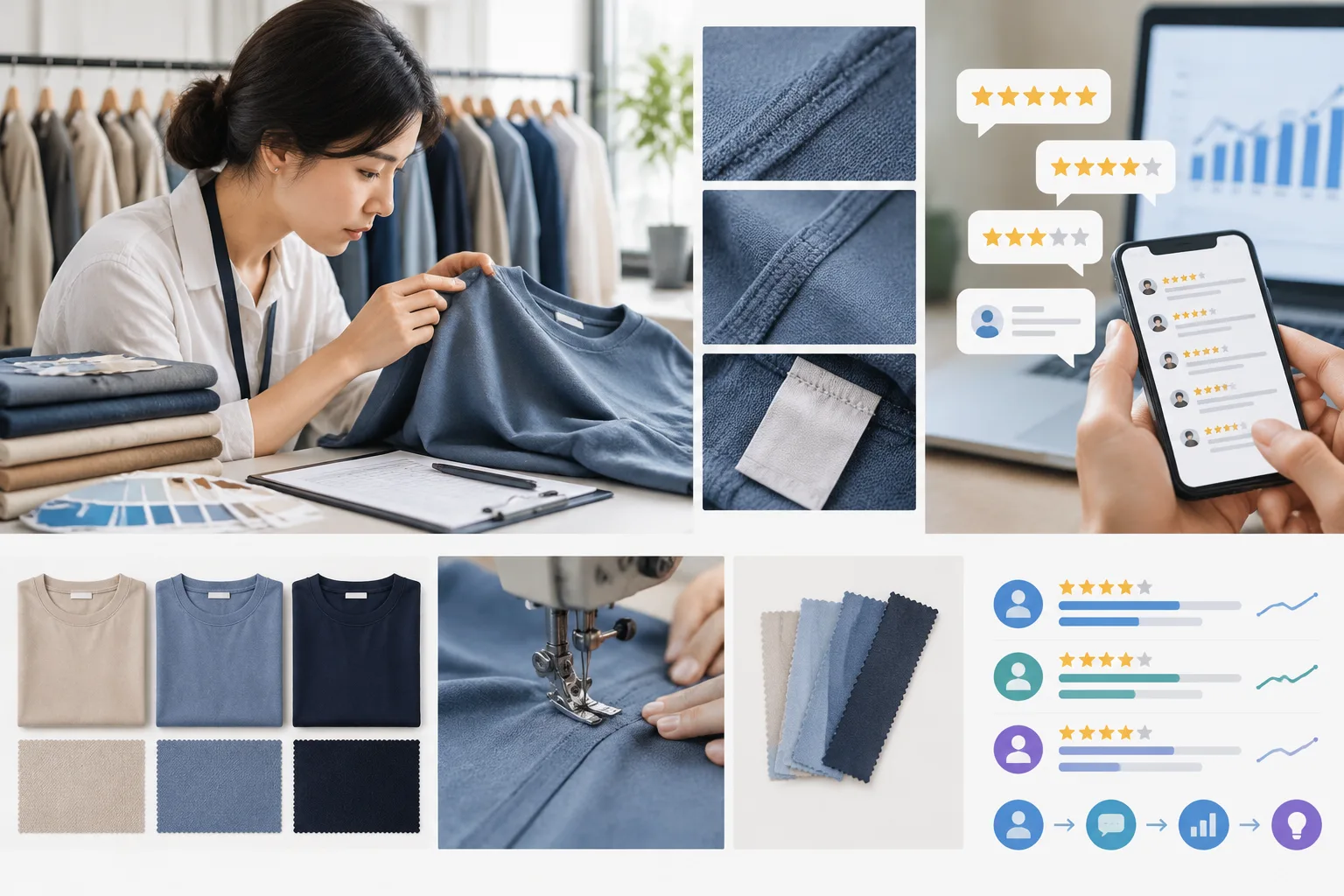
There is no universal credibility score that can settle every apparel review question. A repeatable qualitative process is more defensible. Research on factors affecting online review credibility supports examining review and source characteristics together rather than relying on one persuasive signal. Use the following steps as an editorial and research checklist, not as a formally validated rating system.
- Identify the claim. Define whether the review addresses fit, comfort, construction, care, durability, value, sizing, or a return experience. A review can be useful for one claim while providing little evidence for another.
- Record the experience context. Note whether the reviewer bought, received, wore, washed, altered, or returned the garment. Add the stated activity, conditions, time frame, frequency of use, and relevant gifted, sponsored, affiliate, or other disclosures when available.
- Classify the statement. Mark each passage as a direct observation, self-reported outcome, interpretation, comparison, or unsupported generalization. “The seam opened after repeated wear” is a reported event; “the garment is poorly made” is a broader interpretation that needs careful support.
- Compare across contexts. Look for converging evidence, conflicting experiences, and missing information. Differences do not automatically disprove a review. They may reflect different bodies, activities, climates, care routines, expectations, or priorities.
- State the evidence boundary. Explain what the review set can reasonably show and what it cannot establish. A set of detailed accounts may reveal recurring concerns or possible design issues without proving causation, market-wide demand, or laboratory performance.
When applying the checklist, assess relevance, specificity, transparency, sample coverage, consistency, and uncertainty together. A polished review with a high rating may still lack useful context. A mixed or negative review may contain precise observations that help product teams investigate a problem. Neither sentiment nor writing quality is a substitute for evidence that can be examined.

Limits of Apparel Review Credibility Research
Credible reviews can reveal experiences, expectations, complaints, trade-offs, and possible product issues. They do not automatically establish why an outcome occurred, how common it is among all users, or whether a garment meets a technical or legal requirement. Review credibility is also different from representativeness, product compliance, validated testing, and commercial performance.
The next evidence source should match the unanswered question. Interviews can clarify expectations and decision reasoning. Wear trials can document use under a defined set of conditions. Return data can show recorded return reasons, while transaction data can describe observed purchasing behavior. Garment inspection can help investigate construction concerns, and validated testing may be appropriate for a measurable textile or garment property. Each source answers a different question and has its own limits.
Document unresolved contradictions instead of forcing agreement between reviewers. Record assumptions about fit, care, use frequency, and reviewer status, then identify the evidence needed to test the most important assumption. A product, information, or service change can be framed as a testable improvement, but feedback alone cannot prove that the change will increase sales or improve every customer’s experience.
Apparel Wiki is an independent apparel industry knowledge publication, not a manufacturer, factory, laboratory, certifier, or testing authority. Its practical framework can help readers organize review evidence and decide what to investigate next; it should not be treated as a substitute for appropriate technical, legal, or market validation.
Educational next step: Select a small, clearly bounded set of clothing reviews and build a claim table with columns for reviewer experience, use context, observation, outcome, disclosure, and uncertainty. Then compare the strongest recurring pattern with the most important missing perspective before recommending a product or research change.
What are the main drivers of apparel review credibility?
The main drivers are relevant firsthand experience, specific and inspectable details, clear use context, transparency about the reviewer’s relationship to the garment, consistency with other evidence, and a sample that is described honestly. No single driver proves that a review is accurate.
How can you tell whether a clothing review is based on firsthand experience?
Look for a clear account of what the reviewer did with the garment, such as wearing, washing, altering, returning, or using it for a stated activity. Unclear ownership, missing use conditions, and purely general praise limit what the review can establish.
Why does the reviewer’s use context matter when evaluating an apparel review?
Fit, comfort, maintenance, durability observations, and value depend on factors such as activity, climate, care routine, frequency of use, budget, and personal priorities. A sincere review may be relevant to one use case but weakly relevant to another.
Can detailed apparel reviews still be unreliable?
Yes. Specificity improves assessability but does not guarantee truth. A detailed account may contain memory errors, an unusual experience, unclear comparisons, or conclusions that extend beyond the evidence described.
How should researchers handle conflicting clothing reviews?
Compare the reviewers’ garment versions, fit contexts, activities, care conditions, time frames, and priorities. Treat disagreement as information to investigate, and avoid averaging fundamentally different claims into one universal conclusion.
Are customer reviews enough to prove garment durability or performance?
No. Reviews can report wear experiences and identify possible concerns, but they do not by themselves prove durability, measured performance, compliance, or laboratory results. Use an appropriate wear study, inspection, or validated test when the question requires stronger evidence.