There is no single best boucle yarn count for every product. The appropriate count depends on the intended fabric, the size and frequency of the boucle effect, the end use, the knitting or weaving setup, and the appearance and hand you need. Apparel Wiki is an independent educational publication; information about editorial independence and support is available on our Sponsor page.
Yarn count describes fineness or linear density, but it does not by itself define loop size, softness, bulk, durability, pilling behavior, or final fabric performance. Before comparing numbers, identify whether the stated count belongs to the finished boucle yarn, its core or ground yarn, its effect yarn, or one component of a plied construction. Count is one selection variable alongside fiber content, ply, twist, loop formation, finishing, and sample results.
What Is the Right Yarn Count for Boucle Yarn?
The right count is the one that helps the complete yarn construction meet the product brief under the intended processing conditions. A count suitable for a delicate apparel knit may be unsuitable for a structured garment fabric, accessory, or decorative textile. Likewise, two boucle yarns with similar count information can create different fabrics when their loop structure, fiber blend, twist, or component balance differs.
For that reason, choosing a yarn count for boucle yarn should begin with the result you need rather than with a preferred number. Define the target fabric weight, cover, drape, texture, seam bulk, and visual scale of the loops. Then confirm how the yarn will be formed and finished. A finer or lighter construction may support a more delicate surface effect, while a heavier or bulkier construction may create greater cover or texture. These are development hypotheses, not universal performance rules.
Read the supplier’s specification carefully. A number may describe the finished novelty yarn, a single component, or one part of a multi-component yarn. It may also use a commercial notation that requires confirmation. The count should therefore be recorded with its unit, construction description, fiber content, ply, twist, loop details, and finishing information rather than stored as an isolated quality score.
What Yarn Count Actually Measures
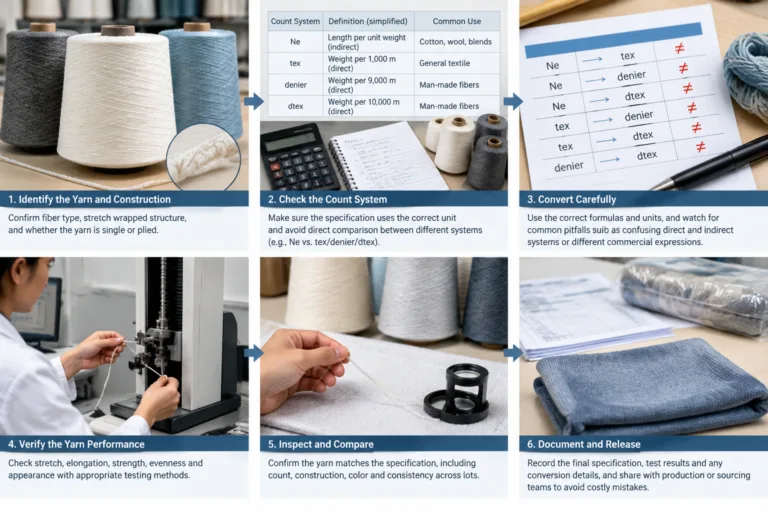
Yarn count expresses linear density through either a direct or an indirect system. Direct systems state mass per unit length. Tex is grams per 1,000 meters, denier is grams per 9,000 meters, and dtex is grams per 10,000 meters. In these systems, a larger number means more mass per stated length. It generally indicates a heavier linear density, not automatically a larger diameter or a bulkier boucle effect.
Indirect systems express length per unit mass. Within the same indirect system, a larger number generally indicates a finer yarn because more length is present for the same mass. This is why the phrase “higher yarn count” is incomplete unless the count system and unit are named. A larger direct-count number and a larger indirect-count number do not point in the same direction.
| Count type | What it expresses | How to read a larger number |
|---|---|---|
| Direct, such as tex, denier, or dtex | Mass per stated length | More mass per length within that system |
| Indirect | Length per unit mass | Generally a finer yarn within that system |
For unit clarification, the standard relationships are tex = denier ÷ 9 and dtex = tex × 10. A hypothetical example is 90 denier = 10 tex = 100 dtex. This only converts between related direct linear-density units. It does not convert directly to Ne, and it does not establish yarn diameter, loop size, surface bulk, or fabric behavior.
When reviewing a supplier specification, preserve the original unit and show any conversion as a clarification. Do not replace the supplied value with a converted number and then infer that the yarn will knit, weave, drape, or wear in a particular way. Those conclusions require construction information and controlled samples.
How Boucle Construction Changes the Meaning of Count
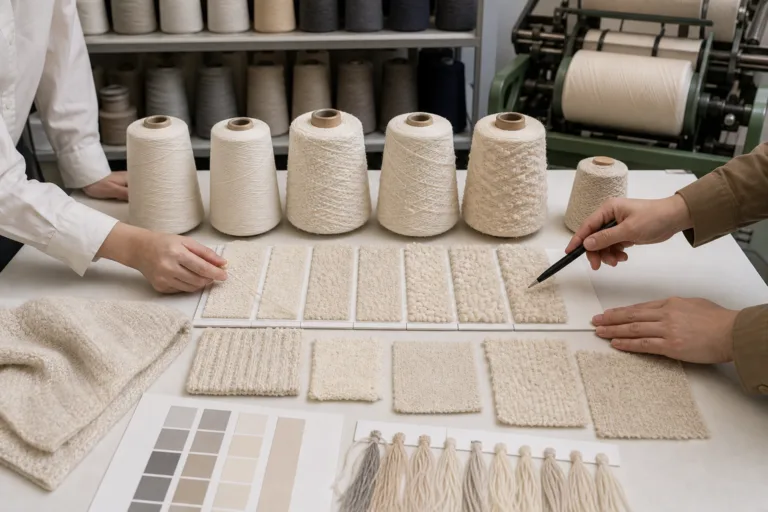
Boucle yarn is an effect yarn whose visible surface is created through its construction, not through count alone. It may include a core or ground component, an effect component that forms loops, and additional plies or binding elements that help hold the structure together. The finished yarn’s count may therefore conceal how much material creates the visible effect and how that effect is stabilized.
Always confirm what a specification refers to. A notation such as 30/2 may describe a single-yarn and ply relationship, a plied construction, or a supplier-specific convention. It should be treated as an illustrative notation requiring supplier confirmation, not as a universal interpretation. Ask whether the number identifies one component, the finished yarn, or a stated construction before comparing it with another yarn.
Loop size, loop frequency, twist, ply, fiber blend, and finishing can change the appearance even when two yarns show similar count information. They can also affect feed consistency, surface definition, snagging risk, and the way the yarn behaves during knitting or weaving. Count helps describe linear density, but it does not reveal the full geometry or stability of the boucle structure.
A practical development record should separate the finished-yarn count from component counts. Record the count system and unit, the count of each reported component, the ply notation, fiber content and blend ratio, twist, loop description, and finishing treatment. This fuller description makes later sample comparisons more reliable and prevents a component count from being treated as equivalent to the finished boucle yarn.
Match Yarn Count to Fabric, End Use, and Processing
Start by describing the product and fabric rather than selecting a number in isolation. A lightweight apparel knit may prioritize controlled surface definition, low visual scale, and comfortable drape. A structured garment fabric may need more cover, a more pronounced texture, or greater resistance to distortion during handling. Accessories and decorative textiles may allow a different balance of bulk, texture, and process stability.
For knitting, review the planned gauge, feeder behavior, needle compatibility, and the possibility of snagging or uneven feed. For weaving, review the planned sett, tension, abrasion exposure, and finishing route. These variables determine whether the yarn can form the intended fabric consistently. Machine, loom, gauge, sett, and finishing decisions are project-specific, so count alone cannot establish compatibility.
Compare candidate yarns against the same fabric construction and processing conditions wherever possible. Record cover, drape, hand, seam bulk, visual loop definition, feed consistency, and visible defects. Fiber content, blend ratio, twist, ply, and finishing may influence hand, durability, wash response, and pilling risk as much as or more than linear density. Apparel Wiki provides educational guidance, not manufacturing, laboratory, or sourcing services, so project approval should rely on verified specifications and samples.
A Step-by-Step Method for Choosing a Boucle Yarn Count
The most reliable way to choose a boucle yarn count is to treat it as a development decision rather than a number-selection exercise. Begin by describing the product, fabric type, target hand, intended visual scale of the loops, and acceptable manufacturing risks. A lightweight apparel knit, a structured garment fabric, and a decorative textile may need very different balances of cover, drape, texture, and process stability.
- Define the fabric brief. Record the intended end use, fabric construction, desired surface definition, hand, drape, cover, seam bulk, and appearance after finishing. Also note whether the yarn will be knitted, woven, or used in another construction.
- Request the complete yarn description. Record the count system and unit, finished-yarn count, component counts, ply, fiber content, blend ratio, twist, loop description, and finishing treatment. Ask whether the stated count applies to the finished boucle yarn or only to its core, ground, or effect component.
- Shortlist by construction before comparing numbers. Eliminate candidates whose loop structure, fiber composition, or intended processing does not suit the product. A similar count does not make two boucle yarns equivalent if their component balance and surface formation differ.
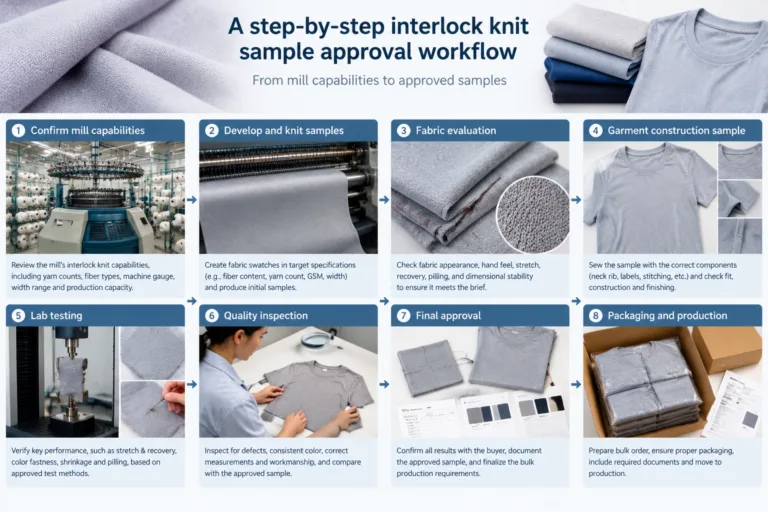
- Sample under planned conditions. Use the intended machine or loom setup as closely as possible. For knitting, observe feeder behavior, needle compatibility, snagging, and uneven feed. For weaving, consider sett, tension, abrasion exposure, and the proposed finishing route.
- Record the result consistently. Compare appearance, cover, drape, hand, visual loop definition, feed consistency, and visible defects. Keep the fabric construction and finishing conditions consistent wherever possible.
- Document the decision. Select the count only after the sample meets the product brief. Record why each candidate was accepted or rejected so the development team can distinguish a measured sample result from an assumption.
This workflow can be organized in an Apparel Manufacturing Tools worksheet or another controlled development record. The important point is to preserve the full yarn identity instead of storing one count field without its construction details.
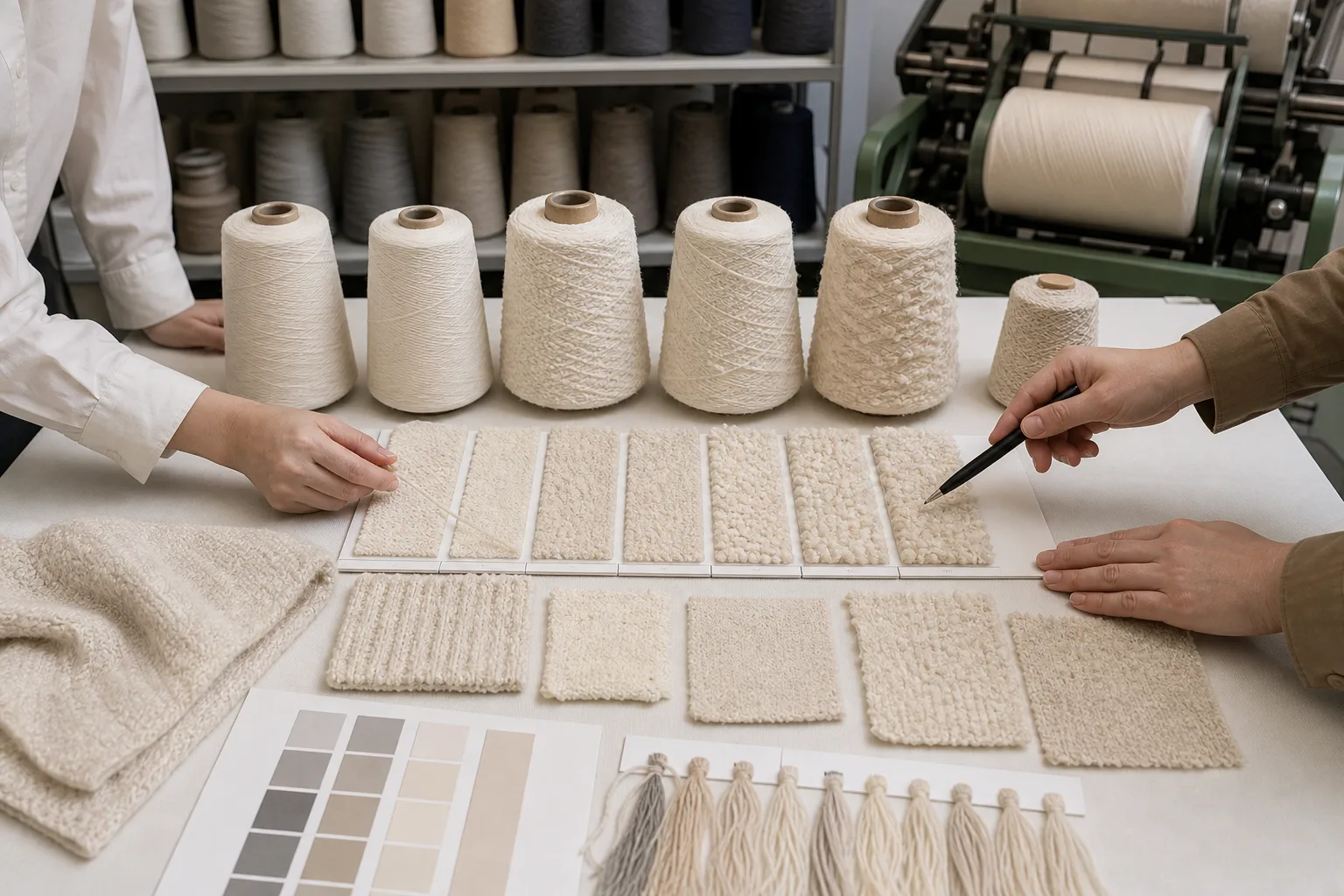
How to Compare Candidate Boucle Yarns Fairly
Candidate yarns should first be placed in the same measurement context. Compare direct-count values with other direct-count values and indirect-count values with other values from the same system. If suppliers use different units, retain the original specification and add a clearly labeled conversion for reference. Do not rank a yarn because its number appears larger or smaller before confirming what that number measures.
A practical comparison matrix can include the following fields:
| Comparison field | What to check |
|---|---|
| Count | System, unit, and whether the figure describes the finished yarn or a component |
| Construction | Core or ground yarn, effect yarn, binding element, ply, and supplier notation |
| Surface structure | Loop scale, loop frequency, twist, stability, and visible effect |
| Material | Generic fiber names, blend ratio, and any relevant finishing treatment |
| Processing | Fabric construction, machine or loom settings, gauge or sett, and finishing route |
| Sample result | Cover, drape, hand, feed consistency, surface definition, and visible defects |
Keep the fabric construction, equipment settings, finishing route, and evaluation criteria consistent when comparing samples. If one yarn is tested at a different gauge, sett, or finishing condition, the result may reflect the process difference rather than the yarn count. This is especially important when a candidate has a more pronounced loop effect or a different component balance.
Consider a hypothetical comparison between a lightweight apparel fabric and a structured outerwear fabric. The first may prioritize restrained texture, fine surface definition, and comfortable drape. The second may place more emphasis on cover, visual weight, and resistance to distortion during handling. Neither application establishes a universal count. They simply create different trade-offs that must be checked through sampling.
Two yarns with similar count information can still create different fabrics because count does not describe every feature of boucle construction. Fiber shape, blend ratio, twist, ply, loop formation, and finishing may influence the final hand and appearance as much as linear density. A fair comparison therefore evaluates the complete construction under comparable conditions, not the count alone.

Common Mistakes, Limitations, and Supplier Questions
One common mistake is treating “higher count” as a complete recommendation. In a direct system, a larger number generally means more mass per unit length; in an indirect system, a larger number generally indicates more length per unit mass and therefore a finer yarn within that system. The phrase has no useful meaning until the count system and unit are identified.
Another mistake is comparing a core or effect component with the finished boucle yarn as though both figures describe the same object. A notation such as 30/2 also requires supplier confirmation because commercial notation may describe a plied construction or another stated convention. Record the supplier’s explanation, rather than assuming the notation has one universal interpretation.
Yarn count is not a substitute for diameter, bulk, loop size, softness, strength, pilling resistance, wash response, or final fabric performance. These outcomes depend on the fiber, construction, equipment, fabric structure, and finishing. Similarly, a commercial fiber or brand name should not replace the generic fiber name and complete yarn description when specifications are being reviewed.
Before sampling, ask the supplier:
- Which count system and unit are used?
- Does the number describe the finished boucle yarn or a component?
- What does the ply notation mean in this specification?
- What are the core, effect, loop, and twist details?
- What fiber names and blend ratios apply?
- What sample information is available under the intended knitting, weaving, and finishing conditions?
Separate supplier descriptions from verified sample observations. A supplier may describe an appearance or construction, but product approval should be based on the specification and the sample result relevant to the intended process. Apparel Wiki is an independent educational publication, not a manufacturer, factory, laboratory, certifier, or sourcing service.
Practical next step: request the complete specification, sample each suitable candidate under controlled conditions, and approve the boucle yarn against the product brief. The best choice is the count and construction that meet the required fabric result, not the number that appears most impressive on paper.
Is a higher yarn count always better for boucle yarn?
No. “Higher” can mean different things in direct and indirect count systems, and count alone does not determine loop appearance, softness, bulk, durability, or fabric performance. Choose the count only after considering construction, end use, processing, and sample results.
Should I compare the count of the finished boucle yarn or the core and effect components?
Start with the finished-yarn count, but also request the counts and roles of the core, ground, effect, and binding components. A component count and a finished-yarn count are not automatically equivalent.
Can tex, denier, dtex, and Ne be compared directly?
Tex, denier, and dtex are direct systems, while Ne is an indirect system. They should not be compared by number size alone. Confirm the system, preserve the original unit, and use conversions only as a clarification.
What information should I request from a supplier before sampling a boucle yarn?
Request the count system and unit, finished-yarn and component counts, ply meaning, fiber content, blend ratio, twist, loop description, finishing details, and any sample information relevant to the planned machine, loom, and finishing process.
Can yarn count predict fabric weight, drape, softness, or pilling by itself?
No. Count describes linear density, not the complete behavior of a yarn or fabric. Fabric structure, fiber properties, boucle construction, twist, finishing, and processing conditions must also be considered and validated through comparable samples.