Before beginning a compliance document systems selection, define the work the system must control: the products and markets in scope, the evidence required, the people responsible, the document lifecycle, and the data relationships that must remain reliable. A compliance document system is a software environment for organizing, reviewing, approving, versioning, retrieving, and retaining compliance-related records. It can support apparel teams, but it does not independently decide whether a garment is legally compliant.
This practical guidance comes from Apparel Wiki, an independent apparel industry knowledge blog rather than a software provider, manufacturer, testing laboratory, or compliance authority. The selection brief should be based on documented business requirements and verified evidence. Editorial independence, including the principles described on the Sponsor page, does not replace product testing or qualified regulatory review.
What Requirements Should You Define Before Selecting a Compliance Document System?
Start with the required workflows and evidence, not with a software acronym or product category. A system described as PLM, ERP, MES, WMS, or compliance software may have overlapping functions, but its label does not prove that it can manage the records, relationships, approvals, or exceptions your team needs. Define what must happen from the first supplier submission or internal specification through review, approval, change, retrieval, and retention.
Your initial requirements brief should identify the products, destination markets, sales channels, operating roles, compliance activities, and document types in scope. It should also distinguish four different kinds of statements:
- Documented requirements: obligations or workflow needs supported by an applicable rule, contract, internal policy, or approved business process.
- Typical industry practices: useful patterns that may improve control but are not automatically mandatory for every business.
- Project-dependent preferences: choices about usability, reporting, configuration, or implementation that depend on the organization.
- Vendor claims: capabilities that require current product documentation, written confirmation, and testing with representative data.
This distinction prevents a common selection error: treating a familiar checklist as universal. The same garment may require different records depending on its destination market, age group, intended use, materials, customer commitments, and whether it is ordinary or protective apparel. Requirements should therefore be conditional where jurisdiction, product classification, or business role affects applicability.
Define the Products, Markets, and Compliance Responsibilities in Scope
Write a scope statement before asking vendors for demonstrations. Include the product types covered, adult or children’s products, ordinary or protective use, materials, trims, packaging, and relevant variants. Record whether the system must distinguish styles, colorways, size ranges, material lots, supplier submissions, purchase orders, shipments, or market-specific versions.
Next, list the destination markets and sales channels that matter to the business. Include direct sales, wholesale, private-label programs, marketplaces, and other channels only where they create different evidence or approval needs. Record the organization’s role in each workflow, such as brand owner, private-label customer, importer, distributor, sourcing office, manufacturer, or supplier. Manufacturing locations may also matter when they affect document collection, language, access, or responsibility.
Do not describe global apparel compliance as one uniform checklist. Market-specific requirements may concern labeling, product safety, chemicals, environmental claims, responsible parties, fiber or material information, origin, care information, or product identification. The applicable requirements must be checked against current official sources for the relevant product and market. A document system can store the resulting evidence and mappings; it should not be assumed to determine legal applicability automatically.
Separate legal or regulatory requirements from customer specifications, voluntary programs, internal policies, and supplier agreements. Then map each requirement to the party that prepares the evidence, reviews it, approves it, and responds when there is an exception. This responsibility map is an operational design decision. It clarifies ownership even when the selected system offers routing, reminders, or automated status changes.
Map the Compliance Documents and Their Full Lifecycle
Create a document-and-relationship inventory before creating a vendor shortlist. Depending on the defined scope, the inventory may include certificates, declarations, test reports, transaction records, supplier submissions, approvals, corrective-action records, label files, product specifications, and supporting correspondence. The point is not to collect every possible file, but to identify the records required for the workflows the organization actually operates.
For every document type, define its source, required fields, owner, reviewer, approval rule, effective date, expiry or review trigger, linked product or material, and retention expectation. Retention periods, signatures, and recordkeeping obligations should remain conditional until the applicable law, customer contract, or internal policy has been verified. The system brief should state what must be configured and what still requires a policy decision.
Define how the system must handle revisions, superseded files, translations, attachments, comments, signatures, and audit history. Require a clear relationship between the document and the correct style, color, size range, material, supplier, purchase order, shipment, or market whenever that relationship affects a decision. A file that opens successfully is not necessarily a complete record: dimensions, material information, version details, and identity data may be lost or disconnected during conversion, editing, export, or archival.
Use representative internal documents when testing this lifecycle. Include complex examples such as a revised material submission, a document covering several variants, an attachment in another language, or an incomplete supplier record. Check whether required metadata survives upload, editing, return, export, and archival. This exposes missing fields and ownership gaps before those problems become implementation issues.
Specify Data Ownership, Version Control, and Approval Rules
Useful automation depends on consistent meanings. Establish controlled definitions for style numbers, colorways, size ranges, material codes, supplier identities, market assignments, document types, and status values. If different teams use the same term to mean different things, a system may route records efficiently while still connecting the wrong evidence to the wrong product.
Assign data owners and change approvers for product, material, supplier, testing, labeling, and regulatory records. Define when a new version is required, which changes trigger review, how superseded records remain visible without appearing current, and how users identify the approved record. The process should provide traceability from a compliance document to the product or material it supports, and from a product change back to affected documents.
Include access roles, review queues, exception handling, and an audit trail where the workflow requires them. These are selection requirements to test, not assumptions based on a product category. Confirm security, permissions, workflow, audit-log, and versioning behavior through current vendor documentation and hands-on testing. Do not claim that a system meets a legal recordkeeping or audit standard without an authoritative basis and product-specific verification.
Finally, separate the organization’s governance decisions from the system’s built-in controls. A platform may route an approval or flag a missing field, but it cannot resolve incomplete source data or inconsistent business definitions by itself. The selection brief should make those ownership and policy decisions explicit before the vendor comparison begins.
Define Integration, Interoperability, and Retrieval Requirements
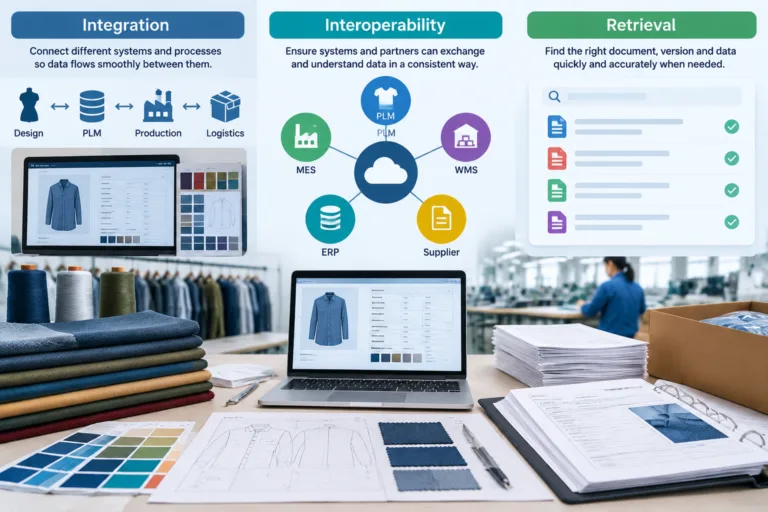
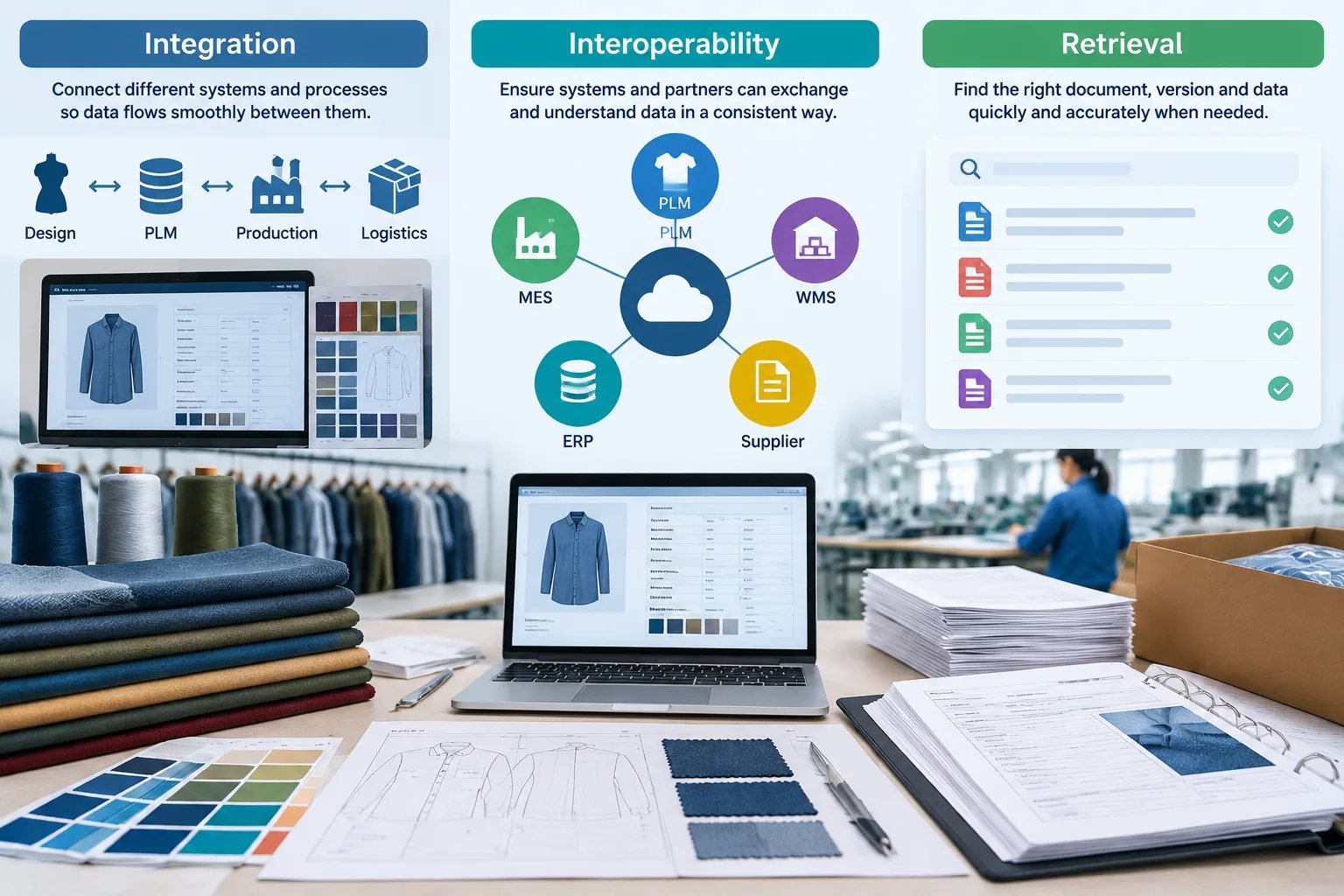
Once the documents and ownership rules are clear, define how the compliance document system must exchange information with the tools your organization already uses. Relevant connections may include product development, planning, resource planning, manufacturing, warehouse, supplier, testing, labeling, and reporting workflows. Include only the systems that are part of the actual operating model. A product acronym alone does not prove that a platform supports the required compliance process.
For each connection, record which system owns each field and which event should create, update, route, or block a compliance record. Specify the identifiers, attachments, metadata, status values, import and export formats, error messages, and recovery steps that matter to the workflow. This helps distinguish a genuine requirement from a general preference such as “integrates with PLM.”
Retrieval deserves the same attention as data exchange. Users may need to search by style, material, supplier, market, document status, approval date, or unresolved exception. Test whether those relationships remain available after a record is imported, revised, returned to another system, or archived. A file that opens successfully may still have lost its material identity, version information, dimensions, or relationship to the approved product.
Use representative complex samples in a controlled proof of concept. Include revised materials, multiple markets, product variants, incomplete supplier submissions, and an exception that must be corrected and resubmitted. Confirm supported connectors, APIs, authentication, field mappings, and error handling through current technical documentation and testing. Do not assume that an exchange of files provides complete operational interoperability or prevents duplicate records.
Turn Requirements Into a Vendor Comparison and Pilot Plan
Convert the requirements brief into a scorecard that candidates can answer and demonstrate. Give each criterion a priority such as essential, important, or optional, then define what observable result would count as acceptable. Compare workflow coverage, document controls, data structure, search and reporting, permissions, integration behavior, administration, training, maintenance, migration effort, and support.
Ask each vendor to demonstrate your representative workflow rather than a simplified presentation scenario. The sequence might include receiving a new document, linking it to a material and style, revising the document, routing an approval, handling an exception, changing the market assignment, and retrieving the currently approved record. Written vendor responses are useful, but they should be treated as claims to verify through documentation, contract terms, or testing.
A pilot should use comparable tasks and a defined sample boundary. Establish a baseline for the current process, then observe quality, completion time, user effort, correction workload, integration behavior, and the handling of incomplete records. Include the effort required for learning, administration, migration, maintenance, and integration when assessing expected value. A polished demonstration does not establish return on investment or prove that the system will perform the same way with your data.
Before the pilot begins, document the observation period, decision owners, acceptance criteria, and exit conditions. For example, the team may require that specified fields remain associated with the correct product, that users can identify the approved version, and that an integration error can be diagnosed and recovered. These are examples of testable criteria, not universal specifications. Weight them according to the organization’s products, markets, risk, and operating responsibilities.

Recognize Limits and Build a Selection-Ready Requirements Brief
A compliance document system can organize evidence, connect records, route work, and make exceptions easier to find. It does not automatically determine whether a product is legally compliant, establish the applicable market rule, or replace qualified regulatory review. The answer may depend on product classification, destination market, intended use, customer commitments, supplier information, and the organization’s role in the transaction.
Record unresolved questions instead of hiding them inside a software requirement. The final brief should identify assumptions, exclusions, data-migration risks, integration dependencies, ownership gaps, and requirements that still need confirmation from an applicable authority, customer, contract, or qualified professional. This makes uncertainty visible during procurement and reduces the risk of treating a vendor response as a legal conclusion.
A decision-ready brief can be organized around eight areas: product and market scope; document inventory and lifecycle; data definitions and ownership; roles and approval controls; integrations and retrieval; pilot scenarios; acceptance criteria; and ongoing governance. Also state how regulatory mappings, templates, master data, access roles, and integration behavior will be reviewed after selection.
The practical selection principle is straightforward: choose a system against the evidence and workflows the organization must control, not against a software category or acronym. Apparel Wiki is an independent educational publication, so this guidance is a requirements framework rather than a product endorsement, certification, or legal determination.
Next step: Turn the brief into a short, reviewable test pack containing representative documents, product relationships, market assignments, user roles, exception cases, and retrieval tasks. Review it with the people who own product data, supplier evidence, approvals, and regulatory decisions before inviting demonstrations.
Frequently Asked Questions
What is a compliance document system in apparel?
It is a system used to organize compliance-related documents, relationships, approvals, revisions, exceptions, and retrieval. Its exact capabilities vary by product, so functions should be confirmed through documentation and testing rather than inferred from a platform label.
Why should apparel teams define requirements before comparing compliance software?
Requirements clarify the products, markets, documents, users, data owners, controls, and integrations the system must support. Without that boundary, teams may compare demonstrations that do not address their actual workflow or evidence risks.
Which documents should an apparel compliance system manage?
The inventory may include test reports, declarations, certificates, supplier submissions, specifications, label files, approvals, corrective-action records, transaction records, and supporting correspondence. The correct list depends on the product, market, customer commitments, and operating roles.
How do market and product scope affect compliance document requirements?
The same garment may require different evidence or review depending on its destination, age group, intended use, materials, sales channel, and responsible business role. Requirements should therefore be mapped to the applicable market and current rule instead of treated as one global checklist.
What should be tested in a compliance document system pilot?
Test a new submission, revision, approval, exception, market change, integration exchange, and retrieval task using representative records. Observe data integrity, user effort, correction work, version visibility, error recovery, and the preservation of product relationships.
Can a PLM, ERP, MES, or WMS automatically replace a compliance document system?
Not automatically. These systems may overlap in some functions, but their names do not prove that they provide the required document controls, evidence relationships, approvals, retrieval, or audit history. Compare the actual workflow and data requirements with verified product capabilities.