Piped seams are not automatically stronger than ordinary seams. They are a construction in which a cord, narrow core, or folded fabric edge is enclosed or inserted close to the seam line, creating a raised or defined edge. Their performance depends on the complete assembly: fabric, piping material, thread, stitch formation, seam allowance, layer arrangement, and intended use. This guide explains how those factors influence piped seams strength while keeping bulk and wearer comfort in view. Apparel Wiki is an independent garment-industry knowledge publication; its educational guidance is supported by Sponsor information and is not a manufacturing or testing service.
What Are Piped Seams, and How Do They Affect Seam Strength?
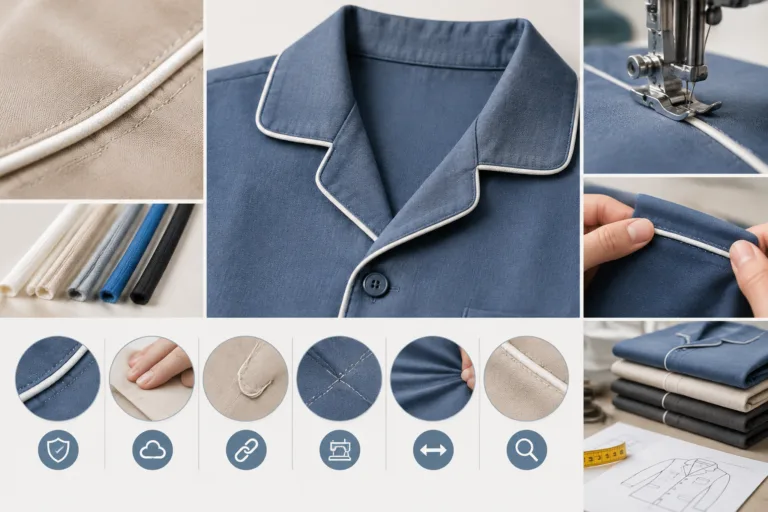
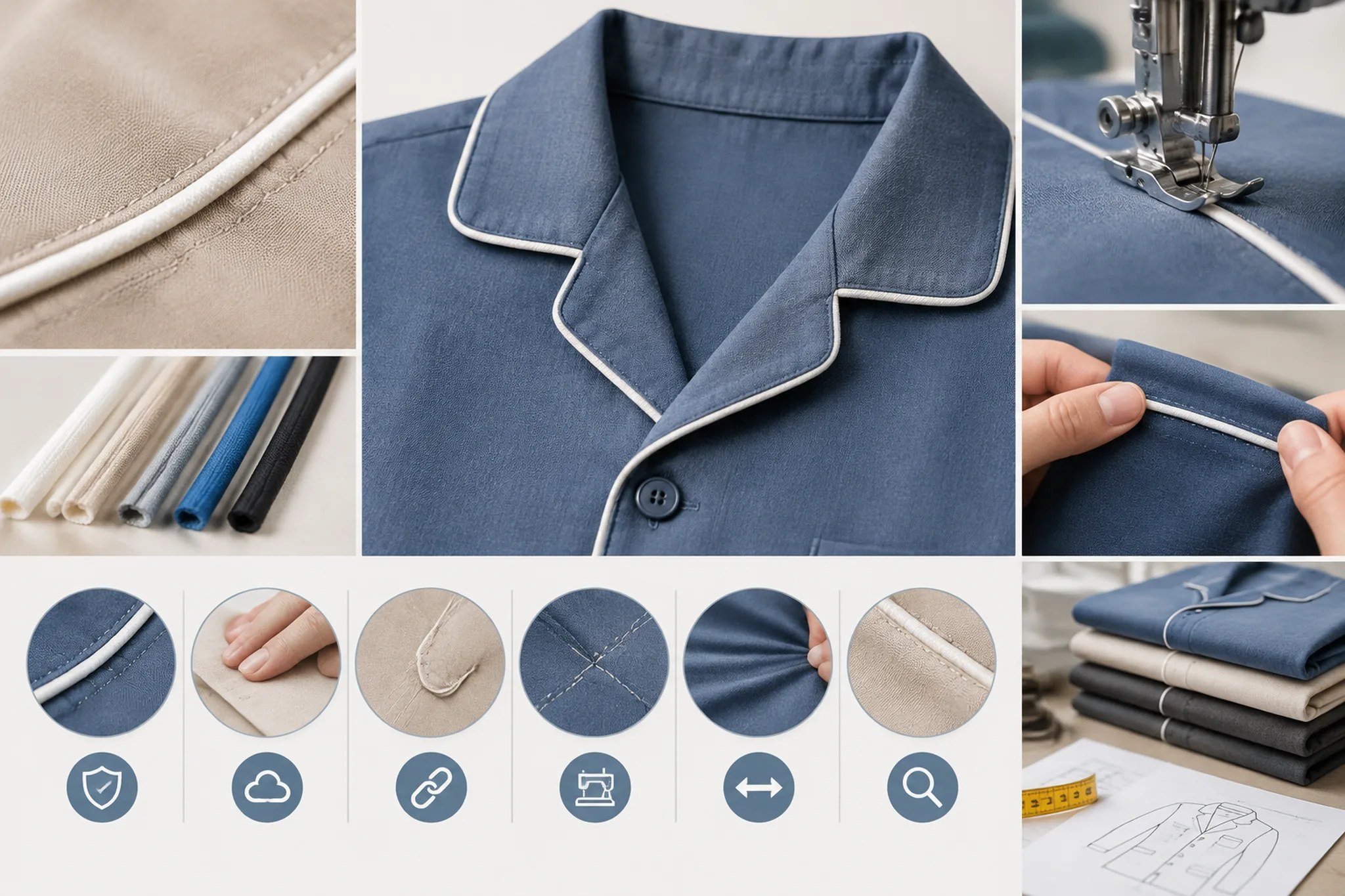
A piped seam is best understood as a seam construction rather than a particular stitch. Piping may be made with a covered cord, a folded strip, or another shaped insert positioned at or near the joining line. The seam holds the garment pieces together; the piping changes the seam cross-section and finished profile. The stitch is the thread structure used to assemble those layers. Keeping these terms separate helps a development team describe what is actually being changed. ASTM International’s standard practice for stitches and seams provides a relevant terminology and construction reference.
Piping can give an edge visual definition, support shape, and help maintain a controlled contour. It also introduces additional material and handling requirements. The needle must pass through a different layer arrangement, the presser foot must accommodate the raised profile, and the seam allowance may need careful trimming, grading, or positioning. These details affect alignment and consistency as much as the choice of thread or stitch.
Seam strength therefore belongs to the assembled system, not to thread strength alone. A seam may resist opening at the stitch line while the adjacent fabric slips, tears, distorts, or suffers needle damage. Conversely, a flexible construction may move comfortably but require more careful control in a high-load area. Increasing resistance to seam opening can also increase stiffness, friction, pressure, or visible seam bulk. The suitable balance depends on the fabric, garment location, loading, movement, and appearance requirement.
Why Piping Creates a Strength, Bulk, and Comfort Trade-Off
Adding piping changes both the number and arrangement of layers at the seam. A covered cord can create a concentrated ridge, while a folded fabric edge can produce a wider but potentially softer profile. Either option may resist flattening during assembly and wear. The result can be a seam that holds its shape clearly, but also one that drapes differently from the surrounding fabric or feels more noticeable against the body.
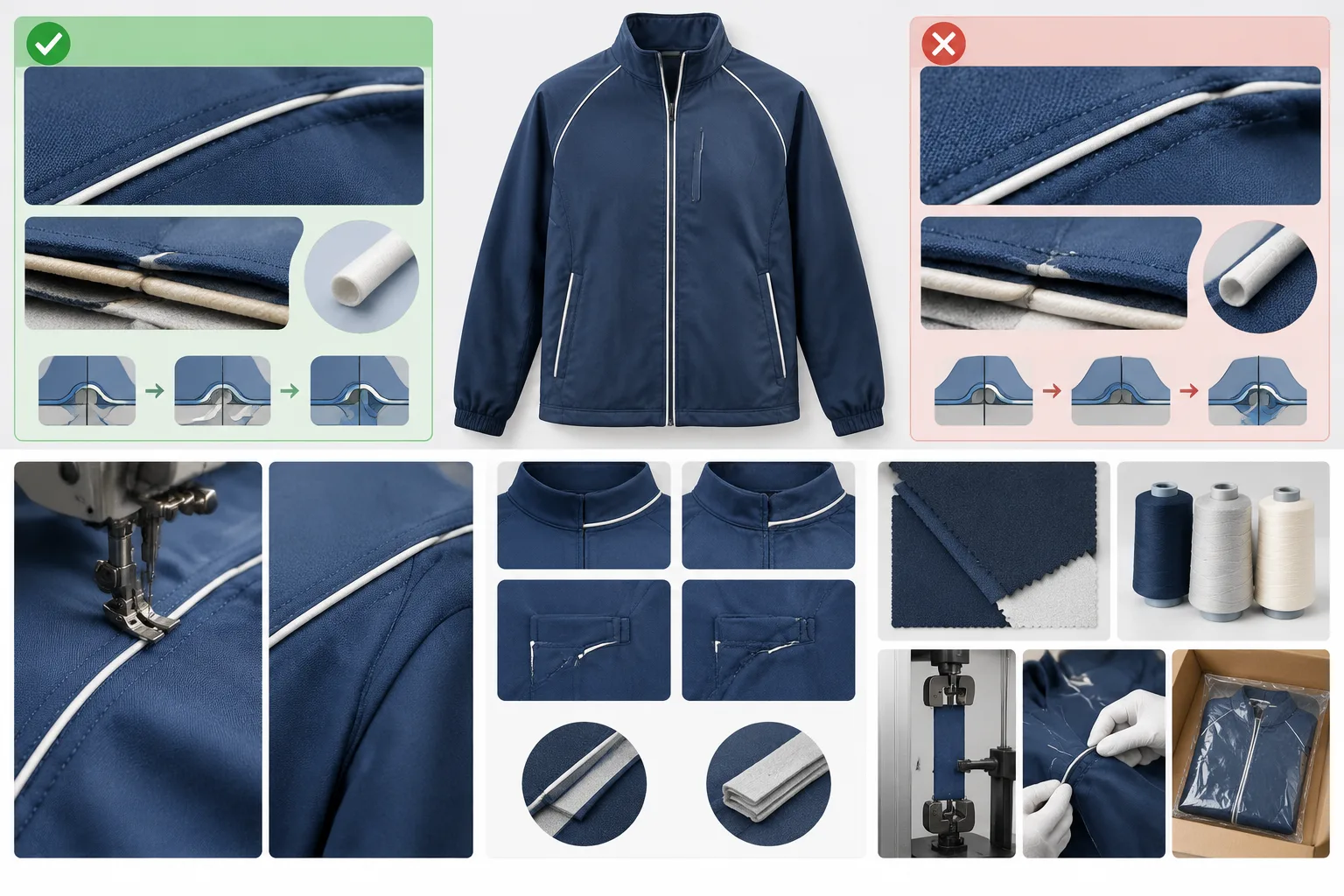
Bulk is not only a visual issue. A thick seam may need different presser-foot access, more careful seam allowance control, and suitable pressing or trimming decisions. At corners, intersections, seam ends, and changes in direction, the added material can make accurate assembly more difficult. Poor control may lead to puckering, uneven piping exposure, exposed cord, distorted edges, or localized stress.
Comfort is application-specific. A raised seam may be acceptable on an outer jacket panel but irritating at a neckline, waistband, underarm, or other area that repeatedly contacts the skin. Stiffness can affect drape and range of movement, while friction may become more noticeable when the garment is lined, worn tightly, or exposed to repeated motion. Fabric handle, lining, piping cover, body area, and wearer sensitivity all influence the result, so a thicker seam should never be treated as automatically stronger or more comfortable.
A seam can also look robust while failing nearby. Possible signs include seam slippage, tearing beside the stitch line, distortion from excessive tension, or fabric damage caused by repeated needle penetration. A denser or heavier construction may move the failure into the fabric instead of eliminating it. Review should therefore consider the seam and the surrounding material together.
Which Construction Variables Control Piped Seam Performance?
There is no universal best piping diameter, core firmness, seam allowance, stitch setting, or thread choice. The main variables should be compared as a group and confirmed with samples made from the intended materials.
| Variable | Possible strength benefit | Bulk or comfort cost | Questions to verify |
|---|---|---|---|
| Piping profile and core | Defines the edge and may stabilize the seam profile | Can increase prominence, stiffness, pressure, or friction | Does the profile suit the garment location and movement? |
| Fabric and covering | May improve compatibility between piping and garment layers | Stretch, fraying, or poor recovery can cause distortion | Does the material flex, recover, and handle abrasion as required? |
| Seam allowance and layer control | Can improve load distribution and edge security | Extra width or untrimmed layers increase thickness | Are trimming, grading, and intersections controlled consistently? |
| Thread, stitch, density, and tension | Can support seam security when matched to the fabric | Excessive density or tension may restrict movement or damage fabric | Does the setting protect both the stitch line and adjacent fabric? |
Fabric weight, stretch, weave or knit structure, fraying behavior, and recovery influence the suitable construction. A rigid piping core may behave differently in a stable woven fabric than in a stretch garment. Similarly, a seam allowance that works in a light shell may create unnecessary bulk when several heavy layers meet.
Thread selection, stitch formation, stitch density, and tension should be considered with needle spacing and seam allowance security. Adding stronger thread alone may not solve opening or tearing if the fabric cannot carry the load. In some cases, the stronger thread simply transfers stress to the fabric or creates a less flexible seam. Construction settings are project-dependent and should be confirmed through prototypes and, where required, validated testing.
How to Develop a Piped Seam That Balances Strength and Comfort
- Define the requirement. Identify the seam’s expected load, movement, visibility, body contact, laundering exposure, and appearance requirements. Note whether the seam is decorative, structural, or both.
- Choose controlled comparisons. Prepare a small set of constructions that change only one or two variables at a time, such as piping profile, covering material, seam allowance treatment, or stitch setting.
- Build representative samples. Use the intended fabric, lining, thread, machinery, and assembly conditions where practical. A sample made with substitute materials may hide thickness, handling, or compatibility problems.
- Inspect construction quality. Check seam alignment, consistent piping exposure, puckering, exposed cord, skipped or damaged stitches, excess thickness, and transitions into corners or intersections.
- Review movement and contact. Handle and wear-test the sample as appropriate for the product. Observe drape, flexibility, pressure, friction, and comfort, while checking whether movement causes opening or distortion.
- Examine nearby fabric. Look for slippage, tearing, needle damage, seam-line distortion, or other evidence that load is moving away from the stitch line.
- Record and revise. Document the materials, construction, machine conditions, sample conditions, observations, and revision decision. Change the construction to match the observed failure mechanism rather than adding reinforcement automatically.
Prototype review is a screening step, not a universal proof of durability or a substitute for product-specific requirements. When formal seam-strength, wash, dimensional-change, or durability evaluation is needed, the responsible team should use the applicable specification and validated test plan.
Practical Checklist for Evaluating Piped Seam Strength and Comfort
A piped seam inspection should consider the complete construction, not only whether the cord looks evenly covered. Review the sample in groups so that cosmetic observations remain separate from functional or comfort risks. Acceptance criteria should come from the product brief, buyer specification, applicable requirements, or a validated test plan rather than from an assumed universal tolerance.
- Appearance and consistency: Check piping exposure, seam alignment, smooth curves, corner transitions, intersections, seam ends, and openings. Look for puckering, waviness, exposed cord, uneven width, twisting, or visible distortion.
- Seam security: Examine skipped or damaged stitches, loose thread, insecure ends, stitch concentration, and areas where the piping changes direction. Confirm that the seam allowance is enclosed as intended and that handling has not pulled the seam off line.
- Adjacent fabric: Inspect both sides of the seam for seam slippage, needle damage, tearing, pulled yarns, stretching, or localized strain. A seam can look intact while the nearby fabric is beginning to fail.
- Flexibility and comfort: Handle the garment through its expected movements. Consider drape, bending, extension, pressure, friction, and contact with the skin or a lining. A firm raised edge may be acceptable at an outer style line but uncomfortable at a neckline, waistband, armhole, or other high-contact location.
- After-care condition: Where laundering or cleaning matters, review the seam after the intended care process. Check for shrinkage-related distortion, cord migration, new puckering, hardening, opening, or changes in the contact surface.
Record each observation as cosmetic, functional, comfort-related, or evidence of a broader construction risk. Compare samples under realistic use conditions rather than relying only on a flat tabletop review. The resulting decision may be to accept the construction, revise it, change materials, or escalate it to validated testing.
When Reinforcement Helps, and When It Adds Problems
Reinforcement is useful when it responds to a known failure mechanism. If the seam opens at an end, the solution may involve improving the termination or local support. If the fabric tears beside the seam, changing the load path, seam allowance treatment, or support layer may be more appropriate than simply selecting a stronger thread. If the cord migrates or the piping distorts, changing the piping material or assembly control may address the cause more directly.
| Observed issue | Possible direction | What to verify |
|---|---|---|
| Seam opening or end failure | Review the termination, seam allowance security, and localized support. | Opening resistance, appearance, flexibility, and comfort at the end point. |
| Fabric tearing or needle damage | Review fabric compatibility, stitch settings, layer handling, and load distribution. | Nearby fabric condition after movement and care exposure. |
| Excessive bulk or a hard point | Reduce unnecessary layers, revise the piping profile, or redistribute the seam allowance. | Profile, drape, pressure, friction, and visual consistency. |
| Distortion or cord migration | Review covering material, core firmness, assembly sequence, and control at turns. | Alignment through curves, corners, intersections, and repeated handling. |
Extra layers, folded sections, support materials, and localized stitching can improve security in one area while adding stiffness, thickness, friction, or wash-related change in another. A locally reinforced section may also create a stress concentration where it meets the unreinforced seam. This is why reinforcing piped seams should be treated as a construction decision, not an automatic quality upgrade.
Change one meaningful variable at a time where practical, then compare the revised sample with the original. Document the failure mechanism, intervention, expected benefit, possible bulk or comfort cost, and verification result. A stronger-looking seam is not necessarily a better garment seam if the wearer experiences a hard edge or the adjacent fabric becomes the new point of failure.
Limits of Visual Inspection and Next Steps for Production Decisions
Visual inspection and hand feel are valuable screening tools, but they cannot establish a universal piped seams strength value or prove long-term durability. They can reveal inconsistent construction, likely stress points, visible damage, and comfort risks. They cannot by themselves confirm how the seam will perform after repeated use, laundering, stretching, or a specified production process.
Formal validation deserves consideration for high-load garments, safety-relevant applications, stretch constructions, repeated laundering, sensitive skin contact, or products governed by buyer or product-specific requirements. The responsible team should select the applicable specification and validated test method for the target product and market. Apparel Wiki provides independent garment-industry education; it is not a manufacturer, factory, laboratory, certifier, or production-approval authority.
Carry the following information into a production decision: fabric and piping materials, seam construction, seam allowance treatment, thread and stitch settings, machinery and assembly conditions, sample-care conditions, observed failure mode, and acceptance criteria. Retest or re-evaluate after a meaningful change to the material, pattern, machinery, or assembly sequence. For related development references and practical resources, consult the Apparel Manufacturing Tools area.
The practical next step is to create a small comparison set using the intended fabric and piping materials, then review each sample against the same appearance, security, comfort, and after-care checklist. Use the observed failure mechanism to guide the next revision, and reserve production approval for decisions supported by the relevant product requirements and validation evidence.
Are piped seams stronger than ordinary seams?
Not automatically. Strength depends on the fabric, piping, thread, stitch structure, seam allowance, and assembly quality. Piping may stabilize or protect an edge, but added layers can also create bulk or shift stress into the surrounding fabric.
How does piping add bulk to a garment seam?
The cord or folded fabric edge adds material and changes the seam cross-section. The resulting profile depends on the piping size, covering, core firmness, fabric thickness, layer count, trimming, and seam allowance treatment.
What makes a piped seam more comfortable against the body?
Comfort usually improves when the profile, flexibility, surface, and seam location suit the garment and wearer. A suitable lining or softer covering may help, but the result should be checked through movement and contact review rather than assumed from the material name alone.
Can stronger thread prevent a piped seam from failing?
Stronger thread may not solve failure caused by fabric tearing, seam slippage, needle damage, poor termination, or cord movement. Increasing thread strength alone can move the failure into the fabric or another part of the construction.
How should a piped seam be tested during garment development?
Begin with representative samples and inspect alignment, stitches, bulk, movement, comfort, adjacent fabric, and after-care condition. For formal decisions, use the applicable product specification and validated test plan rather than relying only on visual inspection.
When should a piped seam use additional reinforcement?
Use reinforcement when a documented failure mechanism shows that local support or a changed load path is needed. Compare the intervention with alternatives and check for new stiffness, hard points, friction, distortion, or stress concentrations before approving it.