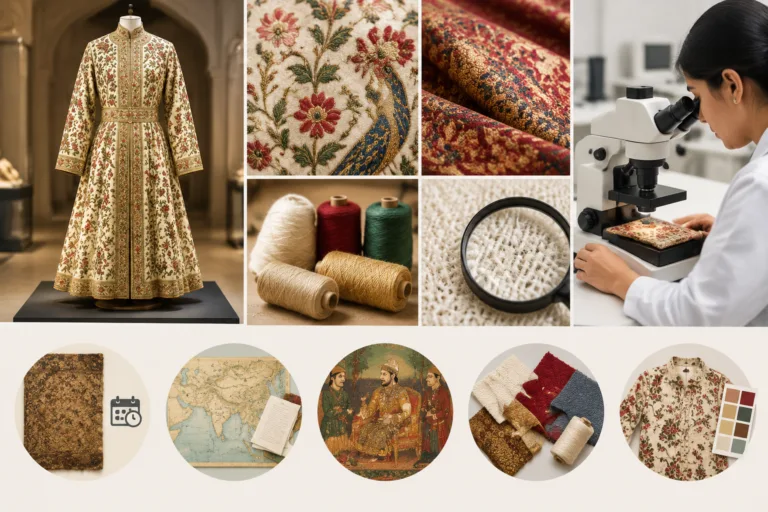
Reliable research on Mughal court textiles begins by separating claims that are often bundled together. A surviving textile may be attributed to a period or region, while its connection to a court, maker, material, or function may require different evidence. In this guide, “research sources” means records that document or help interpret an object, image, text, technique, or historical setting. Apparel Wiki is an independent educational publication; its Sponsor information does not replace collection records or specialist scholarship.
The practical answer is to evaluate each statement on its own. Ask what the source directly records, what it suggests, and what remains uncertain. A museum entry, inventory, court account, painting, conservation report, or scholarly catalog can each support useful conclusions, but none should automatically prove every related claim. Terms such as “Mughal,” “court,” and a particular date or place may describe different levels of attribution.
What Counts as Evidence for Mughal Court Textiles?
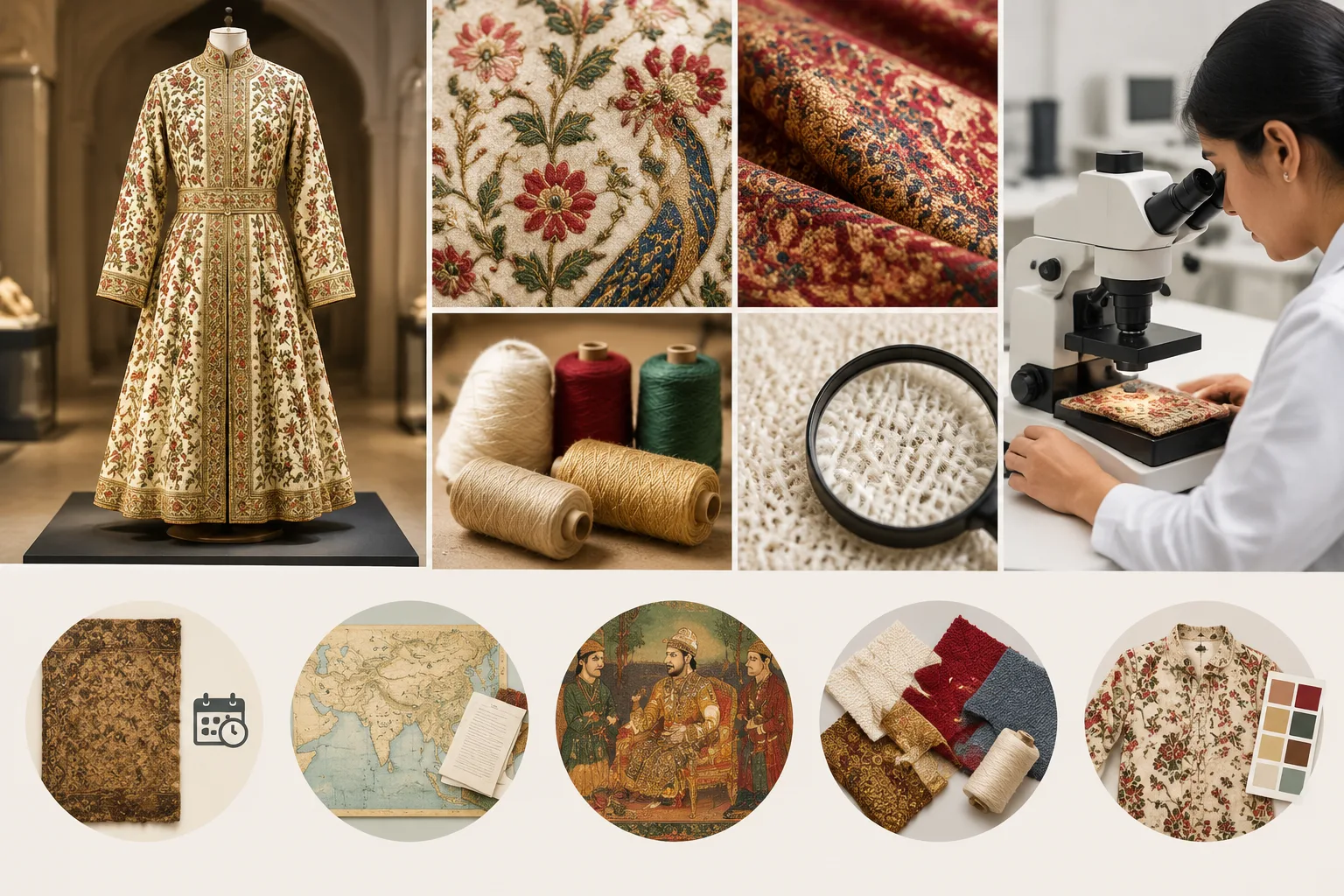
Evidence for Mughal court textiles can include the textile itself, an accession record, an inscription, an inventory, a written account, a manuscript image, or a modern scholarly interpretation. These sources do different jobs. A surviving object may provide evidence about visible construction or condition. An accession record may summarize material, dimensions, provenance, and an attributed date. A written source may document ownership, use, payment, or setting without describing how the textile was made.
That distinction matters when researching Mughal textiles. A textile described as “associated with” a court is not necessarily documented as having been made inside a palace, by a single court workshop, or for one named ruler. Likewise, a date assigned to an object does not automatically establish its date of acquisition, display, or use. “Attributed to,” “possibly,” “described as,” and “associated with” are meaningful qualifications, not weak substitutes for a definitive label.
It is useful to sort statements into four levels:
- Direct-source fact: what an original record, object, image caption, inscription, or technical report explicitly states.
- Editorial synthesis: a carefully assembled summary that connects several documented facts.
- Interpretation: a scholarly argument about meaning, status, trade, labor, identity, or historical significance.
- Hypothetical example: an invented research scenario used to explain a method, not evidence about a particular textile.
These levels should not be blurred. A specialist may argue that textiles helped communicate status, for example, but that interpretation should remain distinguishable from an object record stating its dimensions or recorded provenance. A responsible account also avoids naming one textile, workshop, region, or ruler as uniquely first unless direct evidence supports that distinction.
Which Primary Sources Can Support Textile Claims?
Primary sources for Mughal textiles are best understood as distinct evidence categories rather than one authority class. Surviving textile objects can support observations about their present condition, structure, decoration, and sometimes material, provided the record or examination is adequate. Accession records and inventories can document collection history, ownership, location, or description. Inscriptions may provide names, dates, or dedication information, but their meaning and completeness still require careful reading.
Written records can also include account books, court writing, travel accounts, letters, commercial documents, and contemporary manuscripts. These may help establish that a textile term, transaction, garment, gift, or setting was recorded. They do not necessarily prove the appearance, fiber content, weave, or production location of a surviving object. Documentary evidence about ownership should therefore be kept separate from evidence about production.
A scholarly study of Mughal courtly ensembles, for example, can be valuable when it brings together court biographies, lexicons, and letters. The Bryn Mawr College Repository study illustrates why documentary evidence may need to be triangulated rather than inferred from one surviving object or later image. Its argument remains a scholarly interpretation; readers should still consult the cited editions, translations, and records when making a specific claim.
For each source, record the narrowest reference that lets another researcher find it again:
- For an object, record the institution, collection name, object or accession number, and the exact fields used.
- For a book or article, record the author, title, publication details, page, and relevant quotation or argument.
- For a manuscript or archival record, record the repository, shelfmark, folio, page, document description, and translation used.
- For an image, record the creator, title or caption, date, repository, image identifier, provenance information, and reproduction status.
This practice prevents a search snippet, retailer description, or secondary quotation from quietly becoming the source for a stronger claim than the original record supports. When the claim concerns fiber, dye, structure, or finishing, seek conservation or technical documentation rather than relying on visual inspection alone.
How Do Museum Records and Scholarly Catalogs Differ?
Museum records, exhibition catalogs, collection catalogs, conservation reports, journal articles, books, dissertations, and reference databases often overlap, but they are not interchangeable. A collection record is usually designed to identify and manage an object. It may give dimensions, materials, condition, provenance notes, attribution, and bibliography. An exhibition catalog may add curatorial context and comparative objects. A conservation report may provide technical observations unavailable in a public landing page.
Scholarly catalogs and monographs usually do more interpretive work. They may compare objects, analyze terminology, reconstruct networks of production and exchange, or debate how textiles operated in social and political settings. A scholarly book record such as the JSTOR listing for a history of textiles in the Mughal Empire can be a useful bibliographic lead, but it should not be treated as a substitute for the specific collection records on which an argument may depend.
Read attribution, dating, provenance, restoration, former ownership, and collection-history notes closely. A catalog may describe a date range as approximate, identify an origin as probable, or preserve competing interpretations in its bibliography. Even an institutional source can contain a translation, attribution, or dating judgment that later scholarship may revise. Authority helps locate evidence; it does not remove the need to assess whether that evidence directly addresses the claim.
For central claims, compare more than one transparent source. Give particular weight to records that identify an author or responsible department, object number, examination method, bibliography, and revision context. A specialist source with a clear method may be more useful for a particular question than a prestigious source that only mentions the textile briefly. This is especially important in provenance research, where a concise record may summarize a complicated or incomplete history.
How Should You Evaluate Images, Depictions, and Material Descriptions?
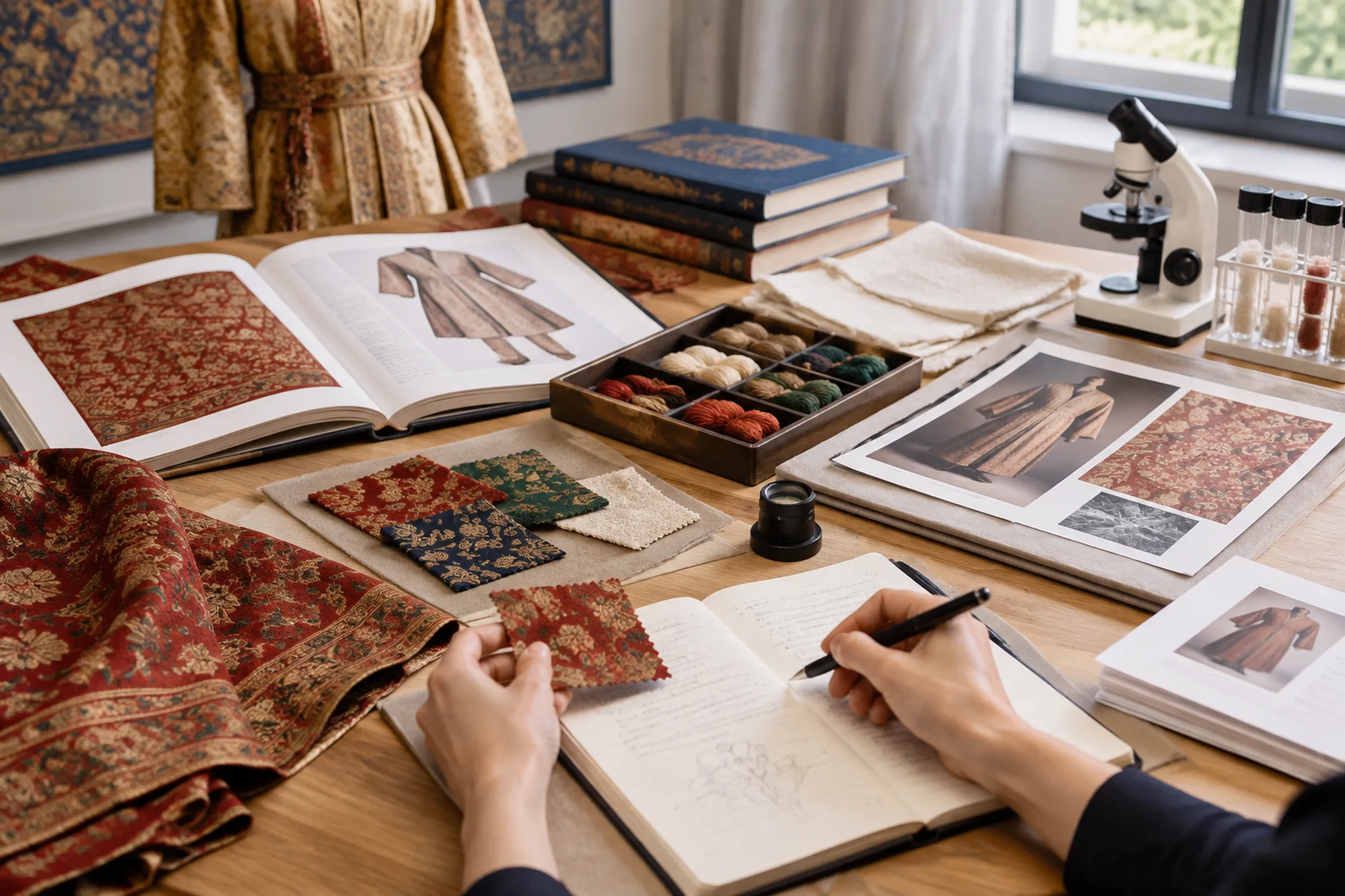
Paintings, manuscript illustrations, photographs, and other images can show a garment silhouette, pattern placement, drape, scale, social setting, or relationship between clothing and the body. They may help researchers ask better questions about appearance and use. They generally cannot, by themselves, establish the actual fiber content, yarn, textile structure, finishing process, production location, or ownership history of the textile depicted.
Always separate the date of the image from the date, origin, and ownership of the textile shown in it. An artwork may be later than the clothing it depicts, or it may present an idealized, conventional, or socially specific scene. One image should not be used to define universal court dress or the clothing of every group within a period.
Material descriptions also need a clear hierarchy. Fiber identity, yarn characteristics, textile structure, and finishing are different layers of information. A weave or commercial textile name is not automatically a fiber name: a term describing a satin structure, for instance, does not by itself establish that the material is silk. Regional and cataloging traditions can also use the same term differently. Technical examination is therefore stronger evidence for fiber, dye, weave, and finishing claims than visual similarity alone.
Finally, image research has separate publication questions. Record the original repository and authoritative caption, check digitization quality, and distinguish the artwork’s historical date from current reproduction and licensing status. Use an image as contextual or comparative evidence unless technical documentation supports a stronger material conclusion.
Which Common Assumptions Need to Be Tested?
A textile described as associated with a Mughal court was not necessarily made inside the court, in a single named workshop, or for one ruler. Court ownership, court display, court commissioning, and court production are different claims. A collection record or written reference may support one of these relationships without proving the others. Ask which connection the source actually documents before turning an association into a statement about manufacture.
A surviving luxury textile also has a limited representational range. It may provide valuable evidence about materials, techniques, taste, status, or preservation, but it does not automatically represent ordinary clothing, every court member, or the whole period. The record may reflect what survived, what was collected, or what was considered valuable enough to document. Social and regional variation should remain visible in the wording.
Terminology creates another recurring problem. A material, pattern, garment, or textile term may shift in meaning across languages, regions, periods, and cataloging traditions. A modern commercial label can also compress several technical or historical distinctions. Check whether the term identifies a fiber, yarn, textile structure, finish, visual motif, object type, or later interpretation. Similar wording is not proof that two records describe identical materials.
Visual resemblance is useful for forming a research question, but it is not conclusive proof of shared origin, direct influence, or an unbroken technical tradition. Similar patterns may result from parallel preferences, circulation, adaptation, reconstruction, or later interpretation. Likewise, a relationship between textiles and trade, labor, status, gender, technology, or regulation requires evidence for the relationship itself. Correlation or contemporaneous association should not be presented as demonstrated causation.
A Practical Workflow for Building a Defensible Research File
Begin with one precise claim. State what is being asserted, and specify the object or image, time, place, group, and function involved. “This textile was used at court” is too broad unless “used,” “court,” and the relevant evidence are defined. Separate questions about material, date, provenance, attribution, ownership, display, and production so that one strong record does not appear to answer all of them.
Next, collect the original record. Use the repository entry, archival description, catalog page, scholarly edition, or technical report rather than relying on a search snippet, retailer description, unsourced summary, or quotation copied through several secondary sources. Save the object number or record identifier, page or folio, exact quotation, image caption, and access details. For translated sources, record the edition and translator because wording can affect interpretation.
An evidence matrix keeps the research transparent and exposes gaps before publication:
| Claim | Source and exact evidence | Certainty and alternatives | Publication wording |
|---|---|---|---|
| Material or structure | Technical record, conservation report, or catalog field | Tested, described, attributed, or unresolved | State only the layer directly supported |
| Date or provenance | Collection history, inscription, inventory, or scholarly discussion | Confirmed, approximate, disputed, or incomplete | Preserve the date range and disagreement |
| Court association | Ownership record, account, biography, image, or contextual study | Direct association or editorial interpretation | Use “associated with” when production is unproven |
Cross-check the important claims independently where possible. A technical record may clarify fiber or structure without establishing ownership. An inventory may document possession without describing construction. An image may show dress or setting without proving the depicted textile’s material. Specialist scholarship can connect these records, but its interpretation should remain identifiable as interpretation rather than being rewritten as an object-level fact.
Finally, write the conclusion at the strength supported by the evidence. List unresolved questions, competing interpretations, and the next primary source to consult. This approach makes a research file useful for teaching, design development, product inspiration, or editorial work without presenting a provisional attribution as settled history.
How to State Findings Without Overclaiming
Precise verbs help readers distinguish documentation from interpretation. Use “the record identifies” for information explicitly stated in a source, “the object is attributed to” for a catalog judgment, and “the image depicts” for what a visual source presents. Use “scholars argue” when reporting an interpretation and “the available evidence does not establish” when a claim remains unsupported. These formulas are not evasive; they show the boundary of the evidence.
When dates, provenance, translations, or material descriptions conflict, report the disagreement rather than silently selecting the most convenient version. Explain which source supports each position and whether the difference concerns the object itself, a later catalog decision, a translation, or incomplete documentation. Keep historical evidence separate from a modern reproduction, design reference, or product-development interpretation. A contemporary textile inspired by a historical image should not be described as the original historical material.
A useful next step is to return to the original collection record, review the specialist bibliography, seek technical documentation where it exists, and document image permissions separately. Apparel Wiki is an independent educational knowledge blog, so its role is to clarify research practice and textile terminology, not to replace a museum record, specialist review, laboratory examination, or archival source.
Frequently Asked Questions
What are the best research sources for Mughal court textiles?
Start with collection records, archival documents, inventories, court writing, manuscripts, contemporaneous images, conservation reports, specialist catalogs, and peer-reviewed scholarship. Match each source to the specific claim it can support.
How can I tell whether a textile was actually associated with the Mughal court?
Look for direct evidence of ownership, commissioning, display, use, or documented court context. Court association does not by itself prove that the textile was produced inside a court workshop.
Can a Mughal painting prove what a historical textile was made from?
Usually not. A painting may show silhouette, pattern, drape, or social setting, but fiber and construction claims require technical or documentary evidence about the textile itself.
Why do museum records use terms such as “attributed to” or “possibly”?
These terms preserve uncertainty about date, place, maker, provenance, material, or interpretation. They indicate a documented scholarly judgment, not necessarily a confirmed fact.
How should I evaluate conflicting dates or provenance records for a Mughal textile?
Compare the original records, catalog notes, collection history, and specialist bibliography. Identify what each date or provenance claim is based on, then report the disagreement and its limits.
What is the difference between a textile’s material, weave, pattern, and finish?
Material may refer to fiber or yarn; weave describes textile structure; pattern concerns visual design; and finish describes treatments or surface effects. One term should not be used as proof of another.