Water resistance and waterproofness are related but not interchangeable apparel claims. Water resistance generally means that a fabric or garment delays wetting or limits water penetration under particular conditions. Waterproofness is a stronger performance claim, but it still needs context: the product specification, test method, garment construction, and intended use determine what the claim actually supports. As an independent educational publication, Apparel Wiki also maintains a clear editorial boundary around its content and sponsorship, as described on its Sponsor page.
In practical terms, a water-resistant garment may manage light rain, splashes, or brief exposure, while a waterproof garment is expected to provide a higher level of resistance to water passing through. Neither label alone proves how long protection will last in heavy or wind-driven rain, under pressure from straps or sitting, around seams and closures, or after washing and repeated wear. Commercial terminology can vary, so a reliable comparison must identify the evidence behind the wording instead of treating either term as universal.
What Is the Difference Between Water Resistance and Waterproofness?
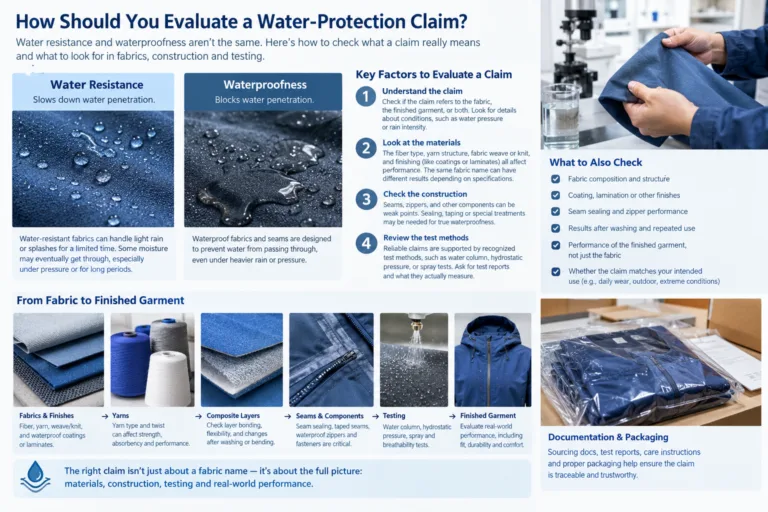
The difference between water resistant and waterproof is best understood as a difference in claim strength and evidence, not as two perfectly fixed categories. A water-resistant surface may cause droplets to bead, spread more slowly, or run off before the textile becomes wet. A waterproof claim usually indicates that the material or garment is intended to resist water penetration more completely under defined test or use conditions.
That distinction does not create a guaranteed time limit or a universal level of protection. A fabric may resist water in a controlled test while the finished garment admits water through needle holes, pocket openings, zippers, or unsealed seams. Similarly, a garment described as waterproof may be suitable for one exposure scenario but not for prolonged immersion, severe pressure, or a different care history. The relevant question is always: what was tested, how was it tested, and does that evidence match the finished product?
Product language also needs to be separated from a supported performance claim. Words such as “showerproof,” “water-repellent,” or “weather-ready” may communicate intended use without identifying a specific test. That wording is not automatically misleading, but it leaves more unanswered questions. For sourcing, development, and quality decisions, request the applicable specification and test information rather than relying on the label alone.
How Do Water-Resistant and Waterproof Garments Repel or Block Water?
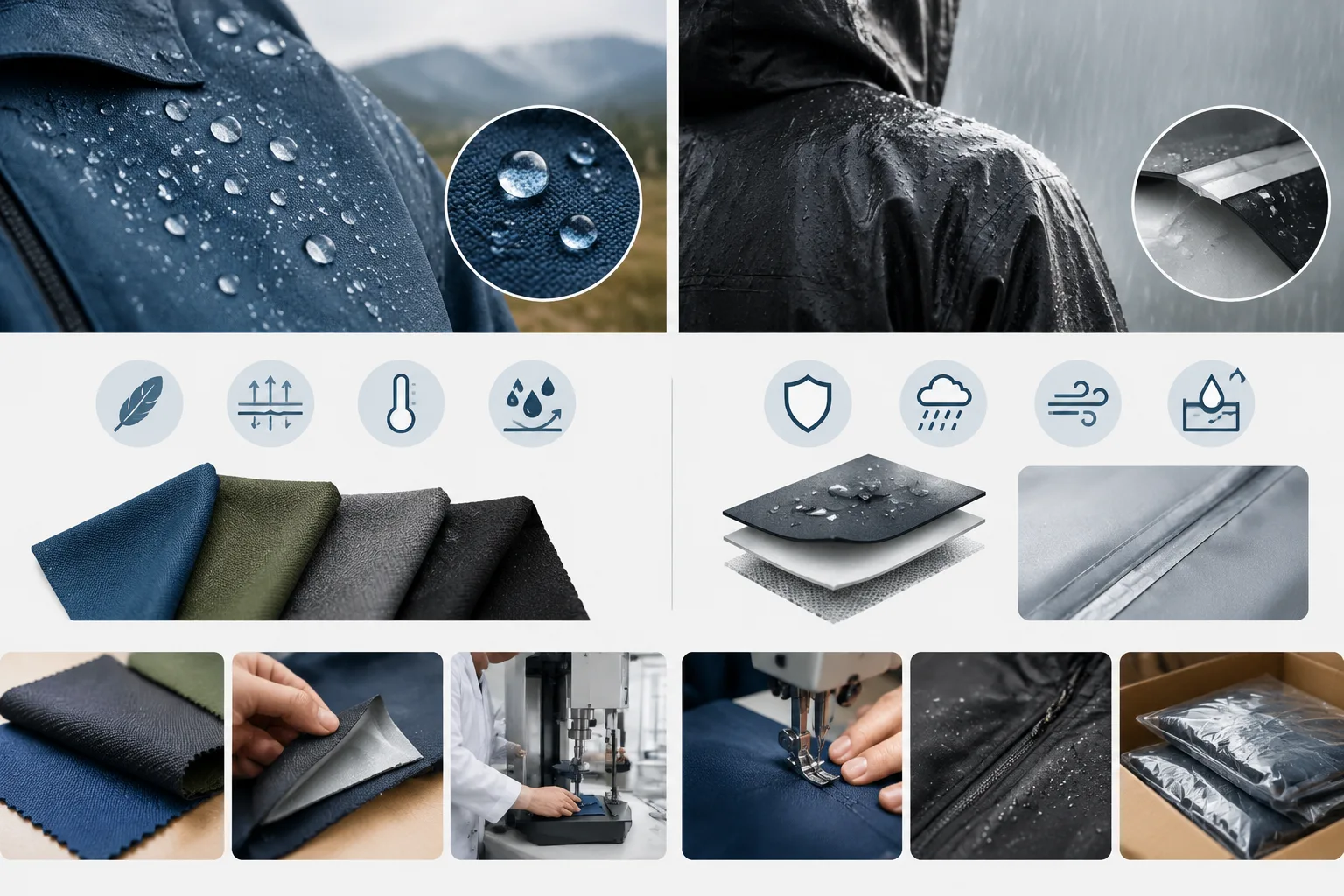
Water-repellent finish vs waterproof membrane is a useful comparison because the two operate at different material layers. A surface finish can lower the tendency of water to spread across the face of a textile. Droplets may bead and roll away, helping the garment remain more comfortable or less visibly wet during limited exposure. A finish that encourages runoff does not necessarily prevent water from passing through the fabric when exposure becomes prolonged or pressure increases.
A coating, membrane, laminate, or other barrier can provide a more direct obstacle to water penetration. Its performance depends on the complete material system, including the face fabric, backing, pores or openings, thickness, bonding, flexing, and any damage. The commercial name of a fabric is not technical proof. Fiber content, yarn arrangement, woven or knitted structure, and finishing describe different information layers, and each may need separate documentation.
Waterproof garment construction extends beyond the main fabric panel. Seams can contain needle holes or gaps; zippers and snaps can create linear entry points; pockets, cuffs, hoods, hems, and other openings can expose the wearer even when the surrounding textile performs well. Panel joins and areas that are repeatedly folded or stretched may also behave differently from a flat test specimen.
For that reason, a fabric report does not automatically prove how waterproof clothing works as a finished garment. A coated or laminated textile may perform well before cutting and sewing, yet the garment may have different weak points after assembly. Construction provides useful clues, but it does not independently determine stretch, breathability, durability, or water protection.
Which Variables Change Real-World Water Protection?
Real-world water protection depends on the exposure as well as the material. Rain intensity, duration, wind, body movement, contact with wet surfaces, and pressure from a backpack strap or a seated position can change the forces acting on the garment. A result that is adequate for intermittent drizzle may not represent performance during sustained rainfall or repeated contact with moisture.
Material condition matters too. Fabric weight, structure, stretch, flexing, folding, abrasion, contamination, and chemical or mechanical damage can influence how a finish or barrier behaves over time. With composite materials, layer bonding and the areas that repeatedly bend deserve particular attention. Washing, drying, storage, and repeated wear may also change performance, so care instructions should be treated as product-specific rather than assumed to be universal.
Garment design introduces another group of variables. Seam construction and sealing, closure design, hood and cuff coverage, hem openings, pocket placement, and fit all affect whether water reaches the wearer. These details are why fabric-only evidence and finished-garment evidence should be recorded separately. Water protection is also distinct from moisture-vapor management, warmth, air permeability, and general comfort; a garment can perform differently across each of those dimensions.
Water Resistance vs Waterproofness: Comparison Table for Apparel Decisions
The following table is a practical interpretation guide for designers, buyers, sourcing teams, and quality professionals. It does not replace the applicable specification, test report, or product documentation.
| Claim or evidence | What it may communicate | What it does not establish | Questions to ask |
|---|---|---|---|
| Water-resistant | The textile or garment may delay wetting or limit penetration under stated conditions. | It does not establish protection during prolonged rain, pressure, immersion, or repeated use. | Was the fabric, a seam, or the complete garment evaluated? Under what exposure conditions? |
| Water-repellent finish | The surface may encourage droplets to bead and run off. | Surface repellency is not proof that water cannot pass through the material. | How is the finish identified, and what evidence addresses its condition after care or abrasion? |
| Waterproof | The product is presented as providing a stronger barrier against water penetration. | The word alone does not prove seam, closure, opening, durability, or finished-garment performance. | What test method and sample configuration support the claim? Were seams and closures included? |
| Fabric test report | A particular material sample produced a result under specified conditions. | It does not automatically represent production garments, construction changes, or wear history. | Does the tested sample match the production material, bonding, finishing, and assembly? |
| Finished-garment evidence | The assembled product was assessed in a defined configuration. | It does not guarantee identical results after every wash, repair, modification, or use condition. | Were the test conditions, conditioning, care history, and intended exposure relevant to the product? |
For an everyday garment, a water-resistant finish may be useful for light or intermittent exposure. For sustained or demanding exposure, a waterproof claim deserves closer scrutiny of the barrier, seams, closures, openings, and test conditions. These are decision aids, not guaranteed use categories: the specification and evidence must control the final interpretation.
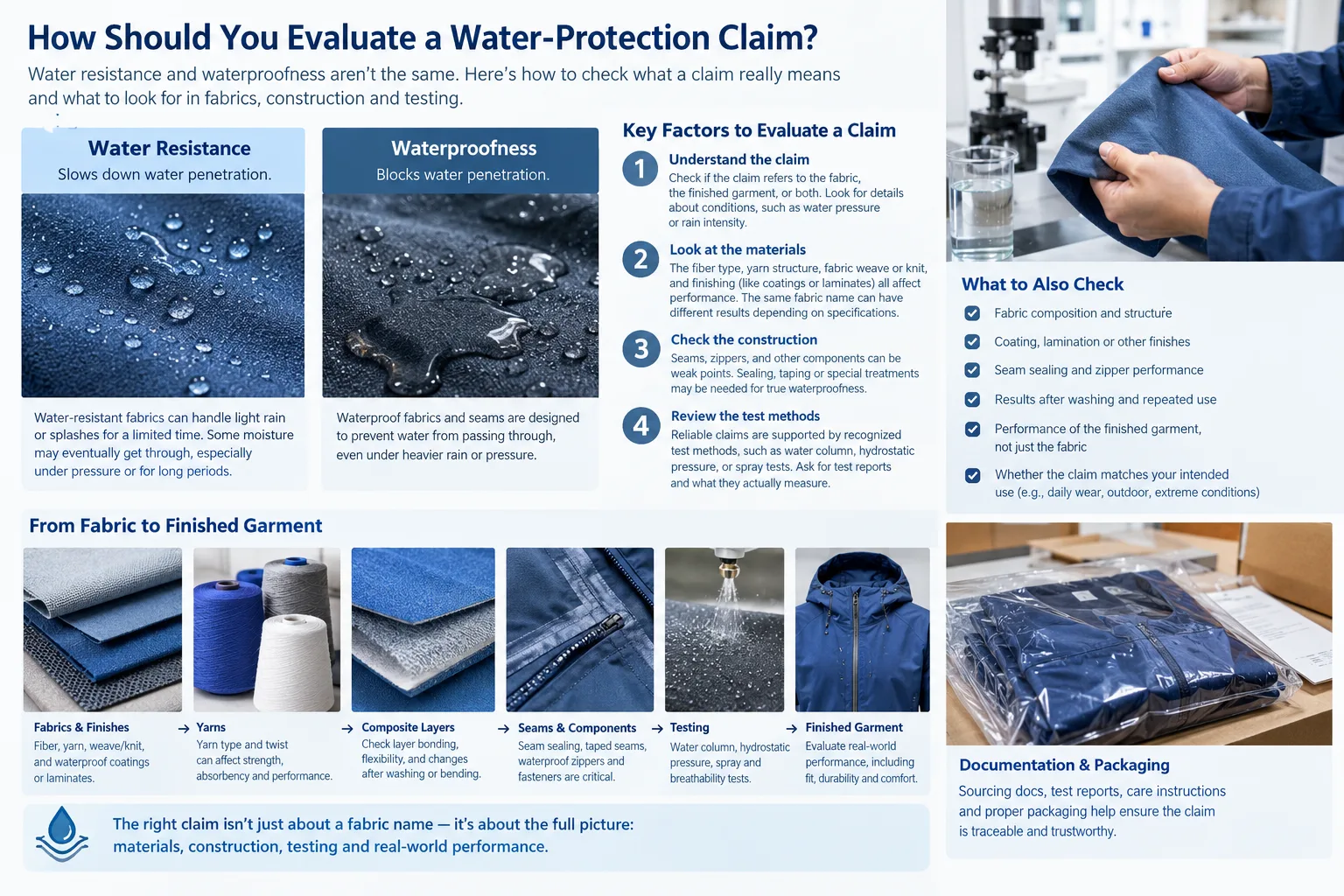
How Should You Evaluate a Water-Protection Claim?
Start with the exposure scenario rather than the marketing term. Define the activity, expected weather, exposure duration, wearer movement, temperature, contact with wet surfaces, and pressure from factors such as sitting or shoulder straps. Also decide what happens if protection fails. A commuter jacket and protective apparel for a high-consequence application may require different evidence even when both are described as waterproof.
Next, request the exact claim wording and the specification behind it. Useful documentation may identify the material composition, fabric structure, finish or barrier, seam treatment, closure design, care conditions, and tested sample configuration. “Waterproof material” is not sufficiently specific if the intended claim applies to an assembled garment with seams, pockets, zippers, vents, cuffs, and other possible entry points.
Review the test report in context. Check which method was used, who issued the report, what specimen was tested, how it was conditioned, and which test conditions and result units were recorded. Confirm that the method addresses the relevant failure mode. A surface-wetting assessment, for example, does not answer the same question as an evaluation of water passing through a material.
Trace the evidence to the production item. Determine whether it covers only the face fabric, the complete composite, sealed seams, closures, or a finished garment. Compare the tested specimen with the production material, bonding, finishing, assembly, and care instructions. A result from an earlier development sample may have limited relevance after a supplier, coating, seam type, or construction detail changes.
When durability matters, plan comparisons before and after relevant stresses such as laundering, flexing, folding, or abrasion. Visual checks and controlled sample trials can reveal changes worth investigating, but they are not formal certification of waterproofness. For production release, conformity, or higher-risk decisions, use an applicable test method and appropriately qualified independent laboratory or compliance professional.
Keep a written list of missing information, conflicting descriptions, and unanswered questions. Supplier statements can support an investigation, but they should not be treated as independent validation. The objective is not to collect the largest set of numbers; it is to obtain evidence that matches the intended garment, exposure, care cycle, and acceptable level of risk.
What Are the Main Trade-Offs and Limitations?
Water protection is one part of a garment performance brief. A barrier material or more extensive seam protection may influence hand feel, stretch, weight, appearance, moisture management, manufacturing steps, or cost. The direction and importance of these effects depend on the complete product. They should be assessed on representative samples rather than inferred from the waterproof claim alone.
Waterproofness also does not automatically establish warmth, wind protection, breathability, or wearer comfort. Moisture generated inside a garment is a different issue from rain entering from outside. Design details, activity level, layering, ventilation, fit, and environmental conditions can all affect the wearer’s experience, even when the outer material performs as specified in a water-penetration test.
Durability is another limitation. Finishes, coatings, membranes, laminates, and bonded layers may respond differently to washing, drying, folding, flexing, abrasion, contamination, or chemical exposure. Sewn and repeatedly bent areas deserve particular attention in composite materials. Follow the product-specific care instructions and verify performance after the stresses that are relevant to the intended use.
A passing fabric result cannot eliminate garment-level entry points. Seams, needle holes, zippers, pockets, vents, hood openings, cuffs, and hems may still admit water. Conversely, a well-designed garment cannot compensate for a material that does not meet its specified requirement. Fabric evidence and finished-garment evidence answer related but distinct questions.
Commercial descriptions also have limits. Terms such as “technical fabric,” “laminate,” or a familiar weave name do not establish measurable water protection. Fiber content, yarn, fabric structure, finishing, and garment construction are separate information layers. Request specifications and relevant evidence instead of assuming that a material name predicts waterproofness, durability, or comfort.
How Should You Specify and Communicate the Claim?
Write the intended exposure and required performance before selecting the label. The specification should connect the material, barrier or finish, seam treatment, closures, openings, care conditions, and applicable evidence. This gives product developers, sourcing teams, suppliers, and quality staff a shared basis for reviewing the garment rather than relying on different interpretations of “water-resistant” or “waterproof.”
In product copy, state precisely what was evaluated and avoid extending a fabric result to the entire garment. Keep supplier claims, verified direct-source facts, editorial recommendations, and hypothetical use examples distinct. Do not turn a suggested use, such as light drizzle, into a guarantee unless product-specific evidence supports that promise under defined conditions.
Reassess the claim whenever production construction, finishing, material supplier, care instructions, or intended use changes. Even a small revision may affect whether earlier evidence still represents the product. Regulatory, labeling, certification, and mandatory claim requirements can also vary by market and product category, so current advice should come from the relevant authority, standard owner, laboratory, or qualified compliance professional.
A concise buyer and developer checklist is:
- Define the exposure, failure mode, and acceptable risk.
- Record the exact claim and the intended product configuration.
- Specify materials, finishes, seams, closures, openings, and care conditions.
- Confirm the test method, specimen type, conditions, results, and report source.
- Check that tested samples match production construction.
- Repeat relevant evaluations after material or construction changes.
As a next step, add these questions to the tech pack, sample review, or sourcing discussion before approving product language. Apparel Wiki provides independent apparel education, not manufacturing, laboratory testing, certification, or compliance services; formal decisions should rely on current, product-specific evidence from appropriate specialists.
Frequently Asked Questions
Is water-resistant the same as waterproof?
No. Water-resistant generally communicates limited or delayed protection, while waterproof is a stronger claim. Neither term has complete practical meaning without the relevant specification, test conditions, garment construction, and intended use.
Can a waterproof fabric still let water into a garment?
Yes. Water may enter through seams, needle holes, zippers, pockets, vents, cuffs, hems, or other openings. Fabric performance does not automatically establish finished-garment performance.
Is a water-repellent finish proof that clothing is waterproof?
No. A water-repellent finish may encourage water to bead or run off the surface, but that does not prove the material blocks water penetration under the intended conditions.
What should I ask for when a supplier claims a garment is waterproof?
Ask for the exact specification, test method, report source, conditions, specimen configuration, results, material construction, seam and closure details, care history, and confirmation that the tested sample matches production.
Do waterproof claims apply to the fabric or the finished garment?
They may apply to either, so the scope must be stated. Evidence for a fabric, composite, seam, or complete garment should not be presented as though it covers configurations that were not evaluated.
Can washing or abrasion reduce water protection?
They may affect some finishes, barriers, bonded layers, or construction details. The outcome depends on the product, care process, and exposure, so follow its instructions and review evidence after relevant durability stresses.