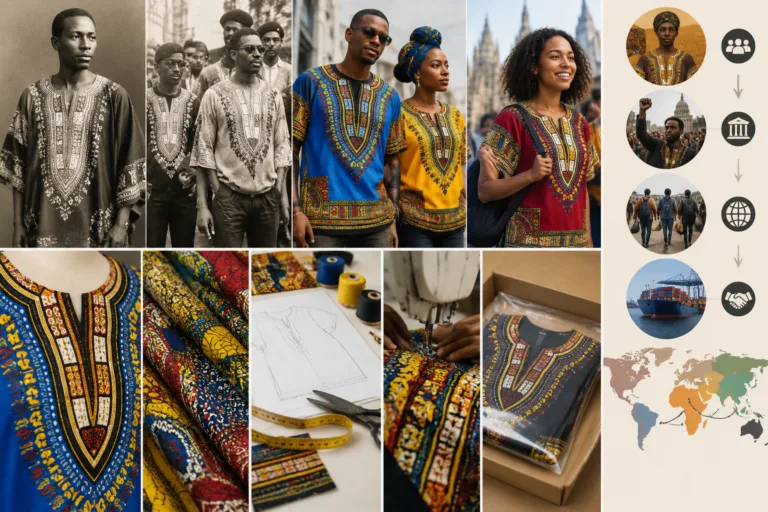
Dashiki history is the history of a named garment whose form and use have changed across places, periods, and social settings. A dashiki is commonly described as a loose tunic or shirt, but that description does not define one fixed pattern. Length, neckline, sleeves, side openings, fabric, decoration, and styling can vary. This article examines those changes without claiming that one object, country, community, or maker represents the complete story. Apparel Wiki is an independent educational publication; its editorial approach is explained further on the Sponsor page.
What Is a Dashiki, and What Does Its History Actually Describe?
When readers ask “what is a dashiki,” they are often asking about both construction and meaning. The most useful starting point is physical: the dashiki is generally recognized as a loose-fitting upper-body garment, often described as a tunic or shirt. Historical and museum records may use related or different terms, however, and an object described as a tunic is not automatically proof that every wearer or community used the word dashiki for it.
For that reason, dashiki clothing history contains several separate milestones. Researchers may be able to identify a surviving garment, a dated photograph, an early use of a name, a documented commercial offering, or a later period of broad public visibility. These milestones answer different questions. The earliest surviving object is not necessarily the first garment made, and the first commercial appearance is not necessarily the beginning of everyday use.
This distinction also helps separate evidence from interpretation. A collection record can document materials, approximate dating, provenance, condition, or construction. A photograph can show that a garment appeared in a particular setting, while leaving its frequency of use unknown. A historian may then interpret those records in relation to dress, migration, identity, trade, or popular culture. That interpretation can be valuable while still remaining different from a directly documented fact.
The focus here is therefore narrower than a single origin story. It follows changes in form and everyday use, while keeping uncertainty visible. Where the available record supports only an association, attribution, or visual comparison, the wording should say so. Hypothetical examples can explain how evidence might be read, but they should not be mistaken for evidence about a particular dashiki or historical community.
Early Forms, Names, and the Problem of a Single Origin Story
Research into dashiki origins becomes clearer when several “firsts” are kept apart: the earliest surviving object, the earliest known image, the earliest recorded use of the name, the first documented commercial offering, and the point at which the garment became widely recognized. A source may be strong for one of these questions and silent on the others. Treating them as one date creates a simple story, but not necessarily an accurate one.
Names also require care. Similar loose garments may be classified differently according to region, period, language, collection practice, or the terminology used by the original maker and wearer. A catalogue may apply a broad garment category, while a later writer uses “dashiki” as a comparative or popular label. Neither description should automatically be treated as proof that the terms were historically interchangeable.
Object records are most useful when read in detail. Look for the collection or object number, recorded materials, estimated date, place associated with manufacture or use, provenance, ownership history, and restoration notes. Approximate dates and disputed attributions should remain approximate or disputed. Restoration may affect what can be observed today, and provenance may document an ownership chain without proving where or by whom an item was first made.
One artifact or one image cannot establish a unique inventor, a universal starting point, or complete adoption. It can establish that a particular object existed, or that a particular form was visible in a particular context. A broader conclusion requires comparison with dated images, catalogues, archival references, oral histories, and institutionally published fashion or textile research. In this sense, the history of the dashiki is assembled from connected records rather than extracted from a single definitive discovery.
How the Dashiki’s Form Changed: Cut, Neckline, Fabric, and Decoration
Physical design provides a practical way to compare dashikis across time and setting. Researchers can first describe what is visible: silhouette, garment length, sleeve shape, neckline, side openings, fabric, surface decoration, seams, hems, and finishing. Only after that description should they consider whether a variation may relate to a particular market, maker, period, or intended setting.
| Form feature | Documented variation | Possible context | Evidence limit |
|---|---|---|---|
| Silhouette and length | Loose shirt, longer tunic, or differently proportioned body | Period, pattern choice, layering, or local adaptation | Shape alone does not establish date or origin |
| Neckline and sleeves | Variation in opening, collar treatment, sleeve width, or sleeve length | Construction practice, climate, styling, or market preference | A photograph may not show hidden construction details |
| Fabric and decoration | Different weights, prints, woven surfaces, embroidery, or trims | Material access, maker practice, occasion, or retail presentation | Decoration does not by itself prove cultural meaning |
| Finishing details | Differences in hems, openings, seams, and surface treatment | Handmaking, commercial patterns, or production methods | Records may omit technical details or later alterations |
Visual similarity should not be overread. Two garments may share a loose cut and colorful surface while differing in date, construction, origin, or function. Conversely, garments that look different may belong to a related design history. Commercial patterns and factory production can standardize selected features, while local makers and wearers may continue to alter proportions, fabrics, decoration, or finishing.
Construction can support an interpretation of wearability only when the evidence permits it. A lighter fabric may appear suitable for warm conditions, but a record that does not identify climate, layering, or use cannot prove that explanation. The same caution applies to symbolism. Describe the neckline, print, or embroidery before assigning political, religious, regional, or identity-based meaning.
From Special Meaning to Everyday Wear: Where and How People Used It
There is no reliable universal answer to whether the dashiki was “originally” everyday, ceremonial, or political clothing. Documented use can vary with the wearer, period, location, garment construction, decoration, and social setting. A dashiki may appear in daily dress, leisure, community events, public appearances, or ceremonial contexts, but each claim should be tied to dated and contextual evidence rather than assumed from the garment’s appearance.
A photograph proves visibility, not prevalence. It may show one person at one event, a staged portrait, a public figure, or a community scene selected for publication. Newspapers, diaries, interviews, advertisements, oral histories, and community archives can help establish how people described or encountered the garment. Comparisons across more than one region or social group are especially important before making claims about broad everyday adoption.
| Setting | What direct evidence may show | What remains interpretive |
|---|---|---|
| Daily dress or leisure | Repeated dated images, testimony, diaries, or local reporting | How common the practice was beyond the recorded group |
| Community or ceremonial event | Event context, participant accounts, and described dress practices | Whether the same garment had the same meaning elsewhere |
| Political or public expression | Contemporary statements, reporting, interviews, or movement records | Whether visibility represented all wearers or only a specific context |
| Media appearance | Dated photographs, broadcasts, or publications | Whether public visibility led to regular everyday use |
Practical factors may also shape use. Comfort, climate, laundering, layering, access to suitable fabrics, and the amount of decoration can influence whether a garment works for repeated wear. Those links should remain conditional unless supported by period-specific testimony or technical and social evidence. Observed clothing does not automatically reveal status, identity, political commitment, or the wearer’s reasons for choosing it.
Identity, Politics, Migration, and Trade in the Dashiki’s Changing Visibility
Dashiki history cannot be separated from the social settings in which people saw, made, bought, and wore the garment. Dress can communicate identity or community affiliation, but the meaning is not fixed by the garment alone. The wearer, period, location, styling, degree of decoration, and surrounding event all affect how a dashiki may have been understood.
Historical sources can document links between the dashiki and public identity, political expression, migration, or media representation. A newspaper report, interview, photograph, advertisement, or community archive may show that the garment appeared in a particular movement or public setting. It does not automatically prove that every wearer shared the same political commitment, or that the garment had the same meaning in another region.
Migration can also change a garment’s visibility without producing one uniform interpretation. A form associated with one local context may be adapted by diasporic communities, presented through retail channels, or reinterpreted in fashion media. Those developments can occur at the same time, but timing alone does not establish a direct cause. Stronger conclusions require period-specific testimony, reporting, images with reliable context, or scholarship that compares the relevant communities.
| Historical setting | What direct evidence may show | What remains interpretive |
|---|---|---|
| Community or diasporic use | Repeated images, interviews, local reporting, or described dress practices | Whether the practice represented the wider community |
| Political or public appearance | Contemporary statements, event records, reporting, or movement photographs | Whether visibility changed everyday use afterward |
| Migration and retail access | Advertisements, shop records, catalogues, or oral histories | How widely the garment was available or adopted |
| Fashion-media presentation | Dated magazines, broadcasts, editorials, or advertisements | Whether media visibility reflected ordinary wear |
Trade and textile availability may have affected which fabrics, colors, trims, and construction methods were accessible in a given period. Retail channels and manufacturing capacity could also make some versions easier to obtain than others. These are useful historical questions, but they should be answered with records from the relevant period. A general statement about trade cannot establish a specific garment’s route to market, and a historical policy cannot be treated as evidence of current conditions.
Commercialization and Global Recognition: What Changed as the Dashiki Reached Wider Markets?
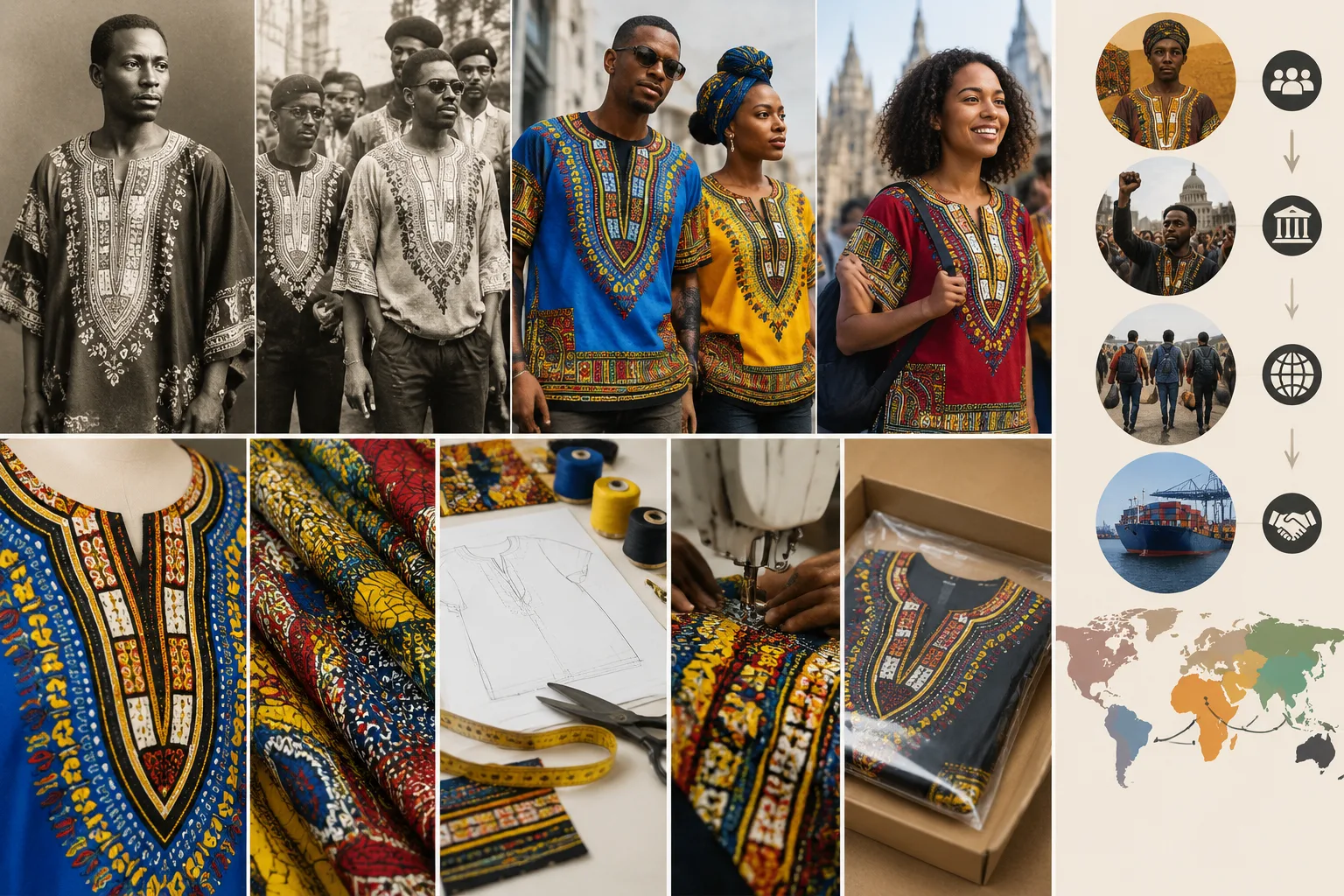
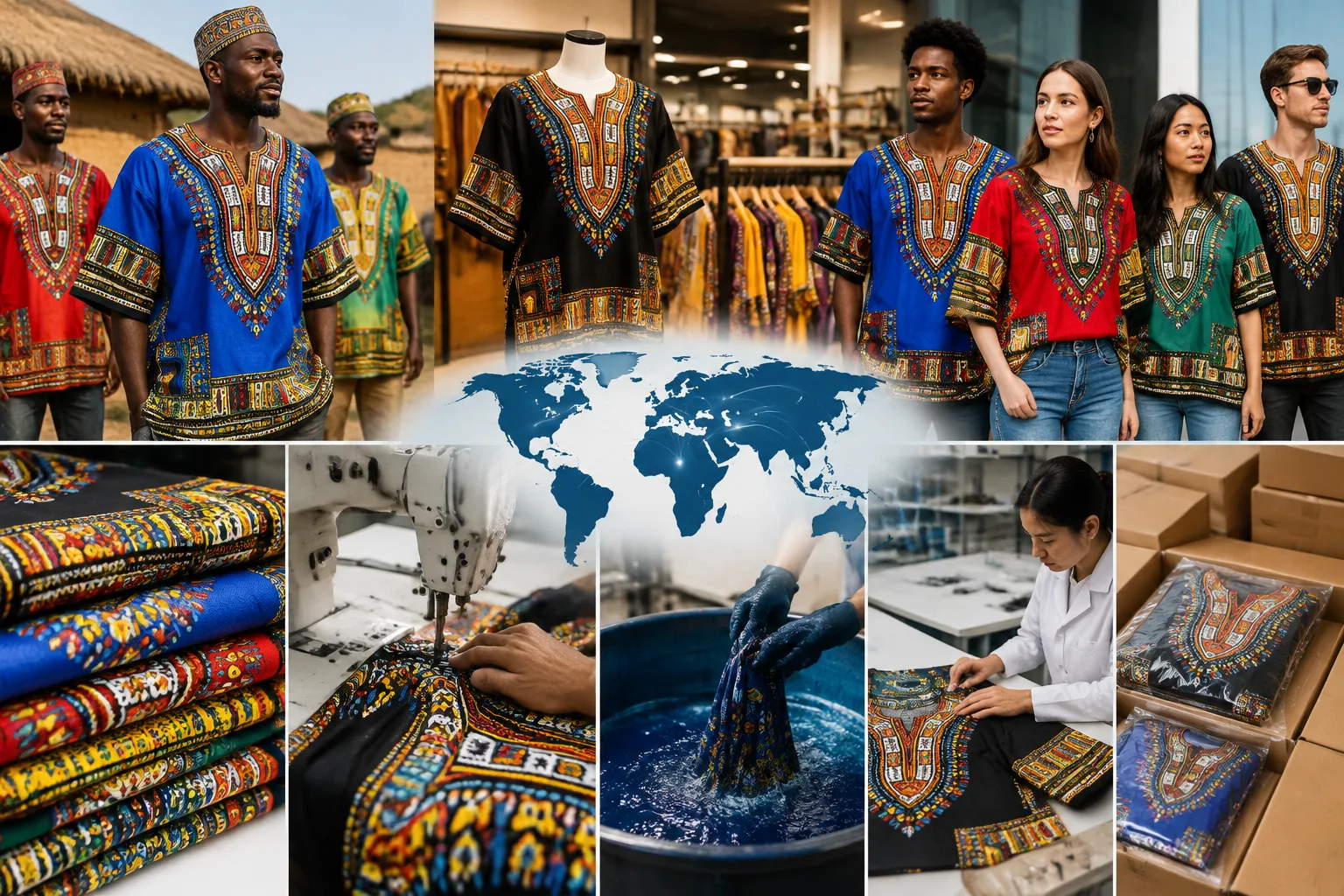
Commercialization is best understood as a series of overlapping developments rather than one launch moment. Local production, community retail, boutique sales, factory production, pattern publication, advertising, media exposure, and international recognition are different milestones. A garment may be familiar within one community before it receives broad fashion coverage, and commercial visibility may expand without making every version identical.
As dashiki forms entered wider markets, naming and retail presentation could influence how buyers understood them. Commercial patterns and repeated production may standardize a neckline, silhouette, or decorative arrangement, while local makers and wearers continue to alter fabric, length, sleeves, finishing, or styling. Similar-looking garments from different periods therefore require more than visual comparison. Their labels, materials, construction, provenance, and documented setting also matter.
Wider availability may have supported new forms of everyday wear, but that conclusion needs evidence from more than a single advertisement or fashion image. Retail records can show that a product was offered; they do not by themselves show how many people bought it, where it was worn, or what it meant to them. Likewise, a patent, pattern date, or first-known advertisement can establish a documented milestone without proving global adoption.
Commercial presentation can also change perceived meaning. A garment shown as community dress, political expression, leisure clothing, or a fashion item may be styled differently for each audience. That does not make one presentation the definitive identity of the dashiki. Regional differences remain important because retail access, textile supply, media coverage, and local dress practices do not develop at the same pace.
For that reason, a responsible dashiki history timeline should use only validated milestones. Each entry should identify what happened, where, when, and what kind of source supports it. The timeline should distinguish commercial introduction from mass-market production, media exposure from everyday use, and international recognition from evidence of equal adoption across markets.
How to Evaluate Conflicting Dashiki History Claims
Conflicting claims often arise because sources answer different questions. A museum record may describe one surviving object. A photograph may document a garment in one setting. An advertisement may show how a seller presented it. A scholarly work may interpret relationships among several sources. None of these automatically supplies a complete history.
When checking a claim about dashiki history, ask:
- What type of source is it? Give particular weight to original object records, dated primary images, contemporary publications, interviews, and documented community materials.
- What date and location are established? An approximate date or unknown location should remain approximate or unknown in the final wording.
- What does the terminology describe? Similar names may refer to different garments, while the same term may change meaning across regions or periods.
- What is known about provenance? Ownership, acquisition, material, construction, restoration, and attribution can clarify an object without proving where the form began.
- What does the image actually show? A photograph can document presence, styling, and context, but not necessarily frequency or broad popularity.
- What kind of claim is being made? Origin, symbolism, political association, commercial availability, and everyday use require different evidence.
Use language that matches the strength of the record. “Documented” can describe a claim directly supported by a source. “Attributed” or “associated with” can preserve uncertainty about origin or meaning. “Appears in” is appropriate when an image establishes presence but not widespread use. “Remains debated” is more accurate than forcing a single answer where sources disagree.
Common errors include treating a museum entry as a complete garment history, treating a patent date as a popularity date, and treating one public figure or photograph as representative of an entire period. Apparel Wiki is an independent educational publication, so this article offers a method for reading the evidence rather than presenting itself as a museum, laboratory, manufacturer, or certifier.
For further research, consult original museum records, compare scholarship from more than one region, and separate image licensing questions from claims about garment date or origin. Readers studying design and production can also use the Apparel Manufacturing Tools resource alongside this historical research, while keeping historical interpretation distinct from present-day product development.
Is there one universally accepted origin of the dashiki?
No. The earliest surviving object, earliest known image, first use of a name, commercial introduction, and later popularity are separate milestones. Available evidence does not justify naming one universally accepted inventor or origin point.
Was the dashiki originally everyday clothing, ceremonial clothing, or both?
Its use varied by period, place, wearer, construction, and setting. Sources may document daily, leisure, community, political, ceremonial, or public uses, but one photograph cannot establish a universal function.
How did the dashiki’s cut, fabric, and decoration change over time?
Documented versions may differ in silhouette, length, sleeves, neckline, openings, fabric, surface decoration, and finishing. Similar appearance alone cannot prove that garments share the same date, origin, or purpose.
How can I tell whether a historical dashiki claim is supported by reliable evidence?
Check the source type, date, location, terminology, provenance, image context, and claim category. Give more weight to original records and dated primary evidence than to unsourced summaries, and preserve uncertainty where the record is incomplete.
Did commercial production and global fashion visibility change how people wore the dashiki?
They may have expanded access, standardized some features, or encouraged new styling, but the extent and meaning of those changes must be established region by region through retail, media, archival, and community evidence.
Is every colorful tunic or shirt a dashiki?
No. Color alone is not a sufficient definition. Identification should consider the garment’s name, cut, construction, decoration, historical context, and the terminology used by the relevant source or community.