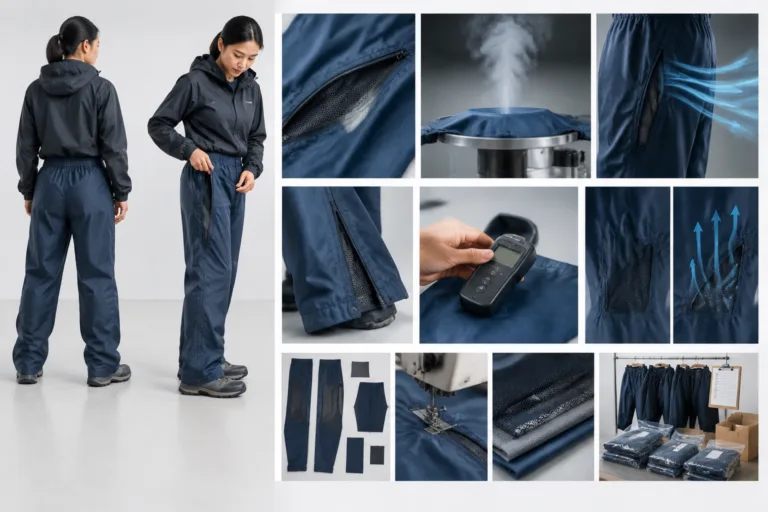
Rain pants ventilation is the garment’s ability to help manage heat, moisture vapor, and perceived clamminess during use while retaining the intended level of rain protection. During development, teams evaluate that balance across the complete garment, not just the fabric. The target depends on activity intensity, climate, base layers, posture, duration, and rain exposure. Apparel Wiki is an independent educational publication; its Sponsor information does not change the need for evidence-based product evaluation.
In practical terms, ventilation is a task-based product requirement. A development team must translate it into material, pattern, construction, and verification decisions suited to the intended use. A prototype that feels comfortable during slow walking in mild rain may behave differently during cycling, climbing, extended sitting, or repeated leg movement.
What Does Ventilation Mean in Rain Pants Development?
Ventilation in rain pants describes how the garment helps heat and moisture move away from the wearer or out of the clothing system. It includes the combined effect of moisture-vapor transport through the material, air exchange around openings, the space between the shell and the body, and movement-generated changes in that space. The result is experienced as greater or lesser heat buildup, dampness, and clamminess.
This concept should be separated from related properties. Waterproofness concerns resistance to liquid water entering from outside. Breathability is often used broadly for moisture-vapor transmission, but it may refer to a material property measured under a particular method rather than the behavior of finished pants. Air permeability concerns air passing through a material under defined conditions. Drying speed concerns how quickly wet material loses moisture. General comfort includes all of these influences plus fit, weight, noise, mobility, and skin sensation.
These properties can interact without being interchangeable. A fabric may show a favorable laboratory moisture-transfer result while the assembled pants still feel clammy because the fit is close, the lining holds moisture, or seam construction and closures limit exchange. Conversely, an open vent may create noticeable airflow without resolving moisture accumulation across the entire garment.
The category name “rain pants” does not establish a functional performance level. A lightweight overtrouser, an active-use shell, and a work-oriented waterproof trouser may have different ventilation priorities because their users move, layer, and encounter weather differently. Development criteria should therefore identify the intended wearer, activity, climate, exposure, duration, and acceptable trade-offs before a team compares prototypes.
How Do Rain Pants Release Heat and Moisture?
Rain pants ventilation works through several pathways at once. Moisture vapor may move through the fabric system when the material and environmental conditions allow it. Air may exchange through openings or around the garment edges. Loose volume can provide space for warm, humid air to shift as the wearer moves, while bending and walking can create a pumping effect between the shell and the base layer. None of these mechanisms alone guarantees comfortable moisture management.
Fabric and barrier pathways
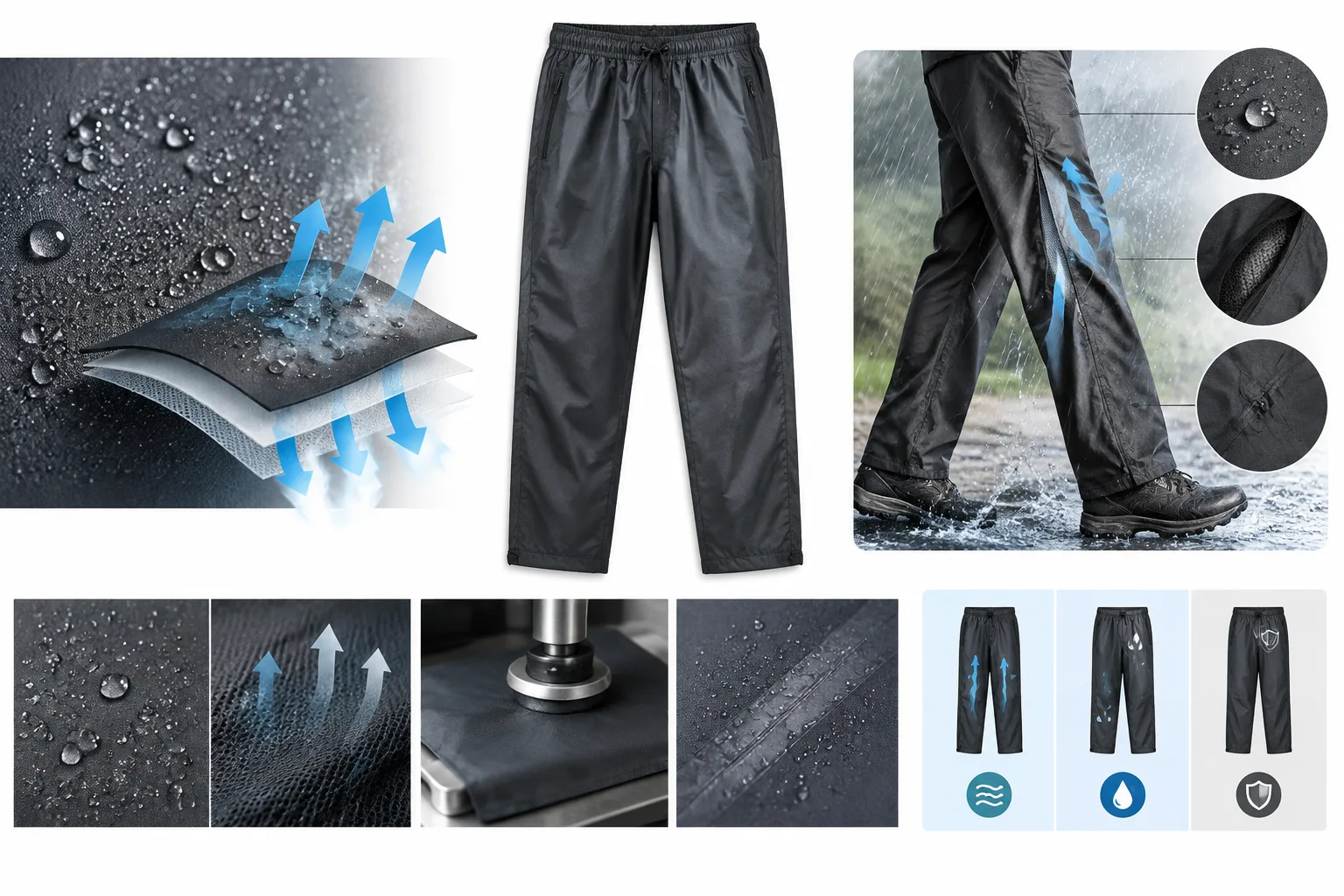
The outer material system influences how vapor and air move through the pants. A waterproof barrier, coating, membrane, or lining may restrict exchange depending on its construction and the conditions of use. Seam sealing can also change the behavior of assembled panels because sealed seams do not function like open fabric areas. These effects should remain conditional unless supported by supplier information, product evidence, or an appropriate test.
A component result is not a finished-garment result. Panel joins, seam tapes, reinforcements, pocket bags, waist treatments, cuffs, and closures all occupy part of the path between the wearer and the outside environment. Layering adds another variable: a base layer may hold moisture against the skin, change the air gap, or alter how the shell moves during activity.
Openings, fit, and movement
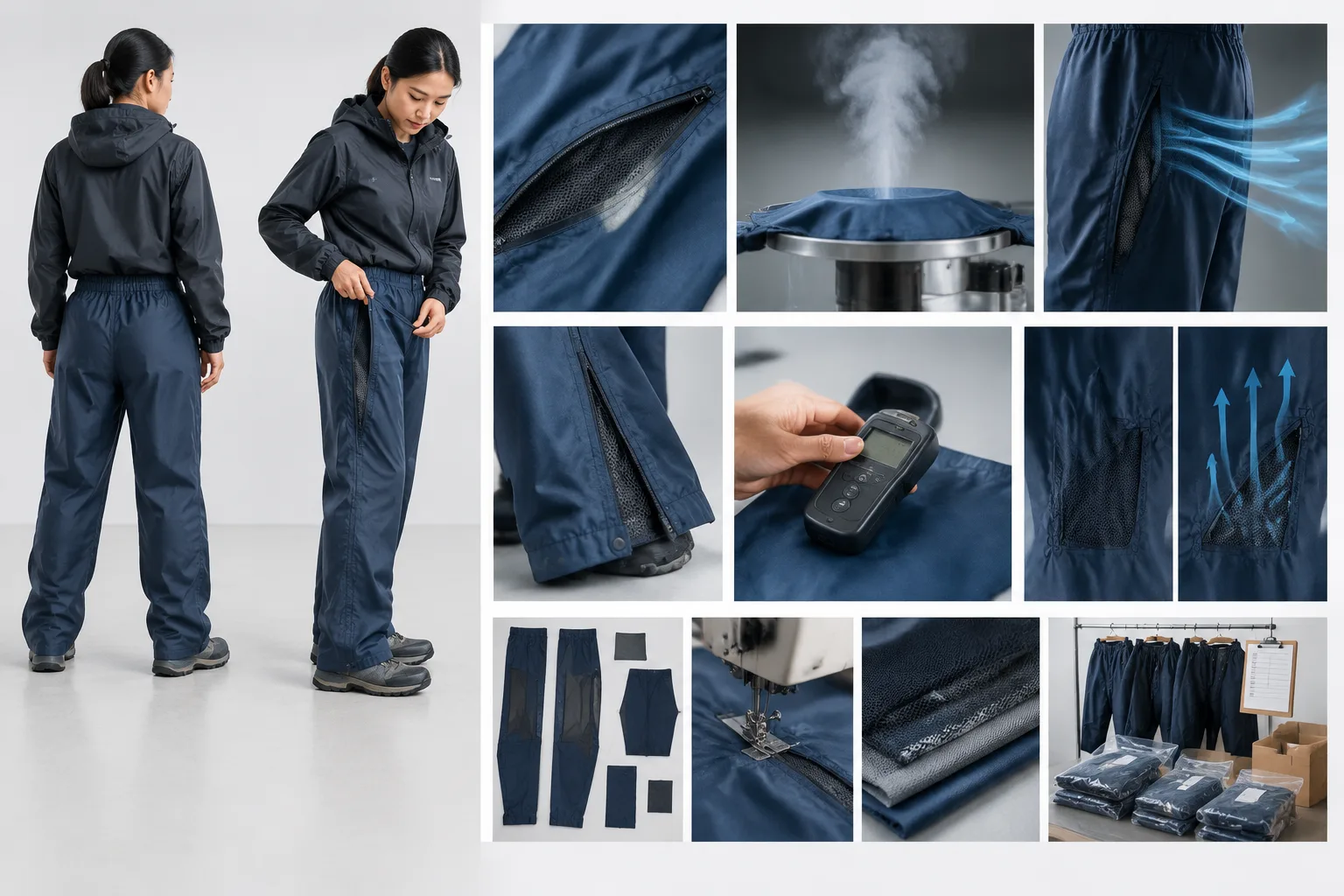
Common exchange points include the waistband, hems, side openings, pocket openings, and dedicated vents. Their usefulness depends on placement, size, protection from rain, ease of operation, and whether they remain open or accessible during movement. An opening that works while standing may be less effective when seated or when a pack, tool belt, or outer layer covers it.
Fit also affects the ventilation experience. Close contact can reduce the air space available for movement and may concentrate heat or moisture at high-friction areas. More volume can support air exchange, but it can also affect mobility, snag exposure, noise, appearance, and rain protection. Ventilation should not be described as identical to cooling: airflow may feel noticeable while the garment still retains moisture, and reduced clamminess may depend on more than visible air movement.
Which Design Variables Change Rain Pants Ventilation?
When a prototype feels too clammy or insufficiently protective, the team should identify where the problem occurs before changing the whole design. Map high-sweat, high-friction, high-movement, and high-exposure zones. Then compare material, pattern, and construction variables as a system rather than ranking one feature as universally best.
| Variable | What to examine | Possible trade-offs |
|---|---|---|
| Material system | Fabric construction, barrier, coating or membrane, lining, weight, and surface feel | Vapor movement, air exchange, rain protection, noise, and durability may change together |
| Fit and pattern | Ease, rise, leg volume, articulation, and contact with the base layer | More space may aid movement and air exchange but affect bulk, snag resistance, or weather coverage |
| Openings and closures | Vent location, adjustability, rain shielding, operation, and access during movement | Greater openness may increase exposure, maintenance needs, or closure complexity |
| Local construction | Waistband, cuffs, pockets, seam placement, reinforcements, and lining transitions | Details can create local heat or moisture accumulation while supporting fit, strength, or protection |
Fit and ventilation should be reviewed together. A leg that is technically roomy may still feel restrictive if articulation is poor, while a close-fitting pattern may concentrate dampness at the knees, seat, or waist. Rise, waistband tension, cuff treatment, and seam placement can affect both comfort and the way air moves as the wearer bends, sits, or walks.
Vents also require task-specific review. A vent that opens easily may improve perceived airflow during high activity, but its location may expose the wearer to rain or become ineffective under another layer. Fixed ventilation, adjustable openings, a fit revision, and a material revision are different interventions. The appropriate choice depends on the garment’s intended task, weather exposure, movement pattern, and required durability.
Before changing a pattern or material, record whether the observed issue is widespread or local. A damp waistband, overheated seat, restrictive knee, or ineffective side opening points to different development actions. Any material performance value should come from authoritative or supplier-specific evidence, and any safety or regulatory implication of cords, closures, visibility features, or openings must be checked for the target market and user group.
How Should You Evaluate Ventilation in Rain Pants Prototypes?
Start by defining the use scenario before evaluating a prototype. Record the expected activity intensity, weather exposure, base layers, posture, duration, target wearer, and likely movement pattern. A pair of rain pants used for low-intensity commuting may require a different balance from one intended for repeated climbing, hiking, or other active movement. The category name alone cannot establish the appropriate ventilation target.
Identify the complete prototype being reviewed. The record should include the material version or fabric lot, barrier and lining configuration, seam construction, closures, vent settings, size, and sample revision. Note whether the pants are being worn over one layer or several. These details matter because a change in fit, layering, or assembly can alter the wearer’s experience even when the main fabric has not changed.
Inspect and wear-test the finished garment through representative actions such as walking, climbing, sitting, bending, and repeated leg movement. Look for where heat and dampness accumulate rather than relying only on a general comfort impression. The waistband, seat, knees, inner legs, cuffs, and areas under closures may behave differently. Observe whether vents remain accessible and useful as posture and movement change.
Use a structured record for clamminess, heat buildup, dampness, restricted movement, vent usability, rain entry, noise, and layering effects. Descriptive wearer feedback is valuable for comparing samples, but it is not the same as a standardized performance result or proof of regulatory compliance. Ask the same questions in the same order where practical, and record the conditions while they are still clear.
Compare one controlled variable at a time when the project allows it. A team might compare two vent configurations, a fit adjustment, or a material version while holding the remaining construction details constant. Laboratory testing, field trials, or both may be appropriate when a quantified claim is needed. Before naming a method or interpreting a result, confirm its scope, sample requirements, environmental conditions, and limitations. Final materials and assembly should be represented because component results do not automatically predict finished-garment behavior.
How Do You Compare Ventilation Against Rain Protection and Durability?
Ventilation should be reviewed as one objective within a broader comparison. A useful development matrix can cover moisture management, rain protection, movement, durability, repairability, noise, weight, appearance, user-operable controls, and compatibility with expected layers. The purpose is not to find the highest ventilation result in isolation. It is to identify the construction that best serves the defined use while making its compromises visible.
A more open construction may improve perceived airflow, but it can also change exposure protection, snag resistance, abrasion behavior, or maintenance needs. An adjustable opening introduces an operating decision for the wearer. A fixed opening may be simpler but less adaptable. A fit revision can increase space for movement and air exchange without adding a vent, while a material revision may affect vapor movement, noise, weight, or rain protection in a different way. Each intervention should be evaluated as part of the garment system.
Use the intended task to prioritize the comparison. For example, an active wearer in warm rain may place greater emphasis on heat buildup and vent operation, while a lower-intensity user wearing compact overtrousers may prioritize coverage, packability, and simple adjustment. These are development examples, not universal market requirements. The relevant priorities should come from the target use, wearer research, customer specification, applicable requirements, and evidence from testing.
Set acceptance criteria before choosing a final direction, and document which compromises were deliberate. Record whether a sample was rejected because of rain entry, poor movement, difficult closure operation, local dampness, excessive noise, or a durability concern. Check any safety or regulatory implications of cords, openings, closures, visibility features, or intended user groups for the target market. A comparison matrix supports decision-making, but it does not replace required risk assessment, laboratory validation, or customer approval.
How Should Ventilation Findings Be Documented and Used in the Next Sample?
Turn each evaluation into a concise development record. Include the intended use, wearer assumptions, weather and activity conditions, base layers, prototype revision, materials, construction details, vent settings, size, and observed comfort or failure points. Distinguish direct observations from measured results, editorial recommendations, and hypothetical examples. This makes later decisions easier to audit and reduces the chance that an informal impression becomes an unsupported product claim.
Translate findings into specific next-sample actions. These may include revising leg volume or rise, changing a vent location, adjusting closure operation, reviewing seam construction, modifying a lining transition, or retesting a material system. State the reason for each action and identify the variable that should remain controlled during the next comparison. A vague instruction such as “improve breathability” is less useful than a defined observation linked to a construction review or follow-up test.
Update the technical package so drawings, measurement points, material references, construction notes, and revision numbers agree. Images and written instructions should describe the same vent placement, closure behavior, seam treatment, and component choices. The appropriate document structure depends on the product, so there is no universal checklist or fixed number of pages. The practical goal is consistent communication between design, development, quality, and production teams.
Before approving the next stage, list what remains unknown. Identify whether another wearer group, movement pattern, weather condition, layer combination, or laboratory evaluation is needed. Teams can use relevant Apparel Manufacturing Tools while organizing development information, but tools and records do not replace project-specific validation. A documented decision provides a clear next step; it does not by itself establish a performance rating or compliance result.
Frequently Asked Questions
What is the difference between ventilation and breathability in rain pants?
Ventilation is a whole-garment assessment of how heat, moisture vapor, and clamminess are managed during use. Breathability usually describes a material or material system’s ability to transmit moisture vapor under defined conditions. The two concepts are related, but fabric breathability alone does not describe openings, fit, movement, seam construction, or layering.
How can a team evaluate rain pants ventilation before production?
Define the intended use, document the prototype configuration, and compare finished samples under representative activity, weather, posture, duration, and layering conditions. Use structured wearer observations for early decisions, then apply appropriate laboratory or field methods when a quantified claim is required.
Which rain pants design features usually affect ventilation?
Material construction, barriers, linings, fit, leg volume, articulation, waistband, cuffs, vents, pocket openings, closures, seam placement, and layering compatibility can all affect the ventilation experience. Their effects depend on the complete garment and the conditions in which it is used.
Can better ventilation reduce rain protection?
It can, depending on how ventilation is created and where it is placed. Openings or looser construction may change exposure protection, while material or fit changes may introduce other compromises. The effect must be checked on the finished garment rather than assumed from the design concept alone.
Why should ventilation be tested on complete rain pants rather than fabric alone?
The assembled garment adds seams, closures, linings, reinforcements, fit, openings, and layering conditions that influence heat and moisture exchange. A component may perform favorably in isolation while the finished pants feel restrictive, accumulate dampness locally, or provide a different level of rain protection.