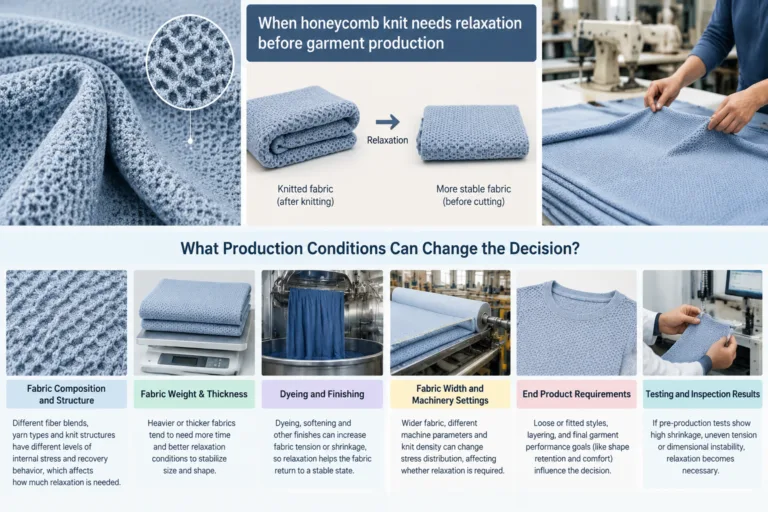
Honeycomb knit fabric may need relaxation before cutting when its handling history, supplier guidance, or a representative trial indicates that its dimensions can change after resting. It is not an automatic requirement for every honeycomb knit. In garment production, relaxation means allowing fabric to settle under defined handling and resting conditions before pattern pieces are cut. The purpose is to make the fabric state used for cutting more comparable to the state evaluated during development.
Apparel Wiki is an independent educational publication, not a fabric manufacturer, testing laboratory, certification body, or production service provider. For project-specific decisions, use the supplier’s current information, inspect the actual material, and record trial results. You can also review the Sponsor page for information about the site’s editorial independence.
What Does Relaxation Mean for Honeycomb Knit Fabric?
Fabric relaxation is a preparation step in which material is given an opportunity to settle before cutting or another production operation. The relevant conditions should be defined for the project rather than assumed from the fabric name. Handling, rolling, folding, spreading, storage, and earlier processing may all affect the state in which the fabric is measured or cut.
“Honeycomb” usually describes a visible surface effect or knit construction associated with a cellular or textured appearance. It does not, by itself, identify the fiber content, yarn, finishing treatment, weight, width, stretch, recovery, or dimensional stability. A honeycomb knit could therefore differ substantially from another fabric sold under the same broad description.
For that reason, honeycomb knit fabric relaxation is a material- and process-specific decision. Relaxation may be appropriate when the fabric’s history or a trial shows a meaningful dimensional change after resting. The structure alone does not establish that relaxation is necessary, nor does it establish the correct conditions for carrying it out.
Why Can Relaxation Matter Before Cutting and Sewing?
Knitting, finishing, winding, storage, and handling can place or preserve tension in some fabrics. Whether that tension remains relevant depends on the particular fiber, yarn, construction, finishing route, and subsequent handling. It would be misleading to assume that every knitted fabric retains the same type or amount of tension.
If a fabric changes dimensions between cutting and later production stages, the change can affect pattern-piece size, alignment, matching, seam relationships, and the fit or appearance of the assembled garment. The possible effect is especially important when the approved pattern or sample was developed from fabric in a different condition than the production material.
Relaxation is best treated as a risk-control step, not a universal quality rule. A trial can show whether the selected fabric changes under representative conditions. That observation is more useful than inferring behavior from the honeycomb appearance alone. A textured surface may provide clues about construction, but it does not prove how the fabric will respond in a cutting room or finished garment.
When Should a Production Team Consider Relaxing It?
A production team should consider a relaxation trial when the supplier provides preparation or handling guidance, when the fabric has a notable storage or winding history, or when inspection suggests that the received material may not be in the same state as the development sample. Sample-making results can also provide a reason to investigate dimensional change before bulk cutting.
It is also sensible to review the decision when the production route differs from the conditions used to develop or approve the pattern. Examples include a different spreading method, a changed finishing route, a different fabric lot, or a change in how the material is stored and presented for cutting. These are decision prompts, not mandatory industry-wide triggers.
Stable results from a representative trial may support proceeding without an added relaxation step, provided that the team’s quality requirements are met. The conclusion should be tied to the fabric and conditions evaluated. Supplier instructions, observed trial evidence, and internal process preferences should be recorded separately so that a preference is not mistaken for a measured material requirement.
How Should You Evaluate Relaxation on a Fabric Trial?
An in-house evaluation can compare the fabric before and after a defined relaxation condition. This is a practical decision framework, not a universal standardized test procedure. Do not assign one rest time, temperature, humidity level, sample count, or allowable change to every honeycomb knit without a suitable specification or qualified technical basis.
Begin by recording the fabric lot, received condition, storage history when known, measurement state, and handling performed before the initial measurement. Mark or identify a sampled area in a repeatable way, then use the same area and measurement approach after the defined resting condition. Keep the comparison clear enough that another team member can understand what changed and under which conditions.
Measure the directions that matter to the product and knit construction, such as lengthwise and crosswise directions where relevant. Record dimensional observations as well as appearance or structure when those characteristics affect pattern placement, matching, or garment shape. The result should distinguish an observed change from an assumed cause; a trial may reveal that dimensions changed without proving which earlier operation created the condition.
Repeat or expand the evaluation when results vary, when the sampled area may not represent the lot, or when production conditions are materially different from the trial. Keep the records with the fabric approval or development documentation. If a buyer, laboratory, or project specification requires a formal test method or acceptance limit, follow that documented requirement rather than treating this in-house framework as a substitute.
What Production Conditions Can Change the Decision?
The decision to relax honeycomb knit fabric depends on more than its visible texture. Fiber content, yarn characteristics, knit construction, finishing, fabric weight, usable width, and received condition can all affect how the material behaves during preparation. The word “honeycomb” identifies a surface or structural feature, but it does not provide a complete fabric specification.
Storage and handling also matter. Fabric may arrive rolled, folded, compressed, or exposed to a different handling history than the material used during product development. Winding, inspection, transport, spreading tension, and the cutting method can each change the state in which the fabric is measured or cut. Later operations may introduce additional dimensional changes, so a relaxation decision should reflect the full production route rather than one isolated step.
Use the supplier’s current specification to identify the stated fiber content, construction, finishing, weight, and width. Treat those details as material information, not as proof of performance under every condition. A fabric’s GSM describes mass per unit area; it does not independently establish thickness, stretch, recovery, dimensional stability, or durability. Likewise, knit structure may provide useful clues without determining the final result.
For that reason, compare the specification with direct inspection and representative trial results. A honeycomb knit with one fiber blend and finish may require a different preparation decision from another fabric sold under a similar commercial description. Keep supplier-provided information separate from independently observed results, especially when the decision affects pattern dimensions or production approval.
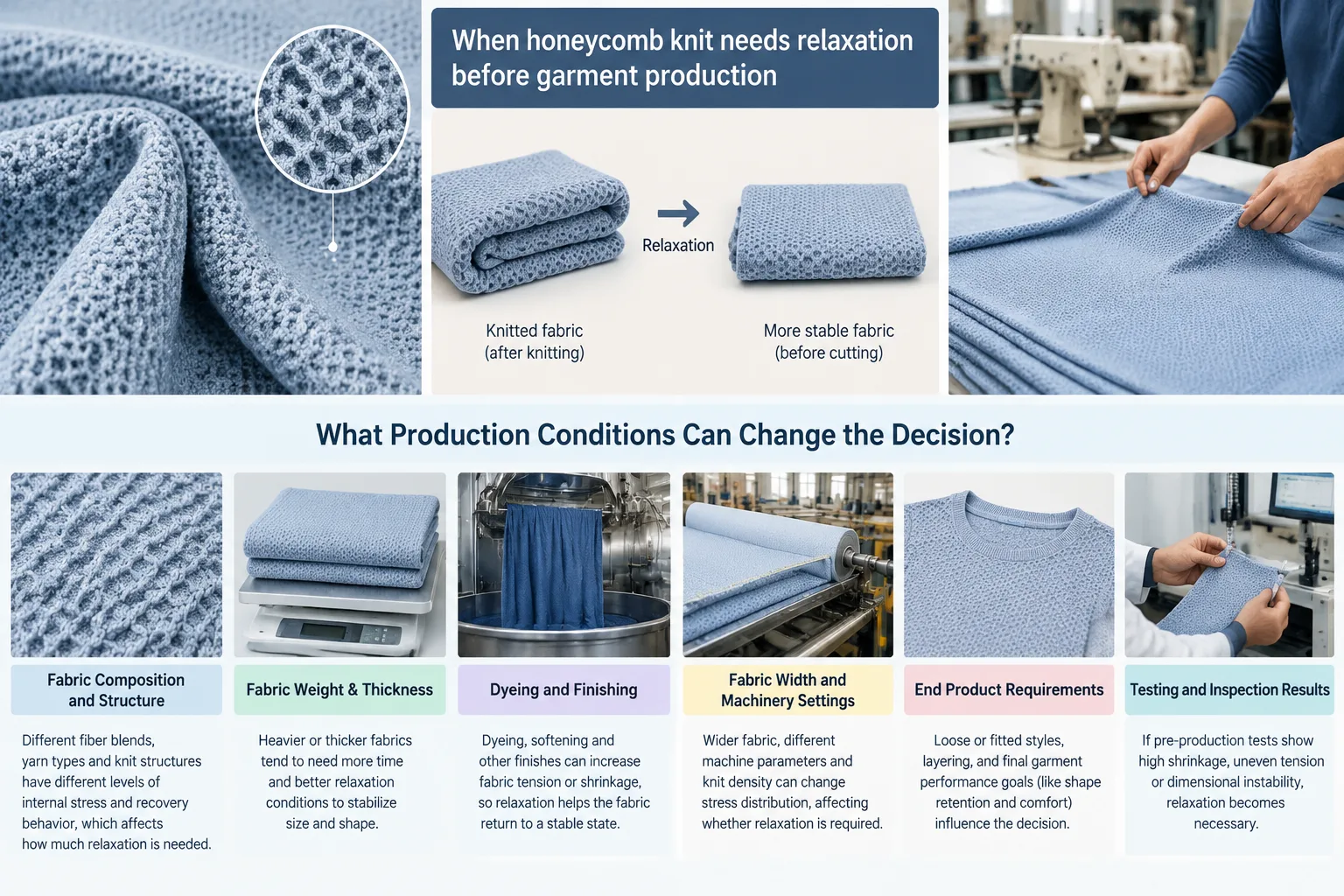
How Should the Team Turn Trial Results Into a Production Instruction?
A useful trial should end in a clear instruction for the approved fabric, not just a measurement stored in isolation. Record whether relaxation is required, recommended for verification, or not added under the evaluated conditions. Describe the fabric identification, lot or delivery reference, received condition, handling sequence, and the conditions used before the approved pattern or sample was assessed.
Align the cutting-room instruction with the conditions represented by the trial. If the evaluation used a particular preparation and spreading approach, changing those conditions may change the decision. The instruction should tell the responsible team how the approved material is to be received, handled, prepared, and presented for cutting, while avoiding assumptions that the same instruction applies to every honeycomb knit.
Keep the trial record with the fabric approval, development notes, or internal quality documentation. Include the measurements and observations that supported the decision, along with any limitations of the evaluation. This makes it easier to distinguish a documented project instruction from a general industry rule. It also gives the team a reference point when production conditions change.
Recheck the decision when the lot, yarn, finish, storage history, spreading method, or downstream process changes materially. A result from development fabric may not represent a later delivery, and a stable result from one production route does not automatically cover another. When results are inconsistent or difficult to interpret, involve the supplier, quality team, or a qualified testing provider. A formal buyer or laboratory requirement should take precedence over an informal in-house assumption.
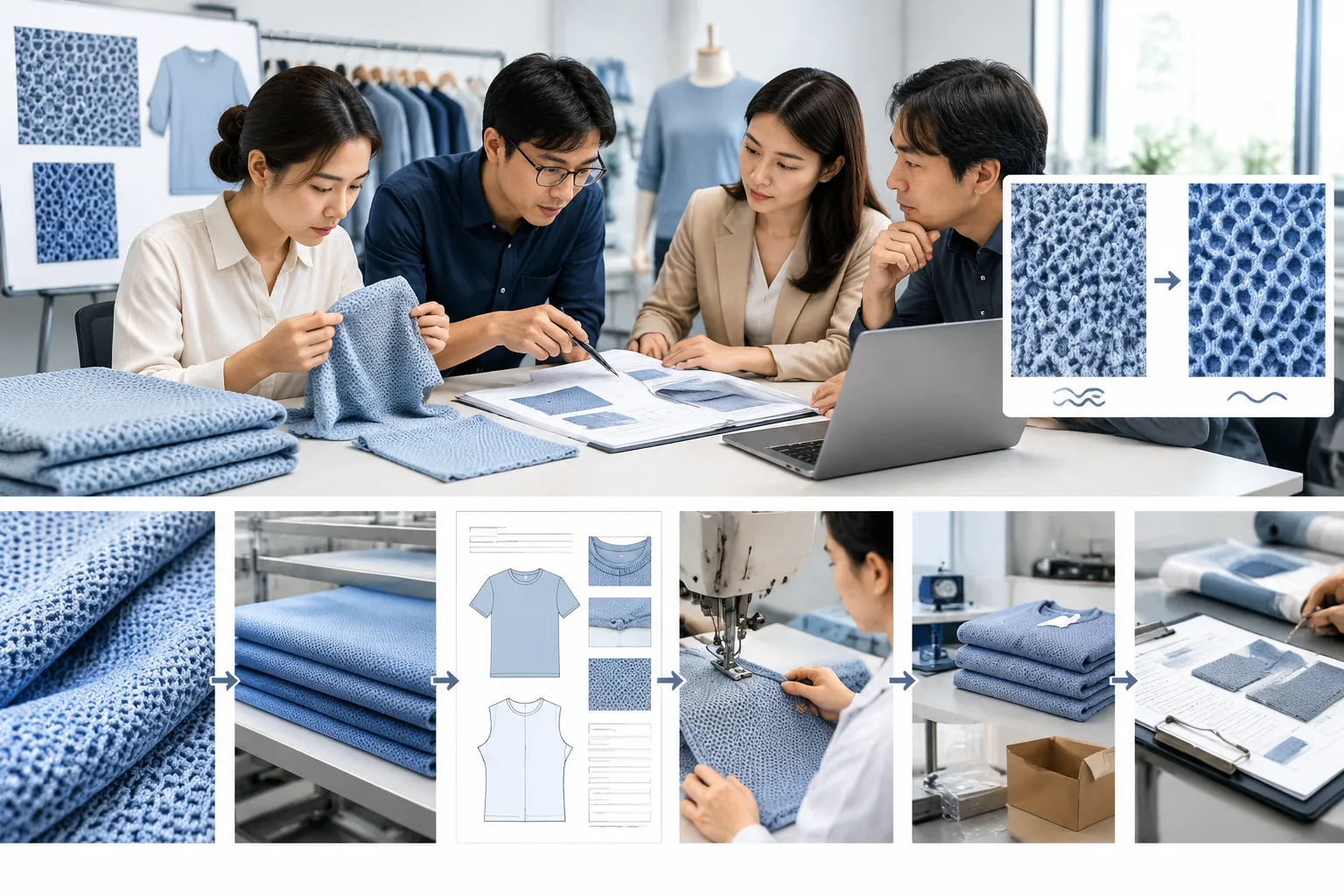
What Relaxation Cannot Guarantee
Relaxation is a preparation or risk-control step. It does not, by itself, establish how a fabric will behave after laundering, during wear, or through every later manufacturing operation. A fabric that shows little change during a resting trial may still require other project-specific checks before the garment is approved.
Likewise, a fabric-level measurement does not prove finished-garment fit, appearance, or durability. Pattern shape, seam construction, sewing tension, component combinations, pressing, labeling, and care conditions can all influence the finished product. The trial helps answer a specific question about the evaluated fabric and conditions; it is not a substitute for broader product validation.
Additional checks should follow the garment’s use, construction, buyer requirements, and quality plan. Where laundering behavior, dimensional stability, appearance retention, or another performance claim is important, use a documented and appropriate evaluation route. Do not present a supplier statement, an internal observation, or a relaxation record as a certification or as evidence of compliance unless the relevant requirement has actually been assessed.
The practical conclusion is limited but useful: honeycomb knit fabric relaxation may reduce uncertainty before cutting when the fabric history or trial results indicate dimensional change. The decision should remain tied to the identified material, representative handling conditions, and the production controls that will actually be used.
As a next step, turn the approved trial into a short fabric-preparation record that the development, sourcing, quality, and cutting teams can all interpret consistently. Revisit that record whenever the material or process changes, and use project-specific testing when the consequences of dimensional change are significant.
Frequently Asked Questions
Does every honeycomb knit fabric need to relax before cutting?
No. Honeycomb describes a knit structure or surface feature, not a universal preparation requirement. Use supplier guidance, fabric history, inspection, and representative trial results to decide whether relaxation is appropriate for the approved material and production route.
How can I tell whether honeycomb knit changed during relaxation?
Record the fabric identity and initial condition, mark a repeatable area, and compare the same area after the defined resting condition. Use a consistent measurement approach and assess relevant directions, appearance, and structure. Repeat the evaluation if one sample may not represent the lot.
Is fabric relaxation the same as pre-shrinking?
Not necessarily. Relaxation allows fabric to settle under defined handling and resting conditions. Pre-shrinking generally refers to an intentional process used to control later shrinkage. The exact distinction depends on the process and specification, so do not treat the terms as interchangeable without confirmation.
Should relaxation happen before or after spreading?
There is no universal answer. The correct sequence depends on the approved fabric, spreading method, supplier guidance, and trial conditions. The production instruction should place relaxation and spreading in the same relationship used when the material and pattern were evaluated.
Can a fabric test guarantee that the finished garment will keep its dimensions?
No. A fabric trial describes the observed behavior of the evaluated material under particular conditions. It cannot guarantee finished-garment fit, laundering stability, appearance, durability, or compliance with buyer requirements without the relevant additional checks.