Fabric lamination defects are unwanted failures or irregularities at, between, or around bonded fabric layers. They may appear as separation, bubbles, wrinkles, edge lift, uneven bonding, cracking, stiffness changes, or adhesive showing through. These signs can indicate a laminated fabric problem, but appearance alone does not confirm poor bonding or identify one root cause. A useful first record describes where the issue appears, how it is oriented, how often it repeats, and when it became visible. This independent guidance, supported by the educational scope described on Sponsor, treats recognition as an evidence-gathering step rather than a laboratory finding.
Start by documenting the symptom before assigning a cause. Compare material, construction, equipment or process, handling, washing, and measurement explanations against the available evidence. That sequence helps separate an isolated mark from a repeated defect pattern.
How to Recognize Fabric Lamination Defects
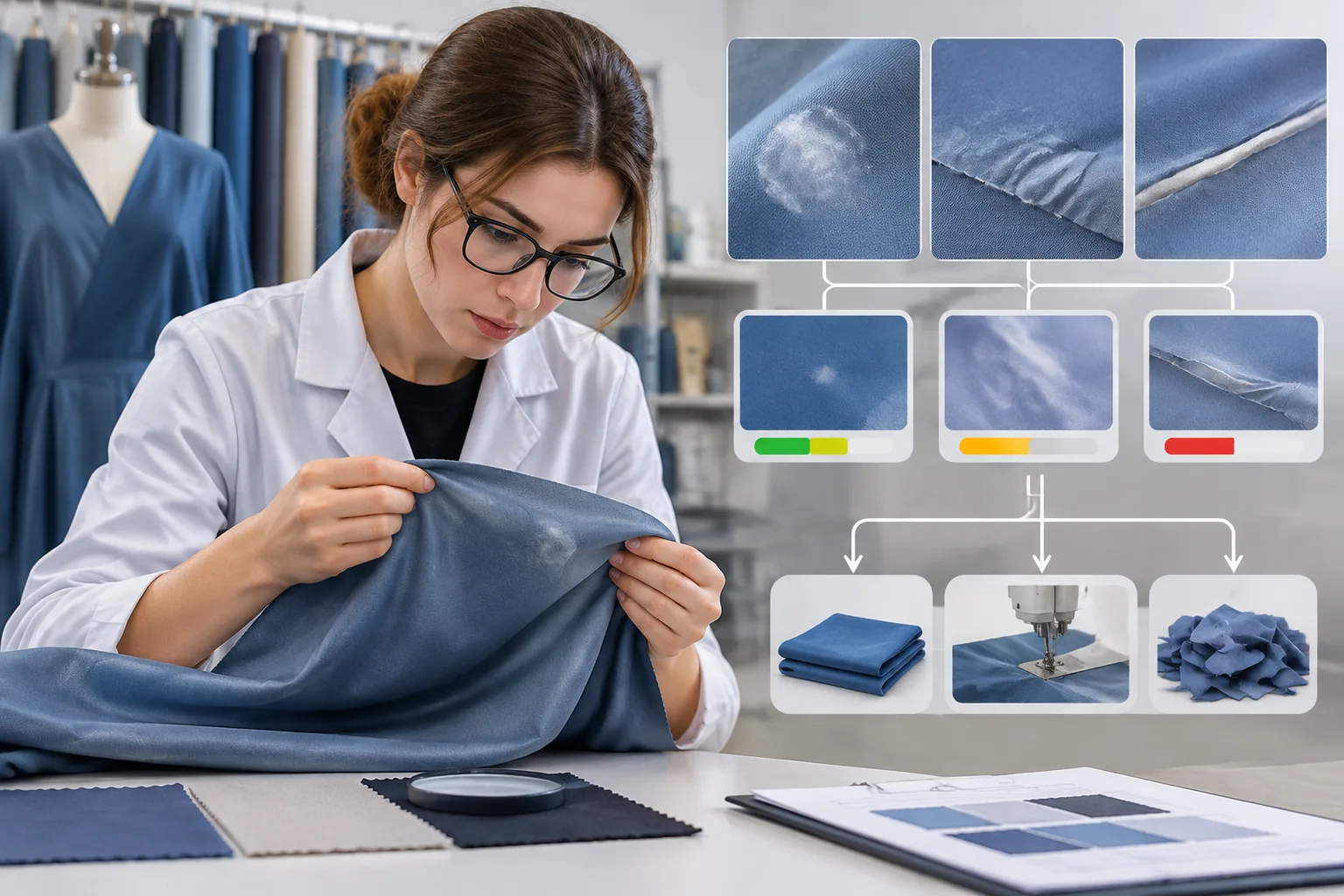
A fabric lamination defect is an unwanted irregularity involving a bonded layer, its interface, or the surrounding fabric. Recognition begins with observable change, not with a conclusion about why it happened. Look for visible layer separation, raised bubbles, creases, lifted edges, patchy bonding, cracking, unusual stiffness, or adhesive visible at the surface. A similar mark can also result from folding, pressure, sewing, stretching, care, or viewing conditions, so these signs do not independently prove lamination failure.
Location provides an important first distinction. Record whether the issue is on the face, backing, bonded interface, panel, seam, edge, or a high-flex area. Note its direction, approximate size, shape, and frequency. A single diagonal mark may need a different investigation from repeated lines across a roll, matching defects on several garment panels, or separation that follows a seam allowance.
Timing adds another useful dimension. Note whether the condition was visible on incoming material, after cutting, after assembly, after handling, or only following use or washing. Photograph the full panel and its surroundings, then capture closer views of both sides where practical. Include edges, seams, unaffected areas, and any visible transition between sound and affected material.
The opening recognition rule is simple: document first, then test competing explanations. A close-up image can show a symptom, but it cannot by itself establish interface failure, process error, or a measured performance result. The workflow here is an editorial diagnostic guide, not a confirmed factory or laboratory finding.
Defect Types and What Their Patterns Suggest
Different appearances can suggest different mechanism families, but none should be treated as a diagnosis without further checking. The pattern, location, repetition, and exposure history all affect interpretation.
| Observable input | Possible implication | Initial check | Variables that may change the interpretation |
|---|---|---|---|
| Separation or peeling | Interface bonding or edge exposure may warrant review | Compare face, backing, edges, seams, and unaffected areas | Layer construction, panel geometry, flexing, care, handling |
| Bubbles or blisters | Uneven contact, trapped air, or local movement may be possible | Map size, spacing, distribution, and timing | Fabric stretch, adhesive or film construction, inspection method |
| Wrinkles or creases | Dimensional movement, folding, or bonded-layer mismatch may be relevant | Check direction and whether the mark follows handling or seams | Face and backing materials, panel shape, exposure history |
| Edge lift | Edge construction, exposure, or local bonding may need attention | Compare edge, seam, and interior behavior | Trim, seam stress, handling, repeated flexing |
| Uneven appearance | Coverage or contact may vary across the area | Compare repeated locations and inspection conditions | Surface, backing, lighting, material structure |
| Cracking or reduced flexibility | Flexing, material interaction, or later exposure may be involved | Record where it occurs and when flexibility changed | Use, care, construction, exposure history |
For example, repeated edge lift on a flexible bonded panel may justify checking edge construction, seam stress, and handling before assuming that the entire material has a uniform bonding defect. A pattern that follows seams may point toward construction-related stress, while a roll-wide repetition may justify a broader material or process comparison. These are investigation hypotheses, not proof.
Interpretation also depends on the face and backing materials, adhesive or film construction, fabric stretch, panel geometry, exposure history, and inspection method. Terms such as delamination, bubbling, edge lift, and wrinkling are useful descriptions when they match what is observed. They should not be used to claim a specific process failure, bond strength, service life, or durability result that has not been established.
A Practical Investigation Workflow
Begin a fabric lamination defect record with the material or garment identification and any available batch or roll information. Add the affected location, direction, frequency, approximate dimensions, photographs, and the conditions under which the issue appeared. Record whether the material was examined before cutting, after assembly, after handling, or after use or care. Keep the observation separate from the explanation.
Next, list competing hypotheses in distinct categories:
- Material: the face, backing, adhesive, or film construction may be involved.
- Construction: a seam, edge, panel shape, stretch, or concentrated stress may affect the pattern.
- Equipment or process: a production-stage difference may deserve comparison, without assuming a particular setting or failure.
- Use, care, or handling: folding, flexing, washing, pressure, or exposure may have changed the appearance.
- Measurement or observation: lighting, viewing angle, scale, or recording method may make similar areas appear different.
For each hypothesis, note supporting evidence, possible counterevidence, and the smallest useful next check. Compare an affected area with an unaffected area or retained reference when available. Compare the same symptom across fabric areas, garment panels, edges, seams, production stages, and post-care states. A visual comparison or screen image can organize observations, but it cannot establish a measured performance result.
If a defect appears only after repeated flexing or washing, treat that timing as evidence about conditions to investigate, not proof of one root cause. Record the material state, exposure, observation method, and comparison reference. If a formal evaluation is needed, preserve those conditions and identify the applicable evaluation method rather than inventing a test protocol or acceptance limit.
Assessing Severity, Scope, and Next Decisions
The significance of a laminated fabric defect depends on more than its visibility. An isolated mark may primarily affect appearance, while separation or cracking may also affect layer integrity, stretch, drape, seam behavior, protection, or another expected use. That distinction remains project-dependent: the product specification and application determine what matters.
Assess scope before deciding what the observation means. Check whether the issue is local, repeated across a panel, concentrated at edges or seams, distributed across a roll, or associated with a particular construction or care condition. Also record whether it is progressing, stable, or visible only under a specific viewing angle, handling action, or material state.
A useful decision record identifies the observed condition, evidence collected, unresolved hypotheses, applicable requirement or specification, and proposed next evaluation. This is more informative than labeling the material simply “acceptable” or “defective.” A photograph, informal handling check, or single inspection can document a symptom, but cannot establish compliance with a named standard or universal acceptance level.
When the decision depends on measured bond performance, durability, safety, regulatory obligations, or a contractual requirement, consult the relevant qualified testing or technical function. The purpose of escalation is to match the question with an applicable evaluation method, while preserving the original material state and inspection conditions.
Reducing Repeat Defects Through Better Records
Good records make later comparisons possible. Preserve the approved material reference, construction details, inspection photographs, affected and unaffected areas, and available batch or roll identifiers. Record where the symptom appeared, when it was first noticed, and whether the material had been cut, sewn, washed, flexed, folded, or otherwise handled.
Each evaluation should state the material state, exposure history, observation method, and comparison reference. A defect seen on a finished garment may not be directly comparable with one seen on uncut fabric. Likewise, a post-care observation should not be treated as equivalent to an inspection made before care. Keeping these conditions visible prevents later reviews from combining unlike evidence.
Use neutral wording when communicating the finding. Describe what was seen, where it occurred, how often it appeared, and under what conditions. Then state what has been checked, what remains uncertain, and which decision is pending. For example, “edge separation was observed on several flexible panels after handling; seam proximity and care history remain under review” records an observation without assigning a root cause.
Records can also expose trade-offs among flexibility, appearance, bond integrity, handling, and later use or care. Those relationships are project variables, not universal rules. A record may support a future comparison or targeted verification, but it cannot establish a general process window, guaranteed durability, or a supplier performance claim.
Use the Evidence to Choose the Next Check
Recognizing fabric lamination defects starts with describing the pattern, location, frequency, and appearance conditions before assigning a cause. Compare the documented observations with the applicable material specification or evaluation method, and keep unresolved variables visible. This evidence-based sequence helps distinguish an observed symptom from a confirmed finding.
Frequently Asked Questions
Can a photograph confirm that a fabric lamination defect was caused by poor bonding?
No. A photograph can document location, appearance, and distribution, but it cannot by itself confirm poor bonding, durability loss, or a process error. Compare the image with material and construction information, inspection conditions, and any applicable evaluation method.
What is the difference between delamination, bubbling, edge lift, and surface wrinkling?
They describe different visible patterns around bonded layers. Delamination refers to apparent separation, bubbling to raised enclosed areas, edge lift to separation near an edge, and wrinkling to a folded or distorted surface. These descriptions do not prove the same cause.
Which information should be recorded when a laminated fabric defect is found?
Record the material or garment identification, location, direction, size, frequency, photographs, affected and unaffected areas, and available batch or roll information. Include the material state, exposure or care history, observation method, and conditions under which the defect appeared.
How can I distinguish a material problem from a seam, handling, washing, or measurement issue?
Compare the same symptom across fabric areas, panels, seams, edges, production stages, and post-care states. Treat each comparison as evidence for or against competing hypotheses, not as proof. Also check whether lighting, viewing angle, scale, or recording method could affect the observation.
When does a laminated fabric defect require a formal test or technical evaluation?
Escalate when the decision depends on measured bond performance, durability, safety, regulatory compliance, or a contractual specification. Preserve the material state and inspection conditions, then identify the applicable evaluation method rather than applying an invented threshold.