In the usual apparel-industry distinction, interlining is a supporting layer placed within a garment construction, often across a broader area between the shell fabric and a lining or backing layer. Interfacing is generally a support material applied to selected zones such as collars, cuffs, waistbands, facings, or plackets. In practice, suppliers and regions may use the terms differently, so the material’s location, attachment method, and purpose should be confirmed in the specification. Apparel Wiki is an independent educational publication; readers can also review our Sponsor page for information about editorial independence.
Neither word identifies one fiber, fabric structure, thickness, or performance level. An interlining or interfacing may be woven, nonwoven, knitted, adhesive-backed, or designed for sew-in application, depending on the product and intended use. The most reliable comparison therefore separates the material itself from the role it performs in the garment.
What Is the Difference Between Interlining and Interfacing?
The main difference is usually one of coverage and construction role. Interlining commonly supports the garment as an internal layer, while interfacing commonly provides localized control where a component needs more body, definition, reinforcement, or dimensional stability than the surrounding fabric. This is a practical industry distinction rather than an absolute universal rule.
| Point of comparison | Interlining | Interfacing |
|---|---|---|
| Usual placement | Within the garment construction, often behind or between larger fabric areas | In defined garment components or zones that need additional control |
| Typical coverage | May extend across a panel or broader garment area, depending on the design | Often follows a collar, cuff, waistband, facing, placket, pocket, or closure area |
| Common purpose | To influence body, stability, insulation, opacity, shape retention, or handle | To stabilize, reinforce, shape, or define a specific component |
| Attachment methods | May be layered, sewn, bonded, or incorporated through a specialized construction | May be fusible or sew-in, depending on the material and production method |
These categories can overlap. A supplier may call a localized support material an interlining, while another may classify a similar product as interfacing. The name alone does not confirm whether the product is woven, nonwoven, knitted, adhesive-backed, or suitable for a particular shell fabric. A clear request should describe the garment area, desired result, attachment process, and care conditions alongside the commercial term.
What Role Does Interlining Play in a Garment?
Interlining functions as an internal garment support layer. Depending on its construction, fiber content, finishing, placement, and interaction with the shell fabric, it may add body, stability, controlled warmth, opacity, or shape retention. It can also influence the garment’s handle and how a fabric responds during sewing, pressing, movement, and wear.
Coverage is project-dependent. An interlining may extend across a substantial panel, sit inside a tailored component, or be used in another internal zone where the designer needs a particular balance of support and flexibility. The word does not establish a fixed coverage area or guarantee insulation, breathability, durability, or any other performance outcome.
The final result depends on the complete construction rather than the support layer in isolation. Shell-fabric structure, lining, seams, grain direction, pressing conditions, and the intended care process can all affect drape, bulk, flexibility, appearance, and dimensional behavior. A lighter option is not automatically the best option if it fails to provide the required control, while a heavier option may create unwanted stiffness or thickness.
What Role Does Interfacing Play in a Garment?
Interfacing is commonly selected for localized stabilization. It may be placed in collars and cuffs to help them hold a designed form, in waistbands and facings to control edges, or in plackets, pocket areas, and closure zones where the fabric needs additional support. It can reduce distortion during construction and create a more controlled hand, but the result depends on compatibility with the surrounding fabric.
Fusible and sew-in interfacing represent different construction decisions. A fusible product uses an adhesive system and a specified application process, so fabric sensitivity, surface appearance, pressing conditions, laundering, and repeated flexing must be considered using the product’s technical instructions. A sew-in option avoids that bonding step but may affect seam allowances, bulk, flexibility, or the order of assembly. Neither method is universally preferable.
Localized support can also produce unwanted outcomes when the material is poorly matched. Possible evaluation findings include bubbling, strike-through, visible edges, puckering, excessive stiffness, or a change in drape. These are sample-review outcomes, not automatic consequences of using interfacing. The appropriate assessment is made on the intended shell fabric and garment component.
Hypothetical scenario 1: Structured collar
Context: A woven shirt needs a collar with clearer edge definition, but the shell fabric has a soft hand. Evidence to review: Compare a suitable fusible and sew-in option on collar samples using the intended construction and pressing process. Trade-offs: Fusible support may provide efficient stabilization but requires adhesive compatibility and process control; sew-in support may preserve more surface discretion but can add construction complexity or bulk. Practical conclusion: Approve the option that gives the required collar shape without visible surface change, excessive stiffness, or unacceptable care-related deterioration.
Hypothetical scenario 2: Delicate, flexible fabric
Context: A lightweight garment needs a stable facing, while the shell fabric is sensitive to heat and must retain a fluid drape. Evidence to review: Make representative samples and inspect appearance, hand, movement, and post-care condition using the relevant product instructions. Trade-offs: Stronger support may improve edge control but restrict movement or show through; a softer option may preserve drape but provide insufficient stability. Practical conclusion: Select based on the facing’s actual behavior in the finished combination, not on the interfacing name or fiber description alone.
Why Do Suppliers Use the Terms Interlining and Interfacing Differently?
Commercial terminology can reflect regional practice, supplier catalog structure, product category, or whether the material is being described by placement, construction, or function. One supplier may use interlining as a broad category for internal support materials, while another may use interfacing for most stabilizing products, including materials intended for larger areas.
This variation does not necessarily indicate that one supplier is wrong. It means that a shared label may hide differences in construction, attachment method, coverage, finish, or intended use. A product name also does not prove that two items from different sources will produce the same hand, drape, appearance, or care response.
For clearer communication with mills, converters, and manufacturers, define the intended function before selecting the commercial name. State where the material will be placed, how much area it will cover, how it will be attached, what hand and flexibility are required, which care process applies, and which sample represents approval. This approach protects against false precision while leaving room for supplier-specific terminology.
How Should You Choose Between Interlining and Interfacing?
Begin with the garment problem rather than the product name. Is the goal to add controlled body across a larger area, stabilize a defined panel, reinforce a closure zone, improve opacity, support insulation, preserve dimensional stability, or control construction? A broad internal support layer may suit one objective, while localized interfacing may suit another. The distinction is practical, but the final choice remains dependent on the garment design.
Next, define the coverage. Support may be required throughout a garment section, within a shaped panel, or only at a collar, cuff, waistband, facing, placket, pocket, or closure. Compare the proposed layer with the shell fabric’s structure, stretch, surface, color, transparency, and sensitivity to heat or moisture. Fiber content or GSM alone cannot predict the finished result because construction and finishing also affect handle and behavior.
| Decision factor | Broad-area interlining | Localized interfacing |
|---|---|---|
| Primary question | Does a larger garment area need internal support? | Does a defined component need extra control? |
| Coverage | May extend across a panel or substantial garment area | Usually follows a pattern piece, edge, or selected zone |
| Attachment | May be bonded, sewn, or held within the construction | May be fusible or sew-in, depending on the product and process |
| Main risk | Unwanted bulk, stiffness, restricted movement, or altered drape | Visible transition, bubbling, strike-through, or excessive edge stiffness |
Care and production conditions are equally important. A garment that will be washed, dry-cleaned, repeatedly pressed, flexed, or exposed to abrasion should be evaluated under relevant conditions. Where bonding is used, confirm the product instructions and the available pressing or production process before approval. Where sewing is used, consider seam bulk, needle penetration, edge behavior, and whether the support layer moves appropriately with the shell.
Hypothetical scenario 1: structured jacket facing. The facing rolls outward during construction, and the surrounding shell is stable enough for localized support. A suitable interfacing sample could improve edge control without adding support to the entire front. The trade-off is a possible visible transition or a facing that feels too firm. The practical conclusion is to compare the facing in a representative garment section and approve the result by appearance, hand, and movement.
Hypothetical scenario 2: lightweight outer garment. The design needs a more controlled body across a broad panel, but the shell has a soft drape and limited tolerance for bulk. A broader interlining approach may be considered, provided the layer does not overpower the shell. The trade-off is between added stability and lost flexibility or breathability. The practical conclusion is to test coverage, seam behavior, and care response before selecting the material.
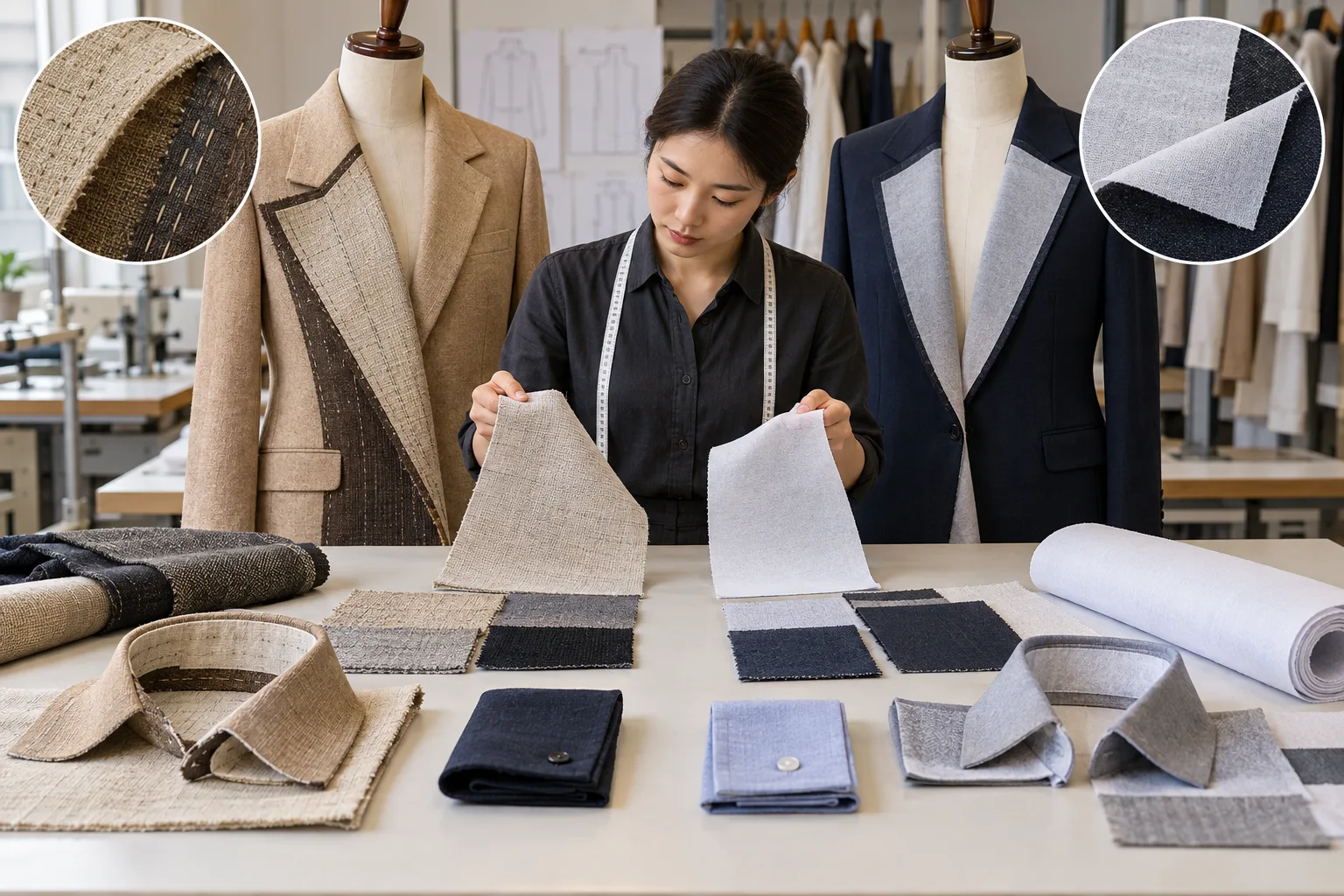
How Can You Evaluate an Interlining or Interfacing Sample?
Judge the support layer as part of the intended garment combination, not as an isolated swatch. Use the actual shell fabric where possible, with the intended grain or direction, seam construction, attachment method, and pressing process. A component description or supplier claim can help identify a product, but it does not establish how the finished garment will look or feel.
Start with a visual review. Check for bubbling, puckering, strike-through, color change, edge visibility, distortion, and uneven transitions between supported and unsupported areas. Inspect both sides when the construction allows it. Look especially at curved edges, corners, seam intersections, openings, and areas that will receive repeated handling. These observations are editorial or development checks unless a formal test has been performed.
Then assess hand and movement. Does the sample feel unnecessarily stiff, bulky, noisy, or board-like? Has the shell lost too much drape, stretch, or recovery? Does the supported area move naturally with adjacent fabric? A result that appears clean when flat may still fail during bending, sitting, fastening, or other ordinary garment movements.
Include the relevant care process in the review. If the finished garment will be washed or dry-cleaned, examine the supported combination after the applicable process rather than assuming the initial appearance will remain unchanged. For bonded products, follow the supplier’s application instructions and record the conditions used. Do not treat a favorable first sample as proof of long-term bond or garment durability without suitable evidence.
- Material: record the commercial description, construction information available, color, and direction.
- Placement: identify the garment area, coverage, grain, and supported or unsupported transitions.
- Attachment: record whether the layer is fused, sewn, or retained by another construction method.
- Appearance: note bubbling, puckering, strike-through, edge visibility, color change, and distortion.
- Hand and movement: assess stiffness, bulk, drape, stretch, recovery, and seam behavior.
- Care and approval: record the process reviewed, sample result, reviewer, date, and approval status.
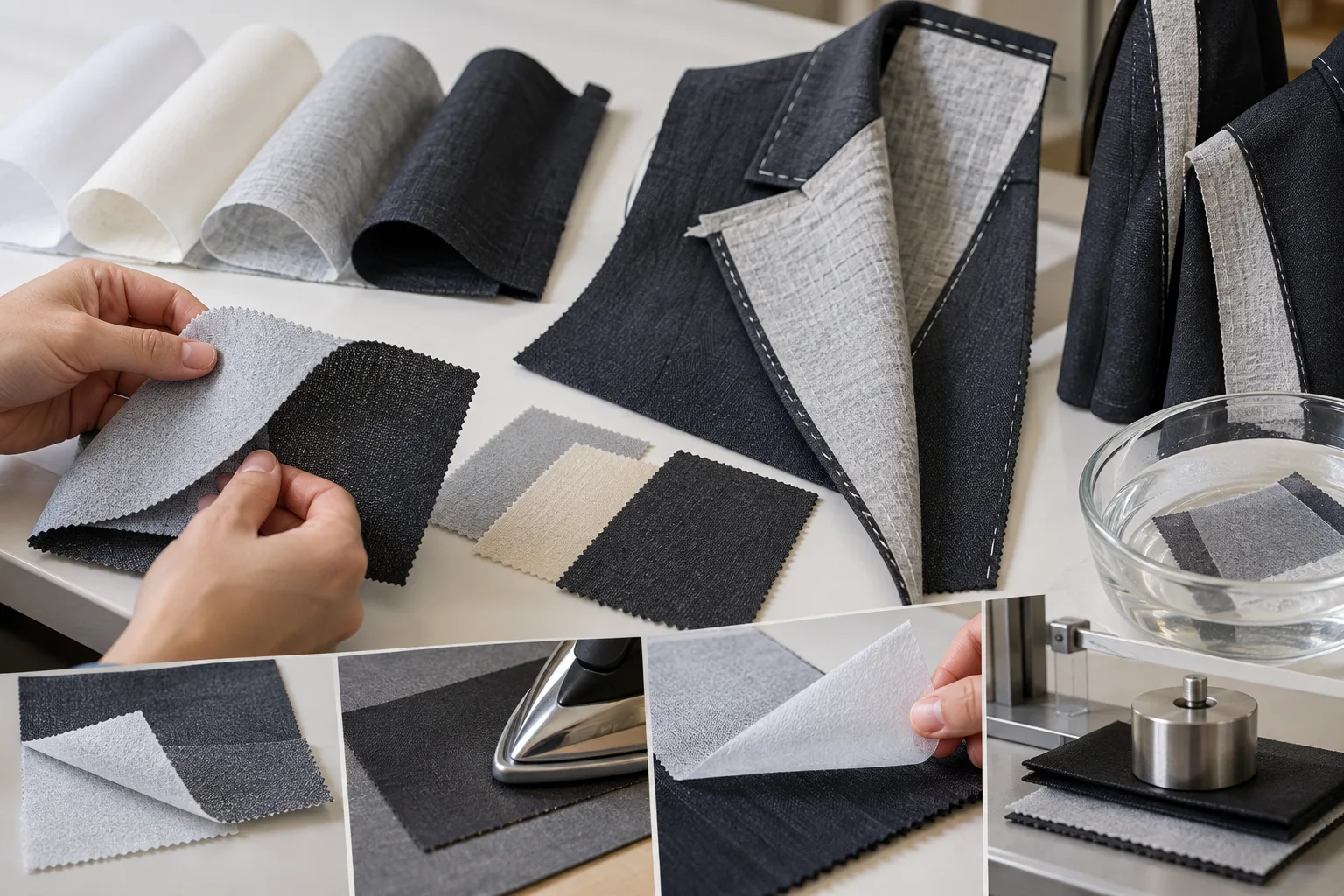
Common Mistakes When Specifying Garment Support Materials
The most common specification error is treating interlining and interfacing as complete material identities. A label alone does not communicate placement, coverage, construction, attachment, target hand, care conditions, or approval requirements. A stronger specification describes the function first and then records the material details needed to reproduce the approved result.
Another mistake is assuming that GSM, thickness, fiber content, or fabric structure will determine performance by itself. These details are useful for comparison, but they do not replace testing the support layer with the intended shell fabric. Similarly, approving a flat swatch can miss problems that appear at seams, edges, curves, closures, or after care.
Teams also overlook the interaction between construction and use. Pressing conditions, flexing, abrasion, laundering, dry-cleaning, and repeated handling may influence appearance and hand. Copying a supplier’s terminology directly into a purchase or technical specification can create ambiguity when another supplier uses the same word differently. Confirm the actual construction and attachment method before approval.
A practical garment-support checklist should include:
- the problem or function to be addressed;
- the placement, coverage, grain, and garment components involved;
- the support-layer construction and attachment method;
- compatibility with shell fabric, lining, seams, stretch, color, and surface;
- the intended care and use conditions;
- appearance, hand, movement, and seam-behavior criteria;
- the representative sample, review method, and approval record.
For the next development review, write the intended function and placement in plain language, then request material information and a representative sample against that description. The Apparel Manufacturing Tools section can support broader development research, but the final decision should remain tied to the specific garment combination and documented sample result.
Can interlining and interfacing mean the same thing?
Sometimes, especially in commercial conversations. Their usual roles differ, but usage varies by supplier, region, and product category. Confirm placement, coverage, construction, and attachment instead of relying on the name alone.
Is interfacing always used only on small garment areas?
No. Interfacing is commonly associated with localized zones, but commercial usage may include larger stabilizing areas. The intended coverage and function should be stated explicitly.
What is the difference between fusible and sew-in interfacing?
Fusible interfacing is attached through an adhesive application process, while sew-in interfacing is retained through stitching or garment construction. The suitable method depends on the shell fabric, appearance, care, and production process.
How do I choose support material for a stretch or delicate fabric?
Match the support to the fabric’s stretch, surface, heat or moisture sensitivity, and intended care. Review a representative sample for drape, recovery, appearance, and attachment response rather than selecting by fiber description alone.
Should I test interlining or interfacing after washing?
Test after washing or other relevant care when that process applies to the finished garment. Compare appearance, hand, movement, and attachment response before and after care.
What information should I include when requesting an interlining or interfacing sample?
Include the garment area, coverage, shell fabric, desired function, target hand, stretch or flexibility needs, attachment method, care process, and sample-approval criteria. Ask the supplier to identify the actual construction and application instructions.