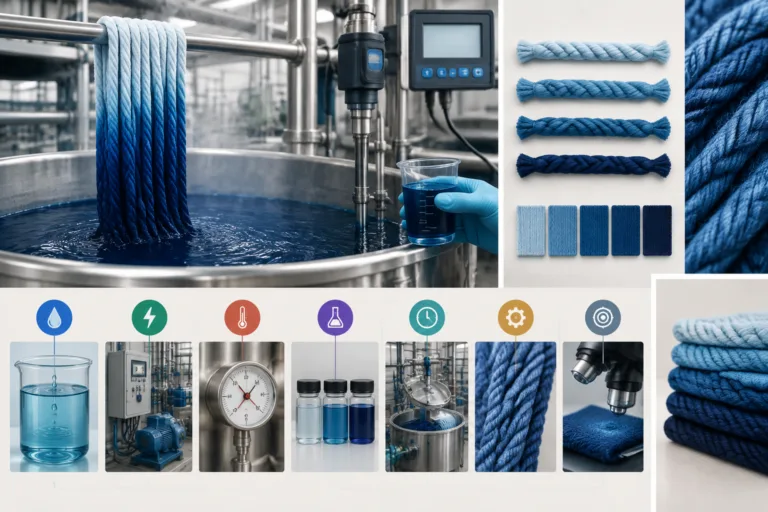
Rope dyeing resource consumption means the water withdrawn or used and the energy supplied during a defined rope-dyeing process. A useful measurement states which stages are included, records the relevant batch and utility data, and divides the included resources by a clearly defined output. The result is a reporting measure, not automatic proof that rope dyeing is more or less sustainable than another method.
For apparel teams, the main challenge is consistency. Preparation, dyeing, rinsing, washing, extraction, drying, steam generation, and shared utilities may fall inside or outside the calculation depending on the project. Apparel Wiki is an independent garment-manufacturing knowledge publication, not a dyehouse, factory, testing laboratory, or service provider. Its editorial independence is described on the Sponsor page.
What Rope Dyeing Resource Consumption Means
In practical terms, rope dyeing resource consumption is the quantity of water and energy associated with a selected process boundary. Water may include incoming process water and additions made during preparation, dyeing, rinsing, or washing. Energy may include electricity and supplied process heat used by the dyeing machine, pumps, extraction equipment, dryers, steam systems, or other directly connected equipment.
The word “consumption” requires care. Water withdrawal, water used in a process, water discharged, water reused, and water consumed are related but not interchangeable categories. A facility may draw water into a dyeing system, recirculate part of it, discharge another portion, and record these flows through different meters or estimates. The report should identify which category each figure represents instead of combining them into one unexplained total.
The same principle applies to energy. Electricity, steam, fuel, and other energy carriers should first be recorded in their original units where possible. A combined energy figure may be useful, but only when the conversion basis is documented and appropriate to the purpose. Otherwise, separate energy intensities are easier to audit and less likely to hide an assumption.
Comparisons become difficult when the process conditions differ. Machine design, load utilization, rope or yarn material, shade depth, recipe stages, bath management, rinsing practice, drying method, and reprocessing can all affect the result. A value that appears lower may simply cover fewer stages, a fuller load, a different material basis, or a different output definition. Research on water consumption in rope and slasher indigo dyeing likewise emphasizes the need for consistent definitions before benchmarking.
Separate the evidence in the record. A meter reading is measured site data. A value calculated by allocating a shared boiler or utility meter is an allocation. A recipe-based volume, supplier declaration, or operator estimate is an estimate. An interpretation about why one batch used more energy is editorial or project analysis. Keeping these categories visible makes the result easier to challenge and improve.
Set the Measurement Boundary Before Collecting Data
Start by deciding what the measurement represents. It may cover one batch, one production run, one machine, a product style, or a defined reporting period. The scope should also identify the material and output basis. For example, a batch result based on finished rope-dyed material mass should retain the original batch quantity and explain whether the mass is wet, conditioned, or otherwise defined.
List each operation before collecting readings. Preparation, dyeing, rinsing, washing, extraction, drying, steam generation, compressed air, and wastewater treatment may be relevant, but they should not be assumed to belong in every calculation. The chosen boundary can be narrow or broad; the important requirement is that it remains explicit and consistent across the results being compared.
| Process step | Water source or meter | Energy source or meter | Included? | Allocation note |
|---|---|---|---|---|
| Preparation | Machine inlet meter or flow record | Electricity or heat meter | Yes or no | State whether shared equipment is allocated |
| Dyeing and rinsing | Stage additions and reuse record | Machine or process-heat meter | Yes or no | Record batch timing and interruptions |
| Extraction and drying | Normally not applicable or separately recorded | Electricity, steam, or fuel meter | Yes or no | Identify shared dryer or boiler allocation |
Direct process utilities should be separated from shared utilities unless there is a documented allocation method. If a boiler serves several machines, for example, the report should explain how the relevant share was assigned and whether the allocation is measured, calculated, or estimated. A precise-looking total with unknown inclusions is less useful than a less complete result with a transparent boundary.
Keep the boundary stable between comparison batches. Adding drying energy to one result while excluding it from another can create a false improvement or deterioration. When the boundary changes, label the new series separately and explain the reason. Factory-specific allocation decisions depend on equipment, meter coverage, production scheduling, and reporting objectives; they are not universal industry rules.
What Water and Energy Data to Record
A repeatable data log should identify the batch before recording utilities. Capture the material type, rope or yarn mass, shade or color family, recipe version, machine, start and end times, selected process stages, and finished output basis. These fields help explain variation without assuming that one factor always determines resource use.
For water, record the source, meter readings or flow records, additions at each included stage, and any reuse or recirculation. If a volume is estimated, record the method and assumptions beside the value. Reused water should remain identifiable rather than being treated as fresh withdrawal or silently deducted from total use. The accounting treatment should match the reporting question and remain consistent across batches.
For energy, record the carrier and the meter reading where available. Electricity and process heat sources should remain separate until any conversion assumptions have been documented. Include relevant equipment within the selected boundary, but do not assume that every facility can isolate the energy used by each pump, boiler, dryer, or machine.
Record events that could distort a batch result: interruptions, partial loads, reprocessing, unusual rinsing, extended holding, delayed drying, or equipment changes. Measured readings are preferable to recipe-based estimates when both are available, but estimates can still be useful when their limitations are visible. A worksheet or digital log should distinguish observed values, calculated allocations, and assumptions.
Calculate Comparable Rope Dyeing Indicators
Once the boundary and records are established, calculate water and energy indicators separately. Water intensity can be expressed as total included water divided by the defined finished output, with the output unit stated explicitly. Energy intensity follows the same structure, but it is usually clearer to report each energy carrier separately before considering a combined figure.
At batch level, the basic structure is:
Water intensity = included water volume ÷ defined finished output
Energy intensity = included energy supplied ÷ defined finished output
These are calculation structures, not universal targets. A hypothetical example might use an invented batch record showing 1,200 liters of included water and 100 kilograms of defined finished output. The resulting indicator would be 12 liters per kilogram for that stated boundary. This number would not be an industry benchmark, and it could not be compared fairly with a result that excluded rinsing or used a different output basis.
Retain the original readings, units, denominator, and conversion factors alongside the normalized result. For repeated batches, report the sample size, material scope, process boundary, and variation rather than presenting one average without context. A lower rope dyeing water or energy intensity may reflect loading, shade requirements, process inclusions, or output definitions rather than better performance. Comparable indicators begin with comparable records.
Interpret the Variables Behind the Result
A rope dyeing result describes a recorded process, not an isolated machine characteristic. Two batches can show different water and energy intensities even when they use the same equipment. Before treating one result as better, compare the load utilization, material composition, rope or yarn mass, shade depth, recipe stages, bath changes, rinsing pattern, and any reprocessing separately.
Load utilization is often an important context because a partially filled machine may distribute shared process requirements across less finished output. Material type and mass can also affect preparation, heating, rinsing, extraction, or drying needs. Shade depth may involve different recipe stages or holding conditions, but no single variable should be assumed to determine resource consumption in every dyehouse.
Energy data deserves the same process-level review. Heating and holding may contribute during preparation or dyeing, while cooling, extraction, and drying can affect the result later in the boundary. A change that reduces electricity at one stage may increase process heat, water use, or drying demand elsewhere. Review the complete included system before calling a change an improvement.
A practical comparison matrix can connect each observed difference with the evidence needed to test its explanation:
| Observed difference | Data to review |
|---|---|
| Different water intensity | Load size, bath changes, rinsing sequence, reuse records, and included stages |
| Different energy intensity | Heating, holding, cooling, extraction, drying, energy carrier, and machine time |
| Different output quality | Shade approval, color records, reprocessing, and downstream finishing requirements |
| Unexpected batch variation | Interruptions, partial loads, recipe changes, meter timing, and production notes |
Process optimization remains a project-specific trade-off. Color reproducibility, quality requirements, equipment constraints, and downstream performance may limit a change that looks attractive on a utility record. Apparel Wiki presents these relationships as measurement questions and editorial guidance, not as a universal rope dyeing recipe or performance claim.

Evaluate Data Quality and Report the Findings
A resource result is only as useful as the evidence behind it. Start by checking whether the relevant meters covered the complete time period and process boundary. Review meter verification or calibration records where available, confirm that readings align with batch start and end times, and check for missing values, inconsistent units, or unexplained changes in the production denominator.
Separate directly measured values from calculated allocations and estimates. A shared boiler, compressor, dryer, or water line may serve several processes, but its contribution should not be assigned to rope dyeing without a documented allocation method. Mark reused or recirculated water clearly, and distinguish it from fresh withdrawal, total use, discharge, or other water categories. These terms should not be treated as interchangeable.
Each reported result should state the process boundary, reporting period, batch sample, material scope, output basis, energy carriers, water categories, unusual events, and known limitations. Keep the original readings beside the normalized indicators. A concise record can use five fields: result, method, evidence quality, limitation, and next measurement action.
Comparison is defensible only when the records are comparable. Check that the same preparation, dyeing, rinsing, washing, extraction, drying, and utility inclusions apply to both results. Also check the material basis, finished-output definition, moisture basis where relevant, allocation method, and calculation conventions. A supplier comparison that ignores these differences can create a precise-looking but misleading ranking.
For broader context, the reference work on water consumption in rope and slasher indigo dyeing illustrates why consistent definitions and boundaries matter when comparing dyeing results. It should inform questions about measurement, not be treated as a universal factory target. Apparel Wiki is an independent educational publication, not a laboratory, certifier, dyehouse, or compliance authority.
One batch or one supplier record cannot establish a universal industry performance level. A transparent limitation statement is part of the finding itself. Internal utility data should not be presented as regulatory compliance, certification, or environmental superiority without the separate evidence and review required for those claims.

Use the Measurement to Choose the Next Action
After the first measurement cycle, resolve the largest data gaps before changing the process. These may include unmetered stages, unclear shared-utility allocation, inconsistent finished-output definitions, or missing records for interruptions and reprocessing. Improving the record can reveal whether an apparent high-use stage is real, allocated incorrectly, or simply outside the comparison boundary.
Repeat measurements across comparable batches before setting an internal baseline or target. Select batches with a clearly described material and process scope, then retain the variation rather than reporting only a single average. Discuss high-use stages with operators and quality teams before changing loading, rinsing, heating, drying, or recipe conditions.
Any proposed reduction should be checked against shade approval, reproducibility, the relevant fastness requirements, and downstream quality. A lower meter reading is not automatically a successful outcome if it causes reprocessing, inconsistent color, or a later-stage burden. Record each trial in an action register with an owner, evidence needed, retest condition, and decision date.
Apparel Wiki offers independent educational guidance for apparel and textile professionals. Its Apparel Manufacturing Tools resource may help organize production information, but it does not replace site measurement, technical validation, or qualified review. The goal is a repeatable evidence trail that supports better decisions within the actual equipment and quality constraints of a dyehouse.
Next step: Turn the first result into a controlled learning cycle: confirm the boundary, verify the readings, compare like with like, investigate the largest unexplained variation, and retest one defined change. This approach keeps rope dyeing resource consumption connected to both utility evidence and the finished product requirements.
What does rope dyeing resource consumption include?
It includes the water used or withdrawn and the energy supplied within a stated process boundary. That boundary may include preparation, dyeing, rinsing, washing, extraction, drying, and related utilities, but every included and excluded stage should be recorded.
How should water use be normalized for rope dyeing?
Divide the included water amount by a clearly defined finished output, such as the measured finished material mass, and state the unit. Keep the original water readings, output basis, moisture assumptions, and boundary with the normalized result.
Which energy sources should be included in a rope-dyeing calculation?
Include the energy carriers that supply the selected boundary, such as electricity and process heat sources, when they can be measured or allocated defensibly. Report carriers separately when possible and document any conversion used for a combined figure.
Can water and energy results from different dyeing factories be compared directly?
Usually not without checking comparability. The factories must use consistent process boundaries, material and output definitions, meter coverage, allocation logic, and calculation methods. Different loading, shade, rinsing, drying, or reprocessing conditions can also change the result.
How can a factory improve the reliability of rope-dyeing utility data?
Use a repeatable batch log, align meter readings with production times, distinguish measurements from estimates and allocations, retain unusual-event notes, and review meter coverage and verification records. Repeat comparable batches before drawing conclusions.
Does lower water or energy use automatically mean a better dyeing process?
No. A lower figure may result from a different boundary or output basis, or it may shift demand to another stage. Evaluate utility data together with shade approval, reproducibility, relevant fastness performance, reprocessing, and downstream quality.