When a recycled fabric minimum is too high, the practical alternatives usually involve changing the product brief, simplifying the material specification, restructuring the purchase, or adjusting the launch plan. None guarantees that a supplier will accept a lower minimum. A recycled fabric minimum, often called a recycled fabric MOQ, is the supplier’s minimum quantity commitment for a specified recycled material and process. It may be only one of several minimums affecting the order.
Before changing the design, separate the fabric minimum from garment-order, dyeing, color, finishing, trim, and packaging minimums. Then compare each possible change against product intent, cost, inventory exposure, quality, color consistency, traceability, and replenishment. Supplier confirmation is essential because the applicable quantity basis can vary by material, construction, process, color, and available stock. Apparel Wiki is an independent educational publication; supplier-specific terms should be verified directly. You can also review our Sponsor page for the site’s editorial independence principles.
What Can Change When a Recycled Fabric Minimum Is Too High?
There are four broad levers to investigate. First, the product brief may be simplified so that more styles, panels, or colorways use the same fabric. Second, the material specification may change, such as using fewer weights, finishes, or custom constructions. Third, the purchasing structure may combine demand across styles, colors, or planned orders. Fourth, the launch may be staged so that an initial commitment and later replenishment are managed as separate commercial decisions.
These are recycled fabric minimums alternatives, not universal ways to reduce a supplier’s requirement. A simpler design may reduce the number of separate material commitments but restrict color or hand-feel choices. A stocked fabric may reduce development complexity but fail to match the required construction or recycled-content documentation. A consolidated order may improve order feasibility while increasing cash tied up in material. A smaller first order may also leave the buyer responsible for later quantities, reserved stock, or unused fabric.
The relevant question is therefore not simply, “How can I reduce recycled fabric minimums?” It is, “Which change creates the smallest commercially responsible commitment while preserving the approved product and evidence requirements?” That requires a written comparison of the supplier’s current brief, each proposed alternative, and the responsibilities attached to every option.
First, Identify Which Minimum Is Actually Blocking the Order
Start with a diagnostic question set. Ask whether the quoted limit applies per style, fabric construction, color, finish, width, weight, dye lot, purchase order, or total material commitment. A supplier may also use a different unit of measure from the buyer’s costing sheet. Confirm whether the minimum is expressed by weight, length, pieces, rolls, lots, or another basis, and ask about available order increments.
A fabric MOQ is not automatically the same as a garment MOQ. The fabric quantity may be constrained by a mill or dyehouse, while cut-and-sew production may have its own minimum per style or color. Dyeing and finishing can introduce separate batch considerations, and trims, labels, cartons, or packaging may have their own purchasing quantities. These layers should be recorded independently instead of being reduced to one quoted number.
Ask the supplier to separate the following where applicable:
- Fabric quantity and the unit used to calculate it.
- Cut-and-sew quantity by style, color, or size range.
- Dyeing, finishing, or preparation quantity and any setup charge.
- Trim, label, packaging, and other component quantities.
- Available increments and rules for combining styles or colors.
Also record the material’s current commercial status. Is it made to order, held in stock, available in greige form, or offered as a substitute construction? These descriptions are not interchangeable, and availability should be confirmed in current supplier records. Request written terms for stock status, lot or color restrictions, combination rules, setup charges, and any conditions that apply to future orders.
A useful supplier question is: “What exactly counts toward this minimum, and which parts of the order may be combined?” Follow it with: “Would the quantity basis, price, timing, ownership, or replenishment condition change under the proposed alternative?” The answers establish whether the problem is genuinely the recycled fabric minimum or a different order-layer constraint.
Product Changes That May Reduce Material Complexity
Once the blocking minimum is identified, review the product brief before assuming that the fabric itself must be replaced. If design and performance requirements allow, one fabric may be shared across more styles, panels, or colorways. A smaller color range, fewer fabric weights, or fewer finishes may also reduce the number of separate material requirements. A shared base fabric with product-specific details added through trims or construction is another possibility, subject to technical review.
Do not treat a shared fabric as automatically equivalent. Compare construction, weight, width, stretch, recovery, hand feel, appearance, durability, fit behavior, and care requirements against the approved brief. The same material specification may not be suitable for every component. An approved alternative can be considered only when it meets the product’s design and performance requirements and remains acceptable for the intended market and customer.
Use the technical pack and bill of materials (BOM) to make the proposal precise. The documents should identify the required fabric specifications, quantities, measurement units, tolerances, waste assumptions, material codes, and any permitted substitutions for that project. A BOM describes what the product uses and in what quantity; it is not a substitute for the supplier’s quotation or a guarantee that a substitute will be available.
Any recycled-content, chain-of-custody, labeling, or customer-claim requirement must be reviewed when the material changes. Textile Exchange describes the Recycled Claim Standard and Global Recycled Standard as systems relevant to recycled-content and chain-of-custody claims; the applicable documentation still needs to be confirmed for the specific material and intended claim. A substitute that looks acceptable in a sample may require different records or claim treatment.
Product simplification can reduce material complexity, but it may limit visual differentiation, color choice, hand feel, or product-level performance. Validate the proposed fabric through specifications, development samples, lab results, and relevant performance testing before treating it as an approved recycled fabric MOQ alternative. The change is a negotiation and planning option, not proof that a supplier will accept a smaller order.
Sourcing Structures to Investigate Before Redesigning the Product
Purchasing structure may offer another route. Ask whether multiple styles, colors, or purchase orders can share one material commitment, and request the supplier’s written method for counting the combined quantity. Combining demand may address the quantity basis without changing the garment, but it can also create shared responsibility for timing, quality approval, and unused material.
Compare a stocked or previously developed fabric with new custom development, subject to current availability and specification matching. Confirm the construction, color options, lot information, recycled-content records, traceability documents, and any differences in performance or appearance. Do not assume that “stock” means unlimited quantity, repeatable color, or suitability for the required product.
If the supplier can reserve or hold material for a planned replenishment schedule, document the arrangement before relying on it. The written terms should address ownership, storage responsibility, holding period, price, quality control, color consistency, future-order conditions, and what happens to unused material. A lower initial commitment may simply move the buyer’s exposure into a later purchase obligation or inventory commitment.
Staged launches, consolidated seasonal orders, or shared buying arrangements may be workable when commercial, quality, and inventory responsibilities are explicit. Compare the initial quantity with the genuinely committed total purchase. A smaller first order is not the same as a smaller overall obligation, and it should not be presented as demand validation if later quantities are already required.
Compare Each Alternative by Cost, Risk, and Product Impact
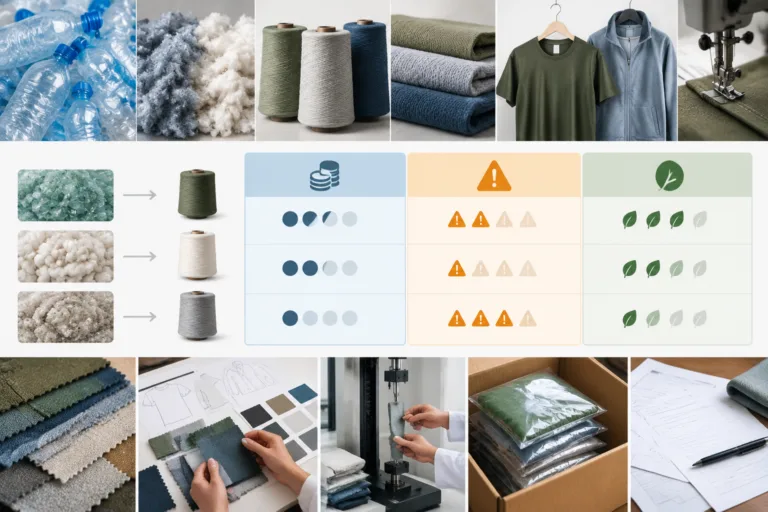
The lowest quoted minimum is not automatically the lowest-risk option. Compare each recycled fabric MOQ alternative by its total commercial exposure: the quantity you must buy, the costs required to prepare it, the inventory you may hold, and the effect on the approved product. A simplified fabric specification may reduce complexity while limiting color, hand feel, visual differentiation, or performance choices.
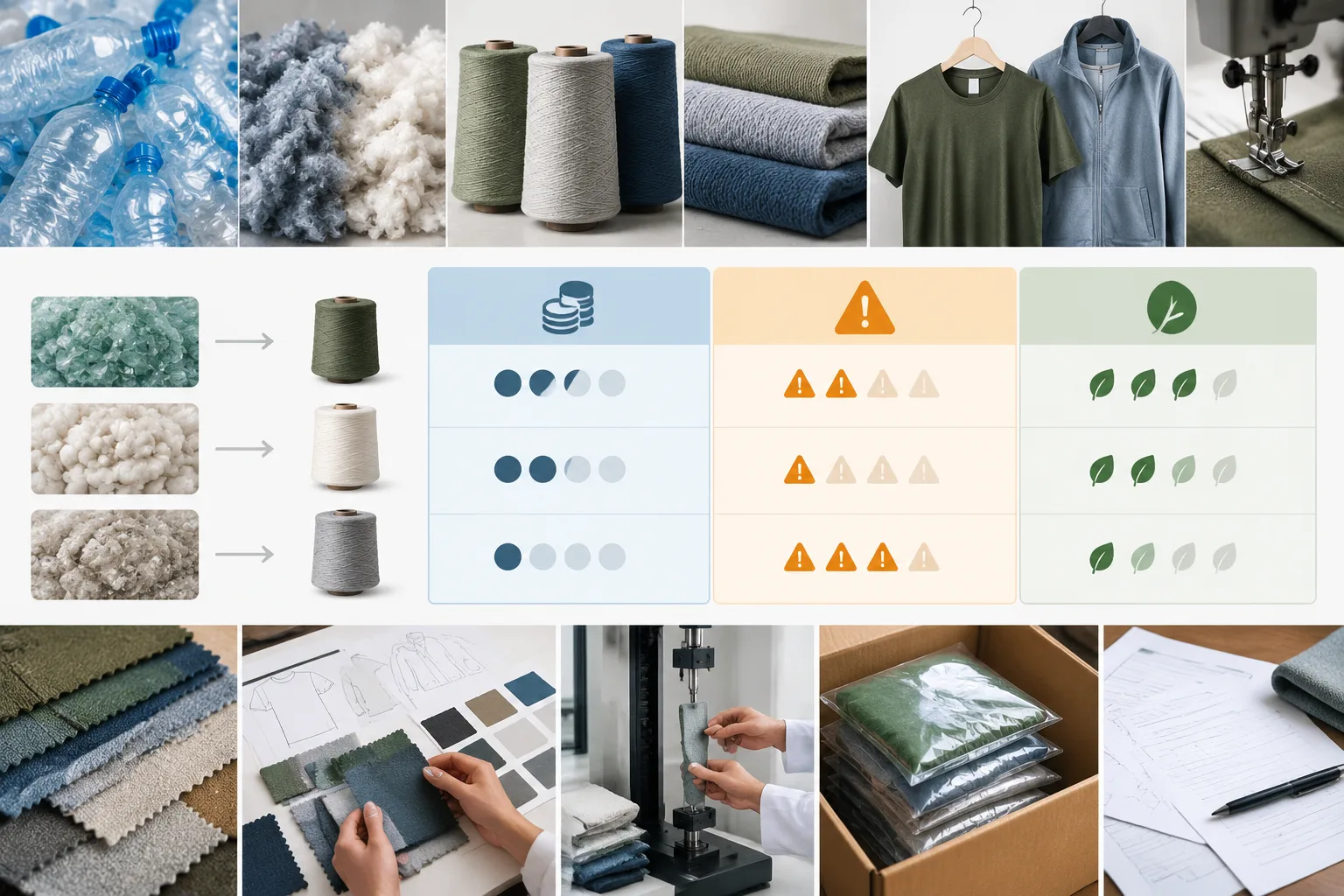
A useful comparison table can include the proposed change, the minimum-order lever, product impact, one-time costs, variable unit-cost effect, inventory exposure, quality risks, claim or documentation risks, and questions still requiring supplier confirmation. Keep the fabric purchase separate from cut-and-sew, testing, packaging, freight, and other order layers. This prevents a lower fabric commitment from being mistaken for a lower total production commitment.
Separate fixed development or preparation costs from variable material costs. For example, a hypothetical option with a variable cost of 12 currency units and a 600-unit preparation fee would model at 18 per unit for 100 units and 14 per unit for 300 units. This illustrates fixed-cost allocation only; it is not a supplier quotation, a complete accounting model, or a prediction of recycled fabric pricing. A larger order could lower the modeled unit cost while increasing cash tied up in stock.
Add landed cost, usable yield, testing, rework, storage, markdown, or disposal assumptions only when they are relevant to the project and supported by current records. Use approved BOM quantities, supplier quotations, internal cost sheets, and realistic demand assumptions. Do not make a decision from unit price alone. Design, product development, sourcing, quality, and finance should agree on the product and commercial consequences before an option is selected.
A Practical Supplier-Question and Approval Procedure
Start with a written brief covering the required fabric construction and properties, recycled-content or material-claim requirements, color range, estimated quantity, launch timing, and expected replenishment pattern. Ask the supplier to quote the existing brief and each proposed alternative on the same unit basis. The comparison is only meaningful when the quantity basis and included services are clear.
Request separate figures for material, development or preparation, dyeing or finishing, testing, packaging, freight, and any minimum-related charge that applies. Ask whether each amount is calculated per style, fabric, color, lot, weight, or total purchase. Also ask what quantity increments are available, whether combinations are permitted, and whether the quoted terms apply to stock, made-to-order material, or a substitute construction.
Before approval, obtain samples or technical documents that allow the team to review construction, appearance, hand feel, color, shrinkage, and required performance. The appropriate evidence depends on the product brief and target market. A material change can also affect recycled-content, chain-of-custody, labeling, or customer-claim documentation. Textile Exchange information on the RCS and GRS is one useful reference point, but the applicable requirements must be confirmed for the actual material and claim.
Record what happens to leftover material, whether a future lot can match the first lot, and who owns or stores reserved inventory. Confirm the holding period, price changes, quality controls, and conditions for repeat orders in writing. Sample approval and document review reduce uncertainty, but they do not guarantee production performance or future availability. Approve the alternative only after confirming product fit, commercial exposure, quality evidence, and documentation responsibilities.

When a Recycled Fabric Minimum Should Not Be Reduced
Keep the original material requirement when a proposed alternative fails the approved product brief. A lower minimum does not justify unacceptable changes in fit, appearance, durability, safety, construction, or required performance. The same principle applies when a substitute cannot support the recycled-content or customer-claim evidence the product requires.
Be cautious about consolidation when it creates unacceptable color inconsistency, excessive leftover stock, unclear traceability, or an unapproved substitution. A stocked fabric may solve an initial quantity problem but still be unsuitable for the required construction or unavailable in a repeatable color. Treat stock, reserved material, and future replenishment as supplier-specific conditions that require current written confirmation.
Do not describe a low-MOQ launch as demand validation when the business remains committed to later purchases or unused material. Escalate the decision when the proposed change affects labeling, market access, restricted-substance controls, customer commitments, or documented material claims. These issues require product-specific and market-specific review rather than a general assumption about recycled fabrics.
The practical decision rule is to choose the smallest commercially responsible commitment that still meets the approved product and evidence requirements. If no alternative satisfies those conditions, retaining the higher minimum may be less damaging than accepting a cheaper-looking option that creates quality failures, claim risk, stranded inventory, or an unsuitable product.
Next step: Prepare a one-page comparison for the current brief, one or two realistic alternatives, and the supplier questions that remain open. Use written quotations, approved samples, technical records, and demand assumptions to document the decision. Apparel Wiki is an independent educational publication, so supplier-specific terms must be confirmed directly by the purchasing team.
Can changing the product design lower a recycled fabric minimum?
It may reduce material complexity or make a shared purchase more practical, but it does not guarantee a lower supplier minimum. Confirm the effect on performance, appearance, claims, and total order exposure.
Is a fabric MOQ the same as a garment MOQ?
No. Fabric, garment production, dyeing, color, finishing, trims, and packaging can each have separate quantity constraints. Ask the supplier to state the unit and quantity basis for every minimum.
Can several styles or colors be combined to meet a recycled fabric minimum?
Sometimes a supplier may allow a combined material commitment, but the rules vary. Confirm whether styles, colors, lots, or purchase orders can be combined and how the total is calculated.
What should I ask before accepting a stocked or substitute recycled fabric?
Ask about construction, available quantity, color and lot information, future availability, performance evidence, recycled-content records, traceability, labeling, ownership, and the conditions for repeat orders.
Does a smaller first order always reduce financial risk?
No. A smaller first order may shift risk into later purchase obligations, reserved inventory, higher preparation costs, or difficult replenishment. Compare the genuinely committed total, not only the first shipment.
How should I compare a lower MOQ with quality or traceability trade-offs?
Compare total cost, inventory exposure, product impact, quality evidence, claim documentation, and replenishment conditions. Reject the option if it fails an approved product or evidence requirement.