Modal fiber processing is the controlled conversion of modal staple fiber into spun yarn. Consistent modal yarn quality depends on managing variation from incoming-fiber inspection and preparation through drafting, spinning, winding, and package evaluation. This is a manufacturing topic rather than a claim that the fiber name alone guarantees softness, strength, or any other finished-product result. Apparel Wiki is an independent educational publication; its editorial work is separate from any Sponsor relationship.
In practical terms, consistency means that yarn properties remain sufficiently repeatable within a lot and comparable from lot to lot against an agreed specification. It does not mean that every package is completely free of faults. The relevant outcomes may include linear density, tensile behavior, elongation, evenness, hairiness, imperfections, visual appearance, and suitability for the intended fabric construction. The appropriate result depends on the fiber grade, blend, yarn count, equipment, process route, and test method.
What Is Modal Fiber Processing for Apparel Yarn?
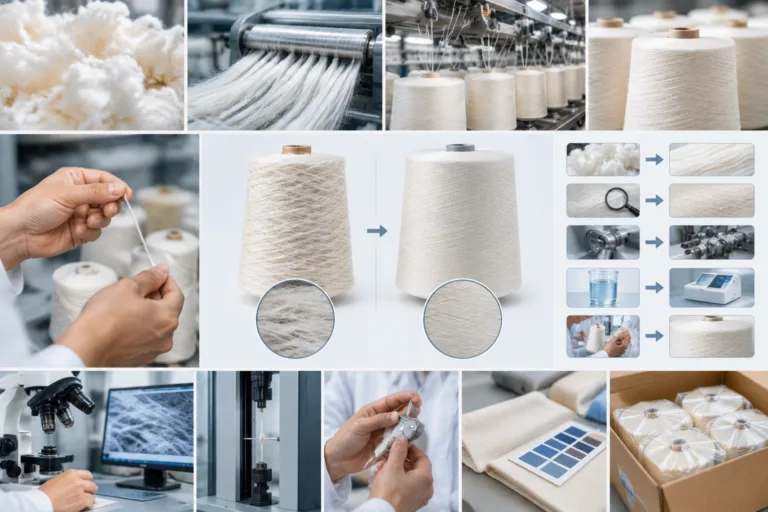
For this article, modal fiber processing means preparing modal in staple form and converting it into spun yarn. The process can include opening, blending, carding, drawing, optional roving, spinning, and winding. This scope is different from processing modal filament, where a continuous filament route is involved, and from fabric finishing, which occurs after yarn formation. In the United States, modal also appears as a named manufactured-fiber category in official textile labeling rules, but labeling identity is not a complete description of yarn performance.
The useful manufacturing question is therefore not simply whether a yarn is called modal. It is whether the supplied fiber, process controls, and test evidence support the required yarn construction and end use. A mill may achieve acceptable uniformity through different equipment arrangements or operating choices. General process logic can be transferred, but exact settings should be treated as project-dependent because fiber specifications, blend composition, machine design, environmental conditions, and yarn count all affect the result.
Which Processing Stages Control Modal Yarn Consistency?
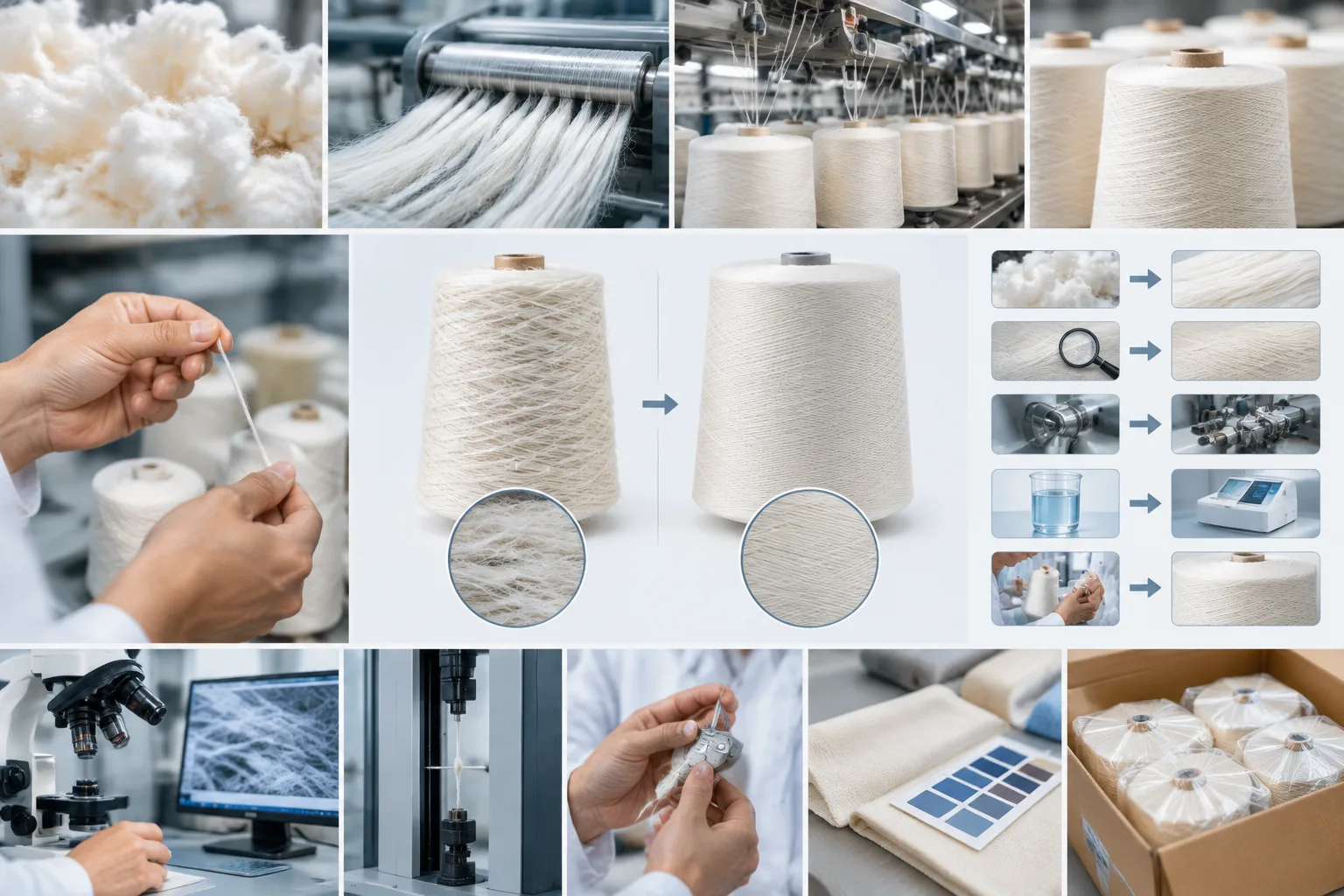
Modal staple-fiber yarn quality is shaped by a chain of controlled handoffs rather than by one machine operation. The chain normally begins with incoming-fiber inspection, bale or lot identification, and storage under conditions suitable for the material. The fiber may then be opened and blended before carding separates, aligns, and forms a more workable web or sliver. Drawing combines and drafts the material to improve control, while roving may be used in some spinning routes before the final yarn is produced.
At each handoff, the mill needs to know what material entered the stage, what process was applied, and what intermediate condition resulted. Lot identity, blend recipe, machine, position, shift, and package records help connect a later yarn result to an earlier source of variation. This traceability is especially important when the same nominal fiber is processed on more than one machine or when several lots are blended into a production run.
Preparation quality can influence how consistently fibers are controlled during drafting and spinning. Uneven blending, damaged fiber, poor separation, or unsuitable material handling may appear later as instability, variation, or increased faults. However, a particular defect should not automatically be attributed to carding or another named stage without supporting production records and test evidence. A process map identifies where to investigate; it does not prove the cause by itself.
Spinning establishes the yarn structure through the selected drafting, twist, and formation conditions. Winding then transfers yarn to a package and may detect or remove some faults according to the equipment and settings used. It cannot necessarily correct the underlying process cause. The exact sequence, machinery, and control points vary with the spinning system, blend, yarn construction, and mill layout, so a general modal spinning process should be used as a framework for review rather than a universal recipe.
What Fiber and Process Variables Affect Yarn Uniformity?
Start with the incoming material. Relevant variables may include fiber length distribution, fineness, strength, moisture condition, cohesion, contamination, and differences between supplier lots. The values and significance of these characteristics must come from verified supplier data or measured inspection results. A change in one characteristic can alter how the fiber opens, blends, drafts, or holds together, but the practical effect depends on the complete fiber specification and the equipment processing it.
During preparation, opening intensity and blending uniformity affect how consistently the fiber mass reaches carding and drawing. Carding quality and drafting control influence the regularity of the strand presented to spinning. At the spinning stage, twist, tension, and other machine conditions affect the balance among strength, elongation, hairiness, breakage, and production stability. Winding conditions can influence package build and fault removal. These relationships are trade-offs, not fixed rules that apply to every modal yarn.
Moisture and static can also affect handling and fiber control. Suitable operating conditions depend on the fiber, blend, equipment, and surrounding environment, so a mill should avoid copying an operating range from another facility without a controlled trial. If a setting improves one measured characteristic but increases another problem, the decision should be based on the approved yarn specification and intended fabric use rather than on a single result.
When quality drifts, separate measured causes from plausible hypotheses. A change in evenness may coincide with a new fiber lot, a machine change, or a drafting adjustment, but coincidence is not confirmation. Record the input lot and process conditions, compare results using the same method, and change one meaningful factor at a time where practical. This approach supports modal yarn uniformity without assuming that modal inherently produces a particular advantage in every yarn system.
How Should a Mill Evaluate Modal Yarn Quality?
Evaluation should begin with a product specification, not with a test result collected after production. The specification should identify the fiber and blend, where applicable, along with yarn construction, count or linear density, twist requirements, package requirements, and intended end use. It should also state the relevant test methods, sampling basis, conditioning requirements, units, and acceptance decision process. Without those definitions, two technically correct reports may still be difficult to compare.
Test representative samples across relevant lots, packages, machines, and time periods according to a documented sampling plan. Useful evaluation categories can include linear density, tensile behavior, evenness and imperfections, hairiness, appearance, moisture condition, and package build. The exact tests should match the yarn and its intended fabric application. Record the instrument, method, conditioning, sample location, lot identity, and result units so that a later investigation can reproduce the comparison.
Be precise about yarn count terminology. Direct linear-density systems describe mass per unit length, while indirect count systems describe length per unit mass. They should not be compared as though larger numbers have the same meaning. For plied yarn, ask whether the reported notation refers to the single-yarn count or the resulting plied construction. A supplier should clarify the system and notation before a buyer uses the number for approval or comparison.
- Confirm the fiber identity, blend, yarn construction, and lot reference.
- Confirm the sampling plan and whether samples represent packages, machines, and production time.
- Check the test method, instrument, conditioning, units, and reporting basis.
- Compare results with the approved specification rather than with an unsupported universal target.
- Record whether the result supports lot acceptance, further investigation, or neither decision.
Acceptance sampling supports a decision about the sampled batch under the agreed plan; it does not prove that every package is defect-free. Likewise, a single test result is evidence about the tested material under the stated method and conditions. It should not be presented as a universal fact about modal yarn or automatically extended to fabric and garment performance.
How Do You Troubleshoot Inconsistent Modal Yarn Quality?
When modal yarn quality changes between lots, packages, or machines, begin with the measurement rather than the material name. Define the failure precisely: identify the affected property, test method, units, sample location, affected packages or lots, and the approved comparison baseline. “Uneven yarn” or “poor strength” is not yet a diagnosis. The investigation needs a reproducible description of what changed and where it was observed.
Next, confirm that the result is technically comparable. Review the sampling method, conditioning status, instrument condition, calculations, and reporting basis before changing a production setting. A difference can be created by inconsistent sampling or test preparation rather than by a change in fiber or spinning. Check whether the report compares the same yarn construction, count system, package type, and test method.
Then map the variation through the production record. Compare fiber lot, blend recipe, bale or batch identification, machine, position, shift, operator handoff, and process stage. Traceability helps separate a material-linked issue from a preparation, drafting, spinning, or winding issue. The aim is to find the earliest point at which the deviation appears, rather than assigning responsibility to the final stage where the defect becomes visible.
Retained fiber, intermediate material, yarn samples, and package records can help establish that point. For example, a difference already present in incoming fiber or prepared material requires a different response from a deviation that appears only on one spinning position. Winding inspection may reveal or remove certain faults, but it does not necessarily correct the process condition that created them.
Where practical, run a controlled trial that changes one meaningful factor at a time. The relevant factor might concern blending, preparation, drafting, twist, tension, moisture condition, or winding, but the suitable choice depends on the equipment and yarn construction. Verify the result with the same sampling and test method used to identify the problem. A changed result is useful evidence, but it should not be treated as a confirmed cause until the relationship is repeatable and supported by the records.
Close the investigation by recording the confirmed cause, contributing factors, corrective action, verification result, and controls for the next lot. Keep confirmed findings separate from plausible explanations that have not been tested. If the variation follows an incoming fiber lot or the supplier cannot provide adequate technical information, escalate with the relevant records and samples instead of making an unsupported claim about modal itself.
How Should Buyers Specify and Compare Modal Yarn Suppliers?
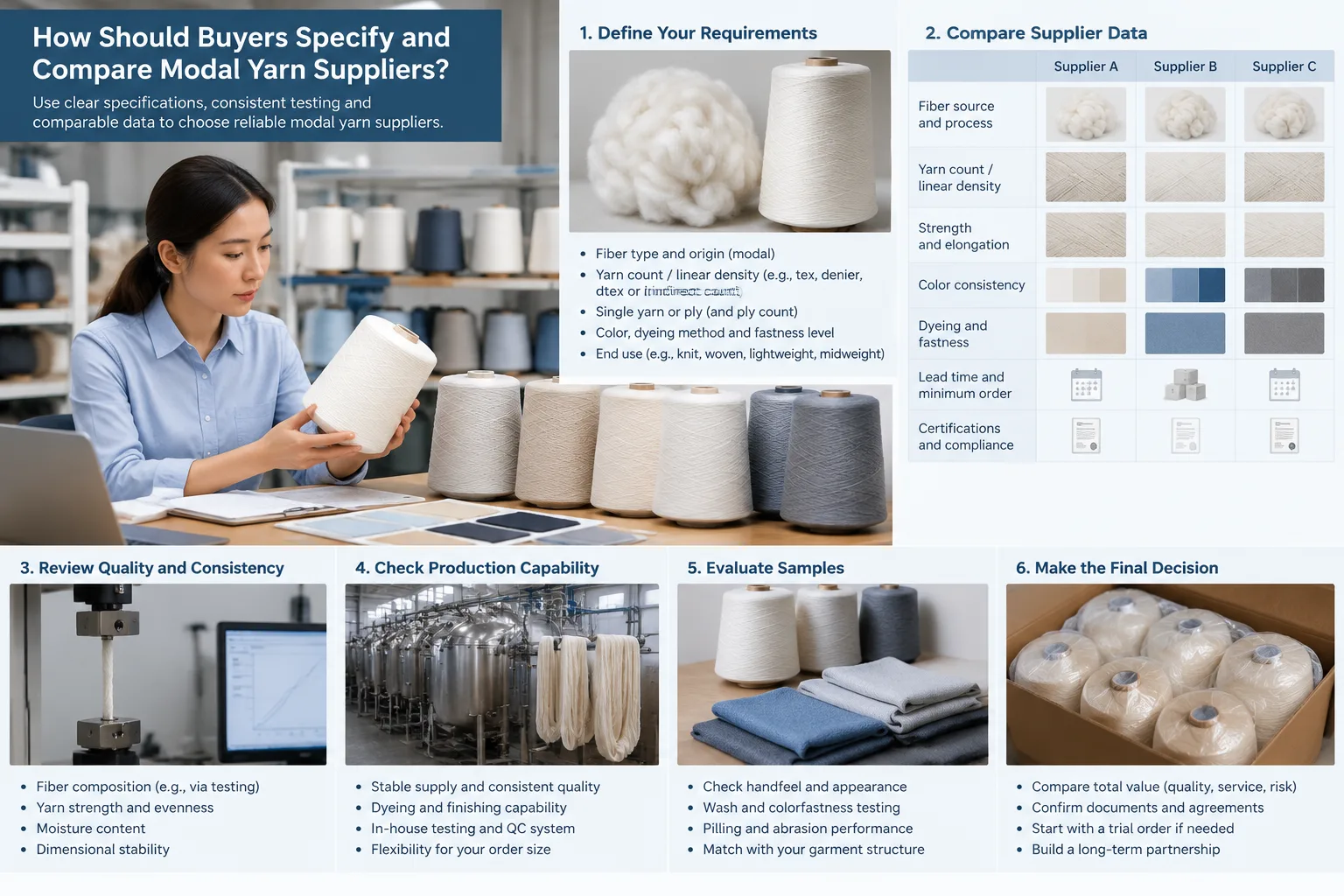
A buyer should specify modal yarn as a product with defined inputs, construction, evidence, and intended use, not as a material name alone. Request the generic fiber name, any relevant commercial designation, the fiber form, blend composition, yarn construction, and available lot documentation. If the yarn is blended, record the proportions and identify whether the comparison concerns the same fiber forms and yarn structure.
Ask how the supplier identifies and segregates fiber lots, controls blending, conditions material, monitors process variation, and retains samples. These questions do not require the supplier to disclose every machine setting. They establish whether a later deviation can be traced and investigated. Also ask how the supplier handles nonconforming results, package-level concerns, and changes to an approved material or process.
Define required yarn properties around the intended fabric and garment application. Depending on the product, the specification may address linear density or count, tensile behavior, elongation, evenness, imperfections, hairiness, appearance, moisture condition, twist, and package build. The relevant list and limits are project-dependent. The word modal does not complete the specification and does not by itself establish softness, durability, pilling behavior, or finished-garment performance.
Require every test report to identify the method, instrument where relevant, units, conditioning, sampling basis, test date, lot or package identity, and whether the value is measured or declared. Clarify whether a count notation describes single yarn or plied yarn. Direct linear-density systems and indirect count systems express different relationships, so their numbers should not be compared as though a larger number has the same meaning in both systems.
A simple supplier comparison matrix can cover material identity, process transparency, specification completeness, test evidence, traceability, defect handling, and suitability for the intended end use. Treat origin, sustainability statements, certifications, and legal labeling as separate verification questions. Confirm them for the relevant market and exact material rather than inferring them from a commercial name or a general description of modal.
What Are the Limits of Modal Fiber Processing Guidance?
Process guidance is transferable only within limits. A setting that performs well with one fiber grade, blend, spinning system, climate, yarn construction, or machine condition may require adjustment elsewhere. Even similar equipment can respond differently when the input material, operating environment, maintenance condition, or target yarn changes. General process logic can guide a trial, but it cannot replace product-specific validation.
Yarn test results also have a defined scope. They describe the tested material under the stated method and conditions; they do not automatically predict fabric handle, pilling, shrinkage, garment durability, or consumer experience. Those outcomes depend on later yarn, fabric, dyeing, finishing, garment, and care variables. A blend can alter the performance combination, but the result depends on fiber form, proportion, yarn structure, and fabric construction.
Process consistency should remain separate from regulatory compliance, certification status, origin claims, and environmental claims. Statements about softness, durability, biodegradability, or sustainability require evidence for the exact material and process, while labeling requirements depend on the relevant sales market. Apparel Wiki is an independent educational publication, not a manufacturer, laboratory, certifier, or supplier. Its practical guidance should support questions and validation, not replace qualified technical or compliance review.
For a development decision, obtain the fiber technical data, define the yarn specification, agree on the sampling and test plan, run a controlled trial, and review representative yarn, fabric, or garment samples before bulk approval. Keep the approved baseline and investigation records together so that future lots can be compared on the same basis.
What is modal fiber processing?
Modal fiber processing is the preparation and spinning of modal staple fiber into yarn. It includes material handling, opening, blending, carding, drafting, spinning, winding, and related inspection, with the exact route depending on the yarn system and construction.
Which stages most affect the consistency of modal spun yarn?
Incoming-fiber control, blending, carding, drawing, drafting, spinning, and winding can all affect consistency. The most important stage depends on where the variation first appears in the production record and test results.
What should a buyer check in a modal yarn quality report?
Check the fiber identity and blend, yarn construction, lot or package identity, test method, units, conditioning, sampling basis, date, and measured results. Compare the report with the approved specification and confirm the count notation, especially for plied yarn.
Can modal yarn settings be transferred directly between spinning mills?
No. Settings depend on fiber grade, blend, yarn construction, equipment, environment, and machine condition. A previous setting can be a starting point for a controlled trial, not a universal specification.
How should a mill investigate variation between modal yarn lots?
Define the failure, verify the test, map the variation to material and process records, compare retained and intermediate samples, test one meaningful change where practical, and document the verified cause and corrective action.
Does the modal fiber name alone prove softness, durability, or sustainability?
No. The fiber name identifies a material category but does not establish finished-yarn or garment performance. Those claims require evidence for the specific fiber, process, construction, market, and end use.