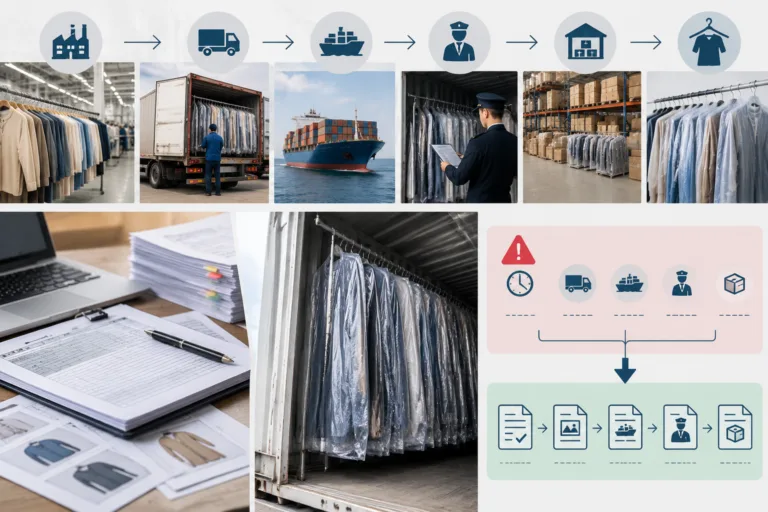

Outsourced operations business risks extend beyond whether an external provider can complete a task at a lower quoted cost. In an apparel business, outsourcing may transfer production, logistics, customer service, software, fulfilment, or another operation to a separate provider, along with some day-to-day execution responsibility. It does not automatically transfer the brand’s commercial, customer, or reputational responsibility. Apparel Wiki is an independent educational publication; this guide is planning information, not manufacturing, testing, legal, accounting, or outsourcing services. For information about supporting the site, see Sponsor.
What Are the Main Business Risks in Outsourced Operations?
The main risks of outsourcing operations are quality and delivery failure, higher-than-expected cost, cash-flow pressure, compliance and traceability gaps, information or intellectual-property loss, provider dependency, business interruption, and customer-experience damage. The relevant mix depends on what is outsourced. A pattern-making arrangement, a garment-production arrangement, a third-party fulfilment service, and an outsourced customer-support system do not create the same exposure.
Begin by separating four questions that are often blended together. A risk event is what may happen, such as an unapproved material change or a delayed shipment. The business impact is what follows, such as rework, a missed launch, a stockout, or customer complaints. Likelihood estimates how plausibly the event may occur in the specific arrangement. The control is the measure intended to prevent, detect, contain, or recover from it.
Risk exposure is shaped by product complexity, target market, contract scope, provider capability, information access, volume, timing, and the brand’s ability to monitor performance. It also depends on fallback options. A provider may appear replaceable until the brand considers approval time, technical files, tooling, confidential patterns, inventory, customer data, or the time needed to move work elsewhere. Common industry practice can inform questions, but it does not prove that a particular provider or operating model is suitable.
How Can Outsourcing Affect Cost, Margin, and Cash Flow?
A lower quoted price does not necessarily mean a lower total cost or lower business risk. The relevant comparison should include the costs required to start, manage, verify, correct, and eventually change the arrangement. For an apparel operation, that may include onboarding, sampling, implementation, management time, inspection, rework, freight, payment fees, returns, claims, switching, and exit costs where they apply.
Define the expense boundary before comparing providers. Classify each item as fixed, variable, pass-through, contingent, or triggered by a change in volume or service scope. This prevents a quoted operating fee from being compared with an internal model that includes very different costs. It also makes clear which assumptions belong to the business rather than to the provider’s proposal.
- Operating cost: What is included in the quoted activity, and what remains with the brand?
- Implementation: Are there costs for onboarding, sampling, systems, data transfer, training, or approval?
- Quality and service: Who absorbs inspection, rework, replacement, claims, returns, and customer-support work?
- Cash timing: When are deposits, invoices, pass-through charges, refunds, and credits paid or received?
- Change and exit: What happens if volume, specifications, currency, service scope, or the provider relationship changes?
Review cash timing separately from accounting margin. Deposits, minimum commitments, credit terms, currency exposure, delayed deliveries, and defects can affect cash availability before the business recognizes the full commercial result. A low-inventory or asset-light model may still carry substantial fulfilment, acquisition, return, service, or dependency costs. Unit contribution can be useful when its boundary is stated: for example, subtract the defined product and related variable expenses from the net amount actually received. It should not be treated as a universal measure unless the business has decided which fees, returns, and fulfilment costs belong in the calculation.
Which Quality, Delivery, and Customer Risks Should Be Tested?
Quality and delivery risks arise when the provider cannot consistently meet the required specification, approval process, capacity range, delivery window, packaging instructions, or change-control process. For apparel, the relevant evidence may include approved samples, specifications, production records, inspection results, shipment status, and corrective-action records. The exact evidence depends on the activity and should come from the specific provider or operating arrangement.
Map the operational failure to its commercial consequence. A defect may require rework or replacement; a delay may disrupt a launch or create a stockout; incomplete work may produce extra internal labour; an unauthorized change may affect fit, appearance, materials, packaging, or customer expectations. Downstream effects can include markdowns, returns, replacement shipments, complaints, and loss of trust. These are business consequences, not merely production inconveniences.
Define measurable acceptance criteria and escalation steps before work begins. The arrangement should identify who approves specifications, how changes are authorized, how defects or delays are reported, and when corrective action is due. Contractual service levels are different from product test methods and different again from an internal quality preference. A review, audit, or inspection can provide useful evidence at a point in time, but none should be treated as a guarantee of future performance.
Also test the speed and quality of information flow. Can the brand see a problem while there is still time to adjust inventory, communicate with customers, or change a shipment? Are records retained in a usable form? Can the provider show what was made, inspected, changed, shipped, or held? Tools such as Apparel Manufacturing Tools may help organize production-related work, but the business still needs arrangement-specific criteria and provider evidence.
How Do Compliance, Traceability, Data, and Intellectual Property Risks Arise?
External providers may handle product information, worker-related records, environmental or customs documents, customer data, commercial terms, technical files, or confidential designs. The obligations associated with that work vary by jurisdiction, product, target market, customer, and each party’s role in the supply chain. A general statement that a provider is compliant is therefore not a substitute for identifying the obligations relevant to the actual arrangement.
Map who creates, stores, verifies, approves, and can change specifications, bills of materials, patterns, production records, customer information, and shipment documents. Assess the risk of unauthorized disclosure, copying, alteration, loss, inappropriate access, or access by an undisclosed subcontractor. Traceability also depends on whether the business can connect records to the relevant material, process, shipment, or provider activity when a question arises.
Request evidence appropriate to the claim. Depending on the issue, that may include a contract, record, declaration, audit result, test report, access log, approval history, or subcontractor disclosure. Evidence should be current enough and specific enough for the decision being made. Confirm whether subcontracting is allowed, how it is approved, and whether the brand can obtain visibility into that work. Legal, privacy, product, customs, labour, and cybersecurity conclusions require review against current authoritative sources for the relevant market.
How Much Dependency and Continuity Risk Is Acceptable?
Outsourcing dependency risk grows when an important activity relies on one provider, facility, region, logistics route, software system, or specialist process. A disruption may affect more than production. It can interrupt product development, order fulfilment, customer service, data access, or the ability to make decisions. Map each dependency and identify what the business cannot perform internally if that external resource becomes unavailable.
Consider realistic failure scenarios, including insolvency, capacity loss, labour disruption, natural disaster, cyber incident, quality suspension, sudden termination, or a change in the provider’s commercial priorities. For each scenario, estimate the business impact, likelihood, detectability, response time, and recovery difficulty. The useful question is not whether disruption can be prevented completely, but whether the business can detect it early and respond before customer or cash commitments are affected.
A backup provider is not automatically a workable contingency plan. Check whether the alternative can meet the required specification, approval status, confidentiality conditions, volume, timing, and target-market needs. Qualification may require new sampling, technical review, commercial negotiation, or operational setup. Record the time and cost needed to switch, along with the conditions under which the alternative would actually be used.
Also document ownership and recoverability. Relevant assets may include patterns, tooling, technical files, approved samples, inventory, work in progress, customer data, production records, and account access. A continuity arrangement is weaker when these items are inaccessible, held by an undisclosed subcontractor, or dependent on a system the brand cannot use during a dispute or provider outage.
Dual sourcing can reduce concentration in some arrangements, but it may add coordination, approval, inventory, and quality-management work. The decision should compare the expected reduction in impact with the additional cost and complexity. A single provider may be reasonable for a low-impact activity with a practical recovery route, while a critical specialist process may require stronger fallback planning.

How Should a Business Evaluate an Outsourcing Arrangement Before Approval?
Begin by defining the arrangement precisely. State the activity, required outcome, scope boundary, decision owner, target market, customer promise, and non-negotiable controls. Include what remains with the brand and what moves to the provider. This prevents a quoted service from being evaluated as if it covered responsibilities, records, approvals, or customer outcomes that are outside its actual scope.
Next, create a risk register that separates the cause, risk event, business impact, likelihood, existing control, supporting evidence, accountable owner, trigger, response, and residual risk. For example, a provider’s capacity reduction is a cause or condition; a missed production window is the event; delayed launch inventory is the impact. Keeping these elements separate makes it easier to decide whether a proposed control prevents the event, detects it, or supports recovery afterward.
- Define the required output, acceptance criteria, handoffs, and change-approval process.
- Request relevant commercial, operational, quality, compliance, security, financial, and continuity evidence.
- Verify whether evidence is current, specific to the provider, and applicable to the proposed scope.
- Compare providers or operating models using the same criteria and record assumptions separately from confirmed facts.
- Document owners, review dates, escalation triggers, and the practical exit or transition path.
Provider due diligence should test claims rather than collect general assurances. Ask how records are retained, how subcontractors are approved, how incidents are reported, how changes are controlled, and how performance problems are corrected. Where appropriate, compare the provider’s statements with samples, operating records, references, system access, inspection information, or other evidence relevant to the decision. The evidence needed depends on the activity and the consequences of failure.
Complete a pre-launch review before transferring material responsibility. Then choose one of three outcomes: stop because a material risk is unacceptable or unsupported; proceed because the risk is understood and owned; or proceed with controls because specific actions must be completed first. A material risk without an owner, evidence, mitigation, or workable exit path should not be hidden inside an otherwise attractive proposal.

What Controls and Review Questions Reduce Outsourcing Risk?
Assign an accountable internal owner even when day-to-day execution is outsourced. That owner should understand the intended outcome, monitor the arrangement, coordinate decisions, and know when escalation is required. Responsibility for oversight should be visible in internal records and appropriate service documents rather than assumed from the provider relationship.
Review a balanced set of indicators. Depending on the activity, these may include quality issues, delivery performance, cost variance, inventory or work-in-progress exposure, claims, returns, incidents, customer experience, unresolved corrective actions, and changes in provider capacity. One metric rarely describes the full risk position. For example, lower operating cost may coincide with more returns, slower response, or greater dependency.
Define escalation thresholds and response expectations in the documents appropriate to the arrangement. Relevant topics may include corrective-action deadlines, change approval, access or audit rights, incident notification, subcontractor disclosure, record retention, and termination or transition procedures. The exact wording and legal effect require review for the jurisdiction, activity, contract, and parties involved.
Reassess controls when the operating context changes. Triggers may include higher volume, a new product type, a new market, a new subcontractor, a system change, a revised customer promise, or a shift from a small pilot to a core business process. Reassessment is also appropriate when the provider’s role expands beyond the original scope, because the original risk evaluation may no longer describe the actual arrangement.
As a practical next step, turn the risk register into a review calendar. Assign each control an owner, evidence source, trigger, and review date, then record whether the control prevents a problem, detects it, or enables recovery. This creates a repeatable planning process without treating any single contract clause, audit, metric, or certification as a complete solution.
What is the biggest business risk of outsourcing operations?
There is no universal biggest risk. The most serious exposure is usually the risk that combines high business impact with limited visibility, slow detection, weak recovery options, or unclear ownership. Its source may be quality failure, provider dependency, cash exposure, compliance, data loss, or customer disruption.
Does outsourcing reduce a brand’s responsibility for quality and compliance?
Outsourcing transfers specified work and execution responsibility, but it does not automatically remove the brand’s commercial, customer, or reputational responsibility. Applicable duties depend on the product, market, contract, and each party’s role, so the arrangement should be reviewed against current authoritative requirements.
How can an apparel business compare the total cost of outsourced operations?
Define the relevant cost boundary before comparing options. Include implementation, management time, inspection, rework, freight, payment fees, returns, claims, switching, exit, and other costs that apply to the arrangement. Compare expected unit contribution and cash timing, not only the provider’s quoted price.
What evidence should a company request during outsourcing due diligence?
Request evidence that matches the risk: commercial terms, capability information, operating records, quality results, security controls, subcontractor disclosures, financial information, continuity plans, approvals, and corrective-action history where relevant. Check that evidence is current, specific to the provider and scope, and independently verifiable when the decision requires it.
When should a business use a backup provider or contingency plan?
Use one when the impact of provider failure exceeds the business’s ability to absorb or recover from it within the required time. Evaluate feasibility first, including specification, volume, timing, confidentiality, qualification work, cost, and access to assets or records. A named alternative without these checks is not a complete contingency plan.
How often should an outsourced operation be reviewed for risk?
Set a recurring review appropriate to the activity and risk level, and review sooner after incidents, major changes, performance deterioration, new markets, volume shifts, subcontracting, or system changes. The review should examine both results and whether the controls still fit the actual arrangement.