Textile fiber properties are the characteristics that describe how a fiber behaves during processing and use. They include features such as strength, fineness, flexibility, moisture interaction, and response to heat or chemicals. These properties provide useful clues about clothing performance, but they do not determine the finished garment by themselves. Yarn formation, fabric construction, finishing, garment design, care, and wear conditions also shape the result.
Apparel Wiki is an independent educational publication covering apparel and textile knowledge. Its editorial work is supported through the Sponsor page, but the site is not a manufacturer, factory, testing laboratory, certification body, or sourcing service. The explanations below describe general material tendencies; project-specific decisions should rely on information and testing relevant to the actual material.
What are textile fiber properties?
A textile fiber is a flexible, hair-like unit that can be processed into yarn or used in other textile structures. Fiber properties are the measurable or observable characteristics that affect that process and the behavior of the resulting material. For example, fiber length and fineness can influence spinning and yarn formation, while flexibility can affect bending, handle, and the way a textile conforms to the body. Moisture interaction and heat response can also influence processing, comfort, care, and end use.
The phrase types of textile fibers usually refers first to broad fiber identity, such as cotton, wool, silk, polyester, nylon, or regenerated cellulosic fibers. That identity is only one part of the description. A useful material record separates the generic fiber name from its raw-material source, manufacturing process, physical form, and commercial brand. A brand name may identify a particular product or process, but it does not replace the common fiber name.
Material descriptions become clearer when they follow the chain from fiber to garment:
- Fiber: the basic material unit and its inherent or produced characteristics.
- Yarn: the arrangement of fibers into a continuous strand, with its own size, twist, structure, and handling behavior.
- Fabric construction: the way yarns or fibers form a textile, such as woven interlacing or knitted loops.
- Finishing: treatments that can change appearance, handle, dimensional behavior, surface effects, or care response.
- Garment: the finished product shaped by pattern, seams, fit, construction details, and use.
This distinction prevents common naming errors. “Satin” generally describes a fabric structure or surface effect, not a fiber identity. “Knit” describes loop-based fabric construction, not a specific raw material. A satin fabric may use silk, polyester, or another fiber, and a knitted fabric may be made from many different fiber types. Property descriptions should therefore be treated as tendencies rather than guarantees for every product carrying the same name.
How does fiber structure influence clothing performance?
Fiber structure and clothing performance are connected through several interacting levels. Material composition influences the nature of the fiber-forming substance, while molecular arrangement affects how that substance responds to force, moisture, and heat. At a larger scale, fiber morphology includes characteristics such as size, shape, surface, and internal structure. These features are discussed in textile-engineering teaching materials such as NPTEL’s textile-fiber morphology course.
A fiber’s internal arrangement can affect how it stretches, bends, recovers, breaks, or transfers forces within a yarn. Its surface characteristics can affect friction between fibers, which in turn may influence cohesion during yarn formation and the eventual surface appearance of a textile. Fineness and length can also affect how many fibers contribute to a yarn cross-section and how the yarn feels or looks. These relationships are useful mechanisms for understanding behavior, not simple formulas that predict the complete garment.
Moisture-related behavior follows the same principle. The material’s chemistry and structure can influence whether moisture is absorbed into the fiber, held between fibers, or transported along surfaces and spaces in the textile. Yet a garment’s perceived dryness or comfort also depends on yarn density, fabric openness, thickness, finishing, body movement, climate, and the wearer’s environment. A fiber-level tendency may be amplified, reduced, or obscured by later processing.
The practical rule is to separate a mechanism from a universal claim. A particular fiber feature may help explain why a material behaves in a certain way under defined conditions, but it does not establish that the fiber is always stronger, cooler, softer, or more comfortable than every alternative. Clothing performance emerges from the interaction of fiber structure, yarn design, fabric architecture, finishing, garment design, and use.
Which fiber properties matter in apparel?
There is no universal ranking of the best fiber properties for clothing. The relevant priorities depend on the garment’s function, expected climate, care routine, design intent, and production method. A formal shirt, base layer, work garment, outer layer, and decorative textile may require different balances of mechanical, moisture, thermal, visual, and processing behavior.
| Property category | Why it may matter | What to interpret carefully |
|---|---|---|
| Mechanical behavior | Relates to resistance to force, bending, extension, and breakage during processing and wear. | Fiber behavior is not the same as the strength or stretch result of a finished fabric. |
| Moisture interaction | Helps explain absorption, transport, drying tendencies, and possible effects on comfort. | Fabric openness, thickness, finishing, climate, and garment fit also influence the experience. |
| Thermal behavior | Can contribute to insulation, heat response, and comfort in a particular textile structure. | Warmth or coolness cannot be assigned from fiber identity alone. |
| Surface and appearance | Influences luster, smoothness, hairiness, hand, and the visual character of the textile. | Yarn, weave or knit, brushing, dyeing, and finishing may change the visible result. |
| Durability-related behavior | May help assess resistance to repeated handling, abrasion, deformation, or care exposure. | Actual service life depends on construction, stress, laundering, and garment design. |
| Processing compatibility | Supports decisions about spinning, dyeing, heat exposure, finishing, and assembly. | Compatibility depends on the complete material and process, not only the generic fiber name. |
These categories are a selection vocabulary rather than a scorecard. For a garment intended for frequent laundering, dimensional behavior and care response may deserve close attention. For a fitted or movement-intensive design, extension and recovery at the fabric level may matter more than a general description of fiber flexibility. For a visually distinctive product, surface character and finishing may be central.
It is also important to distinguish a fiber property from a measured result. “Fiber fineness” describes a fiber-level characteristic; yarn size, fabric weight, and garment performance are different measurements. Likewise, a statement about a fiber’s moisture interaction does not substitute for testing the relevant yarn, fabric, or finished garment. Reliable comparisons should identify the material layer, construction, test conditions, and intended use before conclusions are drawn.
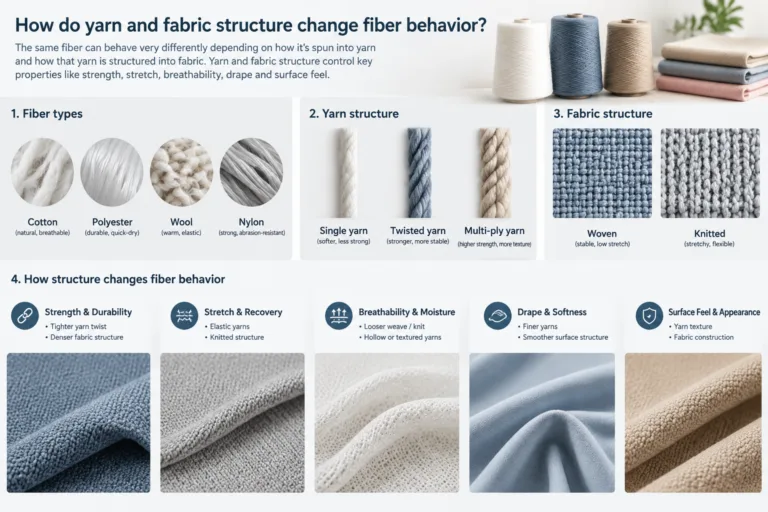
How do yarn and fabric structure change fiber behavior?
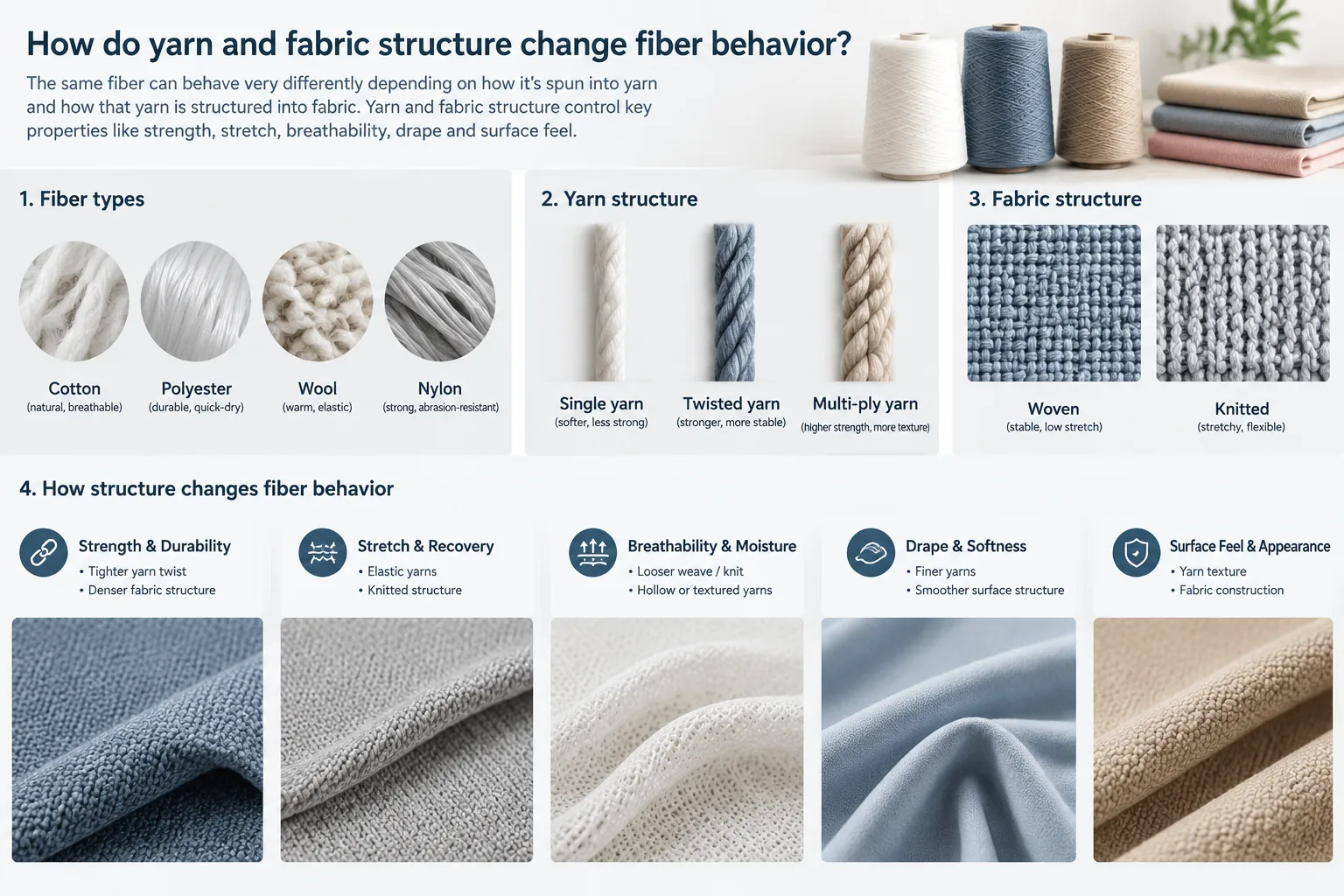
Fiber identity is only the first layer of a textile material. During spinning, fibers are arranged into yarn, and yarns are then formed into fabric. This changes how much of the fiber’s individual behavior is expressed in the material. Yarn twist, compactness, surface hairiness, and arrangement can affect appearance, handle, strength, and dimensional response. The resulting fabric adds another structural layer before the material becomes a garment.
Woven fabrics are formed through the interlacing of yarn systems, while knitted fabrics are formed through interconnected loops. These structures provide useful clues, but neither one automatically determines stretch, breathability, comfort, or durability. A knitted fabric may have limited or substantial extension depending on its loop structure, yarn, fiber content, and finishing. A woven fabric may also gain movement from its construction, fiber characteristics, or the way it is cut and assembled.
Fabric weight, yarn design, density, surface treatment, and finishing can amplify, reduce, or redirect a fiber’s typical tendencies. A fiber with good flexibility may not produce a highly flexible garment if the fabric is dense and firmly constructed. Conversely, a stable fiber can be used in a fabric whose construction allows movement. The relevant question is therefore not only “What fiber is this?” but also “How has this fiber been made into the material being evaluated?”
Blending creates another set of interactions. Fiber form, blend proportion, staple or filament arrangement, yarn construction, fabric structure, and finishing all contribute to the result. A blend may be selected to balance several desired behaviors, but adding one fiber does not automatically make a textile stronger, more comfortable, more durable, or more sustainable. Comparisons are most useful when the materials have similar construction and are considered under similar care and use conditions.
How should you evaluate fibers for a garment project?
Begin with the garment’s job. Consider how it will be worn, the movement required, the wearer’s comfort expectations, the climate, the expected care routine, and the visual or tactile effect the design needs. A fiber that is appropriate for a structured outer layer may not be the best choice for a close-fitting base layer, and a material suited to occasional wear may not meet the demands of frequent laundering.
Next, identify the properties that matter most for that use. These may include dimensional behavior, flexibility and recovery, moisture interaction, thermal response, surface appearance, abrasion-related durability, care response, or processing compatibility. This is a prioritization exercise rather than a universal ranking of fibers. The most relevant property depends on the garment’s function and on which risks would matter most to the wearer or product team.
Review the complete material description. Fiber content should be considered alongside yarn form, yarn size or density information, fabric construction, fabric weight, finishing, and any available care instructions. Commercial names can describe a process, appearance, or product category rather than a fiber identity. Where a label or claim must meet the rules of a particular sales market, verify the applicable requirements for that market instead of treating a general material description as sufficient.
When performance is important, compare like with like. A fiber-level description can support an initial decision, but relevant evidence should come from the actual yarn, fabric, or garment whenever possible. Ask whether the information describes a general tendency, a supplier statement, a direct result from the material under review, or an editorial interpretation. Evidence is more useful when its material layer, construction, care conditions, and intended use are clear.
For product development, a simple comparison record can improve decisions. Note the intended use, priority properties, fiber content, yarn and fabric construction, finishing, care expectations, known limitations, and evidence available for each candidate. This helps prevent a familiar fiber name or attractive commercial claim from carrying more weight than the complete material system.
What can fiber properties tell you, and what can’t they?
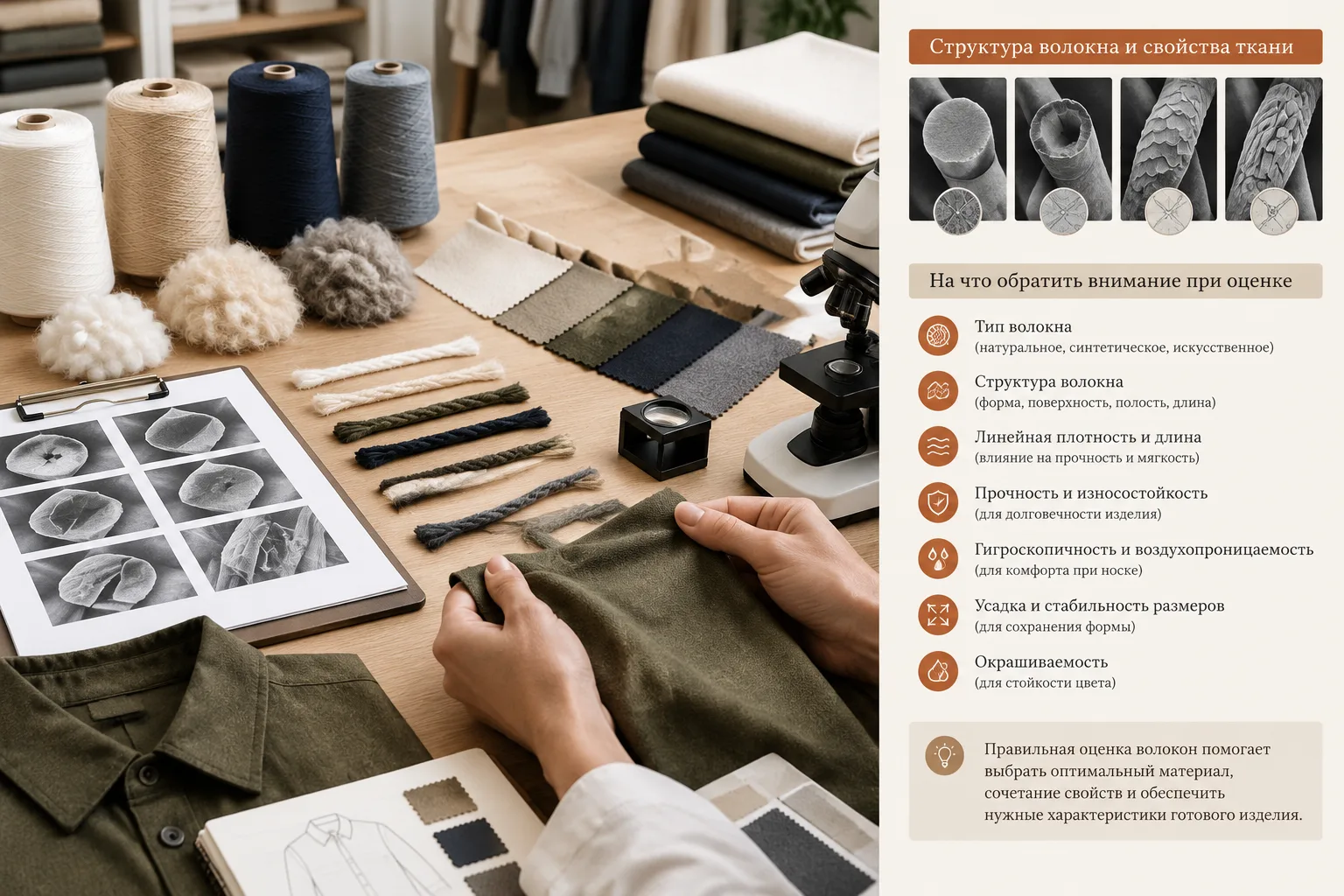
Textile fiber properties provide useful clues about how a material may be processed and how it may behave. They can help explain why different fibers tend to differ in flexibility, moisture interaction, surface character, heat response, or mechanical behavior. They can also help a product team identify which questions should be asked before a fabric is selected.
They cannot, by themselves, predict the finished garment. Comfort depends on the fabric surface, construction, fit, movement, climate, and wearer. Durability depends on stresses, seams, abrasion, laundering, garment design, and construction quality. Appearance may change through dyeing, brushing, pressing, finishing, and use. Even care behavior can depend on the complete textile and the conditions to which it is exposed.
This distinction matters when reading technical descriptions. Fiber fineness is a fiber-level characteristic; it is not the same measurement as yarn size, fabric weight, or garment performance. Similarly, a general statement about moisture interaction does not replace evaluation of the relevant fabric in the intended design. A claim about one material layer should not be silently converted into a claim about another.
The practical next step is to move from general fiber knowledge to evidence for the actual material. Review the yarn and fabric construction, inspect the finishing and care requirements, compare suitable alternatives under comparable conditions, and seek relevant test information when the decision depends on end-use performance. Apparel Wiki is an independent educational publication, so its guides can support understanding and questions for product teams but do not replace supplier documentation or independent material evaluation.
Frequently asked questions
What are the most important textile fiber properties for clothing?
The priority depends on the garment. Common categories include mechanical behavior, moisture interaction, thermal response, surface character, dimensional behavior, durability-related behavior, care response, and processing compatibility.
Does fiber type alone determine how a garment performs?
No. Fiber type offers general tendencies, but yarn construction, fabric structure, finishing, garment design, care, and use conditions also shape the final result.
How do fiber, yarn, fabric construction, and finishing differ?
Fiber is the basic material element. Yarn is an arrangement of fibers or filaments. Fabric construction describes how yarns or loops form the textile, while finishing modifies its surface or behavior.
How does blending fibers affect clothing performance?
Blending can create a different combination of properties, but the outcome depends on fiber form, proportion, yarn design, fabric construction, and finishing. No added fiber guarantees a better result.
How can I compare fiber materials for a specific garment?
Start with the garment’s function, wearer needs, climate, care routine, and design intent. Then compare fiber content together with construction, finishing, documentation, and evidence from the relevant material layer.
Are fabric labels enough to predict comfort and durability?
Usually not. Labels can identify fiber content and care information, but they may not describe construction, finishing, fit, laundering exposure, or the performance of the finished garment.