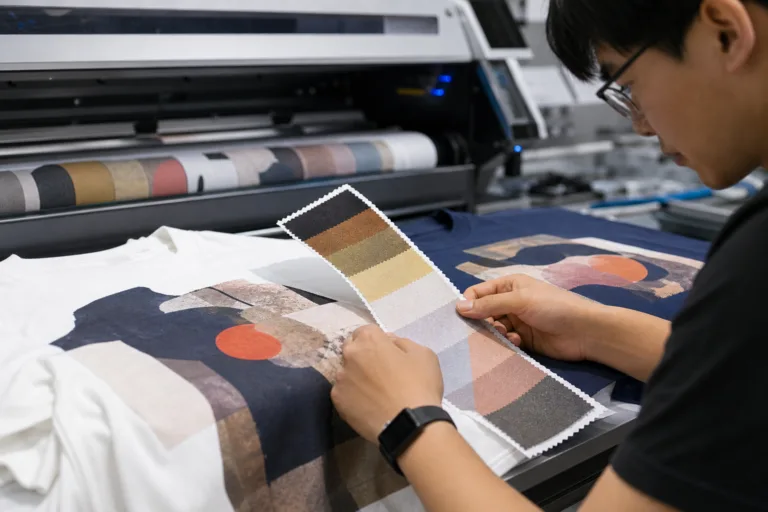
Digital textile printing has become an important part of apparel development because it allows brands and sourcing teams to print complex artwork with less setup, faster sampling, and more flexibility than many traditional methods. In practice, though, the term covers more than one production route. A DTG print on a finished cotton T-shirt and a roll-to-roll print on polyester yardage are both forms of digital textile printing, but the equipment, fabric requirements, order logic, and quality risks are not the same. For buyers, the key is not only understanding the print category, but also matching the method to the fabric, product type, expected durability, and production volume.
If you also need a broader planning view beyond printing alone, the apparel manufacturing tools hub is useful for connecting decoration decisions with fabric choice, measurement planning, product development steps, and sourcing communication. That matters because print success usually depends on details confirmed before bulk production, not only on the printer or the artwork file.
What digital textile printing means in apparel and why it matters
In apparel, digital textile printing refers to printing designs directly from a digital file onto fabric or garments using inkjet-based technology. Instead of making physical screens for each color, the design is sent to the printer and reproduced through controlled ink deposition. This is one reason digital methods are useful for short runs, sampling, photographic artwork, and frequent design changes. A technical overview of textile printing processes also helps explain why digital systems are different from analog methods in terms of setup logic, substrate compatibility, and production scale.
Why it matters is simple: decoration is no longer just a late-stage cosmetic step. In modern product development, print method affects fabric selection, MOQ planning, artwork engineering, wash performance, and even garment construction. A lightweight cotton jersey for DTG behaves differently from a polyester interlock designed for roll-to-roll sublimation. If that difference is not understood early, the product may look right in the lab dip or strike-off stage but fail in real production.
DTG vs roll-to-roll digital printing
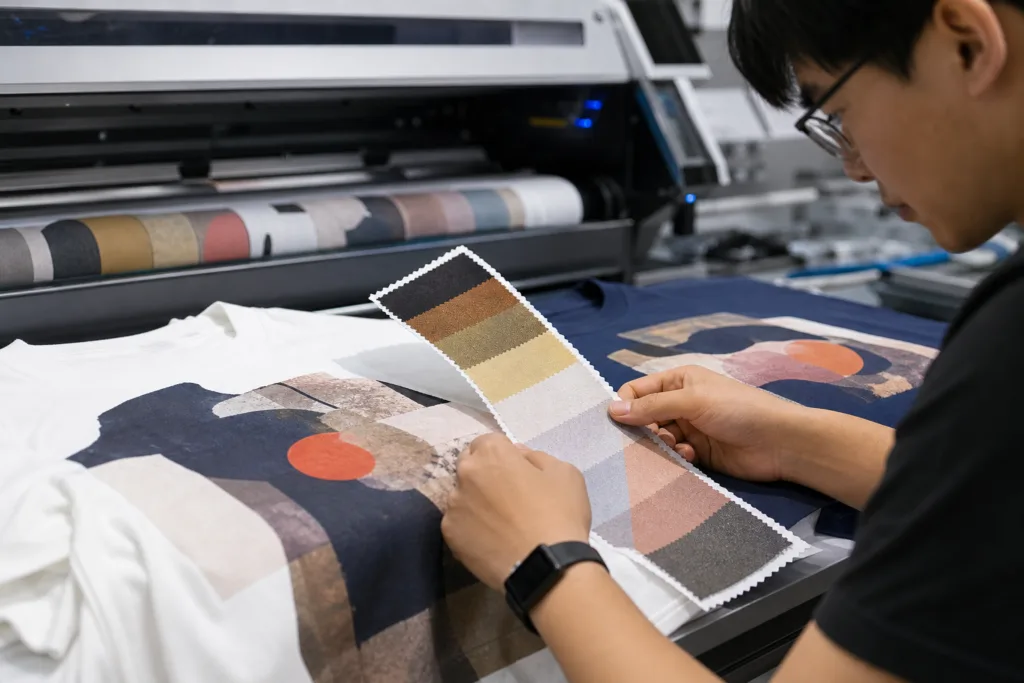
The basic difference is where and how the print is applied. DTG, or direct-to-garment, prints directly onto a finished garment panel or assembled garment, most commonly T-shirts, sweatshirts, and similar casualwear. Roll-to-roll digital printing prints continuous fabric in open width before cutting and sewing. That makes it more suitable for all-over prints, engineered yardage, repeat patterns, and larger production programs.
| Factor | DTG | Roll-to-Roll Digital Printing |
|---|---|---|
| Printing stage | On finished garment | On fabric roll before cutting |
| Typical use | Graphic tees, short runs, on-demand orders | All-over prints, sportswear, fashion yardage, home textiles |
| Common fabric base | Cotton and cotton-rich blends | Polyester, cotton, silk, viscose, nylon depending on ink system |
| Artwork scale | Front, back, sleeve placements | Continuous repeats and full coverage designs |
| Setup demand | Low physical setup | Low screen setup but more fabric/process calibration |
| Best order logic | Very low MOQ, customization, test launches | Sampling to medium and large runs, repeatable yardage |
| Main control point | Pretreatment, platen setup, curing | Fabric feed, color control, fixation, width consistency |
This detail may look small, but it can create problems later if it is not confirmed early. A brand may ask for the same artwork across cotton tees and polyester uniforms, but the practical print route may need to split because the fabric chemistry and end-use performance are different.
How DTG works
Typical workflow
DTG usually starts with artwork preparation, color separation inside RIP software, and garment loading onto a platen. On many garments, especially dark cotton, a pretreatment solution is applied first so white ink and color inks can sit correctly on the surface. The printer then lays down the image, and the print is cured with heat to stabilize the ink film.
DTG works best when the product category is simple and the garment surface is stable. Standard crew neck T-shirts, hoodies, and sweatshirts are easier than garments with heavy seams, zippers, pockets, or unstable texture. Uneven surface height can affect head clearance and sharpness.
Fabric suitability and ink behavior
Most DTG programs perform more predictably on cotton or high-cotton blends because the chemistry is designed to bond well with cellulosic fibers. Some blends can work, but hand feel, brightness, and wash durability may shift depending on fiber percentage and pretreatment control. If a buyer is still deciding the fabric base, this guide to selecting fabrics for print performance helps frame the conversation around surface smoothness, absorbency, opacity, and end use rather than just fiber name.
Ink behavior matters a lot. On absorbent cotton, ink can sink enough to feel soft when balanced properly, but excess pretreatment or poor curing can leave a stiff hand, staining around the print, or weak wash resistance. On dark garments, underbase control is especially important because too much white ink can increase hand feel and cracking risk, while too little reduces image pop.
Typical limitations
DTG is flexible, but it is not automatically the right answer for every printed garment. Common limits include slower throughput for larger quantities, challenges on some synthetic fabrics, reduced consistency across mixed garment lots, and placement restrictions compared with all-over print methods. It is also sensitive to operator control. Small changes in humidity, pretreatment amount, platen pressure, or curing temperature can change the result.
How roll-to-roll digital printing works
Typical workflow
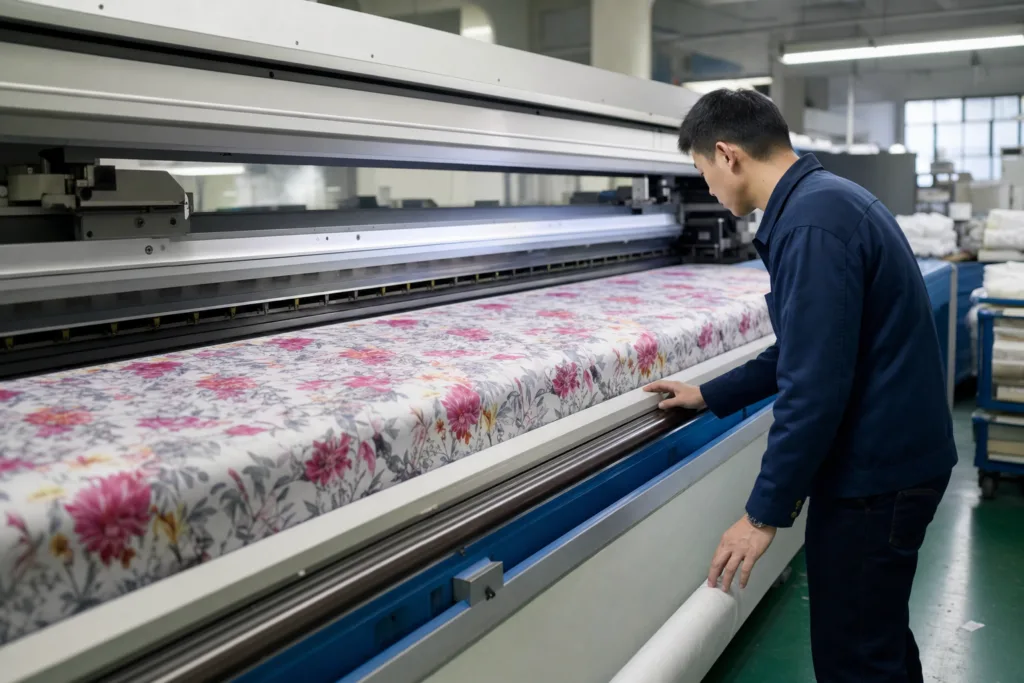
Roll-to-roll printing starts with open-width fabric feeding through the printer. The artwork is printed continuously onto the fabric, then fixed by heat, steam, washing, or another finishing route depending on the ink chemistry. After fixation and inspection, the printed fabric goes to spreading, cutting, and sewing like other yardage.
This route is stronger when the design needs continuous repeat accuracy, engineered panel prints, or large visual coverage. Sportswear leggings, teamwear, fashion dresses, linings, scarves, and many home-textile products fit this model better than DTG.
Substrate compatibility and production strengths
Roll-to-roll is not one single chemistry. The method may use reactive inks for cotton and viscose, acid inks for nylon or silk, pigment inks for broader fiber flexibility, or sublimation-related workflows for polyester. In apparel sourcing practice, polyester is especially common in digitally printed performance products, so this overview of polyester fabric variants is useful when matching print method to moisture management, stretch, opacity, and intended wear conditions.
The main strength of roll-to-roll is that it separates printing from garment assembly. That makes full-coverage graphics, matching across pattern pieces, and engineered repeats far more realistic. It also allows a factory to hold printed yardage inspection before cutting, which can reduce some garment-level surprises.
Fabric and garment selection criteria
Method choice often comes down to fabric first, not artwork first. A smooth, combed cotton jersey for retail graphic tees is a common DTG candidate. A polyester interlock for teamwear is more likely to move into a roll-to-roll digital route, especially when the design covers the full garment. If the team is still comparing construction types, understanding how knit and woven fabrics differ in use helps because stretch, surface stability, drape, and panel distortion all affect print behavior.
| Fabric or product type | Usually more suitable method | What to confirm first |
|---|---|---|
| Cotton jersey T-shirt with chest graphic | DTG | Pretreatment response, print area, wash expectations |
| All-over print polyester sports tee | Roll-to-roll | Ink route, color migration risk, panel matching |
| Cotton tote or flat panel item | DTG or direct flat digital method | Surface evenness, color density |
| Viscose woven dress print | Roll-to-roll | Drape after printing, shrinkage, fixation process |
| Customized one-off merchandise | DTG | File handling, individual order workflow |
| Teamwear in recycled polyester | Roll-to-roll | Performance requirements and fiber source consistency |
Recycled content can add another layer to the discussion. For polyester-based print programs, a comparison of virgin and recycled polyester is helpful because yarn source, surface consistency, and brand sustainability goals may affect the final fabric decision even before printing trials begin.
Print quality factors buyers should evaluate
Color accuracy and repeatability
Digital systems can reproduce complex artwork well, but color accuracy still depends on profiling, fabric base tone, ink set, and fixation consistency. A print that looks correct on bright white fabric may shift on optical-white-treated fabric or natural cotton. For brands with strict identity colors, lab approvals should cover both visual appearance and repeatability in bulk.
Hand feel and surface appearance
Hand feel is one of the biggest practical differences between methods and setups. DTG can feel soft on light cotton if the ink load is balanced, but dense dark-ground prints may feel heavier. Roll-to-roll results vary by chemistry: sublimation-style polyester prints often preserve fabric softness well, while pigment or reactive routes can feel different depending on binder, post-treatment, and fabric construction.
Sharpness, registration, and fabric distortion
On garments, DTG sharpness depends on a flat print area and correct platen alignment. On yardage, roll-to-roll sharpness depends on feed stability, tension control, and fixation. Stretchy knits can distort between printing and cutting, so panel alignment has to be checked on the real pattern, not only on a strike-off swatch.
Wash durability and testing
Print quality does not end at first appearance. Apparel buyers should confirm wash performance, crocking risk, and colorfastness according to the intended end use. A fashion sample with occasional wear has different expectations from a team uniform or children’s dailywear item. Standards such as ISO 105-C06 for colorfastness to washing are relevant because they show how laundering durability is evaluated in a structured way during textile testing and quality assurance.
Key benefits of digital textile printing
The main benefit is flexibility. Digital printing allows quick artwork changes, easier sampling, lower physical setup compared with screen-based methods, and a stronger fit for short runs or product personalization. For brands testing new prints, it reduces the risk of paying for screens and long setup cycles before demand is proven.
Another benefit is design complexity. Gradients, photographic images, and large color counts are much easier to handle digitally. This is useful in fashion capsules, licensed graphics, event merchandise, and sportswear programs where every size, player name, or market version may need variation.
Speed also matters, but it should be understood correctly. Digital can be faster in development and low-setup situations, yet not every digital workflow is faster in bulk. Throughput depends on print width, machine speed, drying or fixation stage, inspection capacity, and downstream cutting and sewing. In many projects, the problem is not the printing speed itself. The problem is that artwork approval, fabric availability, or test confirmation was delayed.
Environmental and operational impact
Digital printing is often discussed as a more resource-aware alternative because many workflows reduce screen preparation, overproduction, and some wet processing steps. In the right setup, it can support lower sampling waste, more precise ink placement, and shorter design-to-production cycles. That said, environmental performance is not automatic and should not be simplified into a marketing claim.
What actually needs review includes ink chemistry, fixation energy, pretreatment use, fabric waste during calibration, wash-off requirements for certain ink systems, rejected meters, and whether production is print-on-demand or overproduced into inventory. A DTG one-piece reorder can be efficient from an inventory standpoint, while a poorly controlled roll-to-roll run with heavy rework may not be efficient at all.
From a sourcing perspective, it is useful to ask the supplier how they manage strike-offs, machine calibration waste, rejected panels, and curing or fixation controls. Those answers are usually more informative than broad sustainability statements.
Cost and efficiency comparison
Cost comparison between DTG and roll-to-roll should be done by project type, not by headline price. DTG often works well for single-piece orders, micro-runs, and graphic placements because setup is simple and there is no need to print full fabric yardage first. Roll-to-roll becomes more efficient when many garments share the same printed yardage, when all-over print is required, or when cutting yield can be optimized across a larger marker.
| Cost factor | DTG impact | Roll-to-roll impact |
|---|---|---|
| MOQ | Usually low | Low to medium depending on fabric and finishing setup |
| Setup time | Low | Low screen setup, but more fabric/process preparation |
| Unit cost at very low volume | Often favorable | Can be high if fabric processing minimums apply |
| Unit cost at scale | May become less efficient | Often stronger for repeated yardage programs |
| Sampling speed | Fast for graphic garments | Fast for printed fabric concepts, but depends on finishing |
| Inventory flexibility | Strong for on-demand | Strong when printed fabric planning is accurate |
Lead time is similar. A DTG project may start quickly but slow down if each garment is individually customized. A roll-to-roll project may require more preproduction alignment, yet run smoothly once fabric, color profile, and marker planning are stable.
Best use cases by application
Fashion and sampling
For capsule collections, visual approvals, and low-risk market testing, both methods can be useful. DTG is stronger for simple print-placement garments. Roll-to-roll is stronger for dresses, matching sets, and any concept where the print is part of the fabric identity.
Sportswear and teamwear
Performance products usually lean toward roll-to-roll, especially when polyester dominates and full-garment graphics are required. Names, numbers, and repeatable team colors should be reviewed together with stretch recovery, seam placement, and panel matching.
Uniforms and organization orders
Uniform needs are often mixed. Small chest logos on cotton polos may suit other decoration methods, while high-coverage polyester uniform components can fit digital yardage printing. Buyers should focus on laundering frequency, color consistency across reorders, and size-set approval.
Home textiles and soft goods
Roll-to-roll has a clear advantage for bedding, curtains, and fabric-based accessories because the substrate arrives and moves through production as yardage rather than individual garments.
Common mistakes and production risks
- Choosing by artwork only: A design may look suitable for digital printing, but the fabric or product structure may push the decision in another direction.
- Ignoring pretreatment variables in DTG: Uneven pretreatment can cause staining, dull areas, and inconsistent wash results.
- Skipping full-process testing: A small strike-off is not enough if the real order uses different fabric lots, widths, or finishing conditions.
- Underestimating shrinkage and distortion: Printed fabric can behave differently after fixation and washing, which affects pattern matching and size consistency.
- Approving color on one fabric only: The same file can print differently on another base fabric or another white level.
- Confusing low setup with low total cost: Rework, rejected panels, and poor curing can erase the expected savings.
Selection checklist for brands, developers, and sourcing teams
At Apparel Wiki, we usually suggest reducing the decision to a few operational questions before requesting quotes.
- Is the print going onto a finished garment or onto fabric before cutting?
- What is the actual fiber content and fabric construction?
- Does the artwork require full coverage, engineered placement, or only local graphics?
- How many units are needed now, and how many if the style is reordered?
- What wash durability is required for the real use case?
- Will the product be customized piece by piece?
- Is the fabric white, light, dark, coated, brushed, or textured?
- What approvals are required: strike-off, size set, wear test, wash test, bulk shade band?
- Are sustainability goals tied to fiber source, ink route, waste reduction, or inventory model?
- Can the supplier explain curing, fixation, testing, and reprint control in clear production terms?
Teams that need broader terminology, sourcing logic, and process references can also use Apparel Wiki as a structured starting point when building internal specs or supplier discussion notes.
Conclusion
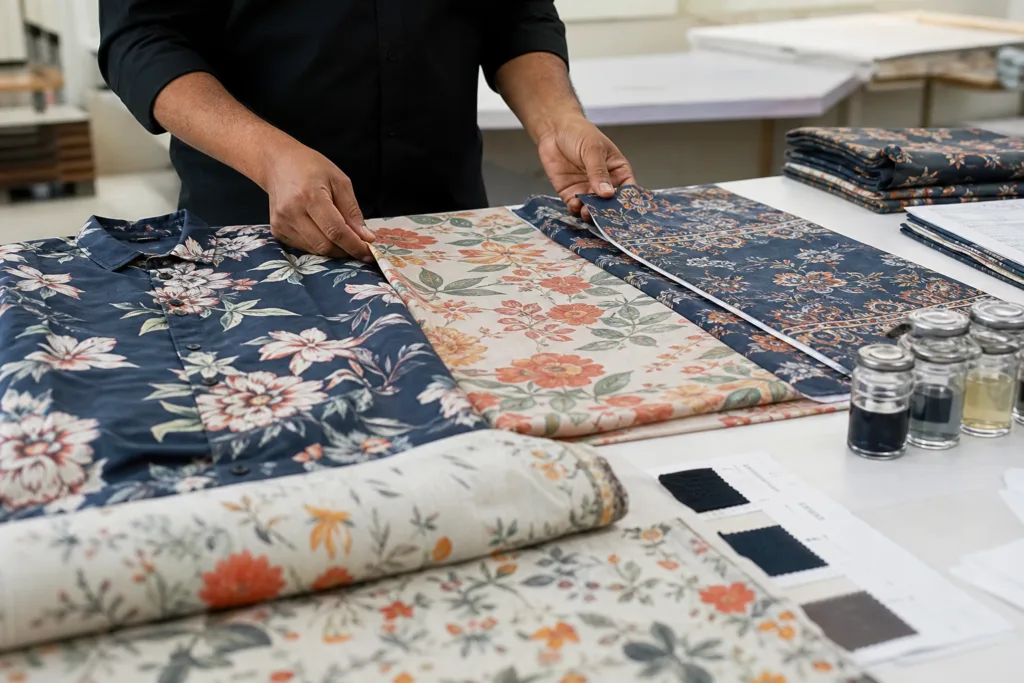
Digital textile printing is not one single decision but a set of production choices. DTG is usually the practical route for direct garment graphics, low MOQ, and on-demand customization, especially on cotton-based casualwear. Roll-to-roll is usually the stronger route for printed yardage, all-over graphics, polyester performance products, and repeatable fabric-based production. The right choice depends on where the print is applied, what fabric is involved, how the product will be used, and what quality level must hold after washing and wear. If those points are clarified early, digital textile printing can support faster development, better design flexibility, and more controlled production results.
FAQs
What is the main difference between DTG and roll-to-roll digital printing?
DTG prints directly onto finished garments, while roll-to-roll prints onto fabric yardage before cutting and sewing. That single difference affects everything else, including suitable fabric types, artwork scale, customization options, production flow, and cost efficiency by order size.
Is digital textile printing only for small orders?
No. It is very useful for small orders and sampling because setup is simpler, but roll-to-roll digital printing can also support larger programs when the same printed fabric is used across many garments. The better question is whether the order structure, print coverage, and fabric route make digital more efficient than other methods.
Which fabrics are usually better for DTG?
DTG usually performs more predictably on cotton and cotton-rich fabrics with a smooth surface, especially for T-shirts and sweatshirts. Some blends can work, but the print brightness, hand feel, and wash performance should be tested on the exact fabric because fiber mix and pretreatment response change the result.
Can roll-to-roll digital printing be used for sportswear?
Yes, and it is often a practical choice for sportswear when the garments use polyester-based fabrics and need all-over graphics, team color layouts, or repeated design panels. The important checks are stretch behavior, color consistency, panel matching, and wash durability after the full print and finishing process.
How should buyers evaluate wash durability for digitally printed apparel?
Buyers should not rely only on first-look appearance. They should ask for wash testing appropriate to the end use, along with checks for colorfastness, crocking, print cracking, and shade change after laundering. A casual promo tee and a frequently washed uniform should not be approved using the same durability expectation.
What is the most common mistake when choosing a digital printing method?
The most common mistake is choosing based on the artwork alone without confirming fabric, garment construction, expected order size, and performance requirements. In many cases the print file is not the real problem; the issue is that the substrate, process controls, or quality expectations were not aligned before sampling.