
Trilobal filament yarn tension problems are fluctuations in the pulling force acting on the yarn as it travels through a processing route. They may appear as tension spikes or drops, uneven delivery, intermittent breaks, loops, streaks, barre-like effects, or inconsistent fabric formation. These signs indicate that an investigation is needed; they do not prove that the trilobal yarn itself is defective. The problem may involve the yarn construction, package, guides, machine settings, environment, handling, or measurement system.
This guide uses a diagnostic approach and keeps Apparel Wiki independent from yarn suppliers, manufacturers, factories, and testing laboratories. The site’s editorial independence is described on the Sponsor page. Before comparing results, record the processing stage, machine type, yarn construction, package identity, and exact location where the variation becomes visible or measurable.
What Are Trilobal Filament Yarn Tension Problems?
A trilobal filament yarn is generally a multifilament yarn in which individual filaments have a three-lobed cross-sectional form. During processing, yarn tension is the force carried along the yarn path as the yarn is withdrawn, guided, fed, formed, or taken up. Tension variation occurs when that force changes in an unstable, inconsistent, or repeating way instead of remaining within the behavior expected for the specific process and setup.
The observable pattern matters. A continuous drift may point toward changing package withdrawal, machine behavior, or measurement conditions. Periodic cycling may be associated with a repeating machine or package event. Isolated spikes may occur at a guide, tension device, delivery point, or damaged section of yarn. In knitting or weaving, the final result may appear as intermittent breaks, loops, streaks, barre-like appearance, or uneven fabric formation. These are symptoms, not confirmed root causes.
The same fabric defect can result from different mechanisms. A yarn property, finish, interlacing condition, package build, damaged guide, incorrect alignment, speed change, environmental shift, handling event, or sensor problem may produce similar observations. For that reason, avoid describing every filament yarn processing problem as a yarn-quality failure before the evidence distinguishes a material issue from a process issue.
At minimum, record whether the variation appears during package withdrawal, at a guide or tensioner, near the feeder or delivery point, in the needle or shuttle area, at take-up, or only in the finished material. Also note whether the issue is linked to one package, one machine position, one route, one speed, or a particular time in the run. This information gives later comparisons a usable context.
How Trilobal Geometry Can Affect Yarn Handling
The three-lobed cross-section can change how filament surfaces contact one another and how the yarn interacts with guides, tension devices, feeders, and neighboring yarn surfaces. In principle, cross-sectional geometry may influence contact area, frictional interaction, packing, and visual appearance. That does not mean trilobal geometry automatically causes unstable tension or makes the yarn more difficult to process.
The actual handling response depends on the complete yarn construction. Relevant variables can include polymer type, linear density, filament count, finish, interlacing or twist, package build, winding behavior, and the length and arrangement of the machine path. A trilobal yarn with one specification may behave differently from another trilobal yarn even when both use the same general cross-sectional description.
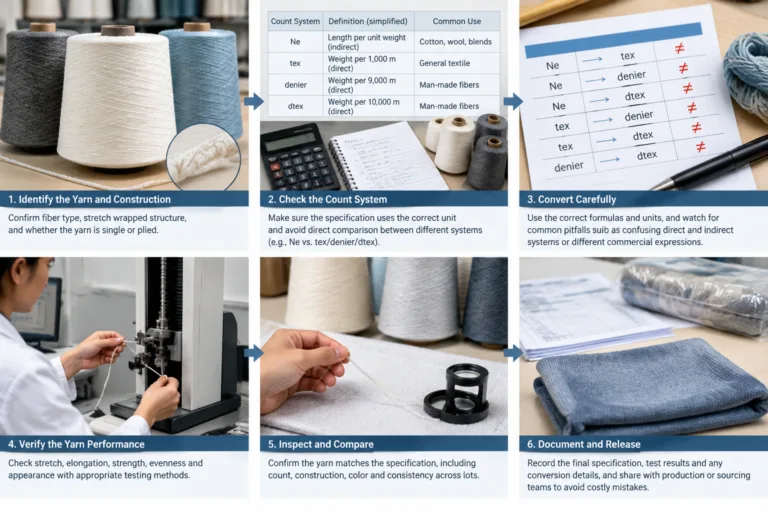
Linear density also needs to be kept separate from diameter and tension. Tex expresses mass per 1,000 meters, denier expresses mass per 9,000 meters, and dtex expresses mass per 10,000 meters. The terminology relationships are tex = denier ÷ 9 and dtex = tex × 10. For example, 90 denier equals 10 tex, or 100 dtex. This hypothetical conversion describes linear density only; it does not measure yarn diameter, friction, or processing tension.
To test whether geometry contributes to a trilobal filament friction or handling issue, compare like-for-like constructions. Keep the linear-density system, filament count, finish, interlacing or twist, package format, processing route, and operating conditions as comparable as practical. If several of these variables change at once, a result cannot reliably be attributed to cross-sectional shape.
First Separate the Symptom From the Root Cause
Begin with an observation record rather than an immediate machine adjustment. Describe what changed, where it changed, how often it occurs, and under what conditions. A photograph can document a streak, loop, or fabric irregularity, but it cannot establish whether the cause is yarn, equipment, environment, handling, or measurement. Pair images with physical samples, tension traces where available, and process records.
Record the pattern
- Identify the location: package withdrawal, guide, tensioner, feeder, delivery point, needle or shuttle area, take-up, or finished material.
- Describe the behavior: continuous drift, periodic cycling, isolated spikes, intermittent drops, or variation during acceleration, deceleration, or stop-start events.
- Check whether the issue varies by package, machine head, route, position, operator, speed, or production time.
- Record yarn lot, package number, package age or storage history when available, machine identifier, position, speed, setting changes, break history, and environmental conditions.
Compare an abnormal sample with a normal reference using the same machine, route, operator, and measurement conditions where possible. Preserve competing hypotheses involving material, package structure, equipment, environment, handling, and measurement error. For each hypothesis, write the supporting evidence, counter-evidence, and smallest practical verification test. This prevents a common observation from being mistaken for a universal cause.
Check the Yarn Package and Yarn Path Before Changing Settings
Inspect the package according to the supplier’s specifications and the equipment manufacturer’s instructions. Look for damaged edges, loose winding, slough-off, telescoping, contamination, moisture exposure, and other visible irregularities. A package can appear acceptable while still showing differences in winding behavior, finish distribution, or withdrawal resistance, so visual inspection is one diagnostic step rather than a complete quality decision.
Trace the yarn from the package to the processing point. Check for sharp or rough contact points, contamination, damaged guides, misalignment, excessive wrap angle, inconsistent contact, and a tension device that does not move freely. Review whether the yarn is rubbing against an unintended surface or entering a guide at a different angle from the accepted setup. Use the machine manual and supplier documentation to determine allowable setup conditions.
A useful comparison is to run a suspect package and a known acceptable package through the same route under controlled conditions. If the problem follows the package, package condition or yarn variation becomes more plausible. If it remains with one machine position, guide, or delivery route, equipment or setup becomes more plausible. These patterns are clues, not proof, and should be confirmed with repeat observations.
Change one contact point or setting at a time and retain the original condition for comparison. Adjusting several guides, tension settings, and speed variables together can temporarily improve the output while hiding the actual cause. If the issue remains intermittent, record the exact event and preserve the affected yarn or fabric sample before making broader changes.
Investigate Machine, Speed, Environment, and Measurement Variables
Once the package and yarn path have been inspected, examine the process conditions that may amplify or imitate a yarn problem. Compare the tension behavior at controlled operating speeds and record what happens during acceleration, deceleration, stop-start events, and sustained running. A variation that appears only during a speed transition suggests a different line of investigation from one that continues at a steady speed.
Review machine alignment, tensioner response, feeder or delivery settings, take-up behavior, and relevant maintenance history against the equipment documentation. Look for contamination, restricted movement, unusual wear, or a setting that differs between machine positions. These checks are diagnostic steps, not universal instructions: the equipment maker’s permitted setup and operating guidance remains the controlling reference.
Environmental conditions may also matter when the yarn specification or a validated technical method identifies them as relevant to handling or measurement. Record temperature and humidity with the time of the observation rather than relying on a general impression of the room. The purpose is to establish whether the event changes with conditions, not to assign a universal humidity range or claim that the environment is the cause.
Measurement itself requires verification. Confirm the sensor’s placement, calibration status, response, sampling rate, filtering, and contact with the yarn. Check that the operator is using the instrument consistently and that the measurement route represents the production route being investigated. A sensor may show a real short event, create an apparent fluctuation through poor setup, or miss an event that falls outside its response or sampling behavior.
Where practical, change one variable at a time and retain the original condition for comparison. Preserve the original tension trace, machine settings, and sample identification. Separating measured results from operator impressions makes the record more useful when production, quality, equipment, and supplier teams review the same problem.

Run a Controlled Verification and Choose the Next Action
A controlled comparison can show whether the variation follows the yarn, package, machine position, route, operating speed, or measurement setup. Use an acceptable reference package or lot and the suspect package or lot through the same machine route whenever feasible. Keep the operator, processing conditions, measurement method, and sample handling as consistent as possible.
Define the question before changing anything. For example, if the event follows one package while the machine position remains unchanged, package condition or yarn variation becomes more plausible. If the event stays with one position after packages are exchanged, the guide, tensioner, feeder, alignment, or local machine condition deserves closer attention. These observations support or weaken hypotheses; they do not prove a root cause after one run.
Record each controlled change and decide in advance what result would support or weaken the relevant hypothesis. Avoid changing speed, guides, tension settings, and packages together because an apparent improvement may conceal the original source. A small, repeatable comparison is generally more informative than a broad adjustment that produces an undocumented short-term result.
The next action depends on the evidence. A confirmed yarn-path issue may justify correcting the affected guide or contact condition according to equipment guidance. A machine-position pattern may require maintenance or setup review. Repeated package-linked variation may justify segregating affected packages while the material is investigated. If the trace is inconsistent or the instrument setup is uncertain, repeat the measurement before making a production decision.
When supplier escalation is appropriate, send traceable information rather than a general complaint. Include the yarn description, lot and package identifiers, retained samples where available, machine route, operating conditions, tension records, defect pattern, and comparison results. State whether the issue followed the package, machine position, speed, route, or measurement setup. This gives the supplier a defined problem to investigate without assuming that the trilobal construction is responsible.

Limits of Diagnosis and Questions to Ask Before Production
The trilobal label alone cannot diagnose tension variation. The processing response may depend on the complete yarn construction, including linear density, filament count, polymer, finish, interlacing or twist, package build, storage history, machine path, operating conditions, and measurement practice. Two yarns described with the same broad geometry may therefore require different evidence before they can be compared.
Before production, request the exact yarn description and its linear-density unit, filament count, finish or interlacing information where available, lot and package identifiers, recommended processing conditions, storage guidance, and relevant test data. Keep units unchanged in the record, and ask the supplier to clarify any commercial yarn notation that could be interpreted in more than one way.
Ask whether the supplier can provide a retained sample, package records, test conditions, and a comparison with a conforming lot. Also confirm which acceptance criteria apply to the project. Customer or internal requirements are not automatically legal or regulatory requirements, and any compliance decision should be checked against the applicable authority.
A local machine adjustment may be inappropriate when package-linked variation repeats, breakage remains unresolved, a safety concern is present, or the defect affects customer requirements. The practical next step is to build a traceable comparison record before approving a broad setting change or rejecting an entire lot. Apparel Wiki provides independent educational information; it is not a yarn manufacturer, factory, testing laboratory, OEM, or ODM service provider.
For future investigations, use the same sequence: describe the symptom, preserve the evidence, compare the relevant variables, change one condition at a time, and escalate with traceable records when the result remains uncertain.
FAQ
Can trilobal filament yarn geometry alone cause tension variation?
Geometry may influence contact and surface interaction, but it is not sufficient to identify the cause. Yarn construction, finish, package condition, machine path, operating conditions, and measurement setup must also be considered.
What should be recorded before troubleshooting a trilobal yarn tension problem?
Record the processing stage, defect location, tension pattern, yarn lot, package number, machine and position, speed, settings, break history, environmental conditions, measurement method, and affected yarn or fabric samples.
How can I tell whether the problem follows the yarn package or the machine position?
Exchange a suspect package with a known acceptable package while keeping the machine route and conditions consistent. Repeated observations are needed because one run provides a clue rather than proof.
Which yarn-path components should be checked first?
Inspect guides, tensioners, feeders, delivery points, and unintended contact surfaces for contamination, damage, misalignment, excessive wrap, restricted movement, or a route that differs from the accepted setup.
Should machine speed or tension settings be changed immediately?
Usually, first preserve the original condition and establish the symptom. Controlled changes can then test a hypothesis, but changing several settings at once can hide the source of the variation.
What information should be sent to the yarn supplier during a quality investigation?
Send the yarn description, lot and package identifiers, retained samples where available, machine route, operating conditions, tension records, defect pattern, and results showing whether the issue followed the package, position, route, speed, or measurement setup.