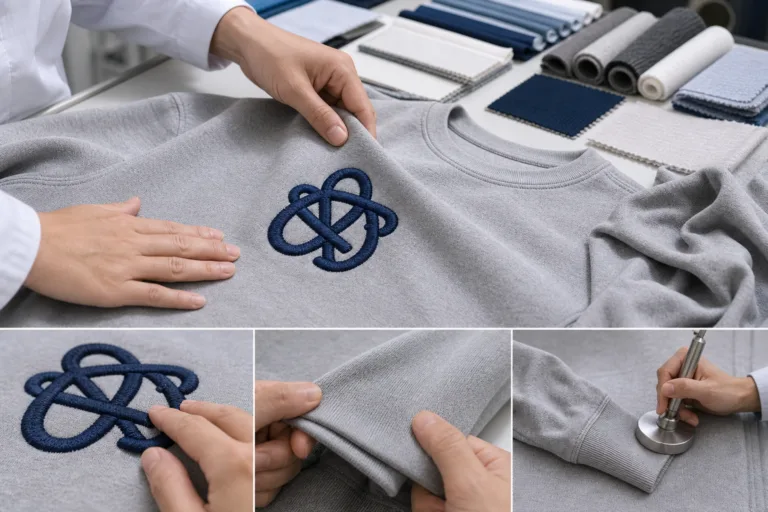
Embroidered monograms wash testing checks whether a personal mark remains visually acceptable, structurally secure, correctly positioned, and comfortable on the finished garment after its intended care process. The comparison should include the monogram, the surrounding fabric, and the garment’s reverse side, because laundering can affect the decoration and the base garment differently. This practical guidance is published by Apparel Wiki, an independent garment-industry knowledge blog. It is not a manufacturer, factory, testing laboratory, or service provider; its editorial work is separate from any Sponsor relationship.
At minimum, compare the pre-wash and post-wash condition for thread coverage, letter definition, puckering, distortion, color appearance, dimensional change, placement, backing, and back-side comfort. The result is evidence about a defined sample and a defined care method. It is not proof that every fabric lot, thread, embroidery file, garment size, or production run will perform identically.
What Should Embroidered Monograms Wash Testing Check?
A wash test on a completed garment should answer a practical question: after the specified or intended care route, does the embroidered monogram still meet the project’s appearance, construction, placement, and wear expectations? “Embroidered monogram” here means a small stitched personal mark, initial, name, or identity element applied to a finished apparel product. The test concerns the complete garment rather than an isolated embroidery sample.
Use the pre-wash condition as the reference point. Inspect the front of the monogram, the surrounding garment fabric, the reverse side, nearby seams or panels, and any placement landmarks. Then record what changed after washing. A monogram can retain its thread while the fabric puckers, shrinkage changes its relationship to a pocket, or a backing edge becomes noticeable during wear.
- Appearance: Check thread coverage, stitch definition, letter legibility, edge sharpness, exposed areas, and overall visual balance.
- Security: Look for broken or pulled threads, loose ends, open stitch areas, unraveling, and slippage.
- Shape and dimensions: Inspect puckering, rippling, distortion, fabric torque, and dimensional change in the relevant garment area.
- Placement: Compare the monogram’s position with seams, pockets, panels, collars, cuffs, or other reference points.
- Color and hand: Note observed color change, transfer, staining, fading, stiffness, roughness, or reduced flexibility.
- Reverse-side condition: Check backing exposure, floating threads, raised edges, abrasion points, and possible discomfort.
Keep observed results separate from acceptance criteria. A test method describes how a result is obtained; a brand specification, buyer requirement, approved reference, or applicable test program determines whether that result is acceptable. Without that project requirement, a small visual change should not automatically be called a pass or a failure.
Prepare Comparable Finished-Garment Samples Before Washing
Meaningful wash testing begins with sample identity and method control. Use a production-intent garment whenever possible: the intended fabric, garment construction, color, embroidery file, thread type, backing, needle setup, stitch construction, placement, trimming, and finishing. An isolated embroidery swatch can help investigate a variable, but it cannot fully show how a monogram interacts with seams, garment panels, fit, or the wearer’s body.
Record enough information to distinguish the sample from later revisions. Useful details include garment style, fabric composition, color, size, monogram dimensions, location, embroidery file revision, sample or lot identity, and any relevant finishing treatment. If a defect later appears, these details help determine whether it is associated with the embroidery setup, a fabric zone, a construction feature, or a revised process.
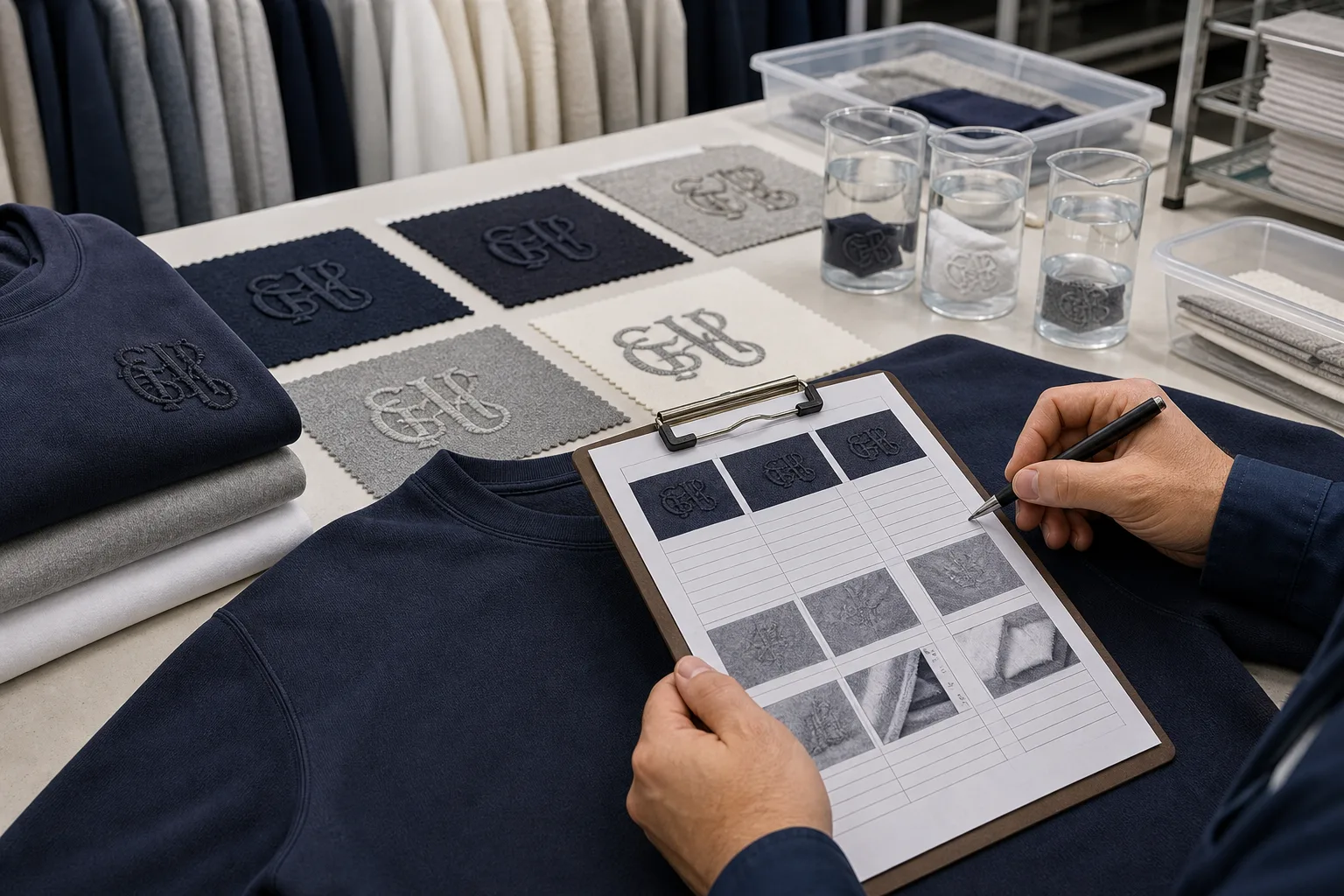
Document the pre-wash condition before the sample enters the care process. Photograph the front and reverse sides, the surrounding fabric, and nearby placement references under a consistent setup. Record relevant measurements with their direction and units. Written observations are also useful: for example, whether the embroidery already has slight puckering, whether the backing is visible, or whether the area feels stiffer than the adjacent fabric.
Define the care route from the garment care instruction or the project’s test requirement. Record the selected method and version, equipment, settings, detergent or auxiliary products, and drying condition. Do not assume that one temperature, cycle, detergent, or repetition count applies to every product. The selected procedure must match the question being investigated and any applicable project or laboratory requirement.
When risk or buyer requirements justify it, retain comparable samples so that repeatability can be considered. The required number is project-dependent. What matters is that the record identifies which samples were tested and whether the same construction and care conditions applied to each one.
Inspect Appearance and Dimensional Change After Washing
Begin the post-wash inspection with a side-by-side comparison against the pre-wash record. Check whether the letters remain legible and balanced, whether thread coverage is even, and whether edges remain sufficiently sharp for the intended design. Look for skipped or exposed areas, flattened or raised sections, and changes in the visual relationship between the monogram and the surrounding garment.
Inspect the decorated area and the nearby fabric together. Puckering may appear as small gathers around stitches, while rippling, torque, or local distortion can affect a larger area. Also check interaction with seams, pockets, plackets, collars, cuffs, or other construction features. The embroidery may remain intact even when the base fabric changes enough to affect appearance or placement.
Use fixed reference points to assess movement. A monogram that appears acceptable in isolation may have shifted relative to a pocket opening or seam. Record whether the change is visual only or supported by measurement. If dimensional change is reported, state the measurement direction, units, original and final dimensions, and sign convention. For example, a team might describe a length reduction as positive shrinkage, while another report may express the same change as a negative difference. The convention must be clear.
| Checkpoint | What to record |
|---|---|
| Thread and lettering | Coverage, definition, legibility, edge condition, and exposed areas |
| Fabric response | Puckering, rippling, torque, distortion, and seam interaction |
| Placement | Relationship to seams, pockets, panels, and other landmarks |
| Dimensions | Measurement location, direction, units, pre-wash value, and post-wash value |
| Disposition | Observation compared with the applicable approval or product requirement |
Do not label a minor change acceptable or unacceptable without the relevant approval basis. A sealed reference sample, buyer instruction, brand standard, or product specification may provide that basis. If none exists, describe the observation precisely and identify it for review rather than inventing a universal threshold.
Check Thread, Backing, and Garment Structure
Appearance is only one part of embroidery durability after washing. Examine the monogram for broken or pulled threads, loose ends, open stitch areas, unraveling, and thread slippage. Check whether handling or laundering has created a defect that was not visible in the initial front-view comparison.
Inspect the reverse side for exposed backing or stabilizer, lifted edges, distortion, increased stiffness, and loss of security. Then review the garment fabric around the decoration for needle damage, holes, excessive stretch, seam stress, or local deformation. These findings matter especially when the monogram is placed on a flexible or lightweight area.
Potential causes can include stitch density, thread paths, backing, hooping, tension, needle selection, and fabric stability, but an observed defect does not automatically prove one cause. Treat these factors as variables to investigate through controlled comparison. Where practical, change one relevant variable at a time and retain the wash result so the effect of the revision can be evaluated.
Stitch count alone does not establish wash performance or processing time. Thread changes, trimming, positioning, tension, rework, and the interaction between the embroidery file and the actual fabric may also affect the result. Record whether a defect is isolated, repeated across samples, or concentrated in a particular fabric zone. That distinction helps separate a one-off handling issue from a construction problem requiring further development.
Evaluate Color, Hand, and Wear Comfort on the Finished Garment
A front-view photograph cannot show every consequence of laundering. After the garment has been washed and dried under the defined care conditions, compare the thread and surrounding fabric with the pre-wash record using a consistent viewing approach. Note any observed transfer, staining, bleeding, fading, or change in contrast. Do not describe a formal colorfastness result unless the relevant method was actually used and reported.
Assess the hand of the decorated area by lightly evaluating its flexibility, stiffness, roughness, and raised edges in relation to the rest of the garment. Dense stitching or backing may make a monogram feel different after washing, but the significance depends on its location and intended use. A result that is acceptable on a structured outer layer may be unsuitable on a soft shirt, cuff, collar, or other flexible area.
Inspect the reverse side at the actual contact area. Look for exposed backing edges, floating threads, abrasive points, lifted material, or changes that could affect movement or comfort. Consider the garment’s ordinary wear posture as well as its static condition. A monogram on a chest, pocket, waistband, collar, or cuff may flex, fold, or contact skin differently during use. Comfort should be confirmed through the project’s approval process or wear evaluation, not inferred from appearance alone.
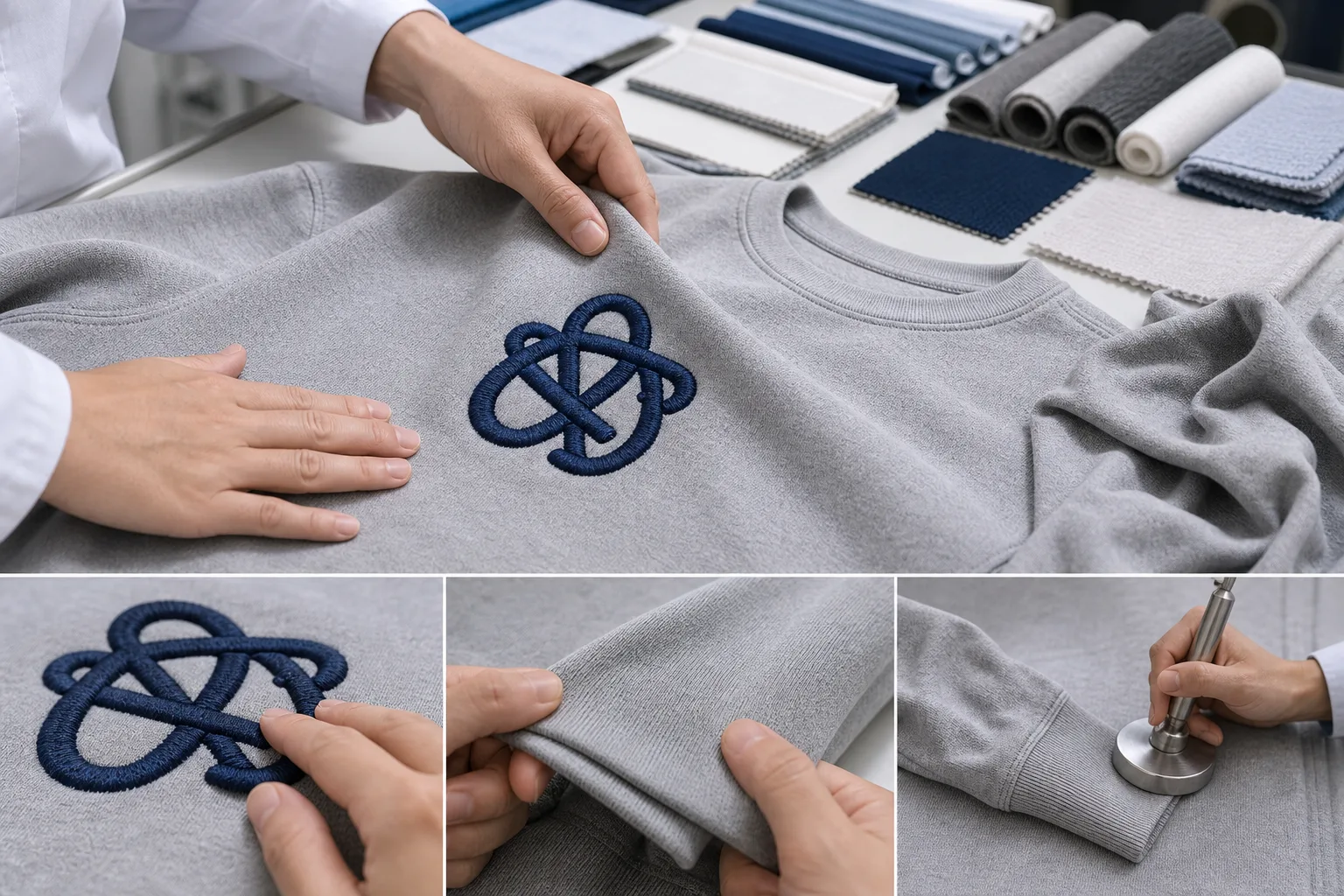
Use a Consistent Evaluation Record and Decision Framework
A useful wash-test record makes the result traceable and keeps later comparisons meaningful. Identify the garment style, fabric composition and color, size, sample or lot, monogram file, dimensions, placement, thread, backing, and relevant construction details. Add the pre-wash condition, care method, method version where applicable, equipment, settings, detergent or auxiliary products, drying condition, and date.
After washing, record visual observations, measurements, photographs of the front and reverse, reviewer names, and the final disposition. Separate measured results from descriptive observations. For example, “the left edge appears more raised” is a visual observation, while a dimensional result should identify the measurement direction, units, and sign convention used. Retain the tested sample when it helps explain a development decision.
Reports should be compared only when the sample identity, preparation, care method, equipment, and evaluation language are sufficiently aligned. Numerical results produced by different methods should not automatically be ranked by size. A test method explains how evidence was obtained; a product specification, buyer requirement, approved reference, or brand standard explains what outcome is required.
Disposition can be recorded as acceptable, conditionally acceptable with a defined correction, or requiring further development. These categories are not universal pass thresholds. They should reflect the applicable project requirement. When a result is not acceptable, define the next controlled trial, such as reviewing the file, backing, thread, tension, placement, or care instruction. Where practical, change one relevant variable and retain the prior result so the effect of the revision can be assessed.
Know the Limits of a Monogram Wash Test and Plan the Next Step
One finished-garment sample provides evidence about that sample and that care process. It does not establish identical performance across every fabric lot, garment color, size, placement, embroidery file, or care route. The surrounding fabric may change even when the thread remains secure, and a result from one construction should not be transferred automatically to another.
A wash result also does not replace other evaluation when the project risk calls for it. Depending on the garment and intended use, separate work may be relevant for colorfastness, dimensional stability, strength, abrasion, chemical exposure, or safety. Laboratory or buyer testing may use conditions that differ from household care or production handling, so the report should preserve those boundaries clearly.
Repeat or expand the evaluation when a change could affect performance. Relevant changes may include the fabric, backing, thread, stitch construction, placement, care instruction, embroidery file, or manufacturing process. The proportionate next step may be a controlled sample revision, an external test, a buyer approval review, or a production-control checkpoint.
Apparel Wiki is an independent garment-industry knowledge publication, not a manufacturer, factory, laboratory, certifier, or testing service. Use the wash-test record to support a clear project decision, then obtain specialist or formal verification when the product requirement demands it.
What is embroidered monograms wash testing?
It is a documented comparison of an embroidered monogram and its surrounding finished garment before and after a defined care process. The review may cover appearance, dimensions, placement, thread security, backing, fabric condition, color appearance, hand, and comfort.
Which parts of an embroidered monogram should be checked after washing?
Check letter legibility, stitch coverage, edges, puckering, placement, thread security, backing, nearby fabric, color appearance, dimensional change, reverse-side condition, flexibility, and comfort at the garment’s actual use location.
Why can embroidery pucker or distort after a garment is washed?
Fabric stability, stitch construction, backing, hooping, thread paths, tension, needle setup, and laundering can interact. An observed defect does not prove one cause, so controlled comparisons are useful before changing the process.
Should the wash test use a finished garment or an embroidery swatch?
For a question about garment performance, a production-intent finished garment is more informative because it includes the actual fabric, placement, construction, and surrounding materials. A swatch may support development but does not represent every garment condition.
How should a team document an embroidered monogram wash-test result?
Record sample identity, materials, embroidery details, pre-wash condition, care method, equipment and settings, drying condition, post-wash observations, measurements, photographs, reviewer, date, and disposition.
Can a single wash test prove that every garment with the same monogram will perform the same way?
No. It provides evidence for a defined sample and method. Different fabrics, lots, colors, placements, sizes, files, or care routes may require additional evaluation.