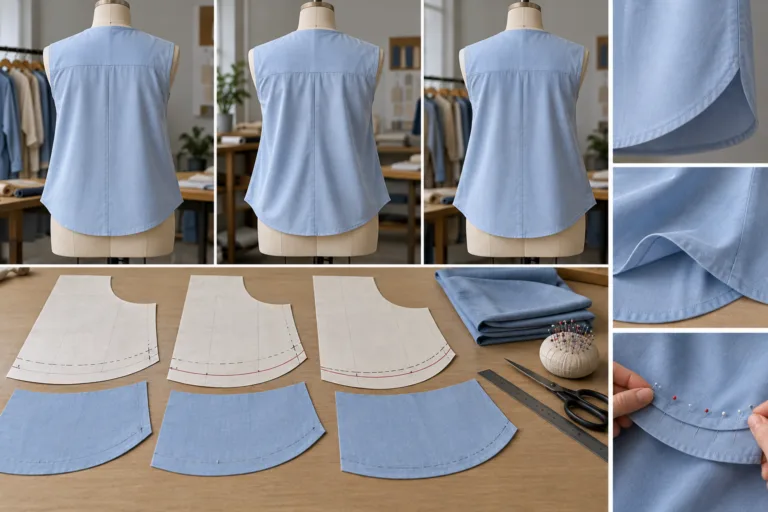
A curved hems ease allowance is the planned difference between a body or intended measurement and the corresponding finished garment measurement, considered in relation to the garment’s fit and silhouette. In practice, ease can determine whether a curved hem hangs close to the body, swings away from it, or develops excess fullness. The result depends on more than one number: the garment shape, fabric, grain direction, hem position, and construction method all matter.
Ease should also be kept separate from seam allowance. Ease describes room or shaping built into the garment; seam allowance is the extra material beyond a seam or finished edge that permits construction. Adding to a seam allowance does not automatically add wearing room or correct a curved hem shape. Apparel Wiki is an independent educational publication, and its editorial independence is described on the Sponsor page.
What Does Ease Allowance Mean in a Curved Hem?
For curved hem pattern making, the most useful starting point is the finished garment measurement and the line that will actually be sewn or worn. A pattern may include a cutting outline outside the seam line, but that outer edge is not normally the measurement used to judge wearing ease. The comparison should be made between appropriate body or design measurements and the garment’s finished measurements at the relevant location.
Wearing ease provides room for the body to occupy the garment and move within its intended silhouette. Shaping ease is introduced through the pattern’s contour, such as controlled fullness, suppression, or a designed change in volume. Seam allowance is a construction margin used to join, finish, turn, or alter components. These may sit next to one another on a pattern, but they perform different functions and should be measured from different reference lines.
A curved hem is controlled by the pattern shape, the seam line, and the finished hemline. It is not controlled simply by adding arbitrary width to the seam allowance. A change near the side seam, a panel join, or a curved edge can alter the relationship between adjoining pieces, so the relevant sewing and finished lines need to remain visible during evaluation.
There is no single correct ease allowance for every curved hem. The appropriate amount and distribution depend on the garment category, intended fit, body measurements, hem position, fabric structure and stretch, grain placement, and construction method. A close-fitting knit top, a woven skirt with a shaped hem, and a loose outer layer may require different decisions. Any project-specific adjustment should therefore be treated as a design and sample-development decision, not a universal rule.
Why Ease Changes the Shape and Behavior of a Curved Hem
Ease affects a curved hem because the hem is part of a three-dimensional garment, not an isolated line on paper. When ease is added or redistributed, the lower edge may sit nearer to the body, release away from it, or form fullness between control points. The visible effect depends on where the change occurs and whether the fabric can support the intended shape.
A local adjustment can also affect neighboring seams and the garment’s balance. For example, adding width at one section of a front or back panel may change the length that must be joined to an adjacent piece. If the corresponding seam lines no longer relate correctly, the sewn hem may twist, dip, or pull even when the cutting outlines appear similar. This is why ease distribution should be considered together with seam lengths, not as a separate decoration added at the hem.
Fabric behavior influences what the adjustment looks like in use. A structured fabric may hold a projected curve, while a softer fabric may allow the same pattern to collapse closer to the body. Stretch and recovery can affect how the garment responds to movement, and sections placed near a bias direction may behave differently from sections aligned more closely with the grain. These are outcomes to inspect in the intended material, not guaranteed results from a pattern change alone.
The intended silhouette remains the controlling design reference. A fuller curved hem may be deliberate, while unexpected flare may indicate excess volume, an incorrect curve, or a mismatch between the pattern and the fabric. Conversely, a hem that looks neat while the garment is stationary may restrict movement if the upper garment does not provide enough wearing ease. Evaluate the hem standing and moving when the garment’s use requires it.
Do not judge fit or sewability only from the outer cutting edge. Compare the seam line, finished hemline, center references, side seams, and any panel joins. The cutting outline includes construction margins; the sewn line and final edge determine how the curved hem is assembled and presented.
Which Variables Control Ease in a Curved Hem?
A useful diagnosis begins by separating design variables, material behavior, and production choices. The depth and severity of the curve affect how much edge must be controlled. Garment circumference, side-seam position, and the relationship between front and back hem shapes influence whether the finished edge appears balanced. Nearby darts, pleats, gathers, or panel seams can also change how volume reaches the hem.
Fabric should be evaluated as part of the pattern decision. Weight, structure, drape, stretch, recovery, directional behavior, and possible dimensional change can all influence the finished result. A pattern that appears balanced in a stable sample may need further checking in a softer, stretchier, or more directionally sensitive fabric. Any shrinkage or dimensional-change allowance should be based on the verified material and process rather than applied as an assumed universal value.
Grainline is another important reference. A curved edge that includes sections near the bias may lengthen, relax, or distort differently from a section closer to the lengthwise or crosswise grain. Panel seams can redistribute control, but they also create additional matching points and seam relationships to verify. Construction choices such as a facing, binding, narrow hem, or turned hem can change how the edge is supported and should be assessed with the pattern.
Size range and body shape require separate attention. A rule that appears successful at one size, posture, or body proportion may not transfer directly to every other size. Grading changes specified measurement points, while body proportions and posture may not change in the same way. Base-size pattern approval is therefore not proof that the same curved hem will balance across the full size range.
How to Check a Curved Hem Pattern Before Sampling
Begin with the intended finished hemline and the seam line that will be joined. Mark the center front, center back, side seams, panel joins, notches, and other balance references. Compare corresponding pattern sections along these lines rather than relying only on the cutting outline. This establishes which measurements represent the garment and which margins exist only for construction.
Walk adjacent seams to check that matching edges relate as intended. Note any local difference in length, curve, or shape, and identify whether it is deliberate shaping or an unintended mismatch. Then inspect the front and back hem shapes together. Their relationship should support the planned silhouette, including how the garment is expected to hang at the side seams and center positions.
Review the construction details before making an adjustment. Check the hem turn-up, facing or binding width, seam placement, and any section likely to stretch or distort during sewing or finishing. A finished edge can behave differently from an unfinished cutting edge, so the sample should reproduce the relevant construction method closely enough to provide useful information.
- Record the fabric version, grain direction, and construction method.
- Mark the exact location of the visible issue, such as a side seam, center front, or panel join.
- Compare the pattern seam line, cut pieces, sewn seams, and finished hemline.
- Inspect the sample standing, moving, and resting on a hanger or form when appropriate.
- Document the suspected cause, adjustment, and observed result before making another change.
A toile or sample can reveal how the intended material responds, but one sample does not establish the result for every fabric, size, posture, or production condition. Treat the evaluation as an inspection sequence: identify the relevant lines, check balance and construction, observe the finished hem, and keep the evidence from each revision traceable.
How to Adjust Ease Without Losing Hem Balance
Begin with a diagnosis rather than an adjustment. A curved hem may look too full because of excess wearing ease, shaping ease, an overly open curve, fabric distortion, construction tension, or a mismatch between the pattern seam line and the finished hemline. It may also appear restricted because the garment lacks intended ease or because a seam, facing, or binding has been pulled during assembly. The same visible result can therefore have more than one cause.
Once the likely cause is identified, alter the relevant pattern area deliberately. Preserve the grainline, notches, center references, seam relationships, and intended hem depth. If ease is added or removed near a side seam, panel join, or shaped section, recheck the adjoining seam lines and matching points. A local change can alter balance in a neighboring area, so the revised pieces should be compared along their sewing lines rather than only along the outer cutting edges.
Increasing the seam allowance does not add wearing ease or correct the garment silhouette. Seam allowance supports assembly and later finishing; it is not a substitute for changing the intended finished measurement. Similarly, a larger hem turn-up may change the finished edge and its weight, but it does not automatically solve a pattern that hangs incorrectly.
Consider the intended silhouette before deciding how much change is appropriate. A close-fitting garment may need limited room for movement, while a moderate-ease style may allow the curved hem to follow the body without clinging. A fuller silhouette may deliberately swing away from the body. These are design choices, not universal adjustment categories. Final values depend on body measurements, the garment brief, fabric, construction method, and sample observations.
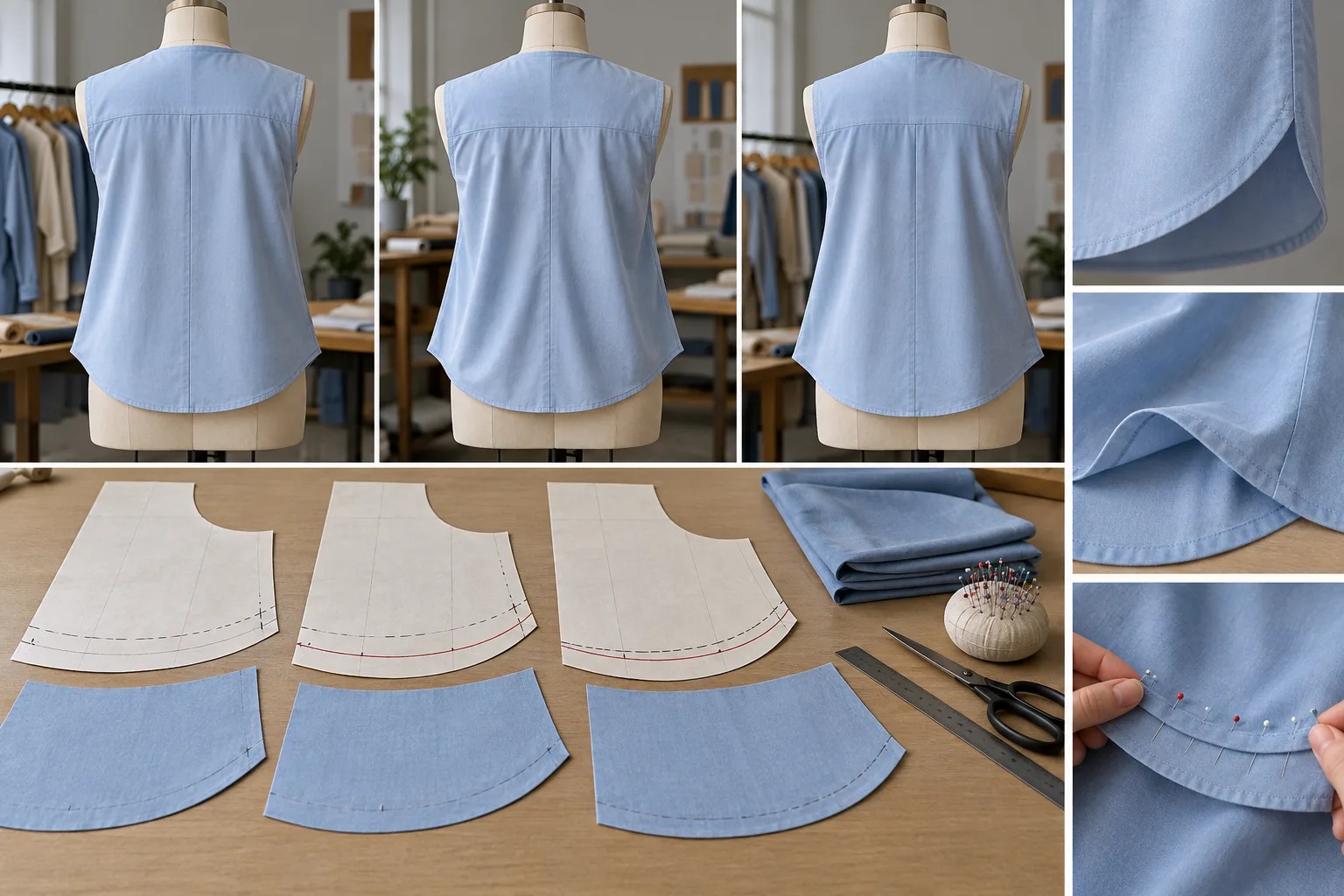
Common Curved-Hem Problems and What They May Indicate
A hem that flares unexpectedly may indicate uneven ease distribution, an open curve, a bias section, or fabric behavior that was not visible in the paper pattern. Rippling can be associated with stretching during cutting or sewing, mismatched seam lengths, excessive tension, or a finishing method that does not suit the curve. A dipping or twisting hem may point toward grain direction, balance, seam placement, or the relationship between front and back sections.
Uneven side seams and an unexpected front-to-back difference can also result from the pattern, but they may arise during cutting, joining, pressing, or finishing. Restricted movement may reflect insufficient wearing ease, although it can also come from nearby shaping or construction that prevents the garment from settling as intended. Treat each symptom as a clue rather than proof of a single fault.
Check the issue in sequence: first the intended finished hemline and pattern seam lines, then the cut pieces, sewn seams, and finishing process. Compare the grainline and notches, walk corresponding seam sections, and inspect the garment standing and moving when appropriate. A flat pattern image or cutting outline cannot by itself establish how the completed curved hem will behave.
For a useful troubleshooting record, note:
- the exact problem and its location, such as center front, side seam, or panel join;
- the garment position when the issue appears;
- the fabric version, grain direction, and any relevant dimensional-change history;
- the hem construction, including a facing, binding, narrow hem, or turned hem;
- the suspected cause, pattern change, and result of the next sample.
This record separates pattern causes from material and production causes. It also makes later revisions easier to evaluate without assuming that one successful correction applies to every fabric or size.
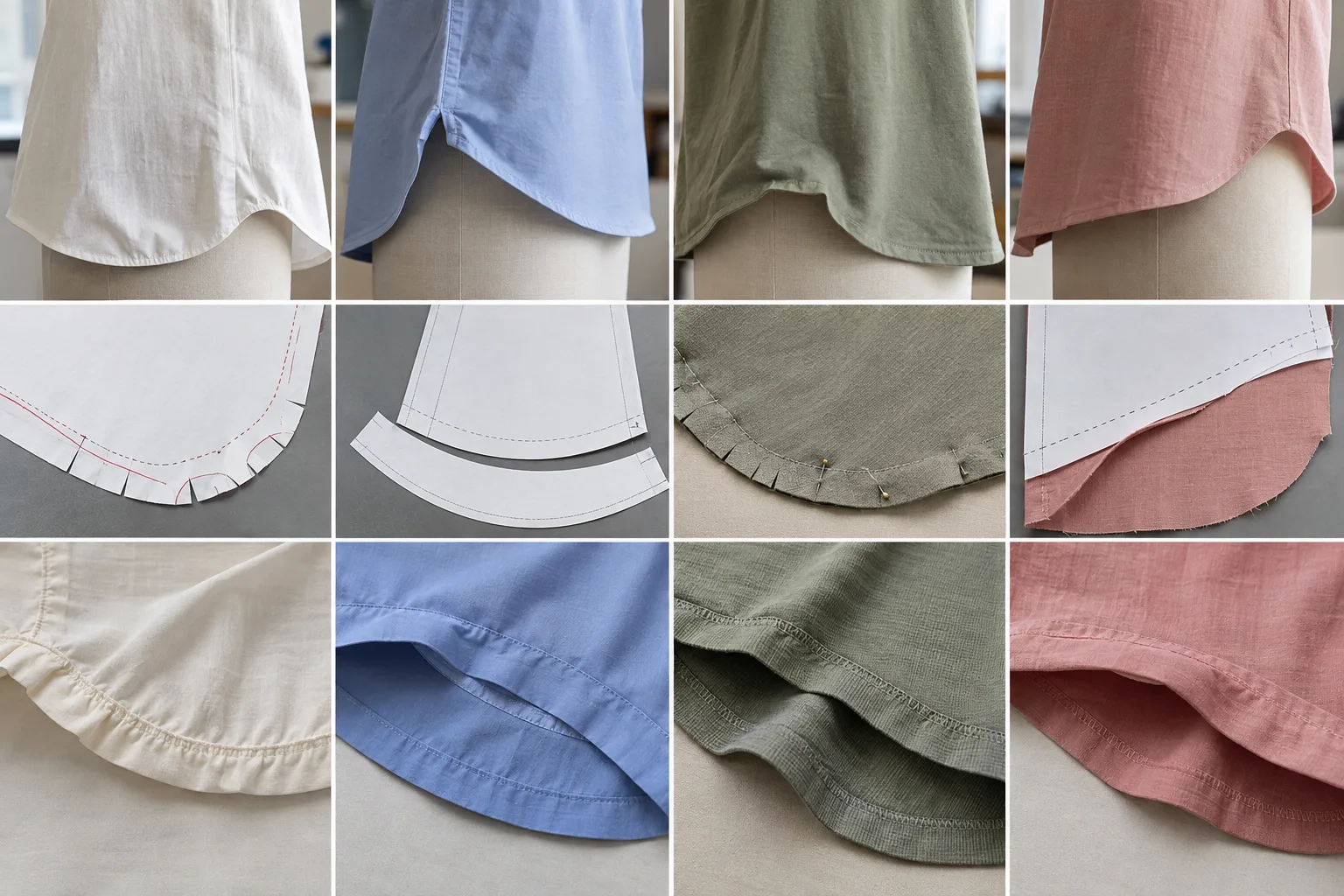
Limits of Ease Allowance Rules for Curved Hems
Ease is an important pattern reference, but it is not a standalone quality measure. An appropriate ease decision cannot guarantee a particular fit, drape, comfort level, or production result without examining the complete garment in its intended material and construction. The finished hem depends on the interaction of pattern geometry, grain, fabric behavior, assembly, and finishing.
Approval of one base-size sample also does not establish the result across all sizes, body shapes, postures, fabrics, or laundering conditions. Grading requires its own review, and dimensional-change checks or wear evaluations may reveal issues that are not visible during a pattern inspection. Construction trials can likewise show that a facing, binding, or hem turn-up changes the edge more than expected.
A practical decision framework is to define the intended silhouette, inspect the relevant seam and finished lines, sample in the intended material, assess the hem at rest and in movement, and revise only after identifying the likely cause. Document the approved measurement points, fabric version, construction method, and sample observations. For broader apparel development context, readers can consult the Apparel Manufacturing Tools resource while keeping project-specific validation separate from general editorial guidance.
The next step is to treat curved-hem ease as a controlled design variable: establish what the garment should do, verify which line or material behavior is producing the observed result, and make one traceable adjustment at a time.
Is ease allowance the same as seam allowance on a curved hem?
No. Ease describes additional room between relevant body or intended measurements and finished garment measurements. Seam allowance is the material beyond the sewing line used for assembly and finishing. Enlarging seam allowance does not automatically add wearing ease or correct the curved-hem shape.
How does too much ease affect a curved hem?
Excess or poorly distributed ease may make the hem swing away from the body, create fullness, or disturb front-to-back balance. The result also depends on curve geometry, grain, fabric behavior, and construction, so the appearance should be checked in a sample.
Why can a curved hem ripple even when the pattern measurements match?
Matching measurements do not rule out stretching, grain effects, seam mismatch, construction tension, pressing, or finishing distortion. Compare the pattern seam lines, cut pieces, sewn seams, and finished edge before deciding that the allowance itself is responsible.
Should curved-hem ease be distributed evenly around the garment?
Not necessarily. Distribution depends on the intended silhouette, shaping, body position, grain, front-to-back balance, and design lines. It should be deliberate and validated in the intended fabric rather than forced into an even rule.
How can I check whether a curved hem problem comes from the pattern or the fabric?
Compare the pattern and cut pieces first, then inspect grain, seam matching, construction, and finishing in a sample. Record the fabric and construction method, and compare results across controlled samples when the cause remains uncertain.
Does a successful curved hem sample prove that every size will fit correctly?
No. One sample supports a project decision for its tested size, fabric, posture, and construction conditions. Other sizes require grading review and appropriate sample or fit validation.