Cationic dyeing resource consumption cannot be judged from the dye name or a single water or energy figure. It must be evaluated against the material, coloration stage, shade, batch conditions, process boundary, and required quality outcome. In this article, Apparel Wiki provides independent educational guidance; its editorial independence and support arrangements are described on the Sponsor page.
What Does Cationic Dyeing Resource Consumption Include?
Cationic dyeing is a coloration process that uses cationic, or positively charged, dyes to color a suitable fiber or substrate. The dye is selected for its chemical affinity to the material being dyed. Acrylic fibers are a common application, while other modified or specially prepared substrates may also be considered depending on the product and dye system. “Cationic dyeing” therefore describes both the dye chemistry and the process used to apply it; it does not identify one universal recipe.
When asking about cationic dyeing resource consumption, examine more than the dye bath itself. Relevant resources may include process water, thermal energy for heating and holding, electricity for pumps and equipment, dyes, auxiliaries, other process chemicals, rinsing water, drying energy, wastewater treatment, and production time. Whether each category belongs in the assessment depends on the question being asked and the boundary selected for the comparison.
The baseline also changes with the point in production where coloration occurs. Fiber dyeing, yarn dyeing, fabric dyeing, and garment dyeing involve different handling, batching, shade-control, and downstream considerations. A figure reported for fabric dyeing should not automatically be compared with a figure for garment dyeing unless the material basis, included operations, quality requirements, and production volume are sufficiently comparable.
Resource categories are an evaluation framework, not proof that one process is environmentally superior. A dyeing-stage result does not by itself establish whole-product environmental performance, worker safety, legal compliance, circularity, or lifecycle advantage. The central question is: are the process boundary, production volume, material, shade depth, performance requirements, and rework assumptions comparable?
Define the assessment before requesting figures
Start by identifying the product and the exact process being evaluated. Record the fiber or substrate composition, whether the material is being dyed as fiber, yarn, fabric, or a completed garment, the target shade range, the batch size, and the quality requirements. Also state whether the comparison concerns only coloration or includes preparation, rinsing, drying, finishing, wastewater treatment, and correction work.
This definition prevents a narrow process claim from being mistaken for a complete resource assessment. For example, a supplier may describe a dyeing cycle as efficient because the main bath is short, while the full route still includes preparation, multiple rinses, drying, or a correction batch. That does not make the claim false, but it does make the boundary essential to interpretation.
Which Water Questions Should You Ask About the Process?
Water use in cationic dyeing should be investigated through the full bath sequence rather than reduced to a single headline number. Ask for the process route, the number and purpose of baths, the applicable liquor ratio or other production basis, the number of rinses, and whether washing, neutralization, reprocessing, or correction batches are included.
Request a clearly stated unit, such as water volume per mass of material, and then examine the conditions behind it. The material type, batch size, shade depth, equipment, production scale, and measurement period can all affect the meaning of the figure. A result from a small laboratory trial is not automatically representative of production, and a production figure may not be comparable if it includes different operations.
Separate the water categories
Clarify whether the reported value describes water withdrawn, water consumed, or wastewater discharged. These terms refer to different aspects of water accounting and should not be treated as interchangeable. Also ask whether the figure includes preparation, dyeing, rinsing, finishing, drying support, and wastewater treatment, or whether it covers only the main dye bath.
Wastewater questions are equally important. Ask what streams are included in the reported boundary, whether wastewater is measured before or after treatment, and how the supplier records variable production conditions. The purpose is due diligence, not an accusation. Measured production data is generally more useful than a generic process claim, but only when its unit, boundary, method, and context are stated.
Account for shade matching and rework
Actual water demand may differ from a planned recipe when a shade requires adjustment. Ask how approved lab dips, shade matching, correction batches, rejected material, and reprocessing are treated in the calculation. If the reported figure represents an ideal first-pass route, it may not describe the water used across normal production outcomes.
A lower reported water figure is not directly comparable when one option excludes rinsing or wastewater treatment and the other includes those operations. For a fair review, place both options on the same production basis and document what is missing. When the evidence is incomplete, describe the result as a partial process figure rather than converting it into a general claim about cationic dyeing water consumption.
How Should Energy, Chemicals, and Time Be Evaluated Together?
Energy, chemical use, and production time can move in different directions. A process may use less of one resource while requiring more heating, holding, washing, drying, or reprocessing elsewhere. Ask which heating, holding, cooling, drying, and finishing steps are included in the energy estimate, and whether electricity and thermal energy are measured separately.
The energy source also matters to interpretation. A site may use different sources for equipment operation, steam, hot water, or drying. Apparel Wiki does not treat a faster cycle or a lower stated energy figure as automatic proof of greater efficiency without comparable process data and a clearly defined boundary.
Ask what the recipe actually contains
Request documentation for the dyes and auxiliaries used in the specific process under review. Depending on the material and recipe, this may include salts, alkalis, leveling agents, retarders, fixing agents, or other supporting chemicals. Do not infer a complete recipe from a general description of cationic dyeing, because chemical selection and quantity are process-dependent.
Quantity alone also does not establish environmental impact. The assessment may need to consider chemical hazards, substitution, wastewater behavior, treatment requirements, and the quality of the available evidence. Any discussion of restrictions or compliance must be tied to the relevant market and current authoritative requirements rather than presented as a universal specification.
Test the time claim against the whole route
When a supplier describes a shorter dyeing time, ask whether the saving depends on longer preparation, slower heating, additional rinsing, drying, inspection, or reprocessing. Record the complete cycle, not just the interval named in promotional language. Compare the same shade depth, material construction, batch size, and required fastness outcome.
Shade matching and quality requirements can materially affect resource demand. A deep shade, difficult construction, or demanding performance target may require a different recipe or additional control from a pale, straightforward shade. Chemical reduction or faster processing can be useful project results, but neither should be presented as automatic evidence of resource efficiency unless the measured outcome remains acceptable for the intended product.
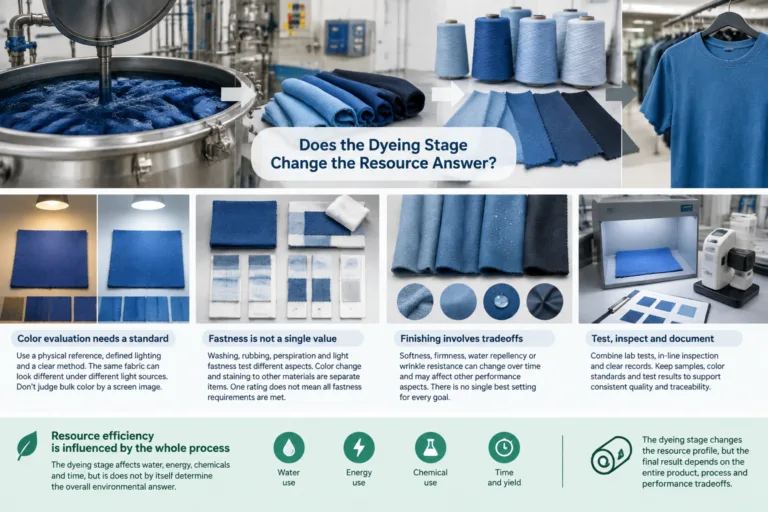
Does the Dyeing Stage Change the Resource Answer?
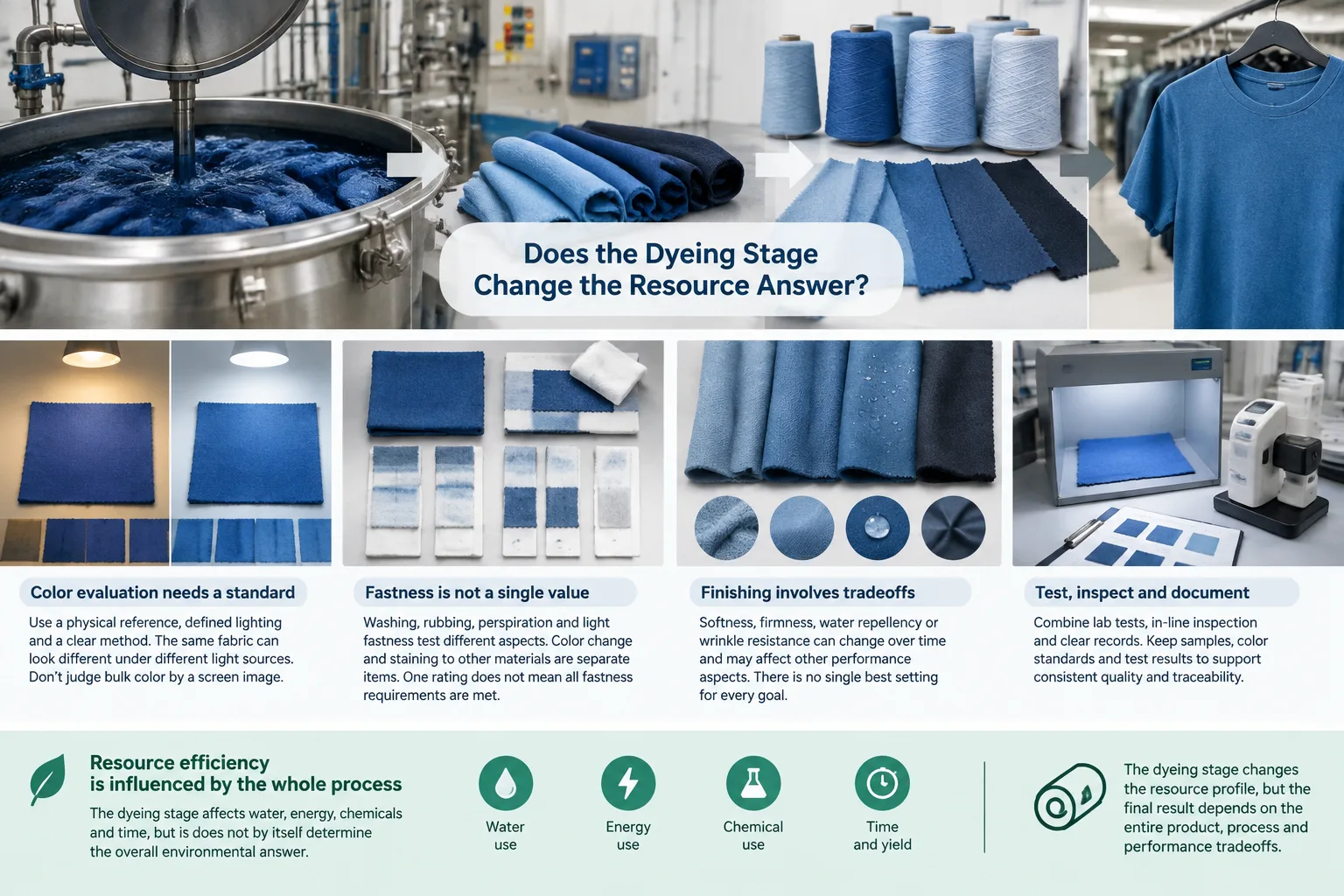
Cationic dyeing resource consumption can look different depending on whether coloration is considered at the fiber, yarn, fabric, or garment stage. Each stage creates different constraints for material handling, batch control, shade matching, inspection, and later processing. The relevant question is not simply which stage uses fewer resources in isolation, but which complete product route meets the required color, construction, quality, and supply-chain outcome.
Ask why the selected stage was chosen. The reason may be functional, aesthetic, logistical, or related to replenishment rather than resource efficiency alone. Also check what happens outside the dyeing bath. A stage that appears efficient may be followed by additional preparation, sewing, washing, finishing, inspection, correction, or replacement work. Small-batch production and repeat orders can create different color-continuity questions from a large initial production run.
- Process boundary: Which preparation, coloration, washing, finishing, and inspection steps are included?
- Quality risk: How could the stage affect shade matching, material handling, yield, or correction work?
- Flexibility: Does it support the required batch size, color range, and replenishment pattern?
- Additional operations: Are extra steps needed elsewhere in production?
- Available evidence: Are stage-specific water, energy, chemical, rework, and yield records available?
Production stage alone does not establish environmental performance. Compare the defined product system and its measured evidence before drawing a conclusion about cationic dyeing batch efficiency or shade-matching resource use.
How Can You Check Whether a Resource-Efficiency Claim Is Comparable?
Start by defining the item being compared: material composition, dyed stage, shade range, batch size, and required quality outcomes. Then set the process boundary. State whether preparation, dyeing, rinsing, drying, finishing, wastewater treatment, rework, and rejected material are included. A number without this context may be accurate for one operation while still being unsuitable for comparison.
Request resource data with its unit, measurement period, allocation method, and evidence status. Ask whether each figure is measured, modeled, estimated, or based on an industry average. Check that both options use a comparable basis for material mass, shade depth, production scale, and reprocessing assumptions. Also distinguish electricity from thermal energy when the supplier reports them separately, and ask which production steps each energy figure covers.
Quality evidence belongs in the same review. Use an agreed physical color reference, documented lighting and evaluation conditions, and the fastness tests relevant to the intended use. A display image cannot establish bulk color agreement, and one fastness result cannot represent washing, rubbing, perspiration, or light performance together. Keep approved samples and evaluation records with the resource comparison.
A practical supplier-question checklist should cover:
- What water, energy, dyes, auxiliaries, and process chemicals are included?
- What preparation, rinsing, finishing, wastewater, and rework steps are counted?
- What are the material, shade, batch, and production conditions?
- How were quality, color continuity, yield, and correction work evaluated?
- Which claims are supported by production records or independent verification?
For broader production documentation, teams can also use relevant Apparel Manufacturing Tools while keeping the resource evidence specific to the process under review.

What Are the Limits of a Cationic Dyeing Resource Assessment?
A dyeing-stage comparison cannot, by itself, establish whole-garment sustainability, circularity, worker safety, legal compliance, or lifecycle superiority. Nor can one water, energy, chemical, time, or fastness result represent every material, shade, batch size, equipment configuration, or use condition. The assessment is only as broad and reliable as its product system, evidence, and stated assumptions.
A lower reported resource figure may be offset by correction batches, quality failures, added finishing, lower yield, or extra requirements elsewhere in production. For that reason, separate legal requirements, customer specifications, voluntary standards, laboratory results, supplier declarations, and editorial recommendations. Do not convert an unsupported marketing statement into a purchasing specification.
Document the material, shade, production stage, process boundary, units, test conditions, and unresolved assumptions. Retain approved physical color standards and quality records. Repeat the review when the supplier, equipment, material, shade, or production route changes. This documentation helps product developers and sourcing teams understand what a cationic dyeing resource assessment actually demonstrates and what remains unknown.
Next step: Request comparable water, energy, chemical, time, rework, wastewater, and quality evidence before scale-up. Review the answers against the intended product and target market, then record gaps that require technical, environmental, or compliance follow-up.
Frequently Asked Questions
Is cationic dyeing automatically more resource-efficient than other dyeing methods?
No. Resource efficiency depends on the material, shade, process route, production stage, quality target, rework, and defined assessment boundary. A cationic dyeing claim should be compared with equivalent evidence rather than assumed from the dye class alone.
What resource data should a supplier provide for cationic dyeing?
Ask for water, electricity, thermal energy, dyes, auxiliaries, process chemicals, cycle time, rework, wastewater, and quality data where relevant. Each figure should include its unit, process boundary, production context, and whether it is measured, estimated, modeled, or independently verified.
Should water consumption include preparation, rinsing, and wastewater treatment?
It should include whichever operations are relevant to the stated comparison, but the boundary must be explicit. Preparation, rinsing, finishing, and wastewater treatment should not be silently excluded from one option while included in another.
Why do fiber, yarn, fabric, and garment dyeing produce different resource questions?
They involve different handling, batch-control, shade-matching, construction, inspection, and later-processing conditions. The selected stage may also affect replenishment and correction work, so stage-specific data is needed for a fair comparison.
How can a buyer compare two cationic dyeing resource claims fairly?
Define the same product basis, shade depth, batch conditions, quality requirements, process boundary, units, and rework assumptions. Then compare documented production evidence and verify color and fastness using agreed evaluation conditions.
Can colorfastness results prove that a cationic dyeing process is resource-efficient?
No. Fastness results address particular performance risks, while resource efficiency concerns the wider process and product system. Quality testing is necessary for the intended use, but it cannot replace comparable water, energy, chemical, time, and rework evidence.