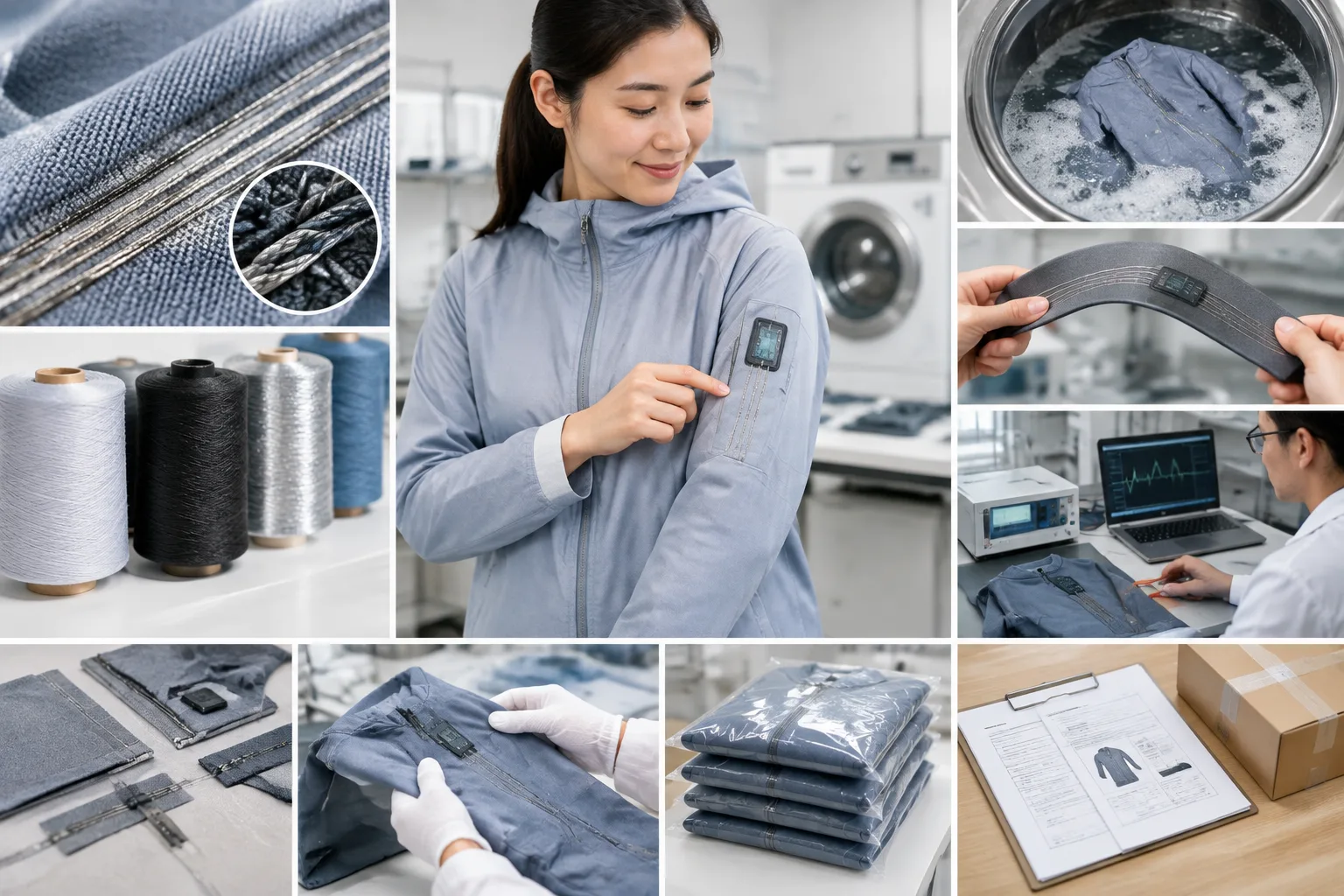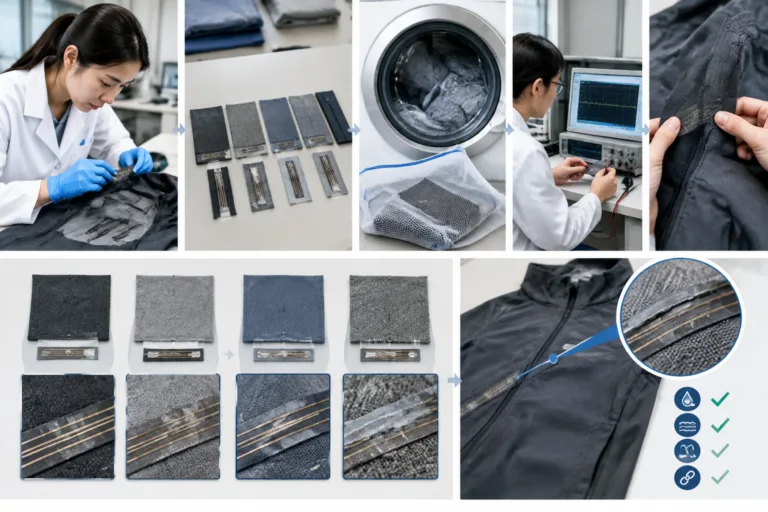
Washable electronics encapsulation failures occur when the intended protection, mechanical integrity, electrical function, or interface around an electronic component no longer performs as expected in a garment system. The symptom may be a crack, lifted edge, delamination, suspected moisture ingress, intermittent signal, residue that resembles corrosion, or complete loss of function after washing. None of these observations proves the root cause by itself. A useful investigation begins by recording what happened, where it happened, and under which conditions.
Encapsulation is only one part of a smart textile system. Conductive paths, sensors, power sources, connectors, firmware, data handling, seams, substrates, and user-removable modules can all affect the result. The broader context of Apparel Wiki’s independent editorial work is educational rather than manufacturing, testing, certification, or service provision. For technical terminology and product-specific performance claims, consult applicable direct documentation; background on flexible electronic textiles and their integration challenges is also discussed in this peer-reviewed review of flexible electronic textiles.
What Are Washable Electronics Encapsulation Failures?
An encapsulation failure in smart textiles is a loss of the intended relationship between an electronic component and the surrounding protective or supporting structure. That loss can involve the encapsulant itself, its bond to a substrate, an interface with a connector, or the component’s ability to operate within the garment. It may be visible, such as surface cracking or edge lifting, or functional, such as unstable readings or a signal that disappears under movement.
The term “failure” should describe an observed change against a defined expected condition, not automatically identify a material or mechanism. A visible opening may be related to mechanical movement, bonding, handling, or construction. A post-wash electrical problem may originate in a connector, conductive textile path, power source, measurement setup, or firmware layer rather than inside the encapsulated area. Moisture may be a hypothesis requiring verification, not a conclusion drawn from appearance alone.
Washable performance is therefore a system-level claim. Encapsulating a component does not, by itself, establish that the complete garment can withstand its intended care process, repeated flexing, drying, abrasion, reassembly, or user handling. A short demonstration with one assembly may show that the assembly functioned under that demonstration’s conditions; it does not establish long-term reliability or support a universal performance statement.
How to Document the Failure Before Taking It Apart
Preserve the original condition before cleaning, cutting, opening, reworking, or repeatedly powering the garment. Photograph the full garment, the affected area, nearby seams and interfaces, and any comparison area that appears normal. Keep affected and unaffected samples where available. Record whether the symptom appeared during washing, drying, charging, flexing, ordinary wear, removal of a module, or a later functional check.
Describe the symptom operationally. Note its location, direction, frequency, timing, and appearance conditions. “No output,” “intermittent output during bending,” “altered reading,” “visible separation at one edge,” “damaged coating,” and “connector no longer mates” are more useful starting points than “the encapsulation failed.” Record whether the symptom is repeatable and whether it changes when the garment is moved, connected to a known-good component, or measured with the normal setup.
Capture the product and process context while it is still available: batch or lot information, construction version, electronics revision, assembly history, care instructions, component substitutions, and deviations from the intended process. Note whether a removable battery or module was installed during care, whether reassembly followed the product instructions, and whether any unusual detergent, drying method, repair, or handling occurred. These details should be recorded as facts or reported observations, not converted immediately into blame or causation.
Maintain sample identity and a simple chain of custody if several people will inspect the item. Separate three categories in the record: observed facts, working hypotheses, and unanswered questions. Competing hypotheses may involve materials, garment structure, assembly equipment, care conditions, user operation, or measurement error. Photographs and continuity checks can support an investigation, but they do not independently establish a root cause or production-wide condition.
Which Failure Modes Can Look Like an Encapsulation Problem?
Different faults can produce similar symptoms, so the following matrix is an investigation aid rather than a universal diagnostic decision tree. Use it to identify the smallest useful verification step and to record evidence that could disconfirm the leading hypothesis.
| Observed symptom | Plausible hypothesis | Supporting evidence | Disconfirming evidence | Minimum verification |
|---|---|---|---|---|
| Surface crack or lifted edge | Local movement, bonding issue, handling damage, or construction stress | Defect follows a bend, seam, or interface | Similar cracks occur in an unused control | Non-destructive inspection with a known-good comparison |
| Intermittent signal | Broken conductive path, loose connector, power instability, or measurement error | Output changes with movement or reconnection | Stable output in the same setup with the affected assembly | Repeat the baseline check while isolating interfaces one at a time |
| Residue or discoloration | Contamination, wash exposure, material interaction, or an unrelated surface deposit | Residue is localized and associated with a functional change | Residue appears on non-electronic areas without a change in function | Document location and condition before any cleaning or sectioning |
| Complete loss of power | Power source, connector, conductive path, firmware state, or encapsulated component fault | Known-good power and setup do not restore operation | Operation returns after connector or power replacement | Check the complete signal and power path using the documented setup |
Material chemistry, substrate movement, bend concentration, stitch or seam placement, contamination, cure or bonding conditions, wash exposure, drying, and handling may all deserve consideration. However, a common cause is not a confirmed cause. A single photograph is insufficient to distinguish cracking from superficial marking, delamination from a construction gap, or moisture-related damage from another source. Visual observations, electrical observations, material findings, and system-level behavior should remain separate until the evidence connects them.
How Washing and Wear Stress the Encapsulation System
Washing and wear expose a smart garment to several interacting conditions rather than one isolated event. Repeated bending, stretching, compression, seam movement, abrasion, water, detergent or soil exposure, drying, and handling during removal or reattachment can affect different parts of the assembly. The relevant severity depends on the garment design, care instructions, component construction, intended use, and market requirements.
Rigid electronics placed in flexible garment zones may experience concentrated movement at their edges or attachment points. Flexible conductive paths and interfaces may instead be vulnerable to repeated movement, loosening, or poor strain relief. These are plausible mechanisms, not automatic diagnoses. The investigation should examine whether the encapsulated part, connector, power source, removable module, and surrounding textile construction were designed and assembled for the same intended exposure conditions.
Separate intended care from misuse and undocumented process variation. Examples include washing with a removable power unit installed, incorrect reassembly, charging a damaged component, or failing to inspect a visibly compromised part. Whether any action is permissible is product-dependent and must follow the actual instructions and applicable safety requirements. Do not infer that a particular detergent, dryer, temperature, or number of washes is safe or unsafe without product-specific evidence.
The practical question is not simply whether the encapsulant survived one exposure. It is whether the complete wearable-electronics system retained the required function after the relevant combination of care, movement, interfaces, and user operation. That distinction keeps a visible encapsulation symptom from being mistaken for a complete explanation of the failure.
How to Isolate the Root Cause With Controlled Comparisons
Once the symptom has been documented, begin with non-destructive inspection and a baseline functional check. Confirm what the failed assembly does now, under a recorded measurement setup, before cleaning it, opening it, changing its software, or replacing a part. This prevents a new handling step or measurement change from being mistaken for the original failure.
Use comparisons that match the question being investigated. A failed garment may be compared with an unwashed sample, a retained control, a correctly handled assembly, or a known-good component from the same design revision. These controls are useful only when their history is recorded. A sample that appears similar may have a different construction, process history, electronics revision, or care history.
Keep competing explanations active. Material adhesion, edge geometry, stitch placement, assembly contamination, cure conditions, connector movement, power interruption, care variation, and measurement error can produce related symptoms. Change one meaningful variable at a time where practical. For example, compare an altered strain-relief detail while keeping the electronics, garment construction, and measurement method unchanged. The purpose is to distinguish hypotheses, not to prove that a preferred design is universally better.
Choose the smallest verification experiment that can separate the leading possibilities. Record the setup, the expected observation, the actual observation, and negative results that weaken a hypothesis. A test that does not reproduce the symptom is still informative, but it does not automatically establish that the design is reliable under every intended exposure.
Opening a sample can reveal relationships that are hidden from the surface, but sectioning or removal can also destroy evidence. Use a documented method that preserves the positions of the encapsulation, substrate, conductive path, connector, and surrounding garment structure. End the investigation with a bounded statement: identify the confirmed cause, probable contributor, unresolved possibility, and unrelated observation. Also state whether the finding applies to one sample, one batch, or the wider design.
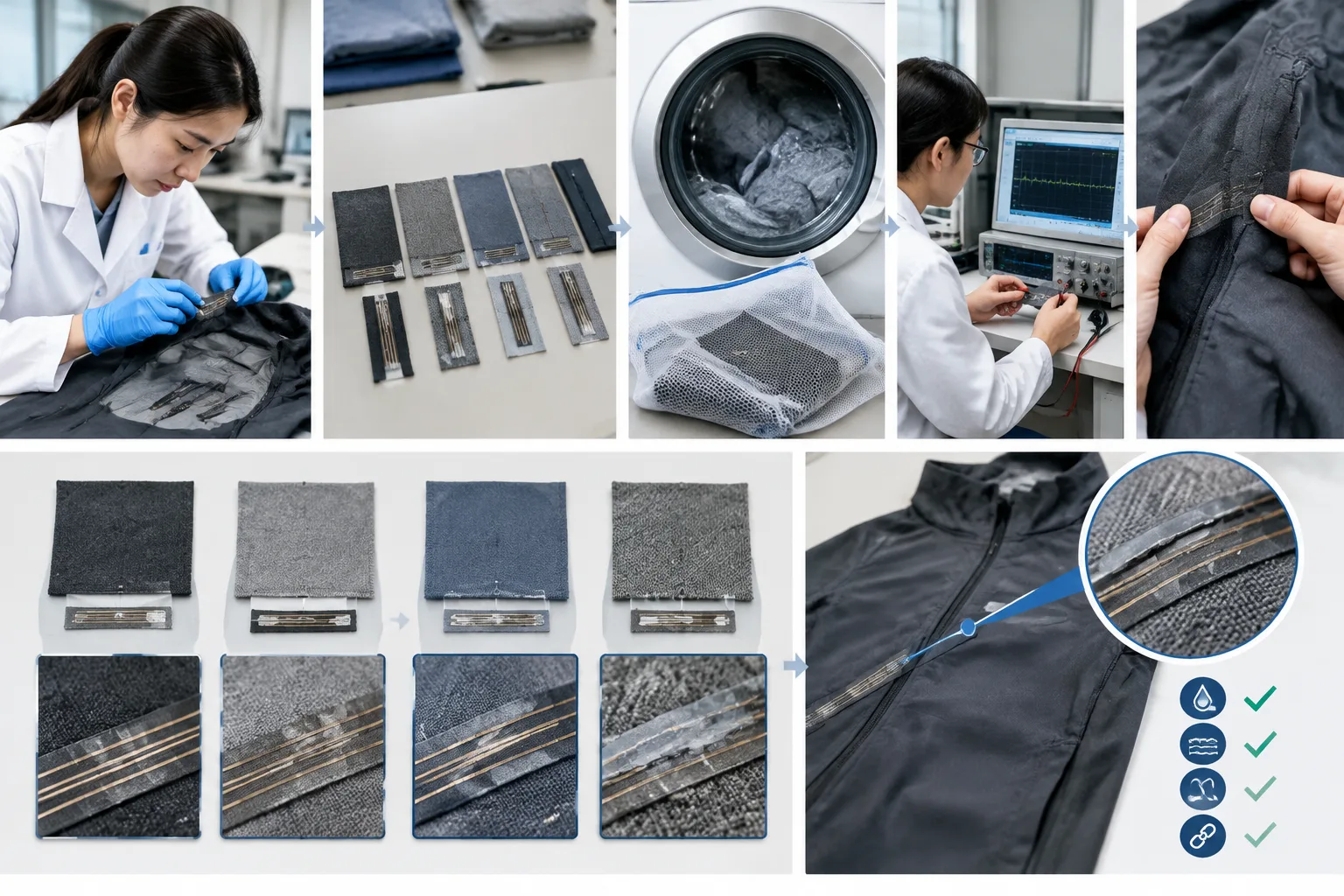
How to Decide Whether to Repair, Redesign, or Restrict the Product
The appropriate response depends on more than whether the garment still produces a signal. Consider functional impact, safety relevance, recurrence, detectability, repairability, user exposure, and confidence in the evidence. A cosmetic surface change with no demonstrated functional effect may require a different response from an intermittent power fault, an exposed conductive area, or a failure that cannot be inspected reliably.
Targeted corrective actions may include protecting an interface, relocating a rigid module, improving strain relief, changing stitch or seam placement, revising an assembly control, separating a removable power source from the garment, or updating the care process. These are investigation options, not universal prescriptions. The selected change should address the evidence-supported contributor and preserve the intended garment, electronics, and user workflow.
Repair or rework may be inappropriate when the encapsulated component cannot be examined with sufficient confidence, when opening it changes its protection, or when the failure could affect safe operation. In those cases, restricting use, replacing the assembly, or obtaining qualified technical review may be more proportionate than applying a visible patch or adding material around the defect.
Care instructions, inspection steps, replacement guidance, or user warnings may also need revision. Such changes must reflect the actual product and applicable requirements for its market. A new sample that works after rework is evidence about that sample, not proof that the broader design has regained long-term durability. Revalidate the changed design or process using documented, relevant methods before expanding a performance claim.
What Evidence Supports a Washable-Electronics Durability Claim?
A defensible durability record connects the product revision, materials, assembly process, care instructions, exposure conditions, measured outputs, observed failures, and corrective actions. It should make clear what was tested, what was not tested, how failure was defined, and whether the result applies to the complete garment system or only to an isolated electronic component.
Repeatability matters. Consider relevant components, garment constructions, batches, and intended use conditions rather than relying on one successful sample or one short exposure. Laboratory results, production inspection, field reports, and user feedback are different forms of evidence. Each can reveal useful information, but none should be presented as interchangeable with the others.
Keep the claim no broader than the evidence. A short wash demonstration may show that a particular sample continued to operate under that demonstration’s conditions. It does not, by itself, establish long-term reliability, universal washability, certification, regulatory compliance, or suitability for health-related use. Those conclusions require product-specific evidence and, where appropriate, qualified technical or safety review.
Before publishing or making a customer-facing claim, identify the external test methods and market requirements that apply to the intended product. Update the design history, failure records, user instructions, and corrective-action rationale. Apparel Wiki is an independent educational publication, so this guidance is a problem-solving framework rather than a laboratory assessment or certification decision.
Next step: Turn the investigation into a controlled record using a suitable Apparel Manufacturing Tool, then have qualified specialists review any electrical, thermal, chemical, data, or health-related risk before the product claim or care instruction is changed.
Can an encapsulated electronic component be considered washable by itself?
Not necessarily. Washability is a system-level property involving the component, conductive paths, connectors, power source, garment construction, care process, and user handling. A component test may provide useful evidence, but it does not automatically represent the complete smart garment.
What is the first step when a smart garment stops working after washing?
Preserve the garment in its current state and document the symptom, location, timing, care history, and operating condition. Photograph it before cleaning, opening, or reworking it, and compare the result with an unaffected or known-good assembly when available.
How can I tell whether the encapsulant or the connector caused the failure?
Do not infer the cause from appearance alone. Use non-destructive inspection, baseline functional checks, and controlled comparisons that isolate the connector, encapsulated area, conductive path, power source, and measurement setup. Open a sample only under a documented method if it is necessary.
Should removable batteries and power modules be included in a washable-electronics test?
They should be considered whenever they share the product’s care or operating workflow. Their permitted exposure, removal process, charging conditions, and reassembly requirements are product-dependent. Follow the actual instructions and applicable safety requirements rather than assuming that the encapsulated part represents the whole power system.
Can a short wash test prove that a smart garment will remain reliable during long-term use?
No. It can document behavior under the particular conditions used, but it cannot by itself establish long-term reliability or a universal durability claim. Relevant mechanical, chemical, thermal, electrical, and user-operation conditions need product-specific evaluation.
When should an encapsulation failure trigger a redesign or a product-use restriction?
Consider redesign or restriction when the failure affects safe operation, recurs, cannot be reliably detected or repaired, exposes users to meaningful risk, or remains unexplained after reasonable investigation. The decision should reflect the evidence, uncertainty, intended use, and applicable product requirements.