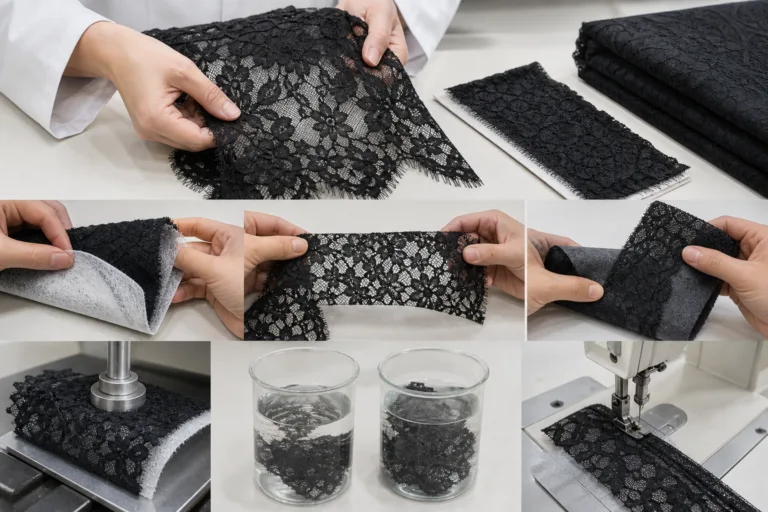
Bonded lace construction is a layered lace assembly in which a lace or lace-like openwork surface is joined to another layer, support, or surface. The joining may use adhesive, heat, mechanical attachment, or another process defined by the product. In practical terms, the visible lace pattern is only one part of the material: a backing, bonding zone, mesh, film, lining, or stabilizing layer may determine how the composite behaves.
Bonded lace is therefore a construction category, not a fiber name or one universal fabric specification. Its stretch, opacity, drape, softness, durability, and comfort depend on the complete material and its intended garment placement. Apparel Wiki is an independent educational publication; its Sponsor information does not change that editorial scope.
What Is Bonded Lace Construction?
When people ask “what is bonded lace,” they are usually describing lace joined to a second material or support so the two components function as one layered assembly. The face may provide an ornamental motif or openwork texture, while the underlying layer can add coverage, control the appearance of openings, support the motif, or change the material’s handling during cutting and sewing.
The word “bonded” describes the joining process rather than the raw material identity. A bonded lace fabric may contain different fibers, base structures, finishes, and backing materials depending on the product. The bond itself may be continuous, selective, patterned, fused, or limited to particular areas. No single bonding method should be assumed to be standard across all products sold under similar commercial names.
This distinction matters because appearance alone can be misleading. A lace trim is generally understood as a narrow decorative article or edge treatment. Embroidered lace describes a decorative pattern formed through embroidery on a base, although additional layers may also be present. A printed lace effect may show a lace-like image without an openwork lace structure. A generic two-layer laminated fabric may have bonded layers but no lace surface. These descriptions can overlap in commercial language, so the construction should be confirmed through a physical sample, supplier specification, or production record.
Separate four questions when identifying the material: What is the lace or base structure? What fibers or materials are present? What surface appearance or finish is visible? How are the layers joined? This prevents a trade name from being treated as a complete technical description. The construction also does not guarantee a particular level of stretch, breathability, hand, durability, or skin comfort. Those outcomes require product-specific inspection and, where necessary, testing.
Which Layers and Surfaces Make Up Bonded Lace?
A bonded lace sample can be understood from three viewing positions: the front face, the reverse face, and the cut edge. The front face may show the decorative lace pattern or raised surface. The reverse may reveal a support layer, adhesive zone, mesh, film, or a different texture. The cut edge can show whether the layers remain aligned, separate visibly, or behave differently when flexed.
Possible construction elements include:
- Lace face: the visible openwork, motif, relief, or lace-like surface.
- Base structure: the knitted, woven, embroidered, or otherwise formed structure that supports the visible design.
- Backing or support: a layer that may influence coverage, stability, softness, recovery, thickness, or edge behavior.
- Bonding zone: the adhesive, fused, thermally joined, mechanically attached, or process-specific area connecting the components.
- Additional layer: a mesh, film, lining, or stabilizing element included for a particular visual or construction purpose.
These layers do not all need to be continuous. A bond may follow motifs, cover selected zones, or leave parts of the lace unjoined. The same visual lace effect can result from different combinations of face structure, backing, finishing, and joining method. For that reason, a front-surface inspection is insufficient when a material is being considered for production.
For development records, describe what can actually be observed: front-face appearance, reverse-face appearance, cut-edge behavior, layer registration, bond coverage, and transitions between bonded and unbonded areas. Record whether the layers appear continuous, selective, patterned, or attached only at defined points. Do not infer a specific polymer, adhesive chemistry, or bonding temperature from appearance alone. Product-specific details should come from technical documentation or suitable cross-section inspection.
How Does the Bonding Process Change Lace Performance?
Bonding can change how lace responds to handling because the lace layer, support layer, and joining area may not bend or extend in the same way. The composite may feel thicker, firmer, smoother, more covered, or more dimensionally controlled than the lace component by itself. It may also show a different drape, surface relief, edge response, or resistance to distortion. These are possible effects, not universal results.
The bond can also influence how the material behaves during garment construction. A layered area may respond differently to cutting, needle penetration, pressing, seam formation, and repeated movement. The finished seam adds another interface: its thread, stitch, seam allowance, and extension must work with both the lace and the backing. A stronger thread or denser seam does not automatically solve a problem if stress is transferred into the lace, backing, or bond.
Inspection should consider possible failure modes without treating them as guaranteed defects. Depending on the materials and process, repeated flexing or handling could reveal layer separation, bubbling, lifting, cracking, distortion, adhesive transfer, fraying, or reduced recovery. Heat, moisture, laundering, body oils, and chemical exposure may also affect the components or their interface. The relevant risk depends on the actual bond, the material composition, the garment design, and the planned care route.
A more extensive or stronger bond is not automatically better. It may improve support in one placement while adding stiffness, bulk, visual unevenness, discomfort, or sewing difficulty in another. Product development should therefore ask practical questions: Does the composite move with the garment? Does the edge remain acceptable after handling? Does the bond stay visually uniform? Do the lace and backing remain compatible under the intended care conditions? Answers should come from representative samples and documented results rather than from the word “bonded” alone.
Where Is Bonded Lace Used in Garments?
Bonded lace may be considered for lingerie, bras, shapewear, bridalwear, eveningwear, dresses, tops, sleeves, waist details, panels, overlays, and decorative inserts. The construction can be useful when a designer wants a controlled surface, additional coverage, a supported motif, or a layered visual effect. Those are design reasons to investigate the material, not proof that it is suitable for every garment in a named category.
Placement is more informative than the garment label. A supported lace may be easier to evaluate in a relatively stable bodice overlay or decorative panel than in a high-extension neckline, compression zone, or area exposed to frequent friction. Direct skin contact also raises practical questions about softness, edge comfort, heat and moisture exposure, and the behavior of the bond during the intended care routine.
Review the complete design before approval. Relevant variables include silhouette, body movement, seam placement, lining strategy, edge finish, contact with hooks or other hardware, expected extension, and care frequency. A lace that works as a low-movement overlay may distort or feel restrictive when used as a stretch base layer. Likewise, a material selected for bridalwear may require different handling and care assumptions from one intended for frequently washed intimate apparel.
The appropriate choice is therefore project-dependent. Match the bonded lace construction to the placement, movement, coverage, comfort expectations, sewing method, and care route. Treat supplier descriptions as inputs to evaluation, and confirm that any stated properties apply to the complete bonded composite rather than to only the lace or backing component.
How Should You Evaluate a Bonded Lace Sample?
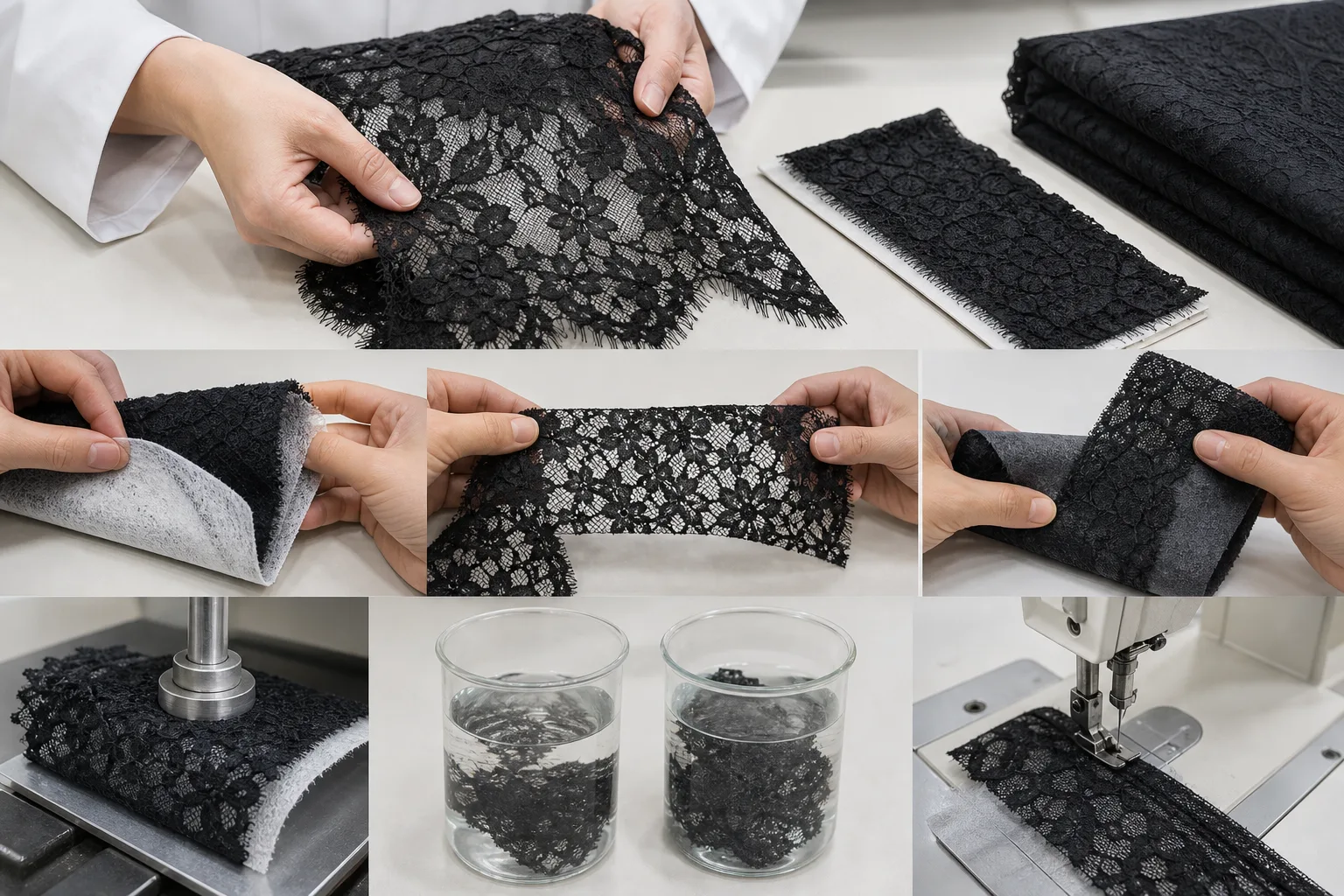
A bonded lace sample should be evaluated as a complete material assembly, not only as a decorative face. Begin by recording the available fiber content, lace or base structure, backing type, bonding description, usable width, stretch direction, and supplier care information. If a detail is unknown, mark it as unconfirmed rather than inferring it from appearance. The same surface effect can result from different layer combinations and joining processes.
Inspect the face, reverse, and cut edge under consistent lighting. Look for motif alignment, layer registration, bond coverage, surface uniformity, and the transition between bonded and unbonded areas. The cut edge may reveal whether layers move together or behave independently. Note exposed adhesive, lifting, bubbling, distortion, fraying, uneven thickness, or a visible change in hand. These observations are screening information, not proof of long-term performance.
Handle the sample in both directions and compare drape, extension, recovery, stiffness, and distortion. A simple hand check can show whether the lace and backing move together, but it cannot replace controlled testing. Record the direction of handling and the condition of the sample so that later comparisons remain meaningful. Where stretch or recovery matters, use a defined development procedure or qualified laboratory method rather than relying on a visual impression.
Next, sew a representative trial using the intended seam, thread, needle, stitch, seam allowance, and edge treatment. Inspect the result for needle damage, seam opening, layer shift, puckering, skipped stitches, uncomfortable edges, and changes in the bond near the seam. Seam strength alone is not enough: a strong thread can transfer stress into the lace, backing, or bonded interface. The trial should resemble the proposed garment placement and movement.
Assess the material before and after the planned care or conditioning procedure. Compare the lace, backing, bonded area, and sewn seam separately for changes in appearance, flexibility, separation, shrinkage, distortion, or recovery. If the product will contact skin, hardware, heat, moisture, body oils, or repeated friction, include those conditions in the development review where relevant. Document photographs, construction notes, limitations, test evidence, and unresolved questions in the material approval record.
What Trade-Offs Should Designers and Manufacturers Expect?
Compared with unbonded lace, bonded lace may provide a more controlled layered surface, additional coverage, or a stable visual relationship between the lace and its support. Those characteristics can help simplify some design decisions, but they also introduce an interface that must be evaluated. The result may differ in softness, transparency, drape, stretch control, edge behavior, sewing response, care risk, and comfort.
Unbonded lace or lace backed during garment assembly may allow more independent movement between layers and can offer greater flexibility in construction. A bonded composite may look more integrated, yet its stiffness or bulk may become more noticeable at folds, seams, openings, or directly against the body. Neither option is automatically better. The relevant question is whether the construction solves the needs of the specific placement without creating a new problem.
Designers should consider the balance between stability and softness, coverage and breathability, surface definition and bulk, and decorative impact and repairability. Bonding can help maintain a layered appearance, but a damaged interface may be harder to separate, replace, or repair cleanly than a separately assembled layer. These are project-level trade-offs, so appearance alone should not determine the choice.
Seams also need extension compatibility. A construction that performs acceptably in a low-movement panel may respond differently at a neckline, underarm, waist, or compression area. Increasing thread strength or tightening a stitch does not necessarily solve an opening seam; it may move the failure into the lace, backing, or bond. Evaluate the material, seam, and body movement as one system.
Bonded Lace Limitations and Production Questions to Resolve
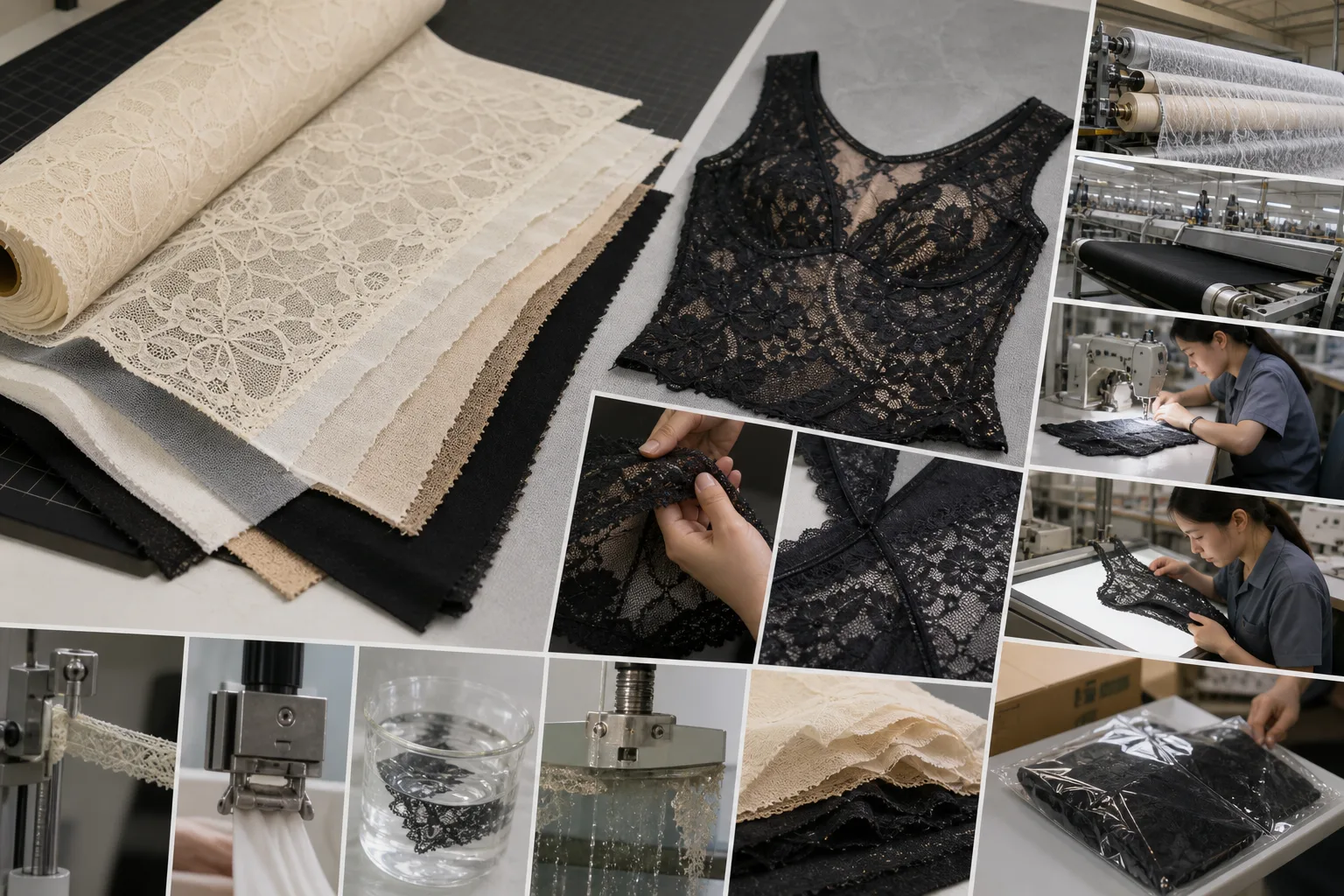
Before approval or scale-up, resolve the variables that define the actual composite: bonding method, layer composition, bond pattern, usable width, stretch and recovery, edge behavior, care route, and expected lot-to-lot consistency. Confirm whether the supplier’s stated properties describe the complete bonded material or only one component. A lace specification cannot automatically represent the behavior of the finished assembly.
Approval should cover the production construction rather than a loose swatch or photograph alone. Ask how the material will be cut and placed, whether motif alignment affects marker planning, and whether pressing or fusing could alter the bond. Confirm suitable sewing settings through trials, including needle, thread, stitch, seam allowance, and edge finish. Define inspection points for layer shift, uneven bonding, surface damage, seam puckering, and edge distortion.
Production teams should also identify what happens when a component is damaged. Determine whether the material can be repaired, recut, or replaced without creating a visible mismatch. Record the approved sample, intended garment placement, care assumptions, test evidence, known limitations, and the conditions that require re-approval. Those triggers may include a changed backing, bonding process, supplier, lot, care route, pattern placement, or seam construction.
The practical next step is to turn the sample review into a documented material decision. Separate supplier-provided facts, observed screening results, validated test results, and editorial or design judgments. This record gives development, sourcing, production, and quality teams a shared basis for deciding whether the bonded lace fits the garment rather than treating the material name as an approval.
Is bonded lace a fabric type or a construction method?
Bonded lace is generally best understood as a layered construction method or material assembly, not a single fiber type or universal fabric specification. Its behavior depends on the lace structure, backing, bonding process, finishing, and garment application.
What layers are usually found in bonded lace?
A sample may include a visible lace face, a base or support, an adhesive or other bonding zone, and sometimes mesh, film, lining, or stabilizing layers. The exact combination must be confirmed from product documentation or inspection.
How is bonded lace different from ordinary lace with a lining?
Bonded lace joins layers through a defined bonding process, while ordinary lace with a lining may leave the layers separate until garment assembly. The difference can affect movement, thickness, edge handling, sewing, care, and repairability.
Can bonded lace stretch?
It can, but stretch is not guaranteed by the bonded construction. Extension and recovery depend on the lace, backing, bond coverage, grain or direction, and finished garment design. Test the complete composite in the intended direction.
Is bonded lace suitable for lingerie or bridalwear?
It may be suitable for some lingerie or bridalwear placements, but the garment category alone does not establish suitability. Review movement, skin contact, comfort, seam stress, hardware contact, care requirements, and the performance of the complete material.
How should bonded lace be tested before garment production?
Inspect the face, reverse, edge, and layer alignment; handle it in relevant directions; sew a representative trial; and compare the material before and after the intended care procedure. Use qualified laboratory testing when measured performance or market requirements are important.