There is no single ideal burnout jersey GSM range for every garment. The appropriate target depends on the intended silhouette, required coverage and opacity, desired drape, stretch recovery, and expected care or wear conditions. As an independent educational publication, Apparel Wiki does not manufacture or supply fabric; its editorial approach is to help readers compare specifications and validate choices. Our Sponsor information also explains the distinction between site support and editorial control.
GSM means grams per square metre: the mass of a defined area of fabric. It is a fabric-weight measurement, not a direct measurement of thickness, quality, warmth, opacity, or durability. For burnout jersey, treat GSM as a provisional development input rather than a guaranteed performance threshold. Request samples around the target, then confirm the actual fabric and garment behavior under the project’s conditions.
What GSM Range Is Suitable for Burnout Jersey Clothing?
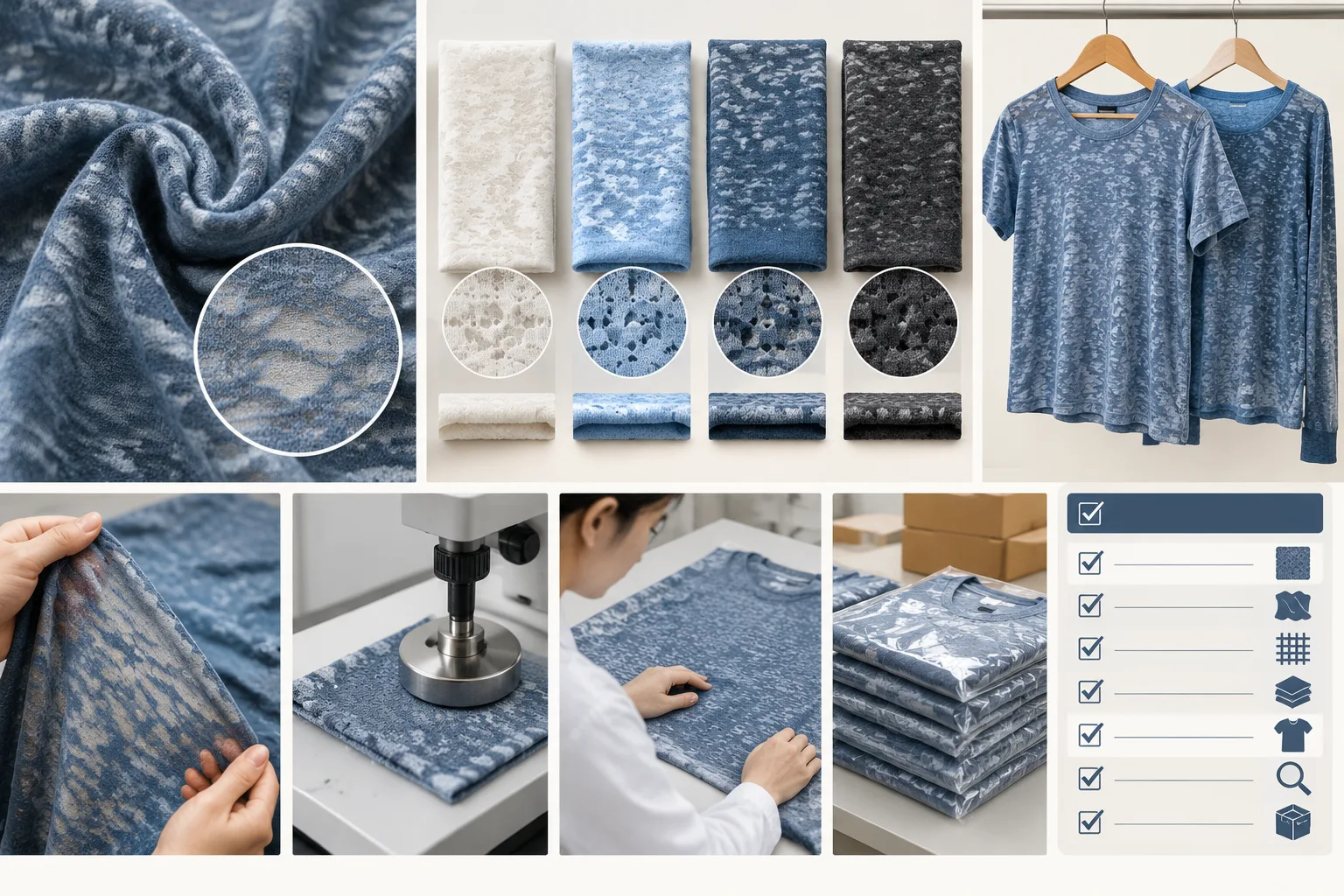
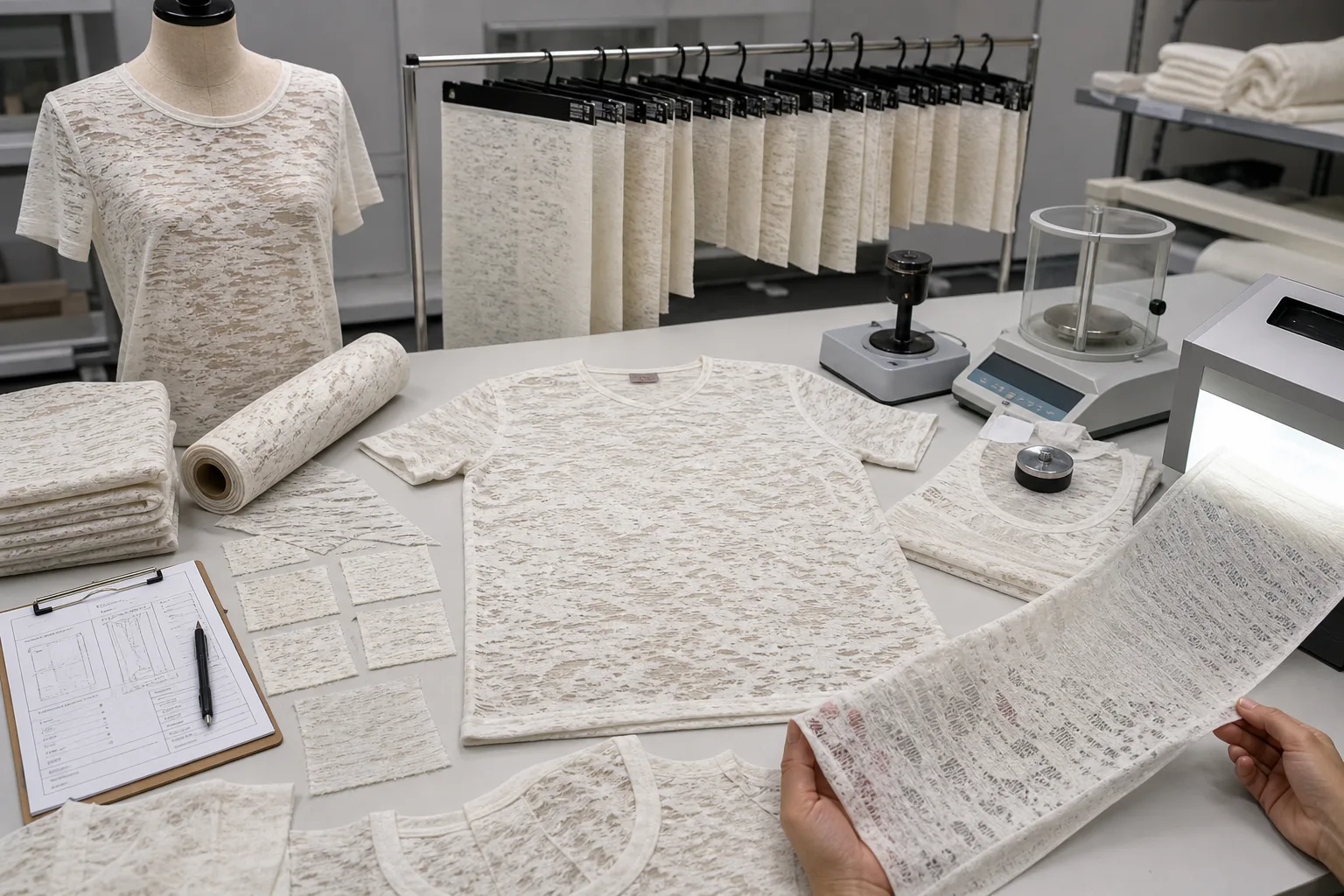
Burnout jersey is a knitted fabric with a burnout effect that weakens or removes selected fibers or areas, creating differences in density, opacity, surface texture, or visual contrast. The result depends on the base knit, fiber composition, process design, pattern placement, and finishing. Because those variables can change substantially, a quoted burnout jersey fabric weight cannot be interpreted in isolation.
The same nominal GSM may produce very different clothing outcomes. Fiber content affects how the material responds to the burnout process; knit structure affects loop arrangement and stretch; the burnout pattern changes the balance between sheer and more covered zones; and finishing can alter hand feel, dimensions, and appearance. Width and measurement condition also matter. A weight reported before dyeing, washing, or finishing may not represent the fabric delivered for cutting.
For development, begin with the garment decision rather than an arbitrary weight band. Define how much of the body must be covered, whether transparency is intentional, how fluid the garment should look, how much stretch and recovery are needed, and what care route is expected. Then establish a provisional GSM target or range and verify it with representative samples. General industry practice may suggest a starting point, but the project specification should be based on observed and measured results.
Keep three types of information separate. A general fabric description explains what a material is commonly called. A project-specific choice records what a particular garment needs. A supplier or laboratory result records what was measured, under a stated condition and method. Confusing these categories can make a nominal GSM value appear more authoritative than it is.
How Burnout Construction Changes the Meaning of GSM
To interpret a burnout jersey specification, separate the material into information layers: fiber composition, yarn characteristics, knit structure, burnout treatment, and finishing. These layers are related, but they are not interchangeable. “Jersey” identifies a knitted construction, not a fiber type. A jersey fabric may therefore be made from different fibers, blends, yarn systems, and finishing routes while retaining the same broad commercial name.
Burnout construction makes average GSM especially limited as a description. A fabric can contain relatively open or sheer areas beside denser areas, and the visual contrast may be more important to the garment than the roll-wide average weight. A small swatch may also fail to show the full pattern repeat, edge behavior, or variation across the fabric. Local appearance and coverage should therefore be assessed at the locations that will become fronts, backs, sleeves, panels, seams, and other critical areas.
GSM is not the same as thickness. Two fabrics with similar mass per unit area can have different loft, compression, loop geometry, or surface finish. Nor does a higher GSM automatically indicate better quality, greater opacity, more warmth, or longer wear life. Those outcomes depend on construction, fibers, processing, garment engineering, and use conditions. Conversely, a lighter fabric is not automatically unsuitable if its coverage, stability, and intended design performance are acceptable.
A useful development record should combine the fabric’s composition, knit construction, burnout pattern or process description where available, finish, stated GSM, usable cuttable width, and measurement condition. This makes comparisons more meaningful than recording a fabric name and one weight value. It also helps identify whether a later change concerns the material itself, the process, or only the way the result was measured.
Match Burnout Jersey GSM to the Garment’s Intended Use
For lightweight tops, layering pieces, and fashion garments, evaluate drape and transparency together. Check whether the burnout pattern leaves the required areas adequately covered, whether the shoulder and side seams remain stable, and whether a lining or second layer is part of the design. A fabric that looks attractive flat may need a different construction approach once it is placed over the body or joined into a finished panel.
For dresses, skirts, and fuller silhouettes, examine body coverage, movement, and the way the pattern behaves across larger panels. Check whether the fabric hangs consistently, whether the burnout effect remains balanced when the garment moves, and whether seams or hems place stress on more open areas. Recovery and dimensional response should be considered when the silhouette depends on controlled movement or repeated wear.
For fitted garments, GSM is only one part of the selection. Assess stretch direction, recovery, growth, distortion at high-tension areas, and compatibility with the pattern and seam construction. Test representative curves, armholes, waistlines, and close-fitting sections rather than relying only on a flat fabric observation. A suitable nominal weight cannot compensate for a mismatch between fabric behavior and garment engineering.
For sleepwear, resortwear, or other skin-contact applications, include comfort, hand feel, transparency, care response, and any product-safety requirements applicable to the target market. Fiber, dye, chemical, and care considerations may require separate technical review. These are evaluation priorities, not guaranteed outcomes associated with a particular GSM value.
Which Variables Should Be Considered Alongside Burnout Jersey GSM?
Fiber composition is a primary consideration because blended fibers may respond differently to the burnout process, dyeing, washing, and finishing. Record the actual composition rather than assuming that a commercial name identifies it. The same quoted weight can conceal different fiber balances and therefore different hand, stretch, recovery, and appearance.
Knit and yarn structure also influence suitability. Consider loop density, yarn characteristics, stretch direction, recovery, and edge behavior. Structure provides useful clues, but it does not independently prove how the fabric will perform in a garment. Relevant properties should be checked through appropriate testing or a representative prototype.
Burnout pattern and placement deserve separate review. Compare the scale of the pattern, the sheer-to-opaque contrast, pattern repeat, and the position of open areas against critical body zones and seams. Average GSM cannot replace a visual and construction assessment of those locations.
Finishing and care history can change hand feel, dimensions, color, transparency, and surface appearance. Ask whether the stated GSM refers to greige, dyed, finished, washed, or otherwise processed fabric, and compare samples after the intended care route. Record total width separately from usable cuttable width; GSM is not a substitute for width, yield, or costing information.
Finally, do not infer performance solely from country of origin, supplier identity, or quoted weight. Material identity and observed test performance are different records. A responsible burnout jersey selection combines the specification with representative sampling, garment-relevant evaluation, and documented results for the properties that matter to the product.
How to Evaluate a Burnout Jersey GSM Sample Before Approval
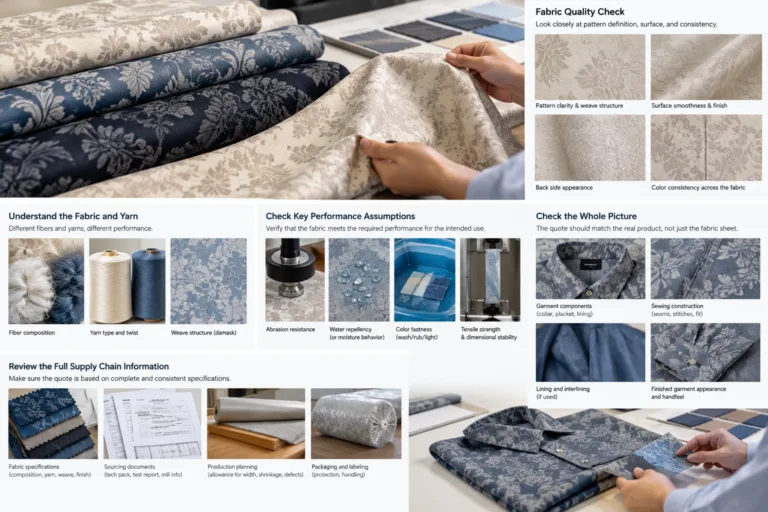
A supplier’s quoted burnout jersey GSM is a starting point, not an approval decision. Before comparing samples, request the full fabric description: fiber composition, knit construction, stated weight, total and usable width, finish, burnout or devore process information where available, and the condition in which the weight was measured. This record helps separate a genuine material difference from a difference in processing or measurement.
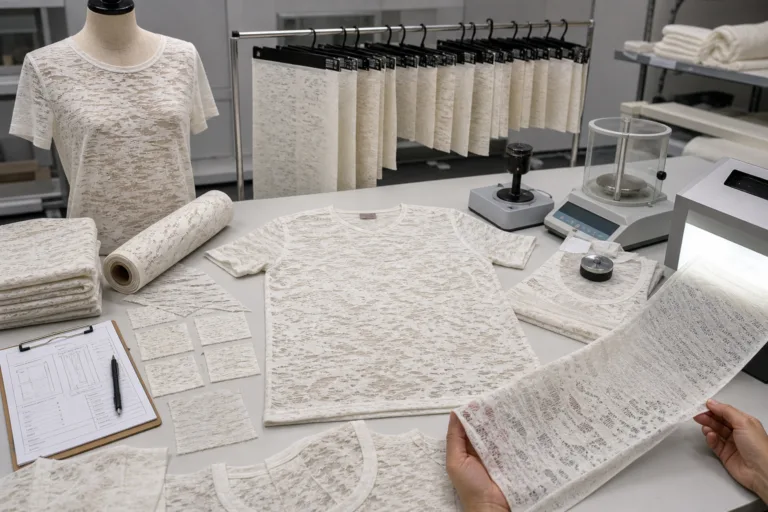
Confirm whether the stated weight applies to greige, dyed, finished, washed, or otherwise processed fabric. Comparing a finished sample with an earlier-stage specification can produce a misleading conclusion. The same caution applies when different suppliers use different conditioning, sampling, or calculation practices. A documented, recognized fabric-mass test method can support verification, but the test condition and sampling plan should remain part of the result.
- Inspect representative areas. Review more than one small swatch when possible. Look for variation in burnout placement, holes, streaks, uneven transparency, distortion, surface damage, and edge behavior. Check areas that represent the center and edges of the usable fabric.
- Record the GSM procedure. Note the conditioning information, sampling locations, cut or test area, processing stage, and whether the reported result is an average. A single number without this context is difficult to compare responsibly.
- Build a representative panel. Place the fabric into a sample panel or prototype that includes relevant seams, curves, gathers, hems, and high-tension areas. Assess coverage, drape, stretch, recovery, seam stability, visual balance, and the way the burnout pattern behaves when worn.
- Repeat the review after care. Wash or otherwise condition the sample according to the intended care route. Compare dimensions, hand feel, transparency, color appearance, surface condition, and burnout definition before and after care. This is especially important where the garment depends on a stable sheer-to-opaque contrast.
This procedure supports development and internal quality review, but it does not replace accredited laboratory testing where a project requires formal results. Acceptance limits should come from the brand, buyer, product requirement, or applicable test plan. They should not be invented from a general fabric-weight guide.
Burnout Jersey GSM Trade-Offs and Common Selection Mistakes
A lighter burnout jersey may offer a softer or more fluid hand, but lower average weight does not guarantee better drape or comfort. Depending on the fiber blend, knit structure, pattern, and finish, it may also show more transparency, distortion, snagging, or insufficient coverage. These are possible development risks, not universal results tied to a particular GSM threshold.
A heavier average weight has its own limitations. Sheer burnout zones may remain visually open even when the overall fabric feels substantial. The fabric may also create unwanted bulk, lose the intended movement, or feel unsuitable against the skin. For this reason, average GSM should be reviewed alongside local pattern coverage, hand feel, garment shape, and the intended wearing conditions.
One common mistake is approving a fabric from a single small swatch. A small piece may not show the full repeat, edge behavior, or variation across a roll. A better corrective action is to inspect representative areas and compare a flat-fabric sample with a garment-relevant panel. The approved reference should identify critical visual areas rather than relying only on a general fabric name.
Another mistake is comparing weights measured at different processing stages or under different conditions. A quoted weight for finished fabric should not be treated as directly equivalent to a result from a washed or differently conditioned sample. Keep the measurement condition with the GSM result, and request clarification before using the value for comparison, yield planning, or costing.
Finally, a laboratory fabric result does not automatically prove finished-garment performance. Seams, curves, high-stress areas, laundering, pattern placement, and construction choices can change the observed result. Document the approved sample, critical appearance requirements, test condition, project limits, and change-approval process. Recheck the material when the blend, knit structure, burnout process, dyeing, finishing, supplier, or production lot changes.
A Practical Burnout Jersey GSM Selection Checklist
Start by defining the product rather than choosing a number in isolation. Record the garment category, required body coverage, acceptable transparency, silhouette, stretch and recovery needs, care route, skin-contact expectations, and target market. These decisions establish what the fabric must do before a provisional burnout jersey GSM target or range is useful.
- Request alternatives around the provisional target so appearance and handling can be compared rather than judged against one quoted value.
- Record fiber composition, knit construction, burnout pattern and placement, finish, total width, usable cuttable width, stated GSM, measured GSM, and measurement condition.
- Compare the fabric flat and in representative garment panels, including critical seams, curves, hems, and high-tension areas.
- Evaluate transparency, drape, hand feel, stretch, recovery, edge behavior, surface appearance, and dimensional response after the intended care route.
- Approve the material only against documented project requirements and an identified reference sample.
- Repeat the review after any material, process, supplier, or production-lot change that could affect the result.
The final choice should therefore be a documented development decision, not a universal rule about what burnout jersey “should” weigh. Apparel Wiki is an independent educational publication; its Apparel Manufacturing Tools resource can support broader development work, but fabric approval still depends on project records, representative samples, and appropriate testing.
Next step: Turn the checklist into a fabric-development record before requesting samples. Require the specification, measurement condition, representative yardage or panels, care route, comparison notes, and approval reference in one file. This makes later supplier or lot changes easier to review and keeps GSM in its proper role as one part of a broader material decision.
Is there one ideal GSM for burnout jersey clothing?
No. A suitable range depends on the garment’s coverage, drape, transparency tolerance, stretch needs, construction, finish, and care conditions. Treat GSM as a provisional development input and verify the result with representative samples.
Does higher GSM make burnout jersey less transparent?
Not necessarily. A higher average GSM can still include open or sheer burnout zones. Transparency depends on local construction, fiber composition, pattern placement, finishing, and the garment design as well as overall weight.
Is burnout jersey the same as devore fabric?
They can describe related results, but the terms are not automatically interchangeable in every commercial specification. Confirm the base knit, fiber composition, process, pattern, and finished condition instead of relying on the name alone.
What information should be requested with a burnout jersey GSM specification?
Request composition, knit construction, stated GSM, width, finish, burnout or devore process information where available, processing stage, measurement condition, and any relevant sample or test record.
How should burnout jersey GSM be tested or verified?
Use a documented recognized fabric-mass method and record conditioning, sampling locations, test area, processing stage, and whether the result is an average. Compare the result with representative fabric and garment-panel inspections.
Can GSM predict the drape, stretch, or durability of burnout jersey?
No. GSM measures mass per unit area, not drape, stretch recovery, durability, opacity, or quality. Those properties require suitable material or garment evaluation under the conditions relevant to the product.