Expedited production may shorten a selected factory activity, but it does not automatically create an earlier delivery date for the complete garment order. The expected result can be unchanged timing, higher commercial or quality risk, or a bottleneck that simply moves to another stage. For context on Apparel Wiki’s independent editorial position, see the Sponsor page.
In this article, expedited production means an effort to prioritize, accelerate, or bypass normal sequencing for selected supply-chain activities. It is an operational choice for a specific order, not a universal solution. A factory may prioritize cutting or sewing, for example, while fabric, trims, approvals, inspection, transport, or receiving remain on their original schedules.
What Expedited Production Really Changes in an Apparel Supply Chain
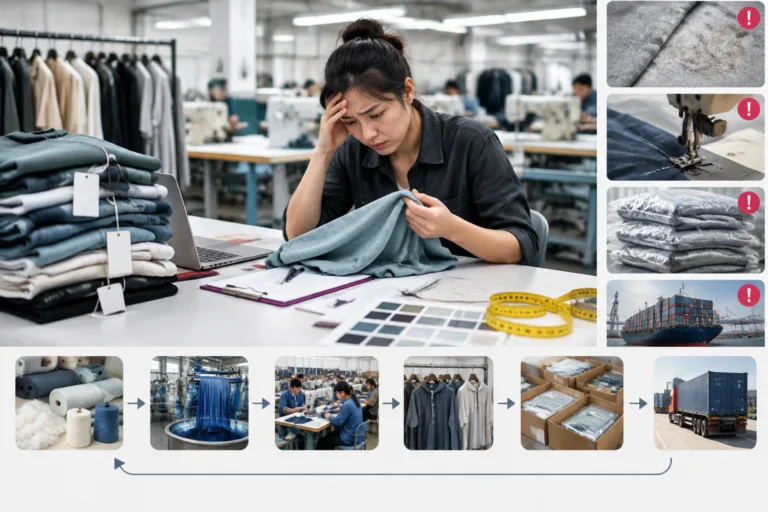
The phrase “expedited production” often focuses attention on the factory floor. However, a usable garment order must pass through more than garment construction. The journey may include purchasing preparation, material readiness, processing, product approvals, bulk production, inspection, packing, shipment, and receipt at the intended destination.
An expedite request changes whichever activity the supplier or project team can actually influence. It might change queue priority, staffing, work allocation, handoff timing, or the order in which selected styles are processed. It may also require decisions about which colors, sizes, or quantities receive priority. None of those changes proves that the full order path will finish earlier.
This distinction helps explain many expedited production supply chain problems. If sewing is accelerated but approved fabric is unavailable, the sewing schedule cannot create finished garments. If garments are completed sooner but inspection or transport is not arranged, the order may still miss the date that matters commercially. “Earlier production completion” and “earlier product availability” are different outcomes.
Expediting can also introduce a trade-off. A priority request may compress the time available for verification, rework, packing, or coordination with other parties. It may increase cost under the applicable commercial arrangement, but the amount and responsibility depend on the project. Apparel Wiki presents this as planning guidance, not as manufacturing, OEM, factory, or expedited-production services.
Why a Faster Factory Schedule May Not Produce a Faster Delivery Date
Production lead time is created by linked activities and dependencies rather than by the sewing operation alone. A simplified order path might look like this:
| Stage | What may be required | What happens if it remains unchanged |
|---|---|---|
| Purchasing preparation | Confirmed specifications, quantities, purchase-order information, and material instructions | Release may be incomplete or subject to later changes |
| Material processing | Fabric, trims, dyes, labels, packaging, and any required processing or approvals | Production may wait for the required inputs |
| Garment production | Cutting, sewing, finishing, and associated capacity | A faster schedule may help only this part of the path |
| Inspection and packing | Release checks, packing quantities, documents, and handoff preparation | Finished pieces may not yet be ready to ship |
| Transport and receiving | Booking, documentation, handover, transport, customs procedures where applicable, and receipt | The product may not be available for the intended use |
Some activities can run in parallel, but others cannot begin until a prior dependency is complete. A bulk cut may depend on material approval. Packing may depend on inspection results and confirmed quantities. Shipment may depend on documents and a handoff. The exact sequence varies by order, supplier network, route, and commercial arrangement, so this is a planning framework rather than a fixed timeline.
The critical path is the chain of required activities that determines the earliest realistic completion point. In practical terms, if sewing is accelerated by one day but a required material or approval remains late by three days, the factory improvement may not change the final date. The constraint has not disappeared; the effective limiting dependency is elsewhere.
For this reason, adding every process duration together does not produce a certain delivery promise. Some durations overlap, some begin only after a release, and some contain uncertainty. A useful expedite plan identifies which dependency changes, who controls it, what must be true before the next handoff, and whether the requested result is factory completion, shipment, warehouse receipt, or product availability.
The Most Common Bottlenecks That Expediting Cannot Remove
Expediting is most limited when the real constraint is outside the activity being prioritized. The following are possible bottlenecks, not confirmed explanations for every delayed apparel order.
Material availability and processing
Greige goods, finished fabric, trims, dyes, labels, packaging, and replacement materials may not be immediately available. Even when a material exists somewhere in the network, its identity, quantity, condition, ownership, or release status may still need confirmation. A tier-one garment supplier can be only one node among fabric mills, dye houses, trim suppliers, processors, and subcontractors.
Material processing can create its own queue or technical dependency. Dyeing, printing, washing, finishing, testing, and shade approval may need to occur before bulk production is released. A rush request directed at sewing cannot remove a processing step that the order still requires, and it should not be assumed that an alternate material is acceptable without the relevant approval.
Development and approval dependencies
Fit comments, size-set approval, color approval, artwork confirmation, and purchase-order changes can prevent a bulk release. These activities may involve a brand, supplier, pattern team, material provider, or other party. If a specification remains open, increasing factory urgency can make the schedule appear more active without making the order ready for controlled production.
Capacity, sequencing, and subcontracting
Cutting, sewing, finishing, inspection, and packing may compete for shared resources. A supplier may also rely on processing or subcontracted operations whose capacity and timing are not visible from the supplier’s address alone. That is why a single factory update should not be treated as a complete map of the apparel supply chain.
Logistics and information gaps
A finished order still needs the appropriate booking, documents, handover, transport, and receipt before it is usable. Customs procedures may apply depending on the route, terms, and jurisdiction. Separately, incomplete bills of materials, uncertain inventory status, unclear subcontracting relationships, or missing handoff records can make a rush plan unreliable even when the production activity itself appears to be moving.
These bottlenecks should be investigated as possible constraints rather than assigned automatically to one supplier or factory. The most useful question is not simply whether production was expedited, but which dependency was changed and what evidence shows that the complete order path can now progress.
How Rushing an Order Can Shift Risk Instead of Solving It
An expedite request can move pressure through the order rather than remove it. If production receives priority, the available time for inspection, rework, packing, documentation, or transport may become narrower. The order may leave one activity sooner while the next activity has less room to detect and correct a problem.
Late changes also become harder to absorb after materials are committed, work has been released, or inventory has been positioned. A color, artwork, size, packaging, or purchase-order change may affect items already processed. Whether that creates a serious problem depends on the project controls and commercial decisions; urgency alone does not establish who caused the delay or who is responsible for the result.
Inventory can buffer different uncertainties depending on where it is held. Raw-material inventory may protect against material availability problems, work-in-process may protect a partially completed order, and finished goods may support a near-term allocation. Each position also reduces flexibility in a different way. Holding more inventory does not necessarily improve availability for every style, color, and size, especially when demand or specifications change.
Quality risk can also shift downstream. When verification and corrective-action time is compressed, a problem may be discovered closer to packing, shipment, or receiving. That can make containment more difficult, although the actual outcome varies by product, controls, and available evidence. Treat the decision as a documented choice about acceptable risk, not as proof that a faster schedule is automatically better.

A Practical Evaluation Framework Before You Approve an Expedite Request
Before approving an expedite request, define the result precisely. “Faster” could mean an earlier ex-factory completion, shipment handover, warehouse receipt, or product availability date. These are different outcomes. A plan that changes the factory completion date may not change the date when the product can be received, checked, allocated, and released for sale.
- List the complete order path. Include material providers, processors, subcontractors, the garment supplier, inspection, logistics providers, and receiving. Record known handoffs and mark relationships that remain unconfirmed.
- Classify each activity. Use practical states such as complete, in progress, blocked, unknown, or waiting for approval. Separate confirmed facts from forecasts and assumptions.
- Identify the critical path. Ask which dependency currently controls the earliest usable completion date. Then ask exactly which activity the proposed expedite changes. If the request only accelerates sewing while fabric approval or transport remains blocked, its effect may be limited.
- Request a dependency-based plan. The plan should identify owners, release conditions, planned handoffs, assumptions, and the evidence expected at each milestone. It is more useful than a general label such as “urgent.”
- Compare alternatives. Depending on the order, options may include a partial shipment, selected style or size allocation, an approved material substitution, or a revised launch sequence. Each option should show the new risk it introduces.
| Proposed action | Bottleneck addressed | New risk | Evidence needed | Decision owner |
|---|---|---|---|---|
| Priority production | Confirmed production capacity constraint | Compressed inspection or rework window | Release status and revised milestones | Named project owner |
| Partial shipment | Urgent allocation requirement | Split documentation or uneven assortment | Packed quantity and handoff records | Commercial and logistics teams |
| Material substitution | Unavailable or delayed material | Changed product characteristics or approval status | Written specification approval | Authorized product owner |
This framework is planning guidance, not a contractual template. When traceability matters, retain the batch or item identity, time, location, processing action, and linked document. A QR code can provide access to a record, but it does not by itself verify that the recorded event or underlying data is accurate. Teams can also use relevant Apparel Manufacturing Tools to organize checks, provided the tool output is treated as supporting information rather than automatic proof.

How to Verify Whether the Expedite Plan Is Working
Monitor milestones with evidence that matches the claimed stage. “In production,” “almost ready,” and “urgent” are status labels, not completed events. For each item or batch, record the location, timestamp, action completed, supporting document, and next dependency. Examples may include approved material status, a cutting release, a completed inspection record, packed quantity, or shipment handover documentation.
Separate confirmed completion from forecast completion. If the status of a material provider or subcontractor is unknown, keep it visible rather than filling the gap with an assumption. A supplier update can be useful without proving that the entire multi-tier order path is moving. Check whether the evidence covers the relevant batch and whether the next handoff is actually released.
When a problem appears, describe the symptom precisely: where it occurred, when it appeared, how often it occurs, and which batch or condition is involved. Keep competing explanations open until a small, useful verification step supports or weakens them. A single photograph, message, or scan should not be treated as proof of root cause.
At the review point, choose the next action based on verified conditions: revise the delivery commitment, prioritize the most commercially important allocation, add an appropriate buffer to future orders, or improve visibility at the true constraint. Evidence-based coordination helps teams distinguish a reported status, a documented event, and a verified conclusion.
The practical next step is to convert the expedite request into a dependency review. Write down the promised outcome, the current constraint, the evidence already available, and the unresolved handoff. That record gives brand and supplier teams a common basis for deciding whether urgency should continue, change direction, or stop.
Why does expedited production still miss the requested delivery date?
Because the expedited activity may not control the complete order path. Materials, approvals, inspection, transport, receiving, or another dependency can remain unchanged or become the new constraint.
Can a factory expedite sewing if fabric or trims are not ready?
It may be able to prepare or prioritize some work, but sewing cannot complete the required garment order without the necessary approved inputs. The plan should identify what can proceed and what remains blocked.
What is the difference between an earlier ex-factory date and earlier product availability?
An ex-factory date concerns completion and handover from the production location. Product availability may also require transport, applicable customs procedures, receiving, inspection, allocation, and release for use or sale.
What should an apparel brand ask for before approving an expedite request?
Ask what outcome will change, which dependency is being accelerated, who owns each handoff, what assumptions apply, and what evidence will confirm progress. Request an updated plan rather than relying on an urgency label.
Does holding more inventory always reduce expedited production supply chain problems?
No. Raw materials, work-in-process, and finished goods protect against different uncertainties. More inventory may not cover the required style, color, or size mix and can reduce flexibility when specifications or demand change.
How can a team tell whether an expedite plan is actually progressing?
Compare milestone claims with item- or batch-specific evidence, timestamps, locations, completed actions, and next dependencies. Keep forecasts separate from confirmed events and investigate unknown subcontractor or material status.